Health
Is BOAS a real risk for Australian Shepherds?
No, it's documented in brachycephalic breeds like Bulldogs and Pugs, not in the longer-muzzled Australian Shepherd.

Quick answer
Is BOAS a real risk for Australian Shepherds?
No, it's documented in brachycephalic breeds like Bulldogs and Pugs, not in the longer-muzzled Australian Shepherd.
BOAS sounds like something any hard-panting dog could have, but it's actually tied to a specific skull shape, and the Aussie's long working muzzle sits well outside the group where this condition shows up.
This page is for owners who've heard general warnings about flat-faced breeds and heat, noticed their own Aussie breathing hard after a hike or herding session, and want to know whether BOAS is something to worry about.
This guide is not medical advice. If your dog shows pain, sudden behavior change, or worsening symptoms, consult a licensed veterinarian.
Some links may be affiliate links. We may earn a commission at no extra cost to you. We only suggest products we believe are helpful for dog owners.
We research and check what we publish, but we do not warrant that any figure, date, price, or statement is accurate, complete, or current, and we accept no liability for any loss, cost, injury, or other harm arising from the use of this site. Use it as one reference among several. You remain responsible for your own decisions and for your dog's care - confirm anything that matters with a licensed veterinarian or another qualified professional before you act on it. Full disclaimer.
Brachycephalic Airway Syndrome is a structural airway condition documented in flat-faced breeds - Bulldogs, French Bulldogs, and Pugs among them - and it isn't established in Australian Shepherds, whose moderately long muzzle falls outside the skull shape that produces it. Heavy panting or breathing changes in an Aussie are far more likely tied to its double coat, exertion level, weight, or an unrelated condition than to BOAS.
BOAS is common within brachycephalic breeds, with studies finding a majority of some flat-faced breeds show at least mild signs, but it is not recognized as occurring in Australian Shepherds at all, making it essentially irrelevant to this breed's real health picture.
BOAS arises from generations of selective breeding for a shortened skull in specific breeds, which compresses airway soft tissue - narrowed nostrils, an elongated soft palate, and everted laryngeal saccules - into far too little space. The Australian Shepherd's skull was never bred toward that extreme, so it simply lacks the structural cause behind the condition.
Because the structural cause isn't present in this breed, heat and humidity don't compound an airway obstruction the way they can in brachycephalic dogs. They still matter to an Aussie through ordinary heat stress tied to its dense double coat and strong drive to keep working, which is a different problem with different management.
See a vet if breathing doesn't settle within a few minutes of rest and cooling, if gums look pale or bluish, or if you notice persistent coughing or new exercise intolerance - these are worth investigating on their own merits, not as signs of BOAS.
General content about flat-faced breeds and heat gets applied to all sorts of dogs online. Here's where that goes wrong for an Australian Shepherd.
See all Australian Shepherd health problems, which breeds are prone to brachycephalic airway syndrome boas, or the full Australian Shepherd breed guide for temperament, exercise needs and ownership costs.
There's no BOAS-related timeline to track in this breed since the condition isn't established here; normal panting in a healthy Aussie should simply resolve within a few minutes of rest, shade, and water.
Success looks like correctly recognizing normal heat- and exertion-driven panting in your Aussie, still taking any genuinely unusual breathing change to a vet promptly, and keeping your attention on the breed's real documented health priorities.
Veterinary medicine groups dog skulls into three broad categories: brachycephalic (short and flat, as in Bulldogs, Pugs, and French Bulldogs), mesocephalic (medium proportions, the category most breeds fall into), and dolichocephalic (long and narrow, as in Collies and Greyhounds). BOAS develops when breeding shortens the skull without shrinking the airway's soft tissue to match, crowding structures like the soft palate and nasal passages into too little space.
The Australian Shepherd has a moderately long, well-proportioned muzzle typical of a breed developed for all-day herding stamina, which is structurally the opposite of the compressed conformation that produces BOAS. That muzzle length is a working trait, not a coincidence - it supports the airflow a dog needs to work outdoors for hours.
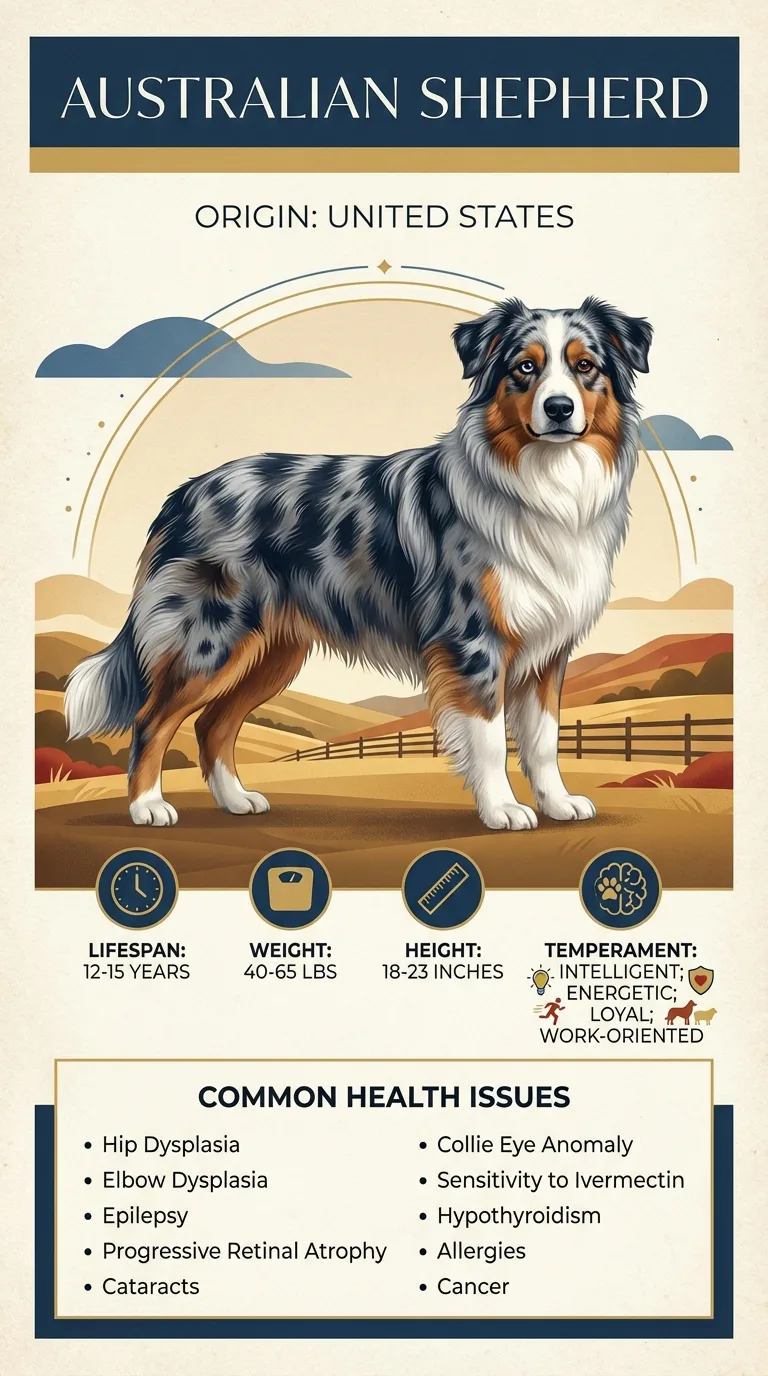
This is also why BOAS doesn't appear on the breed's documented health list, which instead centers on joints, eyes, and a handful of systemic conditions. Hip and elbow dysplasia, several inherited eye diseases, epilepsy, hypothyroidism, allergies, cancer, and a known sensitivity to ivermectin are the real, established concerns for this breed.

Heavy panting during or right after exercise, in warm weather, or when excited is normal behavior in an energetic working breed, and it should settle within a few minutes once your dog rests, cools down, and drinks water. That pattern doesn't point to BOAS or any airway disease - it's simply how the breed cools itself.
What isn't typical, and does warrant a prompt vet visit, is breathing that doesn't settle after rest, bluish or pale gums, sudden collapse, persistent coughing, or noisy breathing while completely at rest. If your vet ever needs to sedate your Aussie to investigate breathing concerns, it's worth confirming their MDR1 status first, since this breed's documented ivermectin sensitivity can affect how certain drugs are metabolized.
The practical bottom line is that unusual breathing changes in an Aussie are worth investigating for causes that are actually common - obesity, allergies, heart or lung disease, or age-related airway changes - rather than for BOAS, which simply isn't relevant to this breed's skull shape.

Priya adopted her Australian Shepherd, Scout, right before a brutal Asheville summer, and after scrolling a viral post about flat-faced breeds struggling to breathe in heat, she started timing every one of Scout's panting spells with real worry. Her vet examined Scout after a loud, fast panting episode that followed a strenuous trail hike and found completely normal airway function - the sound was simply Scout's dense double coat and herding-dog stamina working hard to shed heat, not any structural airway restriction. Instead, the visit turned into a review of Scout's actual breed-relevant priorities: hip and elbow soundness, a baseline eye exam for inherited conditions, and a note in the chart about the Aussie's known ivermectin sensitivity before any future sedation.
Key takeaway: A condition well documented in flat-faced breeds like Bulldogs and Pugs isn't a realistic concern for an Australian Shepherd's structurally different muzzle, so normal heat- and exertion-driven panting deserves smart management rather than a BOAS diagnosis.
No. BOAS is documented in flat-faced breeds such as Bulldogs, French Bulldogs, and Pugs, and the Australian Shepherd's moderately long muzzle places it well outside the skull shape that causes this condition.
Heavy panting is a normal cooling mechanism, especially given the breed's dense double coat and high drive for sustained work; it's tied to coat and exertion, not to airway obstruction.
It describes a short, flattened skull shape - seen in breeds like Pugs and Bulldogs - where airway soft tissue gets compressed into less space than a longer-muzzled dog has. Aussies have a mesocephalic, medium-length skull, not a brachycephalic one.
No, an Aussie's heat sensitivity comes mainly from its heavy double coat and high activity level rather than airway structure, so the cooling strategies that help this breed differ from what's recommended for brachycephalic dogs.
Occasional snoring in an Aussie is more often linked to sleeping position, weight, or mild allergies than to any airway malformation, though loud snoring paired with daytime breathing trouble still deserves a vet check.
Watch for things unrelated to skull shape, like persistent coughing, exercise intolerance, or bluish gums, which can point to age-related heart or airway issues that any breed can develop over time.
Hip and elbow dysplasia, inherited eye conditions like progressive retinal atrophy, cataracts, and collie eye anomaly, plus epilepsy, hypothyroidism, allergies, cancer, and a documented sensitivity to ivermectin are this breed's genuinely established concerns.
No, it's documented in brachycephalic breeds like Bulldogs and Pugs, not in the longer-muzzled Australian Shepherd.
Normal exertion and heat dissipation through its double coat, not airway obstruction.
No, there's no meaningful BOAS risk in this breed to budget or insure against.
No, Aussies are built for sustained work and don't carry the airway restrictions that make heat and exertion risky for brachycephalic breeds.
Breathing that doesn't settle after rest, bluish gums, or persistent coughing deserve prompt evaluation regardless of BOAS.
A one-page prep sheet for this condition: the signs, the questions to ask, what to get priced. Unlocks here.
You get: Vet visit prep sheet
No spam. One-click unsubscribe. See our privacy policy.
Preview page 1 before you decide.