Health
Why do Australian Shepherds gain weight after retirement from work or sport?
Food portions calibrated for high activity often aren't reduced to match a suddenly lower activity level.

Quick answer
Why do Australian Shepherds gain weight after retirement from work or sport?
Food portions calibrated for high activity often aren't reduced to match a suddenly lower activity level.
This isn't primarily a genetic weight-gain story — it's a math problem, and the classic trigger is retirement, not diet.
Owners of a dog that's aged out of hard herding or sport work, or families whose own schedules got busier while feeding routines quietly stayed on autopilot.
This guide is not medical advice. If your dog shows pain, sudden behavior change, or worsening symptoms, consult a licensed veterinarian.
Some links may be affiliate links. We may earn a commission at no extra cost to you. We only suggest products we believe are helpful for dog owners.
We research and check what we publish, but we do not warrant that any figure, date, price, or statement is accurate, complete, or current, and we accept no liability for any loss, cost, injury, or other harm arising from the use of this site. Use it as one reference among several. You remain responsible for your own decisions and for your dog's care - confirm anything that matters with a licensed veterinarian or another qualified professional before you act on it. Full disclaimer.
Obesity in Australian Shepherds is primarily a lifestyle mismatch rather than a strong genetic predisposition, given how high this breed's documented energy and exercise needs are. The classic trigger is a dog aging out of hard herding, sport, or working activity while food portions calibrated for that higher output stay unchanged, though hypothyroidism, a documented health issue, can independently drive or worsen weight gain and should be ruled out.
This isn't documented as a specific genetic predisposition for the breed, but given how high this breed's exercise needs are documented to be, a mismatch between activity and food intake is a realistic, common risk whenever that high activity level drops.
This breed's documented top-of-scale energy level and exercise need mean food intake is often calibrated to a high-output lifestyle, creating real risk of excess calories once that activity level drops for any reason, including age, retirement from work, or injury.
A reduction in daily exercise — through retirement from sport or work, a busier owner schedule, or age-related slowing — combined with unchanged food portions is the most direct environmental driver of weight gain in this breed.
Talk to your vet about a weight-management plan if you notice gradual weight gain, especially alongside reduced energy, which could suggest hypothyroidism rather than diet alone. Sudden, dramatic weight change or accompanying lethargy warrants a prompt visit rather than waiting for a routine appointment.
See all Australian Shepherd health problems, which breeds are prone to obesity, or the full Australian Shepherd breed guide for temperament, exercise needs and ownership costs.
Gradual, safe weight loss in dogs typically targets about 1-2% of body weight per week, meaning a meaningful weight-loss plan often takes a few months to reach a healthy target, tracked through regular vet weigh-ins.
Success looks like a lean body condition maintained through portion sizes matched to actual current activity level, reassessed proactively whenever that activity level changes again in the future, rather than a one-time fix.
A working or competitive Aussie in its prime might be running agility courses, herding livestock for hours, or getting vigorous daily exercise that a family built their entire routine around. When that dog ages out of intense work — retiring from competition, slowing down after an injury, or simply mellowing with age — the natural next step for many families is assuming the dog will 'self-regulate' its way to a lower calorie need. In practice, that adjustment usually has to be made deliberately, because food portions calibrated for a high-output working dog don't automatically shrink on their own once the output does.
This gap between what a dog is fed and what it's actually burning tends to widen gradually rather than announcing itself, which is exactly why weight can creep up over a year or two without anyone quite noticing the day-to-day change, until a vet visit or a struggle to jump into the car makes it obvious.
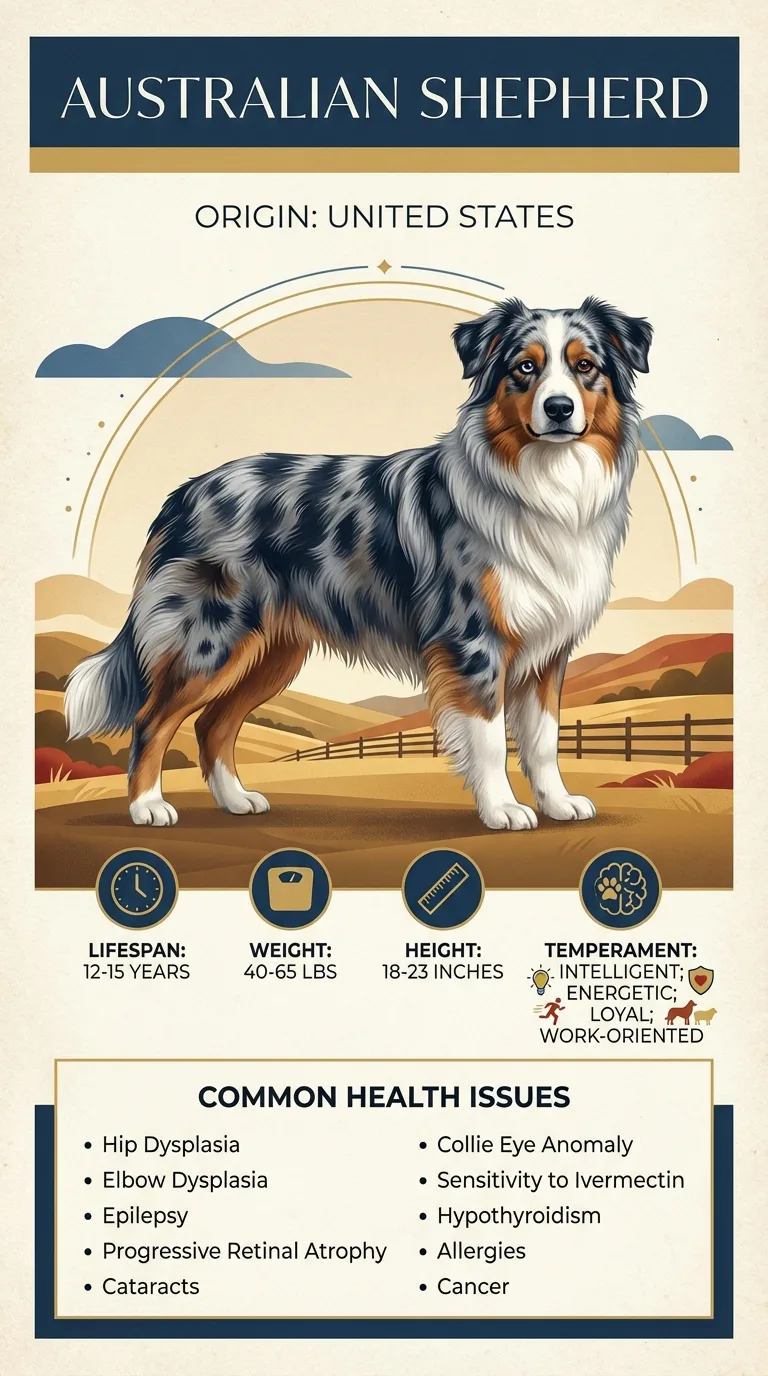
Hypothyroidism is documented as a common health issue in this breed, and it can compound or even drive weight gain independent of diet and exercise changes, since a slower metabolism from low thyroid hormone makes maintaining a healthy weight harder even with an appropriate feeding plan. This is exactly why unexplained weight gain — especially alongside a drop in energy — deserves a vet visit and bloodwork rather than an assumption that it's purely a portion-control issue.
Once any underlying medical contributor like hypothyroidism is ruled out or addressed, the practical fix for lifestyle-driven weight gain is straightforward in concept, if not always easy in practice: recalibrate food portions to match the dog's actual current activity level, not its activity level from two years ago.

Jet had spent years as a competitive agility dog, training and trialing most weekends, fed a higher-calorie active-dog formula in portions matched to that demanding schedule. When his family retired him at age nine due to mild arthritis, they kept feeding him exactly the same way, assuming his naturally high energy would keep him lean regardless. Over about eighteen months, Jet gained close to fifteen pounds without any single dramatic change — just gradual, portion-unchanged weight gain as his activity dropped to daily walks instead of weekly competition training. It wasn't until a vet visit for an unrelated issue that the weight gain was flagged clearly. His family switched him to a senior maintenance formula with reduced portions and added a couple of short daily walks beyond his usual routine. Jet lost the excess weight gradually over about four months and has maintained a healthy weight since, with portions now reassessed every time his routine changes.
Key takeaway: The food that was exactly right for a competing agility dog was exactly wrong for the same dog retired — and the fix wasn't a special diet, just recalibrating portions to match the job the dog was actually doing now.
The risk usually comes from a mismatch — food portions calibrated for a high-activity lifestyle not being adjusted down when that activity level drops, such as after retirement from working or sport activity, rather than a strong inherent genetic predisposition.
Retirement from hard herding, sport, or working activity is a classic trigger, since food portions calibrated for that higher output often aren't reduced to match the new, lower activity level.
Yes — hypothyroidism, a documented health issue in this breed, can drive or compound weight gain independent of diet and exercise, which is why unexplained weight gain paired with lower energy is worth checking with bloodwork.
You should be able to feel (though not necessarily see) the ribs with light pressure, and your dog should have a visible waist when viewed from above. Your vet can assess body condition score accurately at a routine visit.
Excess weight adds direct mechanical strain to joints, worsening conditions like hip dysplasia, and increases the workload on the heart and other organs, compounding several other documented and age-related conditions.
Gradually reduce portions in consultation with your vet, reassess body condition every few weeks, and consider a lower-calorie maintenance formula appropriate for a less active adult or senior dog.
Yes, with a gradual, vet-guided plan combining portion adjustment and appropriate exercise, though very overweight dogs or those with other health conditions should have their weight-loss plan specifically supervised by a vet.
Food portions calibrated for high activity often aren't reduced to match a suddenly lower activity level.
Yes — hypothyroidism, a documented health issue, can drive or worsen weight gain independent of diet and exercise.
You should be able to feel the ribs with light pressure and see a visible waist from above; your vet can assess this accurately.
It adds mechanical strain to joints, worsening conditions like hip dysplasia, and increases workload on the heart.
Gradually reduce portions with your vet's guidance and reassess body condition every few weeks.
A one-page prep sheet for this condition: the signs, the questions to ask, what to get priced. Unlocks here.
You get: Vet visit prep sheet
No spam. One-click unsubscribe. See our privacy policy.
Preview page 1 before you decide.