DogBreedCompass

Malamute or Standard Schnauzer: A Working Dog That Fits a Flat

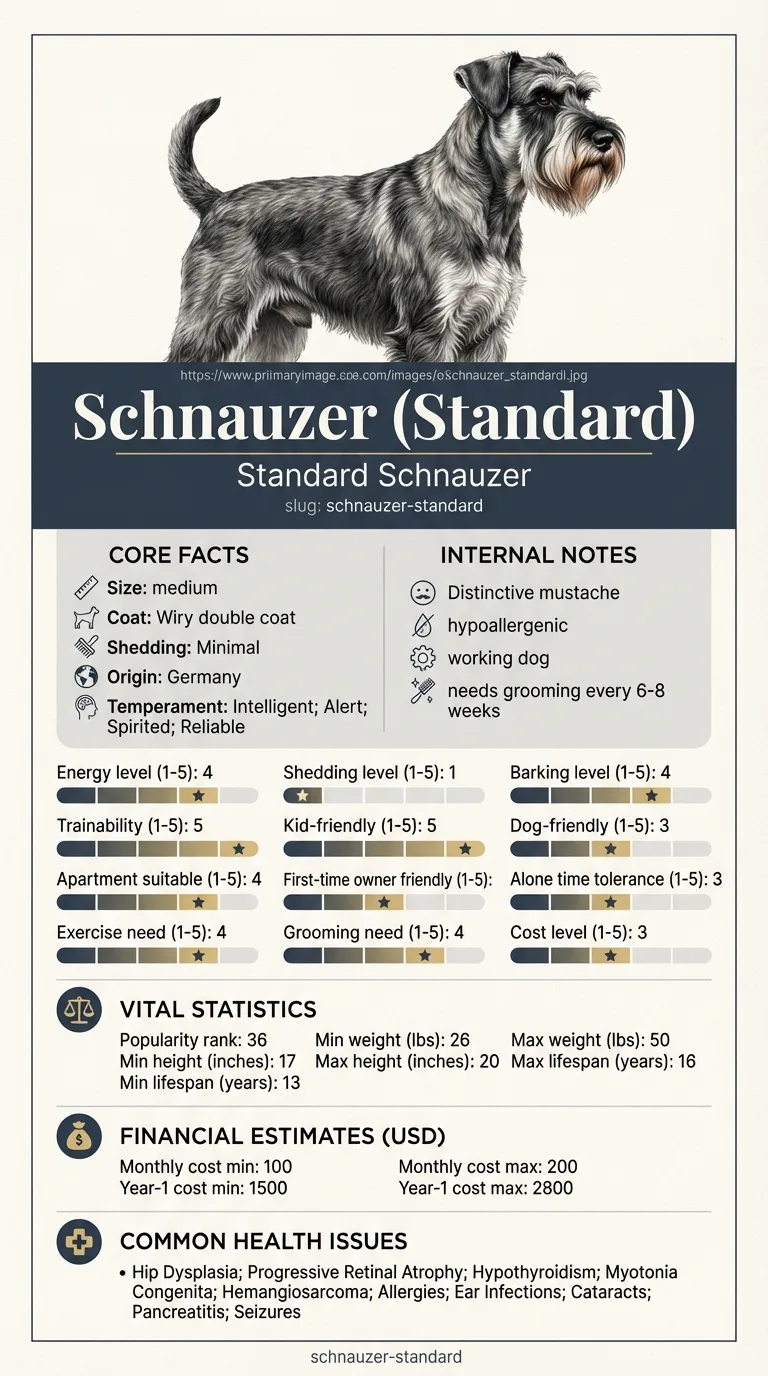
The Standard Schnauzer is a 26 to 50 pound working farm dog that trains at 5/5, sheds at 1/5, suits a flat at 4/5 and lives 13 to 16 years. It shares the Malamute's 4/5 energy and 4/5 grooming rating and almost nothing else.

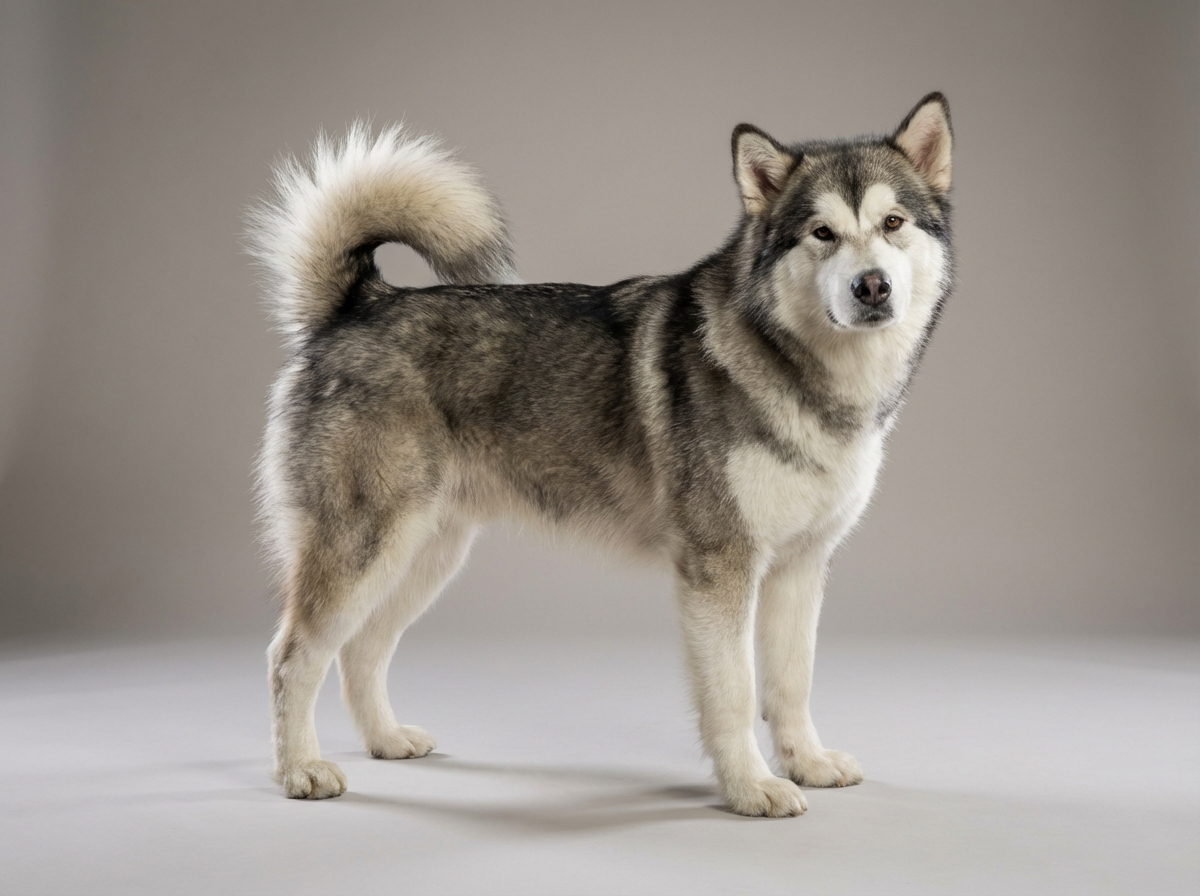
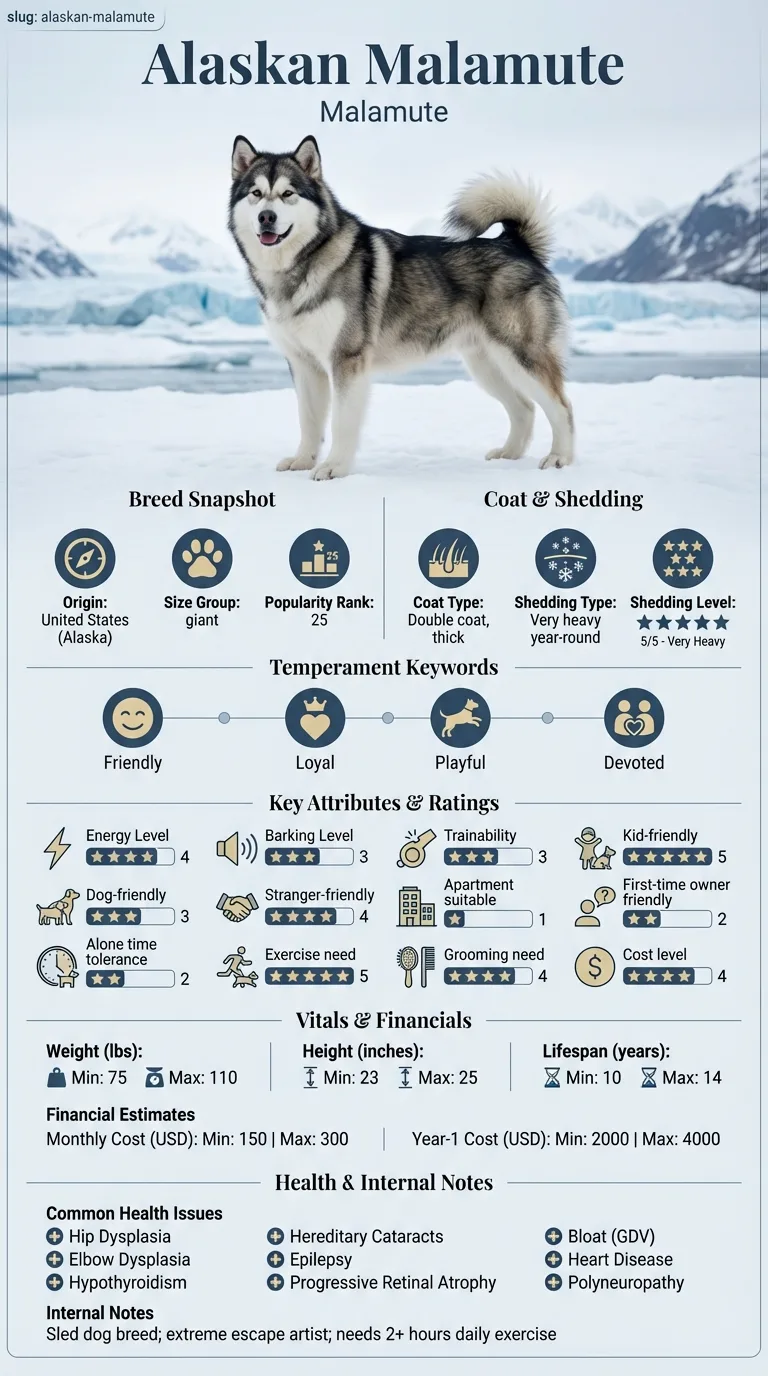
alaskan malamute infographic
schnauzer standard infographic

This page is for someone who wants a real working temperament without a large dog's footprint or a large dog's hair, and is weighing that against an Arctic breed with a two-hour daily requirement.

Quick verdict

The Standard Schnauzer offers most of what people want from a working breed — brains, drive, longevity, a manageable size — with a 4/5 barking rating and a grooming appointment every six to eight weeks as the price.

Choose alaskan malamute if...

Choose the Alaskan Malamute if you want a large cold-weather dog for genuinely physical outdoor work, you have secure fencing and two hours a day, and you would rather rake a coat at home than book a groomer.

Choose schnauzer standard if...

Choose the Standard Schnauzer if you want a highly trainable mid-sized dog that drops no hair, fits a smaller home, tolerates a workday at 3/5 and may still be with you in sixteen years.

Head-to-head comparison

Featurealaskan malamuteschnauzer standardWinner
Weight75–110 lbs26–50 lbsEqual
Height23–25 in17–20 inEqual
Lifespan10–14 years13–16 yearsschnauzer standard
CoatThick double coatWiry double coatEqual
Grooming need4/54/5Equal
Shedding5/5 — very heavy year-round1/5 — minimalschnauzer standard
Energy level4/54/5Equal
Exercise need5/54/5schnauzer standard
Trainability3/55/5schnauzer standard
Barking3/54/5alaskan malamute
Good with kids5/55/5Equal
Good with other dogs3/53/5Equal
Friendly to strangers4/53/5alaskan malamute
Apartment suitability1/54/5schnauzer standard
Good for first-time owners2/53/5schnauzer standard
Tolerates being alone2/53/5schnauzer standard
Typical monthly cost$150–300$100–200schnauzer standard
Typical first-year cost$2,000–4,000$1,500–2,800schnauzer standard

Deep dive

The middle size, and why it is the interesting one

The Standard is the parent of the Schnauzer family. The Miniature was developed by crossing down for a smaller ratter, the Giant by crossing up for a drover and guard, and the Standard is the dog both were derived from — a farm dog expected to kill vermin, watch the yard, move livestock and travel with a cart.

That history explains the ratings better than any description. Trainability 5/5, because a general-purpose farm dog had to take instruction across several unrelated jobs. Energy 4/5 and exercise 4/5, because none of those jobs was sedentary. Barking 4/5, because announcing arrivals was part of the work. Strangers 3/5, because a yard dog is meant to be watchful rather than welcoming. Other dogs 3/5, because terrier ancestry brings a willingness to escalate.

At 26 to 50 pounds and 17 to 20 inches it also occupies a genuinely useful gap. It is substantial enough to hike, run and do dog sports properly, and small enough to live in a flat at 4/5, travel in a normal car and be physically manageable by almost anyone. Most breeds that trainable are either much larger or much smaller.

The Malamute has no equivalent flexibility. It is 75 to 110 pounds, one climate, one exercise requirement and one coat, and it needs a house, a garden and a fence rather than a routine.

If you have read this site's Miniature Schnauzer comparison, note that the Standard is not simply a bigger version. It is more athletic, more trainable at 5/5 against 4/5, better with children at 5/5 against 4/5, and needs closer to an hour and a half of real activity rather than an hour.

Two double coats, 1/5 and 5/5 for shedding

Both breeds carry a double coat and both rate 4/5 for grooming, and the coats behave in opposite ways.

The Schnauzer's outer coat is wiry and stiff and grips its own dead hair rather than releasing it. That is the whole reason for the 1/5 shedding rating — the hair does not fall, it stays put — and the whole reason a groomer is required. Removing the dead layer is done by hand-stripping, which keeps the coat harsh, weather-resistant and correctly coloured, or by clipping, which is quicker, cheaper and permanently softens the texture and lightens the colour. Most pet owners choose clipping and are perfectly happy; anyone who wants the coat to stay harsh needs to find a groomer who strips and expect to pay for the time.

Either way it is every six to eight weeks for the life of the dog, and between appointments the furnishings need attention. The beard, eyebrows and leg hair are softer than the body coat and mat first, and the beard carries water, food and mud out of the bowl and onto whatever the dog leans against. A comb through the furnishings every day or two is the routine that keeps appointments simple.

The Malamute's 4/5 is the same time commitment with none of the cost. An undercoat rake taken to the skin two or three times a week, more during the two annual blows when the wool leaves in sheets. No appointments, no fees, no skill required. The price is hair everywhere at 5/5, permanently, and a firm rule against clipping, because a double coat insulates in both directions and often regrows wrong after a shave.

For a household where hair on furniture is the deciding factor, this is not a close comparison. For a household where a recurring bill is the deciding factor, it reverses.

Myotonia congenita, hemangiosarcoma and a long healthy run

The Standard Schnauzer's 13 to 16 year lifespan is excellent for a dog of its size, and its health list contains two entries that are worth knowing by name.

Myotonia congenita is an inherited disorder of muscle relaxation. Affected dogs show stiffness that is worst when they first start moving and eases with activity, along with a characteristic difficulty rising, a stiff gait and sometimes an enlarged tongue or difficulty swallowing. It appears in puppies rather than adults. The important practical point is that a DNA test exists in the breed, so a responsible breeder should know the status of both parents and an affected puppy is entirely avoidable.

Hemangiosarcoma is the more serious entry. It is an aggressive cancer of blood vessel lining, most often arising in the spleen or the heart, and its defining feature is that it grows silently and then announces itself by bleeding. The typical presentation is a middle-aged or older dog that suddenly becomes weak, has pale gums and a distended abdomen, or collapses. There is no screening test in routine use, which is why the practical advice is behavioural: sudden unexplained weakness or pale gums in an older dog of this breed is an emergency, not a wait-and-see.

The remainder of the list runs hip dysplasia, progressive retinal atrophy with DNA testing available, hypothyroidism, cataracts, allergies, ear infections, pancreatitis and seizures. Pancreatitis is the family trait shared with the Miniature — a reason to keep fatty scraps off the menu.

The Malamute's list is orthopaedic and northern: hip and elbow dysplasia, bloat, hypothyroidism, epilepsy, progressive retinal atrophy, hereditary cataracts, zinc-responsive dermatosis and inherited polyneuropathy. Its screening questions are hips, elbows and eyes.

5/5 trainability with a 4/5 mouth

The Schnauzer's trainability is the strongest thing about it and the barking is the most common complaint, and the two are related.

At 5/5 this is a dog that learns quickly, retains what it learns and enjoys having a job. It does well in obedience, agility, tracking, scent work and protection sport, and it is one of the few breeds of this size that genuinely holds up in serious training disciplines. Its temperament keywords — intelligent, alert, spirited, reliable — describe a dog that wants to be involved.

The barking at 4/5 comes from the same package. A yard dog was supposed to announce things, and a Schnauzer notices everything: the corridor, the post, a car door, a dog two gardens away. Under-occupied, it announces more. The fix is a combination of a trained quiet cue, which works well at 5/5 trainability, blocked visual access to the street, and enough real work that the dog is not looking for something to comment on. It will never be a silent breed.

Exercise is 4/5 — around ninety minutes split across the day, with mental work counting toward it. That flexibility matters. A wet Tuesday can be handled with a shorter walk and twenty minutes of scent games, and the dog will settle.

The Malamute at 5/5 exercise and 3/5 trainability is the opposite arrangement. It needs two hours with physical resistance and derives nothing from puzzle work, and it evaluates instructions rather than following them. Off-lead recall is a goal most Malamute owners never fully achieve; a well-trained Schnauzer can be genuinely reliable, though its terrier-derived prey drive means squirrels and cats remain a live issue.

On solitude the Schnauzer's 3/5 against 2/5 reflects its independent farm background and is unusually good for a dog this attached to its people.

Family fit, cost and the practical week

Both breeds rate 5/5 with children, and both earn it. The Schnauzer is robust for its size, playful and tolerant, and at 30 to 45 pounds it is heavy enough not to be injured by a toddler and light enough not to knock one over — arguably the best size in this whole comparison series for a family with small children.

With other dogs both rate 3/5. The Schnauzer's friction is terrier-derived: bold, willing to escalate, and sometimes same-sex intolerant. The Malamute's narrows with same-sex adults. Neither is a natural dog-park breed.

With strangers the Malamute is warmer at 4/5 against 3/5. Neither is a guard dog, though the Schnauzer's watchfulness and volume make it a far better alarm.

Around cats the Schnauzer's ratting background means real prey drive toward small fast animals, though one raised alongside a household cat usually manages. The Malamute's hunting drive is stronger and less negotiable.

On cost the Schnauzer is the cheaper dog: cost level 3/5 against 4/5, $100–200 a month against $150–300, and $1,500–2,800 in the first year against $2,000–4,000. The grooming appointment every six to eight weeks across thirteen to sixteen years narrows the lifetime gap, but the Schnauzer still finishes ahead — a 40 pound dog simply costs less to feed, medicate and anaesthetise than a 95 pound one.

The honest summary is that these two breeds are rarely competing for the same household. If you can supply two hours of outdoor physical work in a cold climate and want a large dog, the Malamute is unmatched. If you want a working temperament in a body that fits an ordinary life, the Standard Schnauzer is one of the most underrated dogs on this site.

Alaskan Malamute vs Schnauzer (Standard) at a glance

The Standard Schnauzer is a 26 to 50 pound working farm dog that trains at 5/5, sheds at only 1/5, suits a flat, and lives 13 to 16 years. It shares the Malamute's 4/5 energy and 4/5 grooming rating and very little else.

The Standard Schnauzer offers most of what people actually want from a working breed — brains, drive, longevity, and a manageable size — with a 4/5 barking rating and a grooming appointment every six to eight weeks as the trade-off. The Malamute stays larger, heavier-shedding, and needs real space to work.

Choose the Malamute if you want a large cold-weather dog for genuinely physical outdoor work, you have secure fencing and two hours a day, and you would rather rake a coat at home than book a groomer. Choose the Standard Schnauzer if you want a highly trainable mid-sized dog that drops no hair, fits a smaller home, and may still be with you in sixteen years.

Frequently asked questions

How is a Standard Schnauzer different from a Miniature?

It is the original from which the smaller version was bred down. It is more athletic, more trainable at 5/5 against 4/5, better with children at 5/5 against 4/5, and needs about ninety minutes of activity rather than an hour.

Why does a non-shedding dog rate 4/5 for grooming?

Because the wiry outer coat grips its dead hair instead of dropping it. That hair has to be removed every six to eight weeks by stripping or clipping, and the beard and leg furnishings need combing every day or two in between.

Is the barking manageable?

Partly. At 4/5 it is a genuinely vocal breed bred to announce arrivals, but at 5/5 trainability it responds well to a quiet cue, blocked window access and enough real work. It will not become a quiet dog.

What is myotonia congenita?

An inherited muscle disorder causing stiffness that is worst on rising and eases with movement, showing in puppies rather than adults. A DNA test exists in the breed, so both parents' status should be known.

What is hemangiosarcoma and can it be screened for?

An aggressive cancer of blood vessel lining, usually in the spleen or heart, that grows silently and presents by bleeding. There is no routine screening test, so sudden weakness or pale gums in an older dog is an emergency.

Which lives longer?

The Standard Schnauzer at 13 to 16 years against the Malamute's 10 to 14 — an excellent figure for a dog of 30 to 50 pounds and one of the strongest arguments for the breed.

Which is cheaper to keep?

The Schnauzer at $100–200 a month against $150–300, with cost levels of 3/5 and 4/5. Its grooming schedule offsets some of that but not all — a 40 pound dog costs less to feed and treat than a 95 pound one.

Quick answers

View more answers
Living

Malamute or Standard Schnauzer: which should I choose?

The Schnauzer if you want a genuinely trainable working dog in a mid-sized, non-shedding, flat-compatible package and can accept the barking and the grooming schedule. The Malamute if you want a large cold-weather dog and can supply two hours daily.

Costs

Which is cheaper to own?

The Standard Schnauzer at $100–200 a month against $150–300, and $1,500–2,800 in the first year against $2,000–4,000. Cost level 3/5 against 4/5.

Health

What should I ask a Standard Schnauzer breeder?

DNA status for myotonia congenita and progressive retinal atrophy on both parents, hip scores, and whether there is any history of hemangiosarcoma or seizures in the line.

Training

How much exercise does a Standard Schnauzer need?

Around ninety minutes a day split across two outings, with mental work counting toward it. The Malamute needs two hours with physical resistance and gains nothing from puzzle work.

Related DogBreedCompass guides

  • Alaskan Malamute breed guideThe Malamute profile covers exercise load, coat raking and the containment the breed requires.
  • Standard Schnauzer breed guideThe Standard Schnauzer profile covers coat options, working history and exercise expectations.
  • excessive barking in Standard SchnauzersA 4/5 barking rating in an otherwise flat-friendly breed is the complaint owners hit first.
  • hypothyroidism in Standard SchnauzersHypothyroidism appears on both breeds' lists and is easy to miss as slow coat and weight change.
  • hip dysplasia in Alaskan MalamutesHip dysplasia sits on both lists and is the shared screening question for either breeder.
  • Alaskan Malamute vs Miniature SchnauzerReaders looking at the Schnauzer family usually want the smaller variety weighed up too.

Related guides

Important reminder

Health information here is general and is not veterinary advice. DNA testing, screening and individual risk should be discussed with your own veterinarian.

Some links on this site are affiliate links. We may earn a commission if you buy through them, at no additional cost to you.

Find Your Perfect Breed

Match your lifestyle to the right dog.

Take quiz

Find your match

Not sure which breed is right for you? Take our 2-minute quiz to find out.

Take the quiz