Behavior
Sheds less?
Standard Schnauzer.

Quick answer
Sheds less?
Standard Schnauzer.
Cavalier King Charles Spaniel or Schnauzer (Standard)? On paper they differ most on shedding, and on the scales Schnauzer (Standard) is the heavier at 26–50 lbs. Here is how the two compare on everything that shapes an ordinary week.
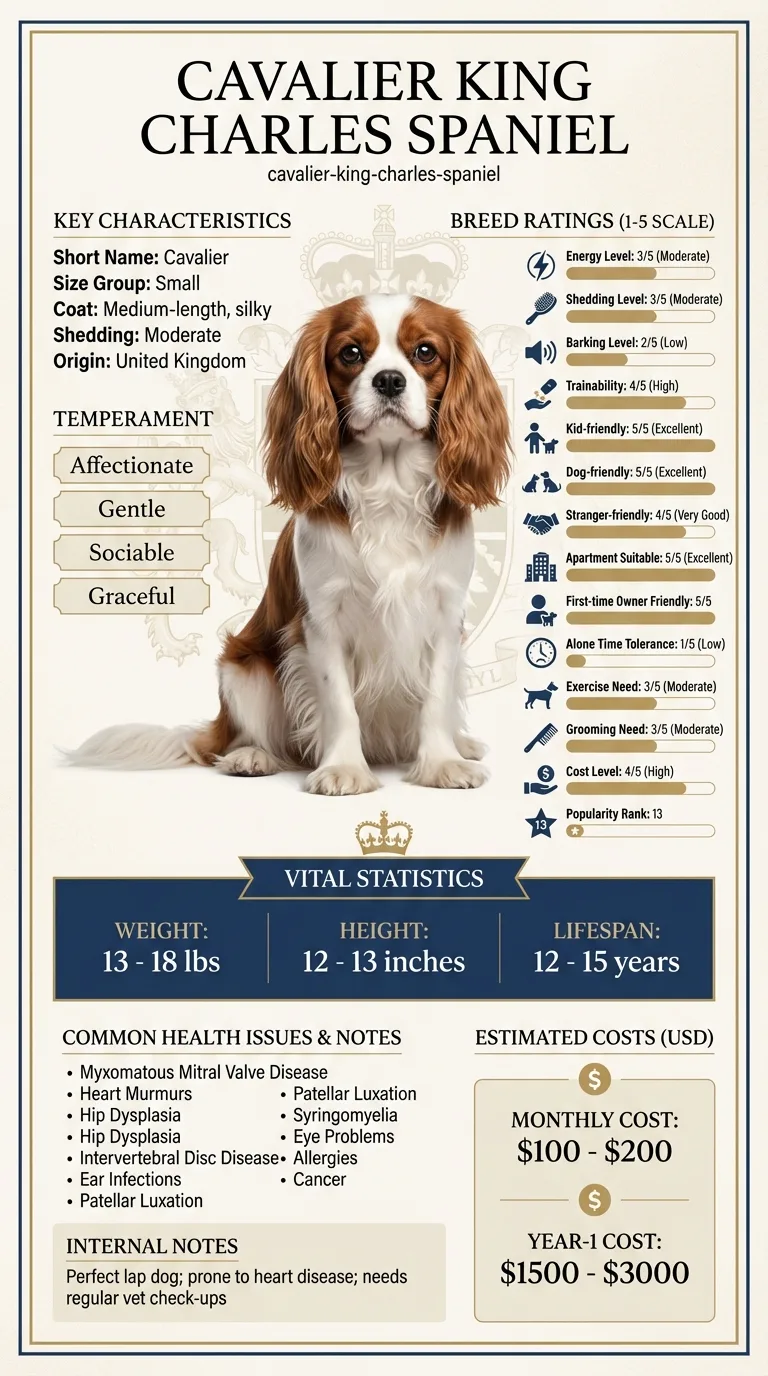
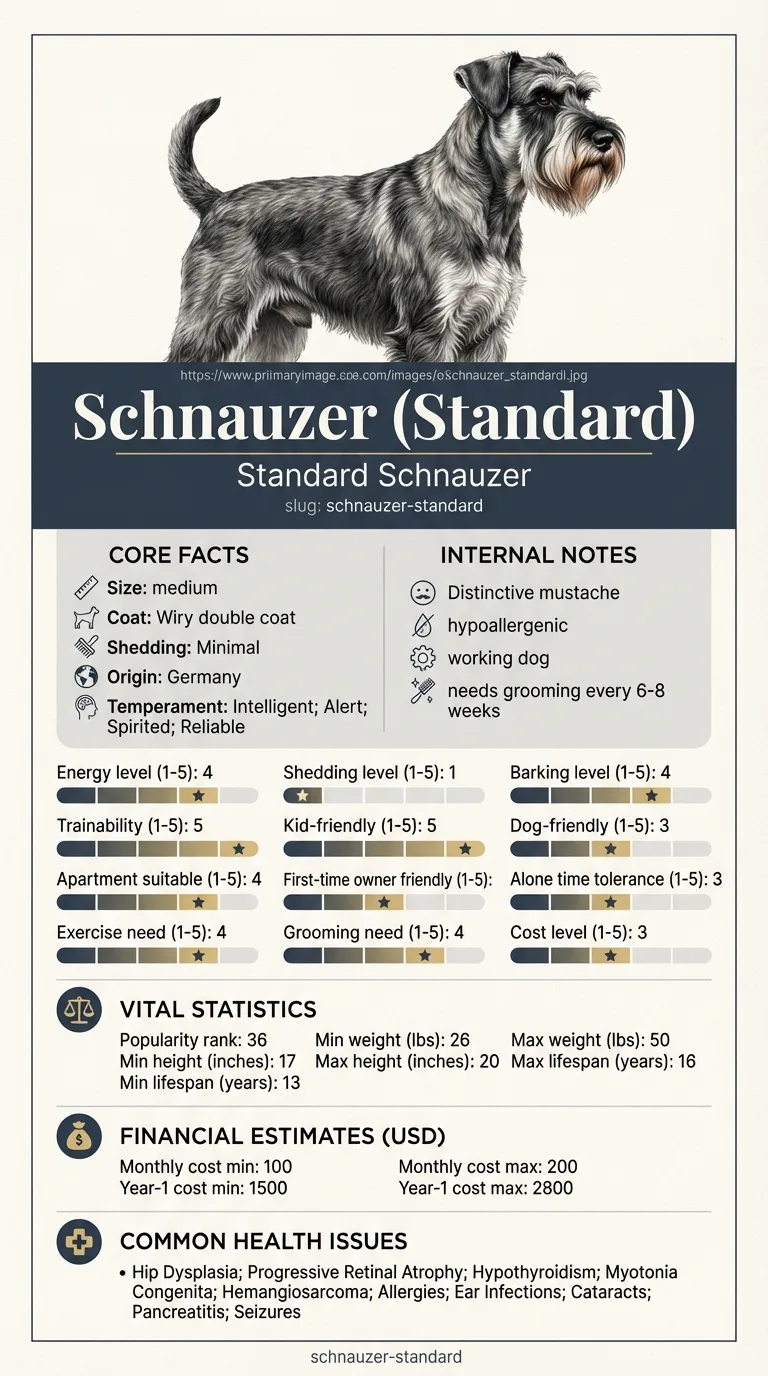
This is for someone already down to Cavalier King Charles Spaniel and Schnauzer (Standard) and deciding between them. For this pair the decision usually turns on shedding and good for first-time owners, so those are covered first and in most detail. Anyone choosing from a flat has a clear answer here: Cavalier King Charles Spaniel rates 5/5 against 4/5. The focus throughout is on daily consequences rather than breed background.
Between Cavalier King Charles Spaniel and Schnauzer (Standard), shedding is what separates them, and Cavalier King Charles Spaniel is the lower-effort dog of the two to keep.
Choose Cavalier King Charles Spaniel if you are in a flat or a smaller home, this is your first dog and you do not want a standing grooming appointment.
Choose Schnauzer (Standard) if shedding is a problem in your house, the dog will be alone during the working day and you want a dog that picks up training quickly.
| Feature | cavalier king charles spaniel | schnauzer standard | Winner |
|---|---|---|---|
| Size class | small | medium | Equal |
| Weight | 13–18 lbs | 26–50 lbs | Equal |
| Height | 12–13 in | 17–20 in | Equal |
| Lifespan | 12–15 years | 13–16 years | schnauzer standard |
| Exercise need | Moderate (3/5) | High (4/5) | cavalier king charles spaniel |
| Grooming need | Moderate (3/5) | High (4/5) | cavalier king charles spaniel |
| Shedding | Moderate (3/5) | Very low (1/5) | schnauzer standard |
| Energy level | Moderate (3/5) | High (4/5) | Equal |
| Barking | Low (2/5) | High (4/5) | cavalier king charles spaniel |
| Apartment suitability | Very high (5/5) | High (4/5) | cavalier king charles spaniel |
| Good for first-time owners | Very high (5/5) | Moderate (3/5) | cavalier king charles spaniel |
| Tolerates being alone | Very low (1/5) | Moderate (3/5) | schnauzer standard |
| Trainability | High (4/5) | Very high (5/5) | schnauzer standard |
| Good with kids | Very high (5/5) | Very high (5/5) | Equal |
| Good with other dogs | Very high (5/5) | Moderate (3/5) | cavalier king charles spaniel |
| Friendly to strangers | High (4/5) | Moderate (3/5) | cavalier king charles spaniel |
| Cost level | High (4/5) | Moderate (3/5) | schnauzer standard |
| Coat | Medium-length, silky | Wiry double coat | Equal |
| Origin | United Kingdom | Germany | Equal |
| Typical monthly cost | $100–$200 | $100–$200 | Equal |
| Typical first-year cost | $1,500–$3,000 | $1,500–$2,800 | Equal |
A Standard Schnauzer at 26-50 lbs and 17-20 inches sits solidly in medium territory, roughly two to three times the Cavalier's 13-18 lbs and several inches taller at 12-13 inches. The Schnauzer's wiry double coat and squared-off, bearded silhouette give it a working-dog look that contrasts with the Cavalier's soft, silky-coated spaniel elegance. Despite the size difference, neither breed is unmanageable for most households - the real planning question is less about physical space and more about the Schnauzer's higher-maintenance coat and greater need for structured activity.
Exercise need favors the Cavalier at Moderate (3/5) against High (4/5) for the Standard Schnauzer, whose intelligent, spirited, alert nature needs real daily outlets or it tends to get vocal and restless. Energy level shows the same gap, Moderate against High, and a Schnauzer that's under-exercised often channels that surplus into barking or destructive chewing rather than settling. The Cavalier's more modest exercise requirement makes it the easier fit for owners without the time for longer runs or structured training sessions on top of daily walks.
Grooming actually costs more with the Schnauzer, High (4/5) against the Cavalier's Moderate (3/5), since its wiry coat needs regular hand-stripping or clipping every six to eight weeks to keep its signature texture. Shedding flips the advantage back to the Schnauzer, though - Very low (1/5) against Moderate (3/5) for the Cavalier - making it the better pick for anyone bothered by loose fur on furniture, even if the coat itself demands more professional grooming appointments. Cavalier owners spend less on grooming visits but deal with more year-round shedding at home.
Barking tilts sharply toward the Cavalier, Low (2/5) against High (4/5) for the Standard Schnauzer, whose alert, watchful instincts make it quick to announce visitors and passersby. Apartment suitability follows the same pattern - Very high (5/5) versus High (4/5) - so while a Schnauzer can live in an apartment, its vocal tendencies need active management around neighbors. Tolerating time alone favors the Schnauzer, Moderate (3/5) against the Cavalier's Very low (1/5), meaning a Schnauzer handles a standard workday better even though its barking makes apartment life noisier.
Trainability actually favors the Schnauzer here, Very high (5/5) against High (4/5) for the Cavalier, reflecting its intelligent, reliable working-breed heritage. But first-time-owner suitability tells a different story - Very high (5/5) for the Cavalier against Moderate (3/5) for the Schnauzer - because a spirited, alert dog that learns quickly also needs a handler who gives it consistent mental work, or that intelligence turns into problem behavior. Experienced owners often find the Schnauzer more rewarding to train precisely because it's so responsive; first-timers may find the Cavalier's gentler learning curve less demanding.
Good with kids ties at Very high (5/5) for both breeds, but the Cavalier pulls ahead with other dogs, Very high (5/5) against Moderate (3/5), and with strangers, High (4/5) against Moderate (3/5) for the more reserved, watchful Schnauzer. Reliable and alert are apt descriptors for a breed that tends to warm up to visitors on its own schedule rather than greeting everyone immediately, unlike the Cavalier's consistently sociable, affectionate default. Families that want a dog that's naturally friendly to every guest lean Cavalier; those who like a bit of watchdog instinct lean Schnauzer.
The Standard Schnauzer edges out the Cavalier on lifespan, 13-16 years against 12-15, and carries a notably longer list of documented health risks: Progressive Retinal Atrophy, Hypothyroidism, Myotonia Congenita, Hemangiosarcoma, Cataracts, Pancreatitis, and Seizures, alongside hip dysplasia. That breadth doesn't necessarily mean worse health outcomes, just that more conditions have been documented in the breed, and reputable breeders now screen for many of them. The Cavalier's list is shorter but concentrated on serious, near-universal cardiac and neurological risk - Myxomatous Mitral Valve Disease and syringomyelia - that affects a very high proportion of the breed by middle age.
Cost level actually favors the Schnauzer, Moderate (3/5) against High (4/5) for the Cavalier, even though monthly costs tie at $100-200 for both. First-year costs are close too, $1,500-3,000 for the Cavalier against $1,500-2,800 for the Schnauzer, but ongoing grooming appointments for the Schnauzer's coat maintenance add a recurring cost the raw cost-level rating doesn't fully separate out. Cavalier owners instead direct that budget toward earlier and more frequent cardiac monitoring as the dog ages, so the money goes to different places even when the totals land close together.
Cavalier King Charles Spaniel weighs 13–18 lbs and lives 12–15 years; Schnauzer (Standard) weighs 26–50 lbs and lives 13–16 years. The two diverge most on shedding, good for first-time owners and tolerates being alone and 2 other rated axes. Almost every rated axis separates them at least slightly. The table below marks a winner only where one breed is genuinely easier for a typical owner; size and origin are facts rather than merits and stay level. Ratings come from one source applied to both breeds, so they are meaningful against each other rather than as absolute scores.

The Schnauzer, rated High (4/5) against the Cavalier's Low (2/5), thanks to its alert, watchful instincts.
Yes - grooming rates High (4/5), since the wiry coat typically needs hand-stripping or clipping every six to eight weeks.
The Schnauzer, rated Very low (1/5) against the Cavalier's Moderate (3/5).
Technically yes on raw trainability - Very high (5/5) versus High (4/5) - but it does best with an owner who can give it consistent mental engagement.
The Schnauzer, typically 13-16 years against 12-15 years for the Cavalier.
The Cavalier, rated Very high (5/5) against Moderate (3/5) for the Schnauzer.
Yes, both tie at $100-200 a month, though the Schnauzer's coat maintenance adds recurring grooming appointments.
Standard Schnauzer.
Standard Schnauzer.
Cavalier King Charles Spaniel.
Standard Schnauzer.
Secure checkout on Stripe. We never see your card.
7-day money-back guarantee. Instant access.
Health information here is general and is not veterinary advice. If your dog shows pain, sudden behaviour change, or worsening symptoms, consult a licensed veterinarian.
Some links on this site are affiliate links. We may earn a commission at no extra cost to you, and we only suggest products we believe are helpful for dog owners.
We research and check what we publish, but we do not warrant that any figure, date, price, or statement is accurate, complete, or current, and we accept no liability for any loss, cost, injury, or other harm arising from the use of this site. Use it as one reference among several. You remain responsible for your own decisions and for your dog's care - confirm anything that matters with a licensed veterinarian or another qualified professional before you act on it. Full disclaimer.
Match your lifestyle to the right dog.
Take quizNot sure which breed is right for you? Take our 2-minute quiz to find out.
Take the quiz