Living
Havanese or Standard Schnauzer -- which fits your life?
Choose the Havanese for the easiest first-dog experience and the least barking; choose the Schnauzer if you want a more active, trainable dog and don't mind more vocal alerts.

Quick answer
Havanese or Standard Schnauzer -- which fits your life?
Choose the Havanese for the easiest first-dog experience and the least barking; choose the Schnauzer if you want a more active, trainable dog and don't mind more vocal alerts.
Havanese or Schnauzer (Standard)? On paper they differ most on exercise need, and on the scales Schnauzer (Standard) is the heavier at 26–50 lbs. Here is how the two compare on everything that shapes an ordinary week.
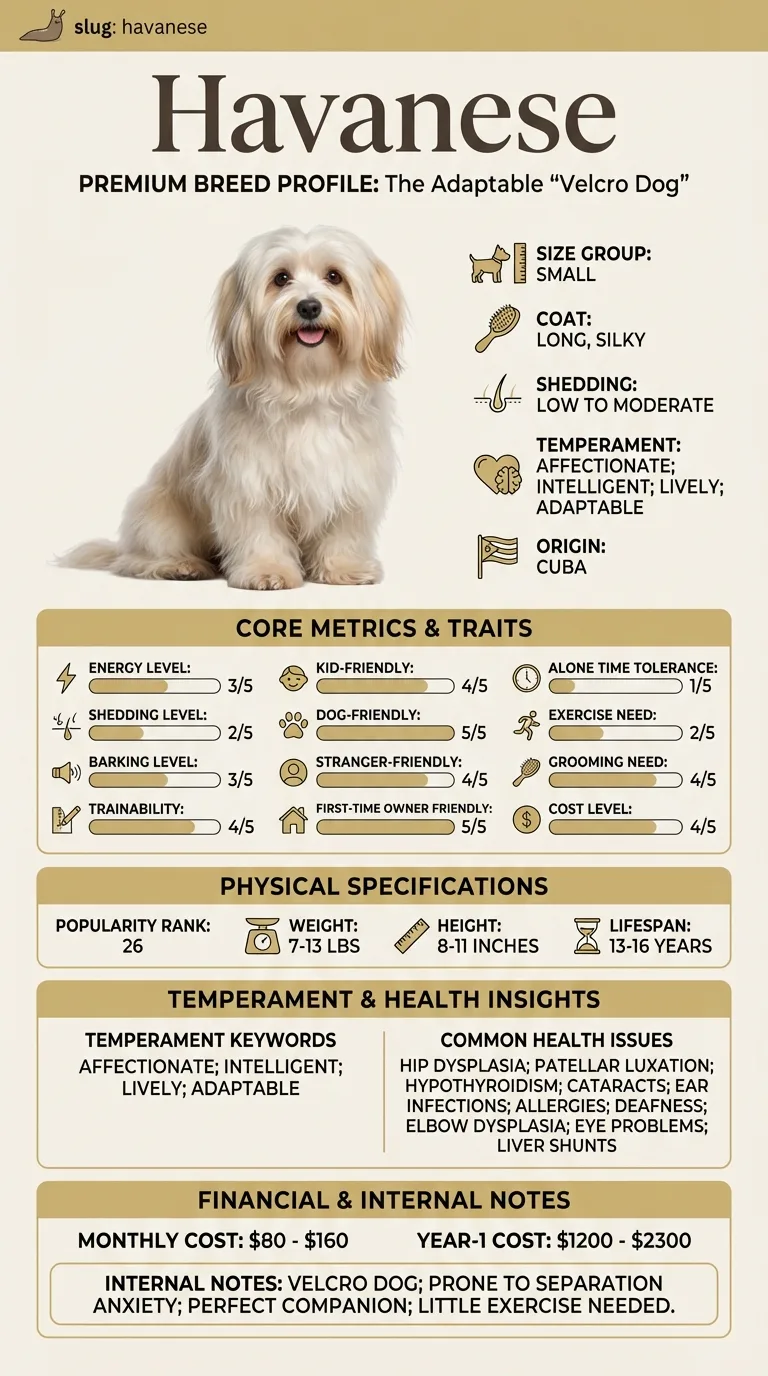
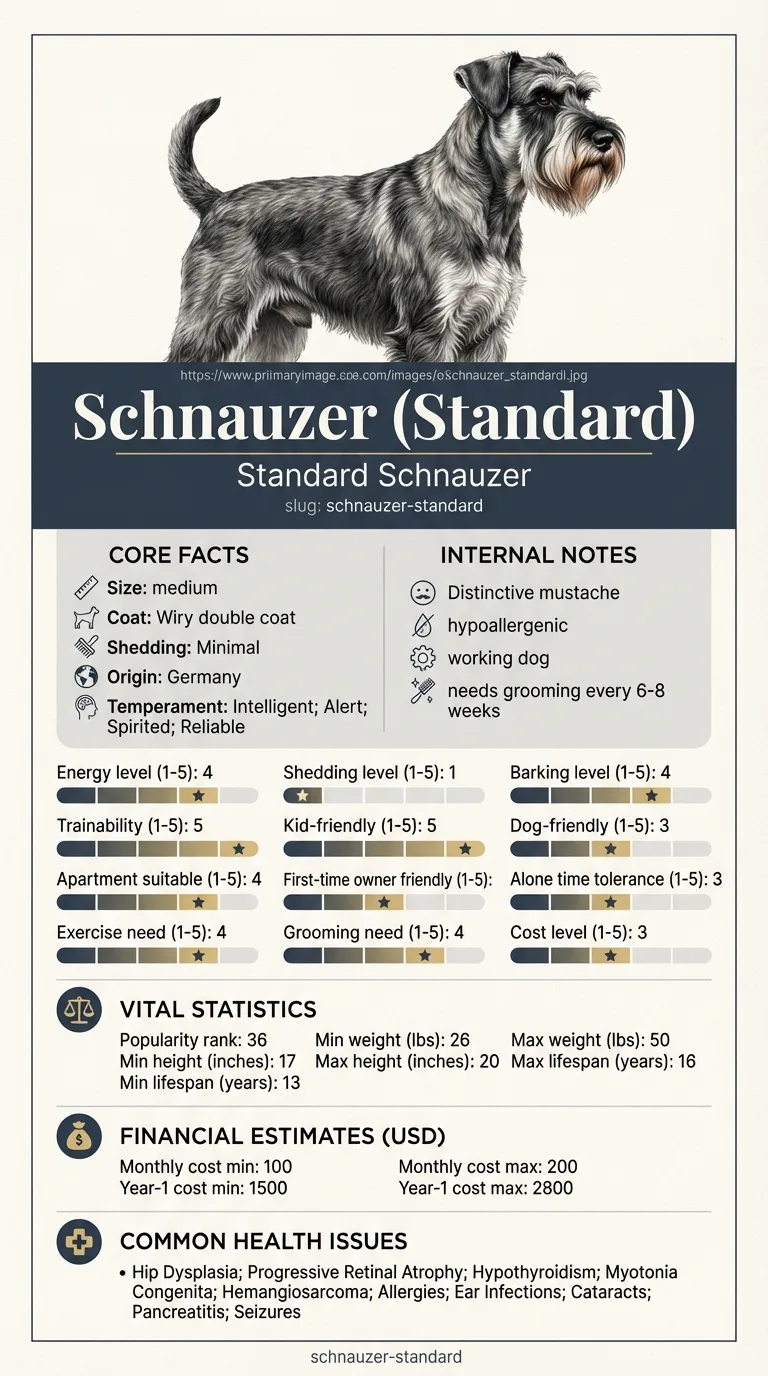
This is for someone already down to Havanese and Schnauzer (Standard) and deciding between them. For this pair the decision usually turns on exercise need and good for first-time owners, so those are covered first and in most detail. Anyone choosing from a flat has a clear answer here: Havanese rates 5/5 against 4/5. The focus throughout is on daily consequences rather than breed background.
Between Havanese and Schnauzer (Standard), exercise need is what separates them, and Havanese is the lower-effort dog of the two to keep.
Choose Havanese if you are in a flat or a smaller home, this is your first dog and your walking routine is modest.
Choose Schnauzer (Standard) if shedding is a problem in your house, the dog will be alone during the working day and there are young children at home.
| Feature | havanese | schnauzer standard | Winner |
|---|---|---|---|
| Size class | small | medium | Equal |
| Weight | 7–13 lbs | 26–50 lbs | Equal |
| Height | 8–11 in | 17–20 in | Equal |
| Lifespan | 13–16 years | 13–16 years | Equal |
| Exercise need | Low (2/5) | High (4/5) | havanese |
| Grooming need | High (4/5) | High (4/5) | Equal |
| Shedding | Low (2/5) | Very low (1/5) | schnauzer standard |
| Energy level | Moderate (3/5) | High (4/5) | Equal |
| Barking | Moderate (3/5) | High (4/5) | havanese |
| Apartment suitability | Very high (5/5) | High (4/5) | havanese |
| Good for first-time owners | Very high (5/5) | Moderate (3/5) | havanese |
| Tolerates being alone | Very low (1/5) | Moderate (3/5) | schnauzer standard |
| Trainability | High (4/5) | Very high (5/5) | schnauzer standard |
| Good with kids | High (4/5) | Very high (5/5) | schnauzer standard |
| Good with other dogs | Very high (5/5) | Moderate (3/5) | havanese |
| Friendly to strangers | High (4/5) | Moderate (3/5) | havanese |
| Cost level | High (4/5) | Moderate (3/5) | schnauzer standard |
| Coat | Long, silky | Wiry double coat | Equal |
| Origin | Cuba | Germany | Equal |
| Typical monthly cost | $80–$160 | $100–$200 | Equal |
| Typical first-year cost | $1,200–$2,300 | $1,500–$2,800 | Equal |
The Standard Schnauzer is a genuine step up in size -- 26-50 lbs and 17-20 inches against the Havanese's 7-13 lbs and 8-11 inches -- without moving into large-breed territory. It's a medium dog, not a giant one, which matters for the exercise and cost differences below. Its wiry double coat and more athletic build reflect the breed's working-dog background as a ratter and farm guardian, distinct from the Havanese's companion-bred origins in Cuba.
Exercise need splits clearly: 2/5 for the Havanese, 4/5 for the Schnauzer, which was bred as a working ratter and guard dog and still carries that drive today. Energy level shows the same gap in a milder form, 3/5 versus 4/5. A Schnauzer that doesn't get enough daily activity tends to channel that energy into digging, barking, or general restlessness -- something to plan around before bringing one into a lower-activity household.
Both rate 4/5 for grooming effort, but the routines differ -- the Havanese needs regular brushing to prevent mats, while the Schnauzer's wiry coat is typically hand-stripped or clipped, a more specialized and often pricier grooming task. Shedding favors the Schnauzer regardless, 1/5 versus the Havanese's 2/5. Finding a groomer experienced with hand-stripping is worth doing before you commit to a Schnauzer, since not every salon offers it.
The Havanese scores higher for apartments, 5/5 vs 4/5, and barks less, 3/5 vs 4/5 -- the Schnauzer is a notably vocal, "Alert" breed, worth weighing seriously if your walls are thin or your neighbors are close. Neither breed tolerates being left alone especially well, though the Schnauzer's 3/5 rating there beats the Havanese's very low 1/5 by a meaningful margin for anyone working long hours.
The Schnauzer trains slightly higher, 5/5 vs 4/5, but the Havanese remains the more first-timer-friendly choice, 5/5 vs 3/5 -- the Schnauzer's higher exercise needs and "Spirited" personality mean training success takes more consistent handling and follow-through. A Schnauzer that's under-stimulated can become harder to manage despite its high trainability score, which is worth factoring in beyond the raw number.
The Schnauzer edges ahead with kids, 5/5 vs 4/5, while the Havanese wins with other dogs, 5/5 vs 3/5, and strangers, 4/5 vs 3/5. The Schnauzer tolerates alone time better too, 3/5 vs 1/5, a genuine advantage for working households. Its "Reliable" temperament tag suggests consistency once it's settled into a routine, even if first impressions with strangers or unfamiliar dogs run more reserved than the Havanese's.
Both breeds share an identical 13-16 year lifespan range in this data, a rare tie between two otherwise quite different dogs. Health risks overlap somewhat -- both lists include hypothyroidism, allergies, ear infections, and cataracts -- but the Schnauzer's ten-condition list adds hemangiosarcoma, a cancer, and seizures, neither of which is on the Havanese's list. Routine bloodwork and monitoring for lumps become especially relevant for Schnauzer owners given that cancer risk.
The Havanese is rated higher on the site's cost tier, 4/5, "high", than the Schnauzer, 3/5, "moderate", yet the dollar ranges given run slightly higher for the Schnauzer in practice: $100-200 monthly and $1,500-2,800 in the first year, against $80-160 and $1,200-2,300 for the Havanese. Either way, budget in the same general ballpark for both, and expect grooming and hand-stripping fees to be the line item most likely to push the Schnauzer's actual costs higher.
Havanese weighs 7–13 lbs and lives 13–16 years; Schnauzer (Standard) weighs 26–50 lbs and lives 13–16 years. The two diverge most on exercise need, good for first-time owners and tolerates being alone and 1 other rated axes. Almost every rated axis separates them at least slightly. The table below marks a winner only where one breed is genuinely easier for a typical owner; size and origin are facts rather than merits and stay level. Ratings come from one source applied to both breeds, so they are meaningful against each other rather than as absolute scores.

The Schnauzer, by a wide margin for a medium breed -- 26-50 lbs and 17-20 inches versus the Havanese's 7-13 lbs and 8-11 inches.
The Schnauzer, rated 4/5 against the Havanese's 3/5 -- it's a naturally vocal, alert breed, worth considering for apartment living even though it still scores a respectable 4/5 for apartment suitability.
Yes -- both are rated 13-16 years in this data, an unusually clean match.
The Havanese, rated 5/5 versus the Schnauzer's 3/5. The Schnauzer trains slightly better on paper (5/5 vs 4/5) but its exercise needs and stronger personality ask more of a new owner.
Both rate 4/5 for grooming effort, but the coats need different handling -- the Havanese wants regular brushing, while the Schnauzer's wiry coat is usually hand-stripped or clipped by a groomer familiar with the breed.
The dollar ranges run slightly higher for the Schnauzer, $100-200 monthly and $1,500-2,800 first year, than the Havanese, $80-160 monthly and $1,200-2,300 first year, even though the site's cost tier rates the Havanese higher overall.
Some -- hypothyroidism, allergies, ear infections, and cataracts appear on both lists. The Schnauzer's list additionally includes hemangiosarcoma and seizures, which aren't listed for the Havanese.
Choose the Havanese for the easiest first-dog experience and the least barking; choose the Schnauzer if you want a more active, trainable dog and don't mind more vocal alerts.
$80-160 for the Havanese versus $100-200 for the Schnauzer -- close, with the Schnauzer running a bit higher.
The Schnauzer needs considerably more, 4/5 versus the Havanese's 2/5.
Identical in this data -- both 13-16 years.
Secure checkout on Stripe. We never see your card.
7-day money-back guarantee. Instant access.
Health information here is general and is not veterinary advice. If your dog shows pain, sudden behaviour change, or worsening symptoms, consult a licensed veterinarian.
Some links on this site are affiliate links. We may earn a commission at no extra cost to you, and we only suggest products we believe are helpful for dog owners.
We research and check what we publish, but we do not warrant that any figure, date, price, or statement is accurate, complete, or current, and we accept no liability for any loss, cost, injury, or other harm arising from the use of this site. Use it as one reference among several. You remain responsible for your own decisions and for your dog's care - confirm anything that matters with a licensed veterinarian or another qualified professional before you act on it. Full disclaimer.
Match your lifestyle to the right dog.
Take quizNot sure which breed is right for you? Take our 2-minute quiz to find out.
Take the quiz