DogBreedCompass

Malamute or German Wirehaired Pointer: Raking Versus Stripping

Six ratings match exactly: exercise 5/5, barking 3/5, dog friendliness 3/5, apartment suitability 1/5, first-time owner friendliness 2/5 and tolerance of time alone 2/5. The differences are in the coat, the work and how long the dog lives.

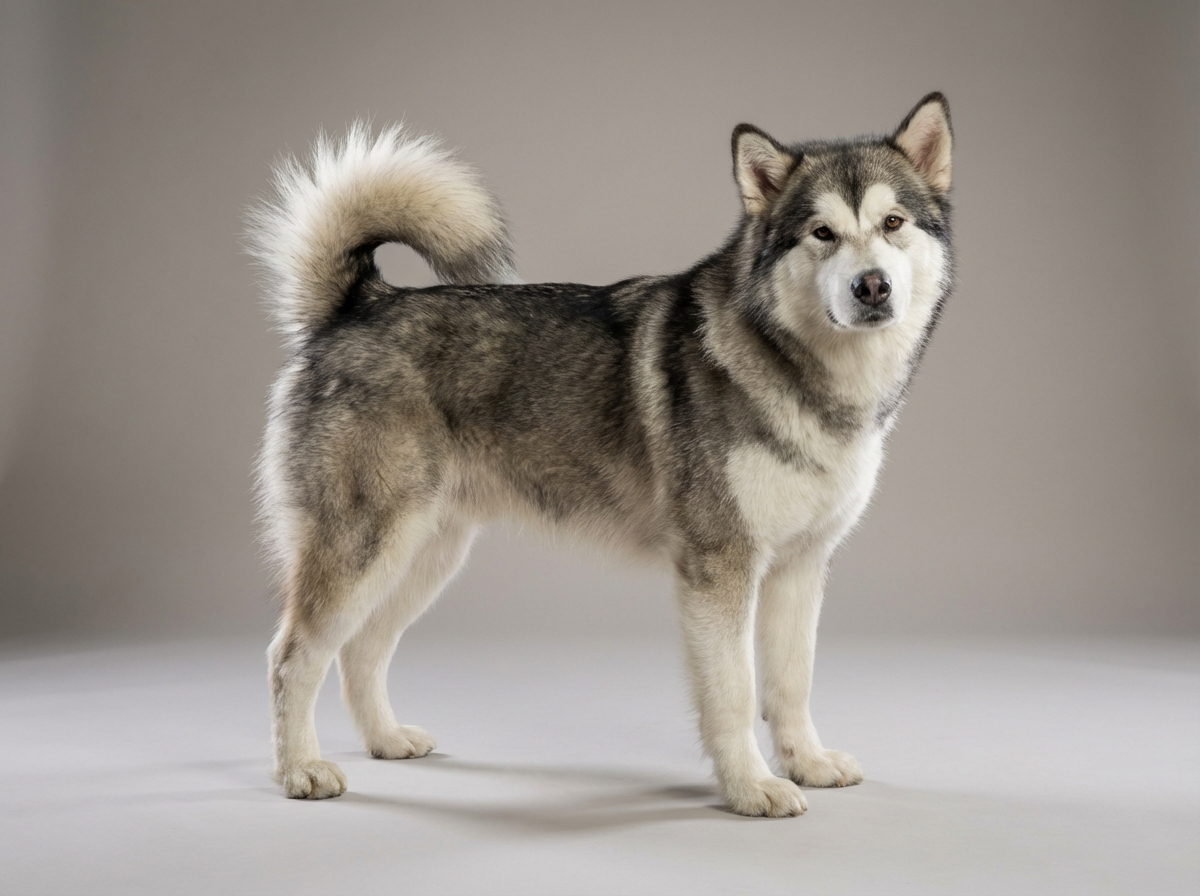
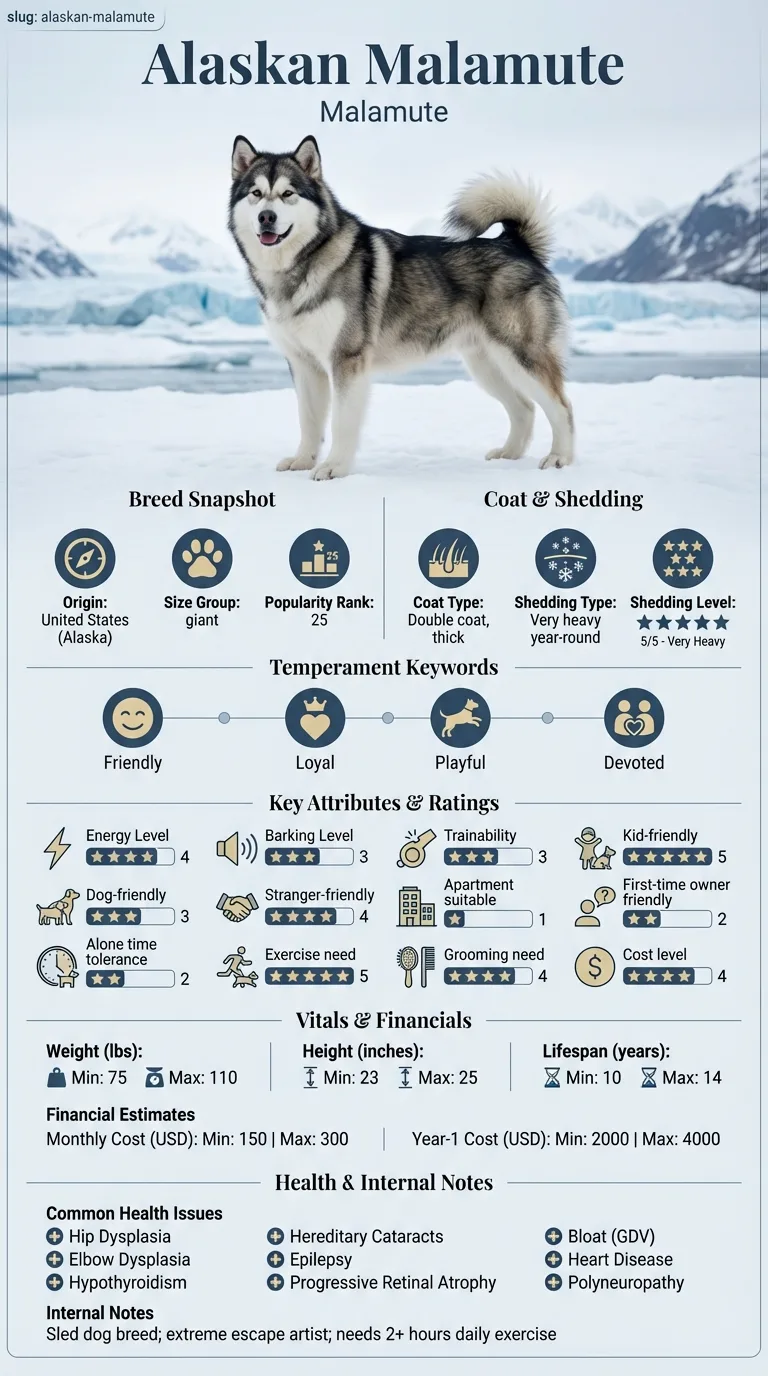
alaskan malamute infographic
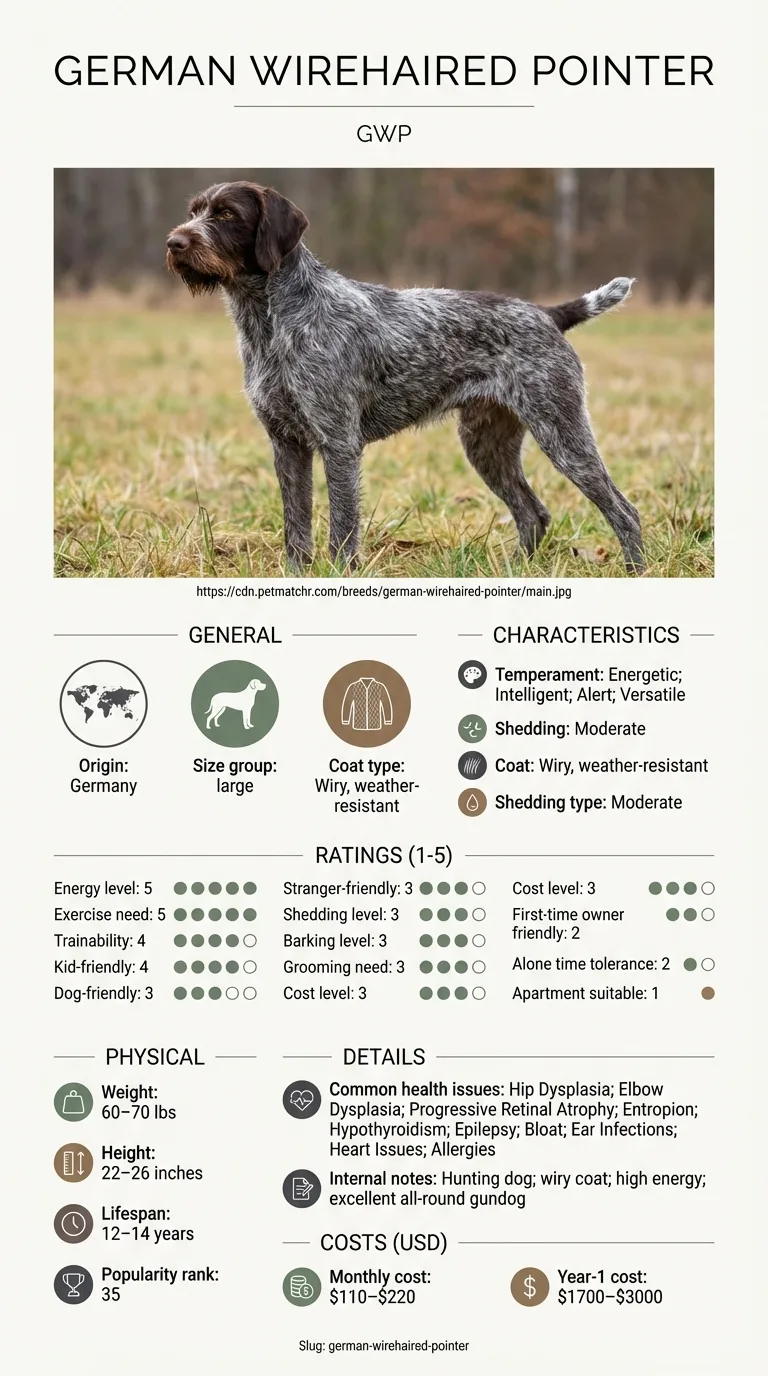
german wirehaired pointer infographic

This page is for someone in a cold or wet climate choosing between two large, hardy, high-exercise working breeds — one that hauls and one that hunts — and wanting to know which one fits their week rather than their weekend.

Quick verdict

The German Wirehaired Pointer lives longer, costs less, trains better and sheds less, but it needs a genuine job and a coat routine most owners have never encountered.

Choose alaskan malamute if...

Choose the Alaskan Malamute if you want a heavier, warmer-natured dog that settles hard once the physical work is done, you can offer load-bearing activity, and you would rather brush than learn to strip a coat.

Choose german wirehaired pointer if...

Choose the German Wirehaired Pointer if you hunt, hike or train seriously in rough country, you want a 12 to 14 year working companion that takes direction at 4/5, and you are willing to hand-strip or pay someone to.

Head-to-head comparison

Featurealaskan malamutegerman wirehaired pointerWinner
Weight75–110 lbs60–70 lbsEqual
Height23–25 in22–26 inEqual
Lifespan10–14 years12–14 yearsgerman wirehaired pointer
CoatThick double coatWiry, weather-resistantEqual
Grooming need4/53/5german wirehaired pointer
Shedding5/5 — very heavy year-round3/5 — moderategerman wirehaired pointer
Energy level4/55/5alaskan malamute
Exercise need5/55/5Equal
Trainability3/54/5german wirehaired pointer
Barking3/53/5Equal
Good with kids5/54/5alaskan malamute
Good with other dogs3/53/5Equal
Friendly to strangers4/53/5alaskan malamute
Apartment suitability1/51/5Equal
Good for first-time owners2/52/5Equal
Tolerates being alone2/52/5Equal
Typical monthly cost$150–300$110–220german wirehaired pointer
Typical first-year cost$2,000–4,000$1,700–3,000german wirehaired pointer

Deep dive

Two weather-proof coats, two rituals nobody warns you about

The grooming ratings sit close — 4/5 for the Malamute, 3/5 for the Wirehaired Pointer — and that closeness hides the fact that the two jobs share almost no equipment and no technique.

The Malamute's thick double coat is a volume problem. It is rated 5/5 for shedding, very heavy year-round, with two seasonal blows during which the undercoat comes away in sheets for two to three weeks. The work is mechanical: an undercoat rake taken down to the skin in overlapping sections, two or three times a week, ten to fifteen minutes a session, more during a blow. The tool matters more than the skill. Mats form behind the ears, in the armpits and along the trousers if you skip weeks, and a mat on a double coat traps damp against the skin and becomes a hot spot. The coat must never be shaved.

The Wirehaired Pointer's coat is a texture problem. A correct wire jacket is harsh, flat and about an inch and a half long, with a weather-resistant outer layer, a dense winter undercoat, bushy eyebrows and a beard. Left alone, the outer hairs blow and the coat goes soft, woolly and loses its water resistance. The traditional answer is hand-stripping — plucking dead outer hairs out by the root, either with fingers or a stripping knife, a few times a year. It is slow, it is a learned skill, and a groomer who understands wire coats will charge accordingly. Clipping is the shortcut and it is a one-way door: clipping cuts the hairs rather than removing them, and repeated clipping progressively softens the texture until the weather resistance is gone for good.

Add the beard. A wire-coated dog with a beard carries water and food out of the bowl and deposits both on the floor, the sofa and your knee, permanently.

Load versus ground: what each dog thinks exercise means

Both rate 5/5 for exercise, so the daily hours are similar. The content is not, and matching the wrong content to the wrong dog is how both breeds end up in rescue.

The Malamute wants resistance. A pack on a hike, a weight-pull harness, a scooter or rig, steep ground, deep snow. Its energy rating of 4/5 is honest — it is not a frantic dog, it is a heavy engine that needs load to feel used. Two hours of hauling work produces a Malamute that sleeps across a doorway all evening. Two hours of flat walking produces a Malamute that is merely awake.

The Wirehaired Pointer wants ground and a task. Its breed notes describe an excellent all-round gundog, and that word all-round is the operative one: this is a dog expected to quarter cover, point, track a wounded animal and retrieve from water in the same afternoon. At 5/5 energy and 4/5 trainability, it takes to structured work fast — scent trails, directional handling, retrieves with rules, water work, field trials. Distance without a task leaves it under-employed, and an under-employed GWP is a fence-runner and a chewer with a great deal of stamina for both.

There is one practical overlap worth naming. Both breeds do genuinely well in cold and wet, which is unusual, and both are miserable in enforced idleness. If your life is outdoors year-round, either can work. If your life is indoors five days a week, neither should be on the list.

Sociability, sensitivity and the beard behind the eyes

The Malamute is the warmer dog on paper: 5/5 with kids, 4/5 with strangers, temperament keywords friendly, loyal, playful and devoted. The Wirehaired Pointer is 4/5 and 3/5 — energetic, intelligent, alert and versatile — which in practice means more reserved with unfamiliar people than its Shorthaired cousin and inclined to be territorially watchful at home. The GWP will tell you someone is at the gate. The Malamute may simply go and meet them.

Both sit at 3/5 with other dogs. For the Malamute the friction point is same-sex adult pairings and food; for the GWP it tends to be intensity rather than aggression — a dog with strong drive that plays hard and does not read subtle signals well from more delicate breeds.

The GWP is the more sensitive animal to train. A 4/5 trainability with a bird dog's temperament means the dog reads your tone closely and shuts down under heavy-handed correction, which is a different failure mode from the Malamute's. A Malamute that dislikes a training session becomes stubborn and unbothered; a GWP that dislikes one becomes flat and avoidant, and rebuilding from that takes longer.

Both are 2/5 for time alone and 2/5 for first-time owners. The GWP's version of separation trouble is usually noisy and destructive; the Malamute's is escape-oriented. Neither belongs in a household that leaves at seven and returns at seven.

Health lists, screening questions and an eyelid problem

The two health lists overlap heavily at the top. Hip dysplasia, elbow dysplasia, bloat, hypothyroidism, epilepsy and progressive retinal atrophy appear on both, which makes the breeder conversation almost identical: hip and elbow scoring for both parents, eye certification, and honesty about any seizure history in the line.

Both are large and deep-chested enough that bloat deserves practical planning rather than worry — meals split into two or three, no strenuous exercise in the hour either side of feeding, and a clear idea of where your nearest out-of-hours surgery is. Gastric torsion is measured in hours, not days.

The Wirehaired Pointer's distinctive entry is entropion, an inward-rolling eyelid that turns lashes against the cornea. It is common enough in the breed to be worth asking about, it usually shows in the first year or two, it is surgically corrected, and it is the sort of thing an owner notices as persistent squinting or weeping in one eye rather than as an obvious emergency. The list also includes allergies and recurrent ear infections — the second being a predictable consequence of a working dog that swims and pushes through cover with drop ears.

The Malamute's distinctive entries are zinc-responsive dermatosis, a northern-breed absorption issue that presents as crusting around the muzzle and eyes and responds to supplementation once identified, along with inherited polyneuropathy and hereditary cataracts.

Lifespan is the quiet advantage here. The GWP's 12 to 14 years against the Malamute's 10 to 14 is a meaningful edge for a large breed, and it usually shows up as a longer active middle age rather than a longer decline. Cost tracks size as expected: $110–220 a month against $150–300, with a first year of $1,700–3,000 against $2,000–4,000.

Containment, climate and the practical week

Both breeds rate 1/5 for apartment suitability, and for once the reason is the same for both — neither will settle without daily outdoor work, and both are physically large enough to make a small flat unpleasant for everyone.

Fencing is where they diverge. The Malamute is described in its own breed notes as an extreme escape artist, and the failure modes are digging under and climbing over. The answer is a fence tall enough to matter, sunk or skirted at the base, with no crates or bins parked near it. The Wirehaired Pointer escapes for different reasons: it goes over or through in pursuit of something that moved. A six-foot fence with a clean line and no launching points handles most of it. A Malamute treats the same fence as a project.

Climate is the rare category where these two nearly agree. The Malamute is Arctic and struggles above about 25 degrees Celsius, needing exercise pushed to dawn and dusk through summer. The GWP's wire coat handles cold, rain, brambles and icy water well, and it copes with warmth better than the Malamute does — a genuinely temperate-to-cold dog rather than a strictly cold one. If you are somewhere with hard winters and mild summers, both fit. If your summers are hot, the GWP adapts and the Malamute merely endures.

The honest weekly picture: the Malamute owner spends more time brushing and fence-checking, the GWP owner spends more time training and driving to places where the dog can actually work.

Alaskan Malamute vs German Wirehaired Pointer at a glance

Six ratings match exactly: exercise at 5/5, barking at 3/5, dog friendliness at 3/5, apartment suitability at 1/5, first-time owner friendliness at 2/5 and tolerance of time alone at 2/5. What differs is the coat, the kind of work each wants, and how long each dog lives.

The German Wirehaired Pointer lives longer at 12 to 14 years, costs less, trains better and sheds less than the Malamute — but it needs a genuine job, ideally hunting or serious fieldwork, and a wiry coat routine most owners have never encountered, including regular hand-stripping. The Malamute is heavier, warmer-natured, and settles hard once its physical work is done, asking for brushing rather than a specialist coat technique.

Choose the Malamute if you want a heavier, warmer-natured dog and would rather brush than learn to strip a coat. Choose the German Wirehaired Pointer if you hunt or train seriously in rough country and want a dedicated working companion.

Frequently asked questions

Which breed lives longer?

The German Wirehaired Pointer, at 12 to 14 years against the Malamute's 10 to 14. For a 60 to 70 pound working dog that is an unusually good figure, and it typically shows as a longer active middle age rather than a longer old age.

Is a wire coat really less work than a double coat?

Less volume, different skill. The Malamute is rated 5/5 for shedding and needs raking two or three times a week. The GWP sheds at 3/5 but needs hand-stripping a few times a year to keep the coat harsh and weather-resistant — clipping softens it permanently.

Which one is easier to train?

The Wirehaired Pointer at 4/5 against 3/5. It was bred as an all-round gundog that takes direction at a distance. The trade-off is sensitivity: a GWP shuts down under heavy correction, where a Malamute simply ignores it.

Which needs more exercise?

Both rate 5/5, but they want different things. The Malamute needs load — a pack, a harness, steep ground. The GWP needs a task — scent work, retrieves, field work. Give either the other one's routine and you get an unsatisfied dog.

Which is friendlier with strangers?

The Malamute at 4/5 against 3/5. Malamutes are indiscriminately warm and make poor watchdogs. The GWP is more reserved and territorially alert at home, so it is the one more likely to announce a visitor.

What does each cost to keep?

Around $150–300 a month for the Malamute and $110–220 for the GWP, with first-year totals of $2,000–4,000 and $1,700–3,000. Food volume and weight-based veterinary pricing account for most of the gap; professional stripping narrows it.

Do both cope with cold and wet weather?

Yes, which is unusual for a pairing. The Malamute's double coat is Arctic-grade and its limit is heat. The GWP's wire jacket sheds rain and brambles and holds up in icy water, and it tolerates warm weather considerably better than the Malamute.

Quick answers

View more answers
Living

Malamute or German Wirehaired Pointer: which should I choose?

The GWP if you want a longer-lived, cheaper, more trainable dog and you have real fieldwork or structured training to offer. The Malamute if you want a heavier, friendlier dog that settles hard after physical work and you prefer brushing to stripping.

Costs

Which is cheaper to own?

The German Wirehaired Pointer, at roughly $110–220 a month against $150–300, and $1,700–3,000 in the first year against $2,000–4,000.

Health

What health issue is specific to the GWP?

Entropion, an inward-rolling eyelid that irritates the cornea. It usually appears in the first year or two, shows as persistent squinting or a weeping eye, and is corrected surgically.

Behavior

Which is harder to keep in a garden?

The Malamute. It digs under and climbs over, and its breed notes describe it as an extreme escape artist. The GWP goes over or through after something that moved, which a clean six-foot fence usually handles.

Related DogBreedCompass guides

  • Alaskan Malamute breed guideThe Malamute profile covers coat raking, heat limits and the containment problem in full.
  • German Wirehaired Pointer breed guideThe Wirehaired Pointer profile covers wire coat care, fieldwork and the breed's exercise expectations.
  • bloat in German Wirehaired PointersBloat is on both health lists and both dogs are deep-chested enough for it to be a planning issue.
  • ear infections in German Wirehaired PointersEar infections are a predictable consequence of a drop-eared dog that swims and works cover.
  • hypothyroidism in Alaskan MalamutesHypothyroidism appears on both breed lists and is easy to miss as a slow coat and weight change.
  • Alaskan Malamute vs German Shorthaired PointerReaders comparing the wire-coated pointer usually also want the smooth-coated version side by side.

Related guides

Important reminder

Health information here is general and is not veterinary advice. Screening availability and individual risk vary — discuss any specific concern with your own veterinarian.

Some links on this site are affiliate links. We may earn a commission if you buy through them, at no additional cost to you.

Find Your Perfect Breed

Match your lifestyle to the right dog.

Take quiz

Find your match

Not sure which breed is right for you? Take our 2-minute quiz to find out.

Take the quiz