Living
Which is bigger?
The German Wirehaired Pointer, by roughly 60 pounds.

Quick answer
Which is bigger?
The German Wirehaired Pointer, by roughly 60 pounds.
German Wirehaired Pointer or Maltese? On paper they differ most on apartment suitability, and on the scales German Wirehaired Pointer is the heavier at 60–70 lbs. Here is how the two compare on everything that shapes an ordinary week.
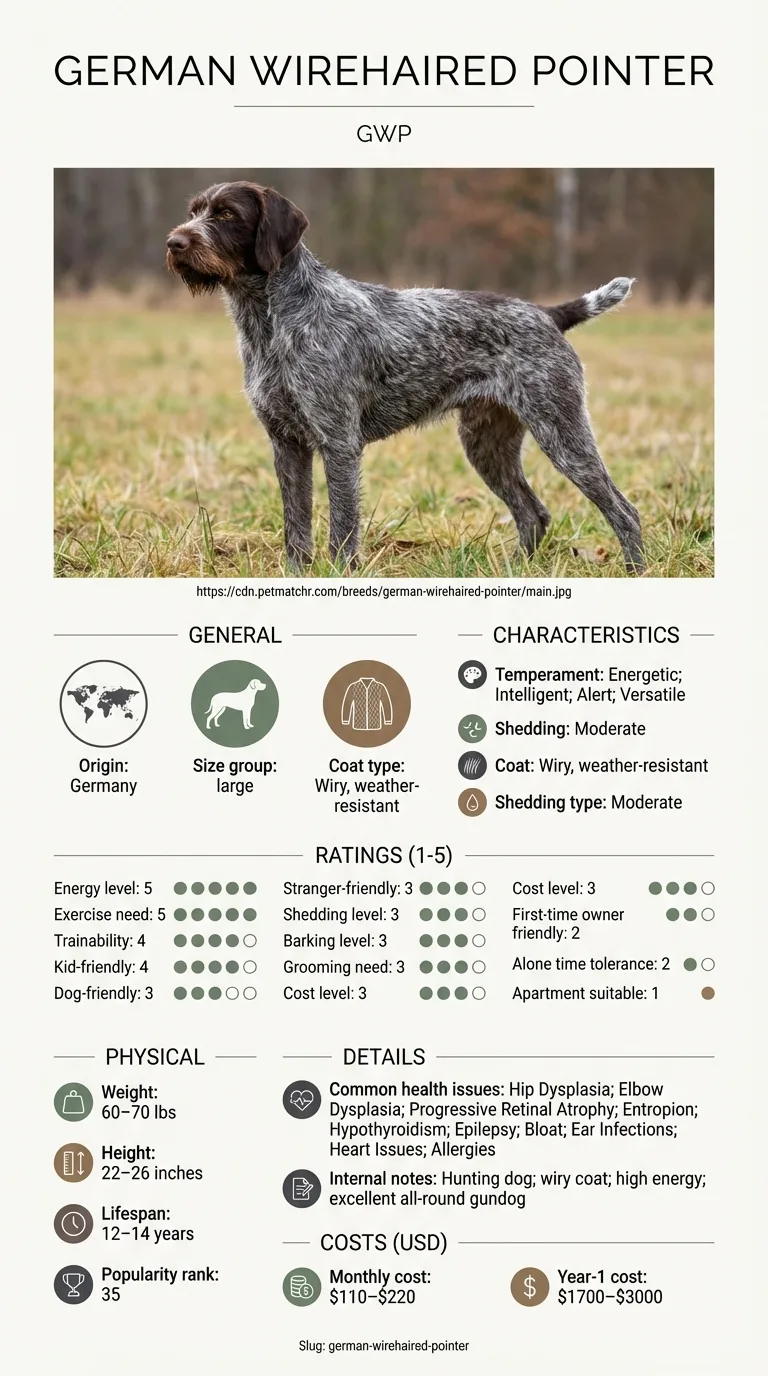
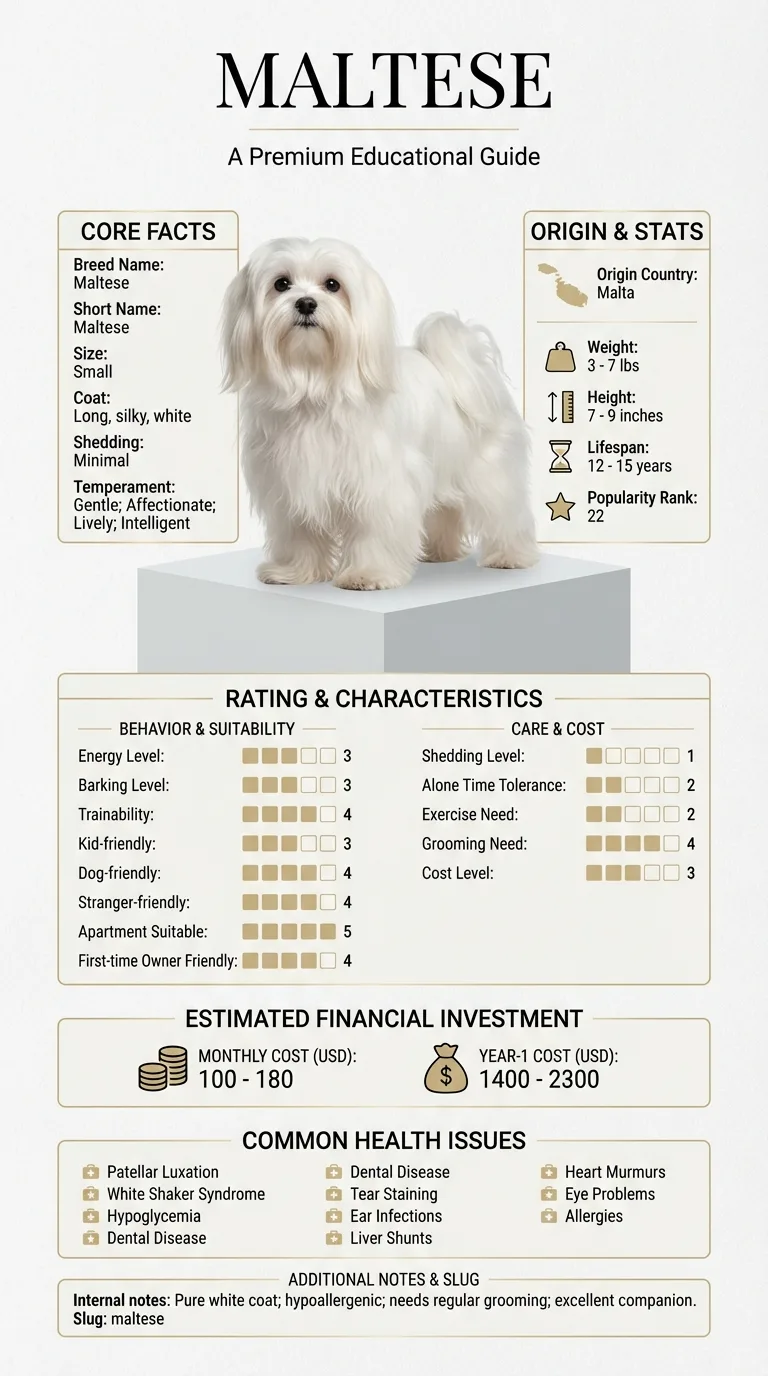
This is for someone already down to German Wirehaired Pointer and Maltese and deciding between them. For this pair the decision usually turns on apartment suitability and exercise need, so those are covered first and in most detail. Anyone choosing from a flat has a clear answer here: Maltese rates 5/5 against 1/5. The focus throughout is on daily consequences rather than breed background.
Between German Wirehaired Pointer and Maltese, apartment suitability is what separates them, and Maltese is the lower-effort dog of the two to keep.
Choose German Wirehaired Pointer if you do not want a standing grooming appointment, there are young children at home and you want a dog that can keep up with an active routine.
Choose Maltese if you are in a flat or a smaller home, this is your first dog and shedding is a problem in your house.
| Feature | german wirehaired pointer | maltese | Winner |
|---|---|---|---|
| Size class | large | small | Equal |
| Weight | 60–70 lbs | 3–7 lbs | Equal |
| Height | 22–26 in | 7–9 in | Equal |
| Lifespan | 12–14 years | 12–15 years | maltese |
| Exercise need | Very high (5/5) | Low (2/5) | maltese |
| Grooming need | Moderate (3/5) | High (4/5) | german wirehaired pointer |
| Shedding | Moderate (3/5) | Very low (1/5) | maltese |
| Energy level | Very high (5/5) | Moderate (3/5) | Equal |
| Barking | Moderate (3/5) | Moderate (3/5) | Equal |
| Apartment suitability | Very low (1/5) | Very high (5/5) | maltese |
| Good for first-time owners | Low (2/5) | High (4/5) | maltese |
| Tolerates being alone | Low (2/5) | Low (2/5) | Equal |
| Trainability | High (4/5) | High (4/5) | Equal |
| Good with kids | High (4/5) | Moderate (3/5) | german wirehaired pointer |
| Good with other dogs | Moderate (3/5) | High (4/5) | maltese |
| Friendly to strangers | Moderate (3/5) | High (4/5) | maltese |
| Cost level | Moderate (3/5) | Moderate (3/5) | Equal |
| Coat | Wiry, weather-resistant | Long, silky, white | Equal |
| Origin | Germany | Malta | Equal |
| Typical monthly cost | $110–$220 | $100–$180 | Equal |
| Typical first-year cost | $1,700–$3,000 | $1,400–$2,300 | Equal |
A 65-pound German Wirehaired Pointer and a 3-7 pound Maltese occupy opposite ends of the size chart, so much so that the table lists both as "large" versus "small" with several other lines marked tie by default -- there is no real overlap to compare. The GWP stands 22-26 inches at the shoulder with a muscular, weatherproof frame built for hours in the field; the Maltese tops out around 9 inches and could nearly fit in a tote bag. Anyone imagining these two side by side should picture roughly a tenfold weight gap. Physical compatibility as playmates is limited: a boisterous GWP could injure a Maltese without meaning to, so supervised, gentle introductions matter more than usual here.
Exercise need is where this pairing diverges hardest: the GWP rates Very high (5/5) against the Maltese's Low (2/5), and energy level splits Very high versus a Moderate 3/5. A German Wirehaired Pointer bred to point and retrieve for hours needs a serious daily outlet -- long runs, hikes, or retrieving drills -- or it will find its own, usually destructive, projects. The Maltese, by contrast, is content with short walks and indoor play, its energy expressed in lively bursts rather than sustained work. A household that can give the GWP 60-90 minutes of real exertion daily could still keep a Maltese happy with a fraction of that; the reverse is not true.
Grooming need actually favors the GWP here, rated Moderate (3/5) against the Maltese's High (4/5), since that long silky white coat needs regular brushing and trims to avoid matting. Shedding runs the other way: the GWP's wiry, weather-resistant coat sheds Moderate (3/5), while the Maltese's single coat sheds Very low (1/5), making it the better pick for anyone bothered by loose hair on furniture. This pair splits the grooming ledger evenly -- one demands more shedding cleanup, the other more scissor and comb time. Neither is a wash-and-go breed, but the type of upkeep differs: hand-stripping a GWP's coat periodically versus daily detangling for the Maltese's flowing hair.
Apartment suitability could not be more lopsided: Very low (1/5) for the German Wirehaired Pointer against Very high (5/5) for the Maltese. A GWP in a small unit without a yard or serious daily exercise commitment tends to become anxious and destructive, while the Maltese was practically built for compact living. Both score Low (2/5) on tolerating time alone, though, so neither is a good fit for owners gone ten-hour workdays -- separation anxiety is a shared risk despite the size difference. Barking is Moderate (3/5) for both, meaning neither breed is silent, but neither is a constant nuisance barker either, at least by breed-average standards.
First-time owner suitability splits Low (2/5) for the GWP versus High (4/5) for the Maltese, and that gap tracks with temperament: the Wirehaired Pointer is described as energetic, intelligent, alert and versatile -- traits that reward an owner who can channel a working dog's drive -- while the Maltese is gentle, affectionate, lively and intelligent, an easier temperament for a first dog. Trainability itself is rated High (4/5) for both breeds, so neither is stubborn to teach; the difference is less about learning capacity than about how much structure and exercise a GWP requires before training sessions even stick. A novice who underestimates the GWP's field-dog energy will struggle regardless of its trainability score.
With kids, the GWP edges ahead at High (4/5) versus the Maltese's Moderate (3/5), its sturdier build tolerating rough play better than a 3-7 pound toy breed can. Everything else favors the Maltese: Moderate (3/5) versus High (4/5) with other dogs, and Moderate versus High with strangers, reflecting its more overtly sociable, lively temperament against the GWP's alert, more reserved-with-outsiders nature. Families with boisterous young children and a fenced yard may lean GWP; households with toddlers who could accidentally hurt a tiny dog, or that want a dog that greets every visitor warmly, likely lean Maltese. Either way, supervision around small kids and small dogs together is worth planning for.
The Maltese edges out a longer expected lifespan at 12-15 years versus the GWP's 12-14. Health profiles diverge by body type: the GWP's list -- hip and elbow dysplasia, progressive retinal atrophy, entropion, hypothyroidism, epilepsy, bloat, ear infections, heart issues and allergies -- reads like a large, active-breed checklist, with bloat a particular emergency risk given its deep chest. The Maltese's concerns -- patellar luxation, white shaker syndrome, hypoglycemia, dental disease, tear staining, ear infections, liver shunts, heart murmurs, eye problems and allergies -- skew toward small-breed and toy-breed vulnerabilities, especially dental disease and hypoglycemia in puppies. Both share ear infection and allergy risk, so ear checks and skin monitoring apply regardless of which one you choose.
Monthly costs sit close together at $110-220 for the GWP and $100-180 for the Maltese, with first-year costs of $1,700-3,000 versus $1,400-2,300 -- the Maltese is somewhat cheaper to start but not dramatically so given the size gap. Cost level itself is rated Moderate (3/5) for both. Where the money actually goes differs: the GWP's budget leans toward food volume, field-dog gear, and joint or bloat-related vet visits, while the Maltese's leans toward grooming appointments and dental care given its listed dental disease risk. Anyone comparing total cost of ownership should weight grooming frequency for the Maltese and food and exercise-gear costs for the GWP rather than assuming the sticker prices tell the whole story.
German Wirehaired Pointer weighs 60–70 lbs and lives 12–14 years; Maltese weighs 3–7 lbs and lives 12–15 years. The two diverge most on apartment suitability, exercise need and energy level and 2 other rated axes. They are level on tolerates being alone, barking and cost level, so those cannot decide it. The table below marks a winner only where one breed is genuinely easier for a typical owner; size and origin are facts rather than merits and stay level. Ratings come from one source applied to both breeds, so they are meaningful against each other rather than as absolute scores.

Yes, but supervise play closely -- the GWP's size and energy (Very high, 5/5 exercise need) can easily overwhelm a 3-7 pound Maltese during rough play. Many households manage the pairing successfully with separate exercise routines and calm, gated introductions.
The Maltese, rated High (4/5) for first-time owners versus the GWP's Low (2/5). The GWP's very high exercise and energy needs demand experience handling a driven working breed.
The Maltese, rated Very low (1/5) shedding against the GWP's Moderate (3/5), though the Maltese needs more frequent brushing and trimming (High, 4/5 grooming) to prevent mats.
The Maltese is, rated Very high (5/5) for apartment suitability; the GWP rates Very low (1/5) and needs a yard or serious daily exercise commitment instead.
The Maltese has a slight edge at 12-15 years versus the GWP's 12-14 years, though both are solidly average lifespans for their size classes.
Only partly -- both share ear infection and allergy risk, but the GWP's list leans toward large-breed issues like hip dysplasia and bloat, while the Maltese's leans toward toy-breed issues like hypoglycemia and liver shunts.
The GWP rates higher with kids (High, 4/5 vs Moderate, 3/5) largely because its sturdier build tolerates boisterous play better than a toy-sized Maltese can.
The German Wirehaired Pointer, by roughly 60 pounds.
Neither -- both rate Moderate (3/5) for barking.
The Maltese, rated Low (2/5) versus the GWP's Very high (5/5).
The Maltese, at roughly $1,400-2,300 versus the GWP's $1,700-3,000.
Secure checkout on Stripe. We never see your card.
7-day money-back guarantee. Instant access.
Health information here is general and is not veterinary advice. If your dog shows pain, sudden behaviour change, or worsening symptoms, consult a licensed veterinarian.
Some links on this site are affiliate links. We may earn a commission at no extra cost to you, and we only suggest products we believe are helpful for dog owners.
We research and check what we publish, but we do not warrant that any figure, date, price, or statement is accurate, complete, or current, and we accept no liability for any loss, cost, injury, or other harm arising from the use of this site. Use it as one reference among several. You remain responsible for your own decisions and for your dog's care - confirm anything that matters with a licensed veterinarian or another qualified professional before you act on it. Full disclaimer.
Match your lifestyle to the right dog.
Take quizNot sure which breed is right for you? Take our 2-minute quiz to find out.
Take the quiz