Living
Which breed is bigger?
The Great Dane, at 110-175 lbs and 28-34 inches, dwarfing the GWP's 60-70 lbs and 22-26 inches.

Quick answer
Which breed is bigger?
The Great Dane, at 110-175 lbs and 28-34 inches, dwarfing the GWP's 60-70 lbs and 22-26 inches.
German Wirehaired Pointer or Great Dane? On paper they differ most on exercise need, and on the scales Great Dane is the heavier at 110–175 lbs. Here is how the two compare on everything that shapes an ordinary week.
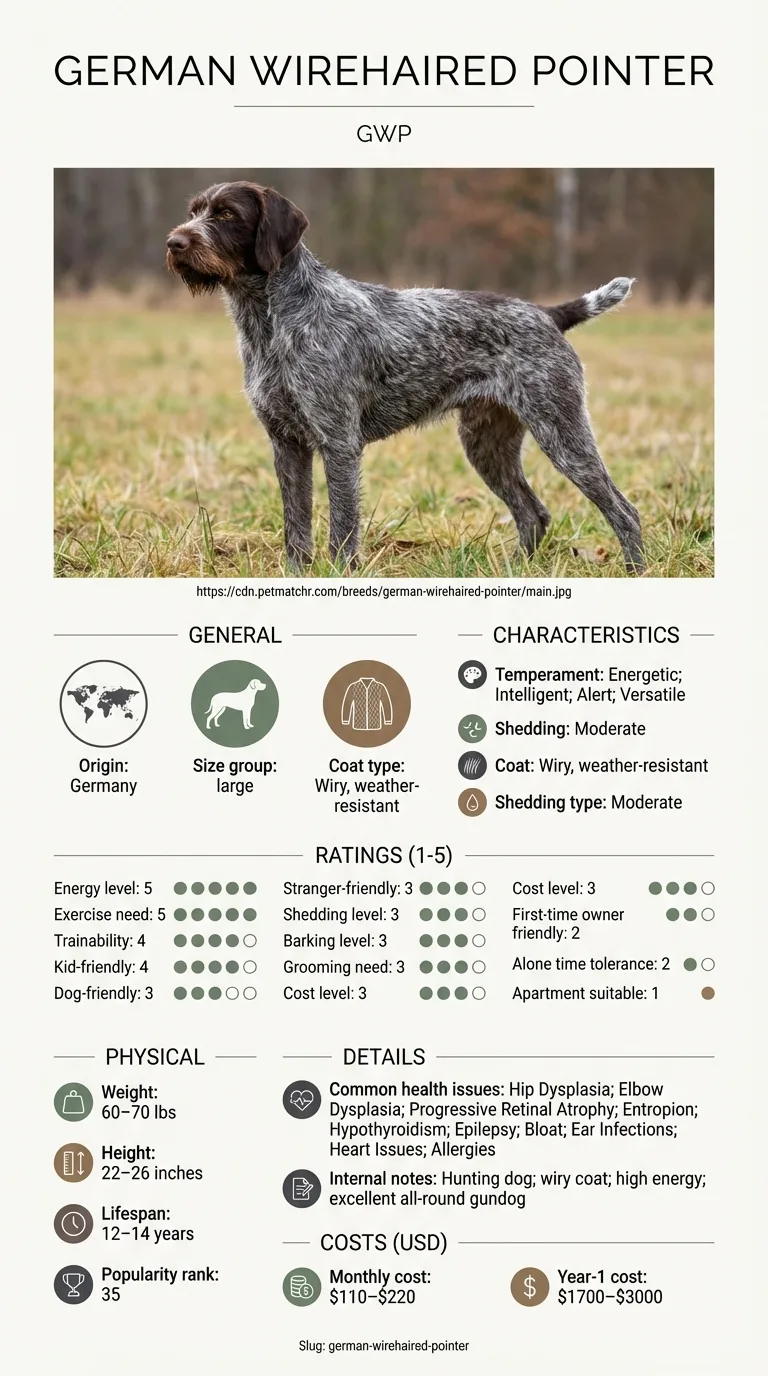
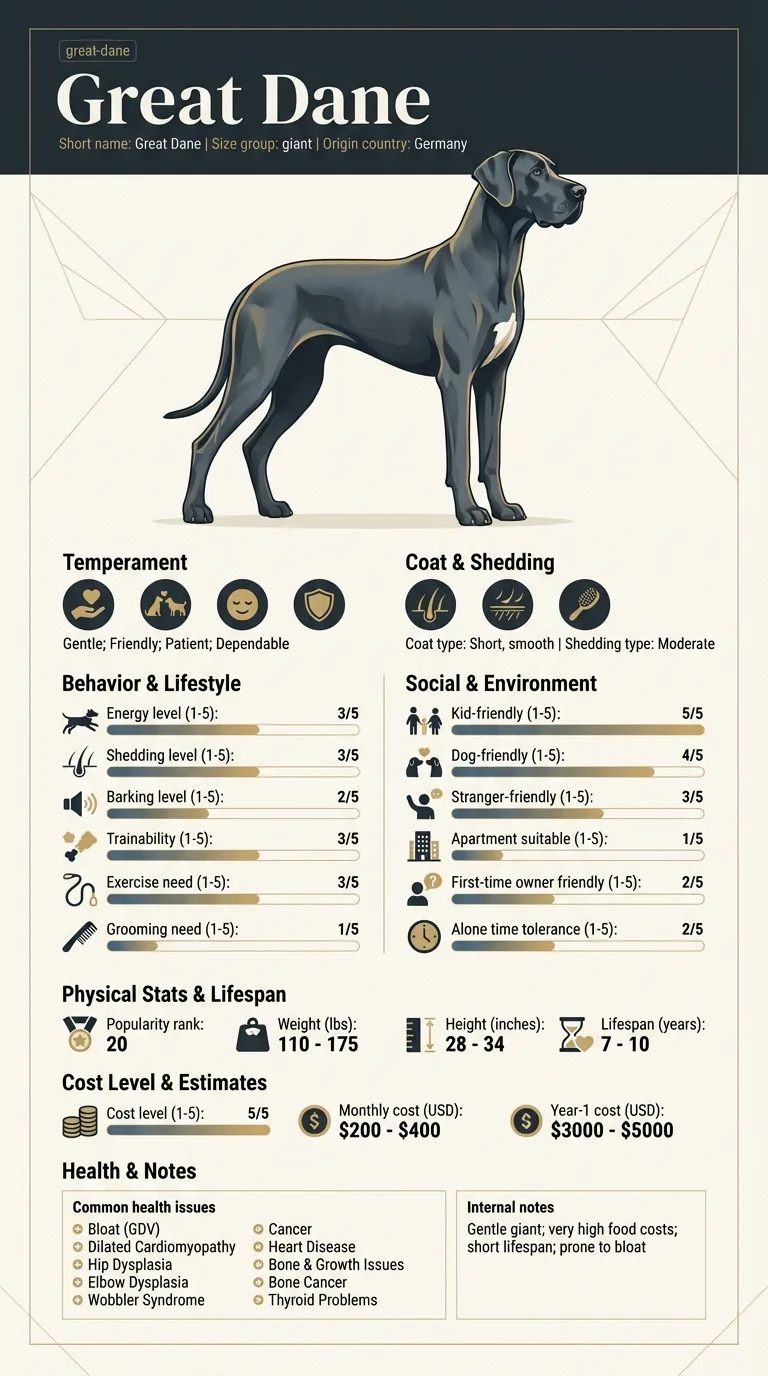
This is for someone already down to German Wirehaired Pointer and Great Dane and deciding between them. For this pair the decision usually turns on exercise need and grooming need, so those are covered first and in most detail. Both rate 1/5 for flats, so housing does not settle this one. It is written for the decision rather than the breed history.
Between German Wirehaired Pointer and Great Dane, exercise need is what separates them, and Great Dane is the lower-effort dog of the two to keep.
Choose German Wirehaired Pointer if you want a dog that picks up training quickly, a smaller dog suits your car, your home or your back and you want a dog that can keep up with an active routine.
Choose Great Dane if you do not want a standing grooming appointment, your walking routine is modest and there are young children at home.
| Feature | german wirehaired pointer | great dane | Winner |
|---|---|---|---|
| Size class | large | giant | Equal |
| Weight | 60–70 lbs | 110–175 lbs | Equal |
| Height | 22–26 in | 28–34 in | Equal |
| Lifespan | 12–14 years | 7–10 years | german wirehaired pointer |
| Exercise need | Very high (5/5) | Moderate (3/5) | great dane |
| Grooming need | Moderate (3/5) | Very low (1/5) | great dane |
| Shedding | Moderate (3/5) | Moderate (3/5) | Equal |
| Energy level | Very high (5/5) | Moderate (3/5) | Equal |
| Barking | Moderate (3/5) | Low (2/5) | great dane |
| Apartment suitability | Very low (1/5) | Very low (1/5) | Equal |
| Good for first-time owners | Low (2/5) | Low (2/5) | Equal |
| Tolerates being alone | Low (2/5) | Low (2/5) | Equal |
| Trainability | High (4/5) | Moderate (3/5) | german wirehaired pointer |
| Good with kids | High (4/5) | Very high (5/5) | great dane |
| Good with other dogs | Moderate (3/5) | High (4/5) | great dane |
| Friendly to strangers | Moderate (3/5) | Moderate (3/5) | Equal |
| Cost level | Moderate (3/5) | Very high (5/5) | german wirehaired pointer |
| Coat | Wiry, weather-resistant | Short, smooth | Equal |
| Origin | Germany | Germany | Equal |
| Typical monthly cost | $110–$220 | $200–$400 | Equal |
| Typical first-year cost | $1,700–$3,000 | $3,000–$5,000 | Equal |
The Great Dane towers over the GWP in every dimension — 110-175 lbs and 28-34 inches tall, against the GWP's 60-70 lbs and 22-26 inches — moving the comparison from large to giant size class entirely. A Great Dane at full height can look a visitor in the eye while standing on all fours, something no GWP, itself a substantial dog, comes close to matching. That scale difference carries through to nearly everything else on this page, from doorway clearance and vehicle size to the sheer volume of food and gear either dog requires.
Despite its size, the Great Dane is the calmer of the two by a wide margin: moderate (3/5) exercise need and moderate (3/5) energy level, against the GWP's very high (5/5) on both measures. That's a significant reversal of the usual assumption that bigger means more demanding — the Great Dane's giant frame actually works against sustained high-intensity exercise, particularly while its joints are still developing, whereas the GWP's mid-size, athletic build was purpose-built for hours of fieldwork.
Grooming clearly favors the Great Dane, very low (1/5) against the GWP's moderate (3/5) — a short, smooth coat needs little beyond an occasional wipe-down. Shedding ties evenly at moderate (3/5) for both breeds, so the grooming gap here is entirely about coat texture and upkeep time rather than the amount of hair actually coming off the dog.
Both breeds tie at rock-bottom very low (1/5) apartment suitability, which for the Great Dane is more about sheer physical footprint than exercise needs, and for the GWP is squarely about its very-high energy. Barking favors the Great Dane, low (2/5) against the GWP's moderate (3/5), and alone-time tolerance ties at low (2/5) for both — so whichever breed a small-space owner picks, expect real space and solo-time challenges either way.
The GWP rates high (4/5) for trainability, a step above the Great Dane's moderate (3/5), though both share a low (2/5) first-time-owner score and a low (2/5) alone-tolerance rating. The Great Dane's gentle, patient, dependable temperament makes it easier to live with day to day despite the lower formal trainability number, since much of what a Great Dane needs is calm, consistent handling of its size rather than complex obedience work. Basic manners training matters more for a giant breed than trick training does, since an untrained Great Dane's sheer mass can create problems an untrained smaller dog never would.
The Great Dane pulls ahead with kids, very high (5/5) against the GWP's high (4/5), and with other dogs too, high (4/5) against the GWP's moderate (3/5) — numbers that back up its gentle and friendly reputation despite the intimidating size. Strangers tie at moderate (3/5) for both. Families drawn to the Great Dane's famously mellow disposition around children will find the data supports that reputation directly.
This is where the size difference costs the Great Dane the most: a lifespan of just 7-10 years against the GWP's 12-14, a gap of up to seven years that's among the largest in any comparison on this site. The Great Dane's health list also reads heavier for a giant breed — bloat (GDV), dilated cardiomyopathy, wobbler syndrome, cancer, bone cancer and thyroid problems, on top of hip and elbow dysplasia shared with the GWP. The GWP's own list, while still ten items long, skews toward more manageable chronic issues like allergies, entropion and ear infections rather than the acute, often fatal conditions common to giant breeds.
Cost is the other place size shows up hard: the Great Dane rates very high (5/5) for overall cost, the top of the scale, against the GWP's moderate (3/5). Monthly spending nearly doubles — $200-$400 for the Great Dane versus $110-$220 for the GWP — and first-year costs follow suit, $3,000-$5,000 against $1,700-$3,000. Food volume alone accounts for a large share of that gap, before factoring in giant-breed-sized furniture, crates and vet bills, all of which scale directly with the Great Dane's much larger frame.
German Wirehaired Pointer weighs 60–70 lbs and lives 12–14 years; Great Dane weighs 110–175 lbs and lives 7–10 years. The two diverge most on exercise need, grooming need and energy level and 1 other rated axes. They are level on tolerates being alone, apartment suitability and good for first-time owners, so those cannot decide it. In the table, a "winner" means easier for an ordinary household — not better. Size, coat and origin are recorded without a verdict. Because both breeds are scored the same way, the gaps are reliable even where the absolute numbers are rough.

The German Wirehaired Pointer, by a wide margin — typically 12-14 years compared to the Great Dane's 7-10 years, a gap driven by the health risks common to giant breeds.
Yes — the Great Dane rates moderate (3/5) for both exercise need and energy level, well below the GWP's very high (5/5) on both.
The Great Dane, rated very high (5/5) for overall cost against the GWP's moderate (3/5), with monthly costs of $200-$400 versus $110-$220.
Yes, very much so — it rates very high (5/5) with kids, the top score on this measure, ahead of the GWP's still-good high (4/5).
The Great Dane, rated very low (1/5) versus the GWP's moderate (3/5), thanks to its short, smooth coat.
Bloat (GDV), dilated cardiomyopathy, wobbler syndrome, cancer (including bone cancer), and thyroid problems are all commonly flagged for the breed, several of which relate directly to its giant size.
No — both rate the lowest possible very low (1/5) for apartment suitability, the Great Dane due to its sheer size and the GWP due to its very high exercise needs.
The Great Dane, at 110-175 lbs and 28-34 inches, dwarfing the GWP's 60-70 lbs and 22-26 inches.
The German Wirehaired Pointer, rated very high (5/5) versus the Great Dane's moderate (3/5).
The German Wirehaired Pointer, rated high (4/5) versus the Great Dane's moderate (3/5).
The German Wirehaired Pointer, at $110-$220 monthly versus the Great Dane's $200-$400.
Secure checkout on Stripe. We never see your card.
7-day money-back guarantee. Instant access.
Health information here is general and is not veterinary advice. If your dog shows pain, sudden behaviour change, or worsening symptoms, consult a licensed veterinarian.
Some links on this site are affiliate links. We may earn a commission at no extra cost to you, and we only suggest products we believe are helpful for dog owners.
We research and check what we publish, but we do not warrant that any figure, date, price, or statement is accurate, complete, or current, and we accept no liability for any loss, cost, injury, or other harm arising from the use of this site. Use it as one reference among several. You remain responsible for your own decisions and for your dog's care - confirm anything that matters with a licensed veterinarian or another qualified professional before you act on it. Full disclaimer.
Match your lifestyle to the right dog.
Take quizNot sure which breed is right for you? Take our 2-minute quiz to find out.
Take the quiz