Living
Which is bigger?
The GWP, at 60-70 pounds versus the Schnauzer's 11-20 pounds.

Quick answer
Which is bigger?
The GWP, at 60-70 pounds versus the Schnauzer's 11-20 pounds.
German Wirehaired Pointer or Miniature Schnauzer? On paper they differ most on apartment suitability, and on the scales German Wirehaired Pointer is the heavier at 60–70 lbs. Here is how the two compare on everything that shapes an ordinary week.
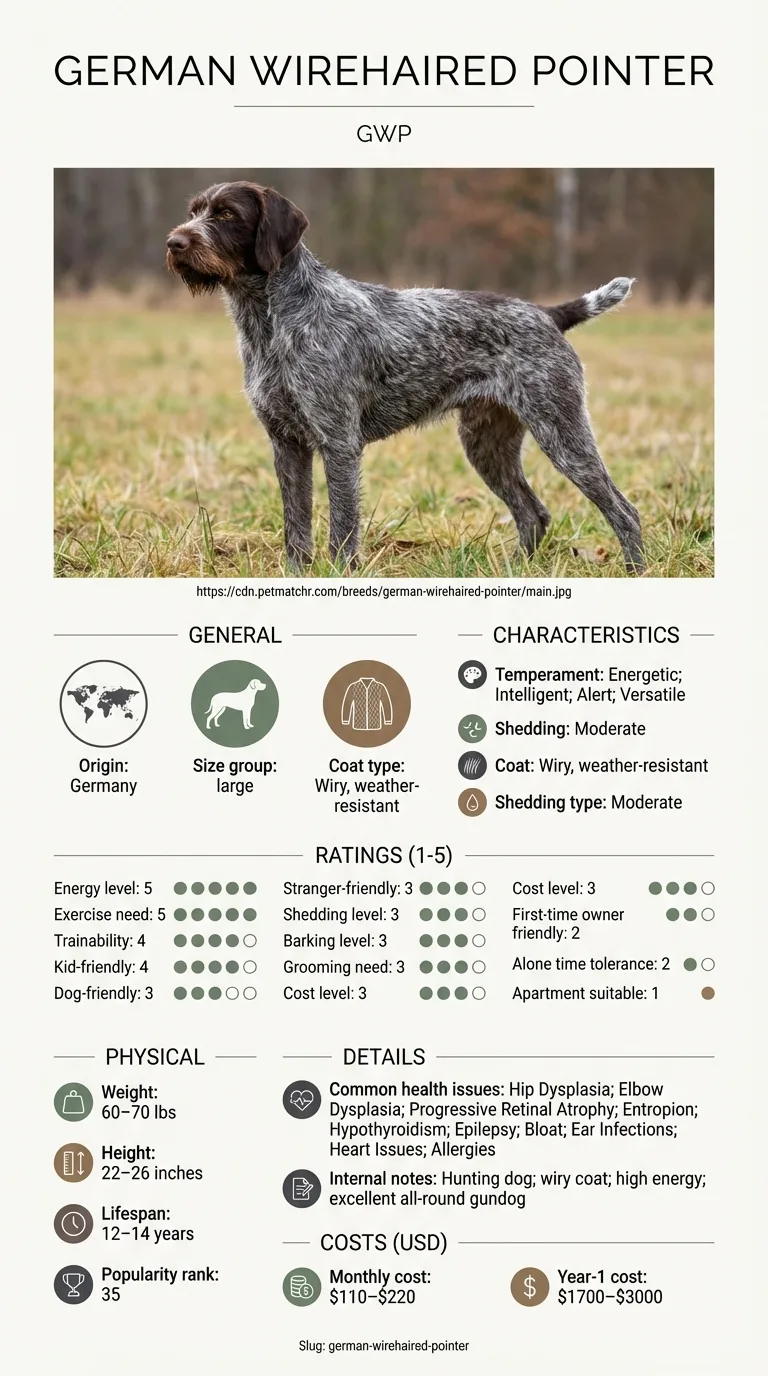
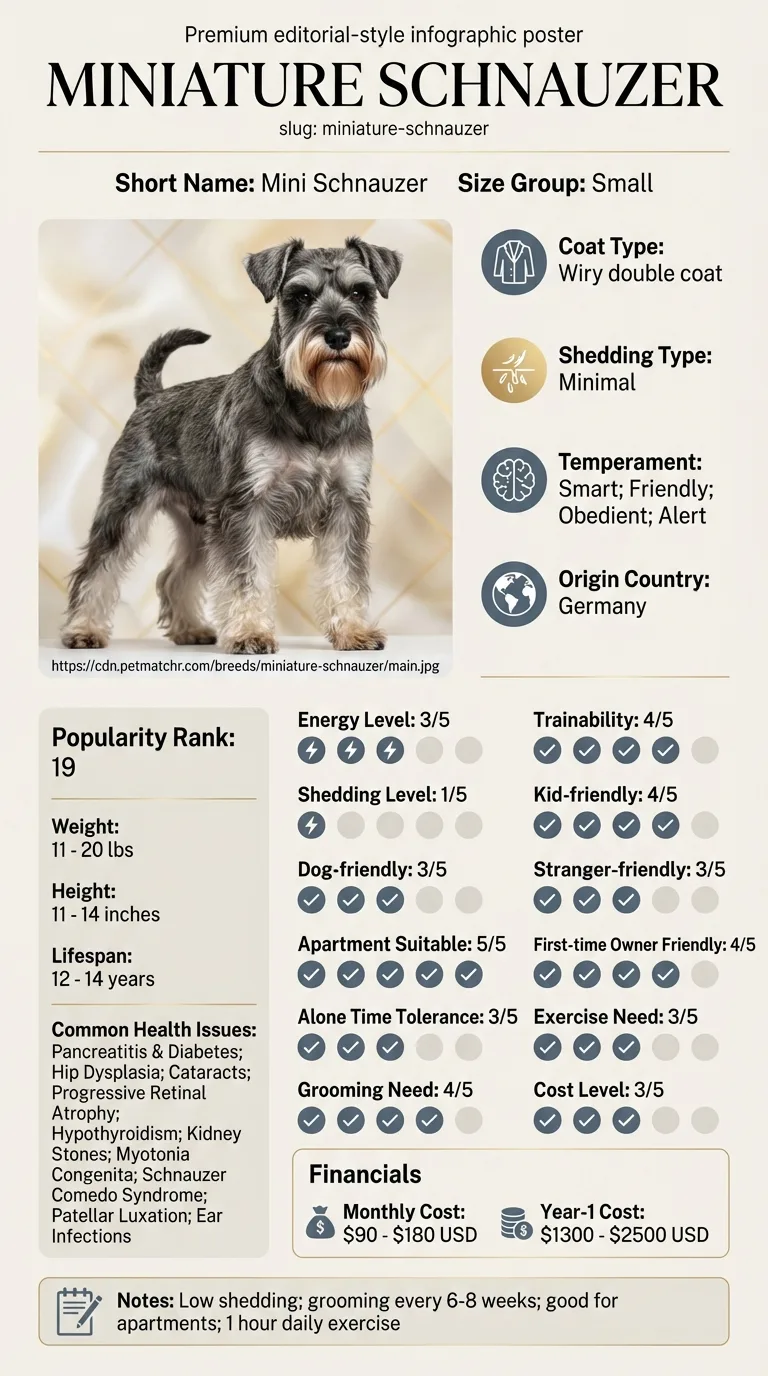
This is for someone already down to German Wirehaired Pointer and Miniature Schnauzer and deciding between them. For this pair the decision usually turns on apartment suitability and exercise need, so those are covered first and in most detail. Anyone choosing from a flat has a clear answer here: Miniature Schnauzer rates 5/5 against 1/5. Breed history is left out; what follows is what you will actually live with.
Between German Wirehaired Pointer and Miniature Schnauzer, apartment suitability is what separates them, and Miniature Schnauzer is the lower-effort dog of the two to keep.
Choose German Wirehaired Pointer if you do not want a standing grooming appointment and you want a dog that can keep up with an active routine.
Choose Miniature Schnauzer if you are in a flat or a smaller home, this is your first dog and shedding is a problem in your house.
| Feature | german wirehaired pointer | miniature schnauzer | Winner |
|---|---|---|---|
| Size class | large | small | Equal |
| Weight | 60–70 lbs | 11–20 lbs | Equal |
| Height | 22–26 in | 11–14 in | Equal |
| Lifespan | 12–14 years | 12–14 years | Equal |
| Exercise need | Very high (5/5) | Moderate (3/5) | miniature schnauzer |
| Grooming need | Moderate (3/5) | High (4/5) | german wirehaired pointer |
| Shedding | Moderate (3/5) | Very low (1/5) | miniature schnauzer |
| Energy level | Very high (5/5) | Moderate (3/5) | Equal |
| Barking | Moderate (3/5) | High (4/5) | german wirehaired pointer |
| Apartment suitability | Very low (1/5) | Very high (5/5) | miniature schnauzer |
| Good for first-time owners | Low (2/5) | High (4/5) | miniature schnauzer |
| Tolerates being alone | Low (2/5) | Moderate (3/5) | miniature schnauzer |
| Trainability | High (4/5) | High (4/5) | Equal |
| Good with kids | High (4/5) | High (4/5) | Equal |
| Good with other dogs | Moderate (3/5) | Moderate (3/5) | Equal |
| Friendly to strangers | Moderate (3/5) | Moderate (3/5) | Equal |
| Cost level | Moderate (3/5) | Moderate (3/5) | Equal |
| Coat | Wiry, weather-resistant | Wiry double coat | Equal |
| Origin | Germany | Germany | Equal |
| Typical monthly cost | $110–$220 | $90–$180 | Equal |
| Typical first-year cost | $1,700–$3,000 | $1,300–$2,500 | Equal |
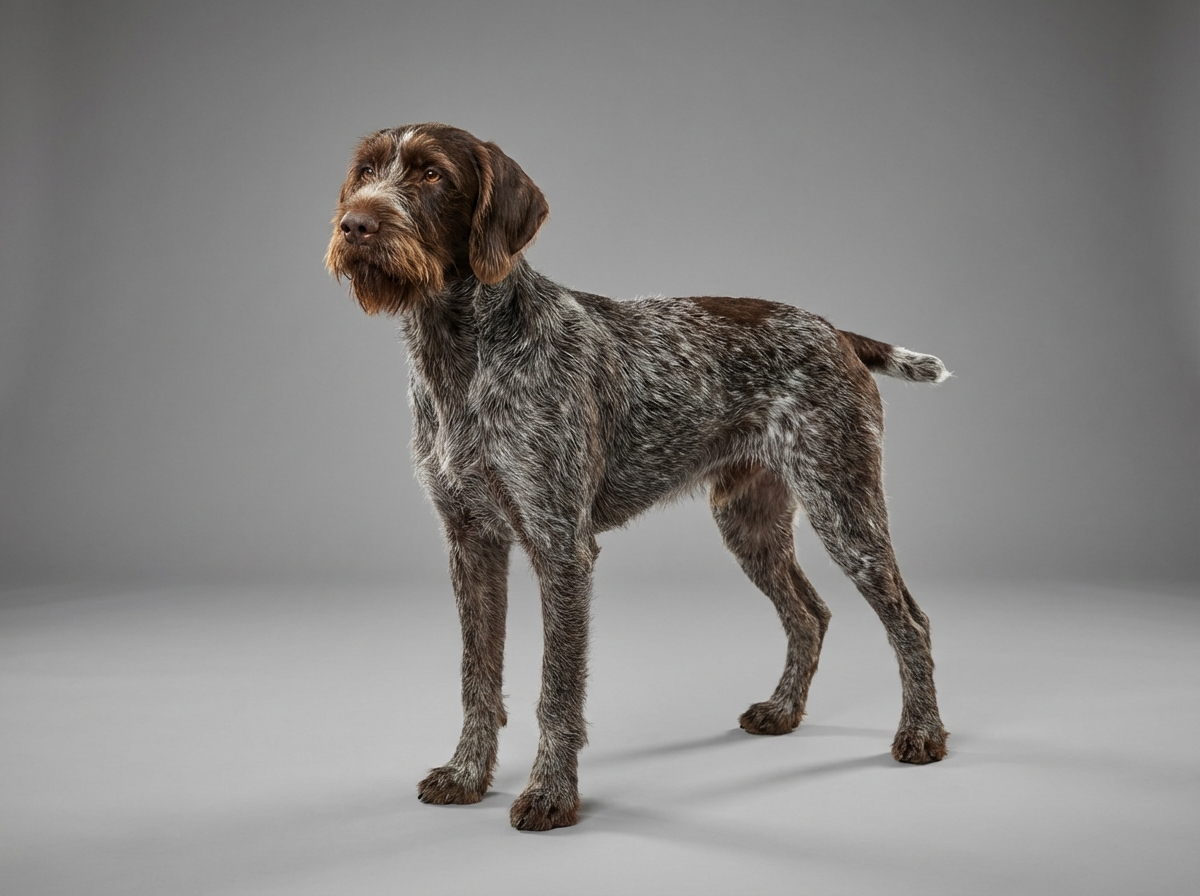
Both hail from Germany, but that's about where the size similarity ends: the GWP stands 22-26 inches and weighs 60-70 pounds, while the Miniature Schnauzer stands just 11-14 inches and weighs 11-20 pounds -- roughly a quarter of the GWP's mass. Coat texture is where they genuinely converge, both described as wiry, the GWP's weather-resistant for fieldwork and the Schnauzer's a wiry double coat suited to its terrier ancestry. Picture a working gundog next to a compact, bearded terrier and you have the visual gap accurately. Anyone who likes the wiry-coat look but wants a fraction of the size and space commitment will find the Schnauzer the more practical match.
Exercise need splits Very high (5/5) for the GWP against Moderate (3/5) for the Miniature Schnauzer -- a real gap, though the Schnauzer is no couch potato itself, still needing daily walks and play to stay balanced. Energy level is listed as a tie despite different underlying values (Very high versus Moderate), suggesting both dogs bring notable get-up-and-go relative to their size classes. In practice, a GWP's fieldwork drive demands acreage or serious daily mileage, while a Schnauzer's terrier energy can be satisfied with brisk walks, a fenced yard, and interactive play. Owners choosing between them should weigh whether they want an athletic partner or a spirited, active-but-manageable companion.
Grooming need actually favors the GWP, Moderate (3/5) against the Schnauzer's High (4/5), since that signature bearded, wiry double coat needs regular trimming, stripping, and beard maintenance to keep its shape. Shedding runs the opposite way -- Moderate (3/5) for the GWP versus Very low (1/5) for the Schnauzer, which is often marketed as allergy-friendlier because of its low-shed double coat. So the tradeoff is straightforward: the GWP sheds somewhat more but needs less styling, while the Schnauzer sheds barely at all but needs a groomer's touch every few weeks to avoid a shaggy, matted look developing around the face and legs.
Apartment suitability strongly favors the Schnauzer, Very high (5/5) against the GWP's Very low (1/5), and that tracks with its lower exercise needs and compact size. Barking flips the advantage to the GWP, though -- Moderate (3/5) against the Schnauzer's High (4/5); Miniature Schnauzers are famously vocal watchdogs, a trait that can be a liability in close-quarters living despite their space efficiency otherwise. Tolerating time alone also favors the Schnauzer, Moderate (3/5) versus the GWP's Low (2/5). Altogether, the Schnauzer suits apartment life better on paper, but its barking tendency means noise-sensitive neighbors are still a real consideration.
Trainability rates High (4/5) for both breeds, so neither struggles to learn commands, but first-time-owner suitability tells a different story: Low (2/5) for the GWP versus High (4/5) for the Schnauzer. That gap mirrors their temperaments -- energetic, intelligent, alert and versatile for the GWP versus smart, friendly, obedient and alert for the Schnauzer, whose "obedient" descriptor signals an easier partnership for a novice. A first-time owner attracted to the GWP's looks should be honest about whether they can meet its Very high exercise need; the Schnauzer offers similar intelligence and alertness in a package that's considerably more forgiving of handler inexperience.
Good with kids and good with other dogs both rate identically for these two -- High (4/5) and Moderate (3/5) respectively -- so neither has a clear edge on paper for family or multi-dog households. Friendly to strangers also ties at Moderate (3/5). The practical difference shows up in scale: a Schnauzer's smaller size makes it easier for young kids to handle safely, while a GWP's sturdier build can better absorb boisterous play without injury risk running the other direction. Households with very small children or elderly family members may lean toward the Schnauzer simply for manageability, while active families with older kids may appreciate the GWP's higher exercise ceiling as a shared activity.
Lifespan ties at 12-14 years for both breeds. Health profiles diverge meaningfully: the GWP's list includes hip and elbow dysplasia, progressive retinal atrophy, entropion, hypothyroidism, epilepsy, bloat, ear infections, heart issues and allergies, while the Schnauzer's includes pancreatitis and diabetes, hip dysplasia, cataracts, PRA, hypothyroidism, kidney stones, myotonia congenita, Schnauzer comedo syndrome, patellar luxation and ear infections. The overlap -- hip dysplasia, PRA, hypothyroidism, and ear infections -- suggests both benefit from routine eye and thyroid screening, but the Schnauzer's pancreatitis and diabetes risk points to fat-intake management as a lifelong concern, something the GWP's list doesn't flag at all.
Cost level rates Moderate (3/5) for both breeds, and the dollar ranges stay close: $110-220 monthly and $1,700-3,000 first-year for the GWP versus $90-180 monthly and $1,300-2,500 for the Schnauzer. The modest gap likely reflects food volume more than anything structural -- a 65-pound dog simply eats more than a 15-pound one. Where costs could diverge in practice: the Schnauzer's grooming needs (High, 4/5) mean regular professional trims add up over a year, while the GWP's higher food and exercise-gear costs come from its size and activity level. Neither breed stands out as notably cheap or expensive to raise relative to the other.
German Wirehaired Pointer weighs 60–70 lbs and lives 12–14 years; Miniature Schnauzer weighs 11–20 lbs and lives 12–14 years. The two diverge most on apartment suitability, exercise need and energy level and 2 other rated axes. They are level on cost level, good with other dogs and good with kids, so those cannot decide it. The comparison marks an easier option only where one exists. Facts like weight and country of origin are not scored. Both dogs are rated from the same dataset, which is what makes the numbers comparable with each other even though any individual dog sits somewhere inside its breed's range.

The Miniature Schnauzer, rated Very high (5/5) for apartment suitability versus the GWP's Very low (1/5), though the Schnauzer's High (4/5) barking rating is worth considering for close neighbors.
The Miniature Schnauzer, rated Very low (1/5) shedding against the GWP's Moderate (3/5).
The Schnauzer is a better fit, rated High (4/5) versus the GWP's Low (2/5) for first-time owners.
The Miniature Schnauzer, rated High (4/5) against the GWP's Moderate (3/5) -- it's a notably vocal watchdog breed.
Yes, both are rated 12-14 years.
The Miniature Schnauzer, rated High (4/5) versus the GWP's Moderate (3/5), due to its wiry double coat needing regular trims.
The GWP, rated Very high (5/5) for exercise need versus the Schnauzer's Moderate (3/5).
The GWP, at 60-70 pounds versus the Schnauzer's 11-20 pounds.
The Miniature Schnauzer, rated High (4/5) versus the GWP's Moderate (3/5).
The Miniature Schnauzer, rated Very high (5/5) apartment suitability.
Yes, both breeds originated in Germany.
Secure checkout on Stripe. We never see your card.
7-day money-back guarantee. Instant access.
Health information here is general and is not veterinary advice. If your dog shows pain, sudden behaviour change, or worsening symptoms, consult a licensed veterinarian.
Some links on this site are affiliate links. We may earn a commission at no extra cost to you, and we only suggest products we believe are helpful for dog owners.
We research and check what we publish, but we do not warrant that any figure, date, price, or statement is accurate, complete, or current, and we accept no liability for any loss, cost, injury, or other harm arising from the use of this site. Use it as one reference among several. You remain responsible for your own decisions and for your dog's care - confirm anything that matters with a licensed veterinarian or another qualified professional before you act on it. Full disclaimer.
Match your lifestyle to the right dog.
Take quizNot sure which breed is right for you? Take our 2-minute quiz to find out.
Take the quiz