Living
Which is bigger?
The German Wirehaired Pointer, at 60-70 lbs versus the Cavalier's 13-18 lbs.

Quick answer
Which is bigger?
The German Wirehaired Pointer, at 60-70 lbs versus the Cavalier's 13-18 lbs.
Cavalier King Charles Spaniel or German Wirehaired Pointer? On paper they differ most on apartment suitability, and on the scales German Wirehaired Pointer is the heavier at 60–70 lbs. Here is how the two compare on everything that shapes an ordinary week.
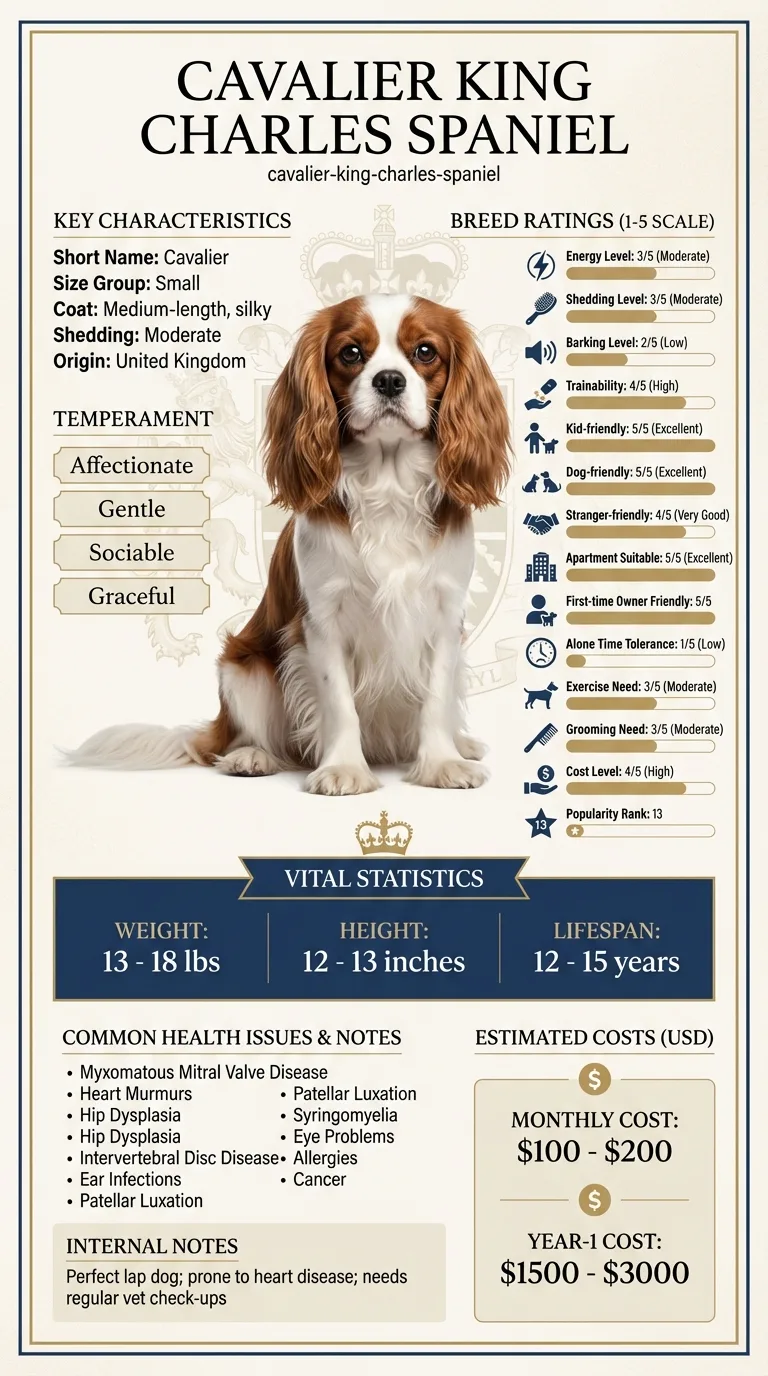
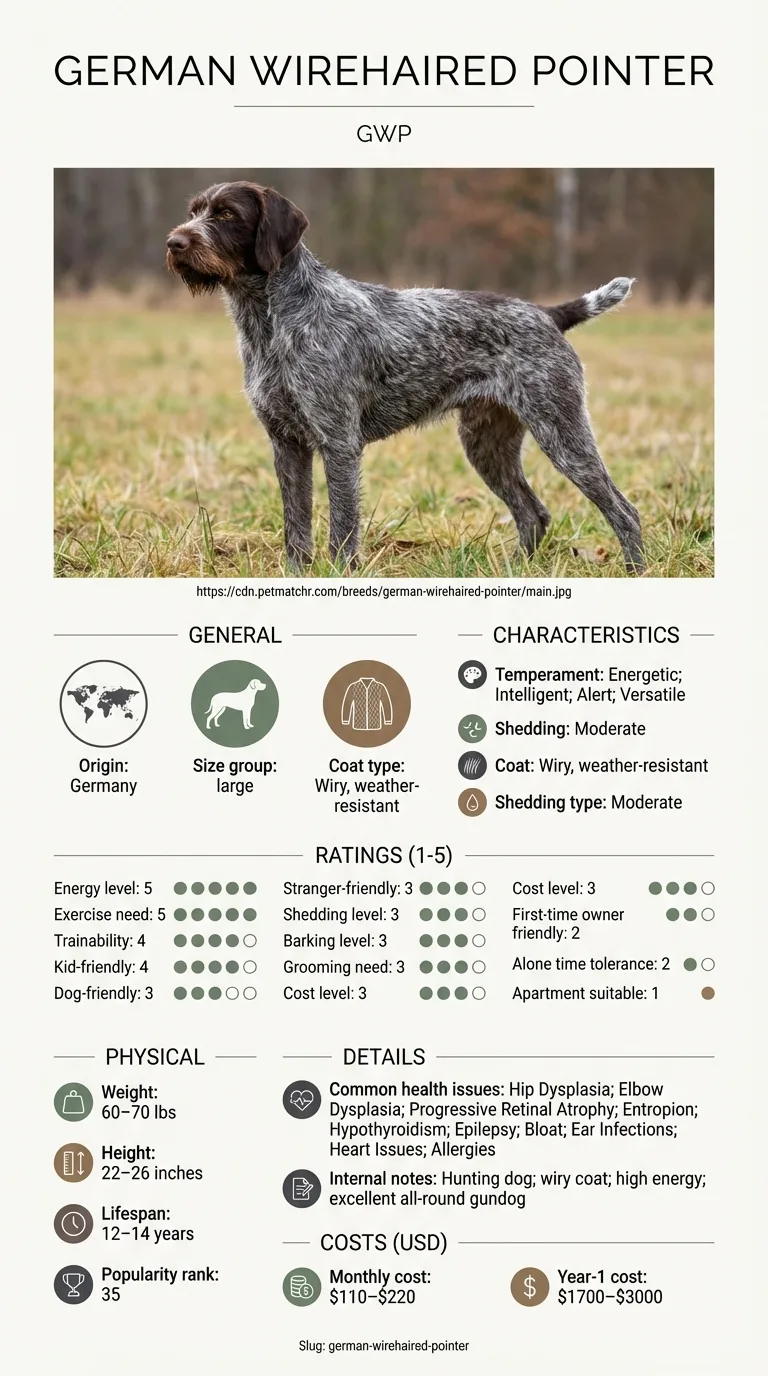
This is for someone already down to Cavalier King Charles Spaniel and German Wirehaired Pointer and deciding between them. For this pair the decision usually turns on apartment suitability and good for first-time owners, so those are covered first and in most detail. Anyone choosing from a flat has a clear answer here: Cavalier King Charles Spaniel rates 5/5 against 1/5. The focus throughout is on daily consequences rather than breed background.
Between Cavalier King Charles Spaniel and German Wirehaired Pointer, apartment suitability is what separates them, and Cavalier King Charles Spaniel is the lower-effort dog of the two to keep.
Choose Cavalier King Charles Spaniel if you are in a flat or a smaller home, this is your first dog and your walking routine is modest.
Choose German Wirehaired Pointer if you want a dog that can keep up with an active routine and you want a dog that is more watchful with visitors.
| Feature | cavalier king charles spaniel | german wirehaired pointer | Winner |
|---|---|---|---|
| Size class | small | large | Equal |
| Weight | 13–18 lbs | 60–70 lbs | Equal |
| Height | 12–13 in | 22–26 in | Equal |
| Lifespan | 12–15 years | 12–14 years | cavalier king charles spaniel |
| Exercise need | Moderate (3/5) | Very high (5/5) | cavalier king charles spaniel |
| Grooming need | Moderate (3/5) | Moderate (3/5) | Equal |
| Shedding | Moderate (3/5) | Moderate (3/5) | Equal |
| Energy level | Moderate (3/5) | Very high (5/5) | Equal |
| Barking | Low (2/5) | Moderate (3/5) | cavalier king charles spaniel |
| Apartment suitability | Very high (5/5) | Very low (1/5) | cavalier king charles spaniel |
| Good for first-time owners | Very high (5/5) | Low (2/5) | cavalier king charles spaniel |
| Tolerates being alone | Very low (1/5) | Low (2/5) | german wirehaired pointer |
| Trainability | High (4/5) | High (4/5) | Equal |
| Good with kids | Very high (5/5) | High (4/5) | cavalier king charles spaniel |
| Good with other dogs | Very high (5/5) | Moderate (3/5) | cavalier king charles spaniel |
| Friendly to strangers | High (4/5) | Moderate (3/5) | cavalier king charles spaniel |
| Cost level | High (4/5) | Moderate (3/5) | german wirehaired pointer |
| Coat | Medium-length, silky | Wiry, weather-resistant | Equal |
| Origin | United Kingdom | Germany | Equal |
| Typical monthly cost | $100–$200 | $110–$220 | Equal |
| Typical first-year cost | $1,500–$3,000 | $1,700–$3,000 | Equal |
A German Wirehaired Pointer at 60 to 70 pounds and 22 to 26 inches tall is a large working gundog by any measure, dwarfing the small, 13-to-18-pound, 12-to-13-inch Cavalier by roughly four to five times the weight. The Pointer's wiry, weather-resistant coat was bred for pushing through brush and cold water on hunting trips, a world away from the Cavalier's silky, medium-length coat meant purely for a lap. This is among the largest size gaps in any Cavalier comparison on this site, and it shows up in everything from crate size to how much space each dog needs simply to turn around comfortably indoors.
Exercise need and energy level both hit Very high (5/5) for the German Wirehaired Pointer, the maximum rating available, against Moderate (3/5) for the Cavalier on both counts. This is a serious working gundog bred to hunt, point, and retrieve across full days in varied terrain, and that drive doesn't switch off in a pet home -- a Pointer without vigorous daily exercise is prone to real behavioral problems, not just mild restlessness. The Cavalier's moderate needs are almost a different category of dog entirely. A household considering the Pointer should be honest about whether an hour-plus of hard exercise daily is realistic before falling for its versatile, alert temperament.
Grooming and shedding both land at Moderate (3/5) for the German Wirehaired Pointer, matching the Cavalier's own Moderate (3/5) ratings on both measures despite the two breeds' completely different coat types. The Pointer's wiry double coat needs periodic hand-stripping to maintain its texture and weather resistance, a specialized task the Cavalier's silky coat never requires, even though both land at the same numeric grooming score. In practice this means similar time investment but different skills -- a Pointer owner benefits from learning to strip a coat or budgeting for a groomer who can, while a Cavalier owner just needs a regular brush.
Apartment suitability draws the starkest possible contrast: Very high (5/5) for the Cavalier against Very low (1/5) for the German Wirehaired Pointer, the lowest score a breed can carry. Barking runs Low (2/5) for the Cavalier versus Moderate (3/5) for the Pointer, adding noise to the case against small-space living, though the size and exercise mismatch matters far more than barking here. Alone tolerance also favors neither breed, Very low (1/5) for the Cavalier and Low (2/5) for the Pointer, meaning both need company planned into the day -- but only the Cavalier could plausibly do that in an apartment to begin with.
Trainability rates High (4/5) for the Pointer against the Cavalier's own High (4/5) -- an exact tie -- but first-time-owner suitability tells a very different story: Very high (5/5) for the Cavalier against just Low (2/5) for the Pointer. An intelligent, alert, versatile working breed like the German Wirehaired Pointer is genuinely capable of learning quickly, but that same intelligence paired with very high exercise needs and independent hunting instincts makes it a demanding first dog, one better suited to an owner with prior training experience and an active lifestyle already in place. The Cavalier remains the far gentler entry point into dog ownership by comparison.
The Cavalier outscores the Pointer across the board here: Very high (5/5) with kids against the Pointer's High (4/5), Very high (5/5) with other dogs against Moderate (3/5), and High (4/5) with strangers against the Pointer's Moderate (3/5). None of these gaps reflect aggression -- the Pointer's alert, versatile temperament is simply more reserved and work-focused than the openly sociable Cavalier's -- but they add up to a meaningfully different household fit. A busy family home with frequent visitors, other pets, and young kids leans strongly toward the Cavalier's numbers; the Pointer suits a quieter household built around one committed handler and serious outdoor time.
Lifespan matches closely at 12-15 years for the Cavalier against 12-14 for the Pointer, but both breeds carry substantial ten-item health lists worth comparing closely. The Pointer's list includes Hip and Elbow Dysplasia, Epilepsy, Bloat, and Heart Issues alongside Entropion and Hypothyroidism -- a broad profile spanning joints, eyes, and organs. The Cavalier's own ten conditions lean more heavily cardiac and neurological, led by Myxomatous Mitral Valve Disease and Syringomyelia. The two lists overlap on Hip Dysplasia, PRA, Ear Infections, and Allergies, so both breeds benefit from routine joint, eye, and skin monitoring even though their standout risks differ.
Both breeds rate Moderate (3/5) for the Pointer against High (4/5) for the Cavalier on cost level, with monthly ranges of $110-220 for the Pointer against $100-200 for the Cavalier, and first-year costs of $1,700-3,000 versus $1,500-3,000 -- closer than the size difference might suggest. The larger Pointer's food costs run higher, but its lower grooming demands and less cardiac-heavy health profile help offset that. The Cavalier's higher overall cost rating likely reflects its more extensive, heart-focused condition list driving expected veterinary spend over a lifetime, even though its day-to-day upkeep costs less than the much bigger Pointer's.
Cavalier King Charles Spaniel weighs 13–18 lbs and lives 12–15 years; German Wirehaired Pointer weighs 60–70 lbs and lives 12–14 years. The two diverge most on apartment suitability, good for first-time owners and exercise need and 2 other rated axes. They are level on grooming need, shedding and trainability, so those cannot decide it. The table below marks a winner only where one breed is genuinely easier for a typical owner; size and origin are facts rather than merits and stay level. Ratings come from one source applied to both breeds, so they are meaningful against each other rather than as absolute scores.

Not really -- it rates just Low (2/5) for first-time owners against the Cavalier's Very high (5/5), reflecting its very high exercise needs and independent hunting instincts.
Considerably -- 60-70 lbs and 22-26 inches tall against the Cavalier's 13-18 lbs and 12-13 inches, roughly four to five times the weight.
The Pointer by far, rated Very high (5/5) for both exercise need and energy level against the Cavalier's Moderate (3/5) on both.
No -- they rate Very low (1/5) for apartment suitability, the lowest possible score, against the Cavalier's Very high (5/5).
The Cavalier, rated High (4/5) with strangers and Very high (5/5) with other dogs, against the Pointer's Moderate (3/5) on both.
Elbow Dysplasia, Bloat, and Heart Issues appear on the Pointer's list but not the Cavalier's, alongside shared risks like Hip Dysplasia and Progressive Retinal Atrophy.
They're close -- $110-220 for the Pointer against $100-200 for the Cavalier -- though the Cavalier's overall cost rating is higher due to its health profile.
The German Wirehaired Pointer, at 60-70 lbs versus the Cavalier's 13-18 lbs.
The Cavalier, rated Moderate (3/5) against the Pointer's Very high (5/5).
The Cavalier, rated Very high (5/5) against the Pointer's Very low (1/5).
Both tie at High (4/5) trainability.
Secure checkout on Stripe. We never see your card.
7-day money-back guarantee. Instant access.

Health information here is general and is not veterinary advice. If your dog shows pain, sudden behaviour change, or worsening symptoms, consult a licensed veterinarian.
Some links on this site are affiliate links. We may earn a commission at no extra cost to you, and we only suggest products we believe are helpful for dog owners.
We research and check what we publish, but we do not warrant that any figure, date, price, or statement is accurate, complete, or current, and we accept no liability for any loss, cost, injury, or other harm arising from the use of this site. Use it as one reference among several. You remain responsible for your own decisions and for your dog's care - confirm anything that matters with a licensed veterinarian or another qualified professional before you act on it. Full disclaimer.
Match your lifestyle to the right dog.
Take quizNot sure which breed is right for you? Take our 2-minute quiz to find out.
Take the quiz