Living
Malamute vs Boxer: which should I choose?
The Boxer if you want a demonstrative family dog, a low-maintenance coat and lower running costs, and can accept 7 to 10 years. The Malamute if longevity matters or you live somewhere cold.

Quick answer
Malamute vs Boxer: which should I choose?
The Boxer if you want a demonstrative family dog, a low-maintenance coat and lower running costs, and can accept 7 to 10 years. The Malamute if longevity matters or you live somewhere cold.
Both breeds rate 5/5 for exercise and both overheat easily, for completely different reasons — one because of an Arctic coat, the other because of a shortened muzzle. What separates them is the clock. The Boxer lives 7 to 10 years and the Malamute 10 to 14, and that gap is not about size.
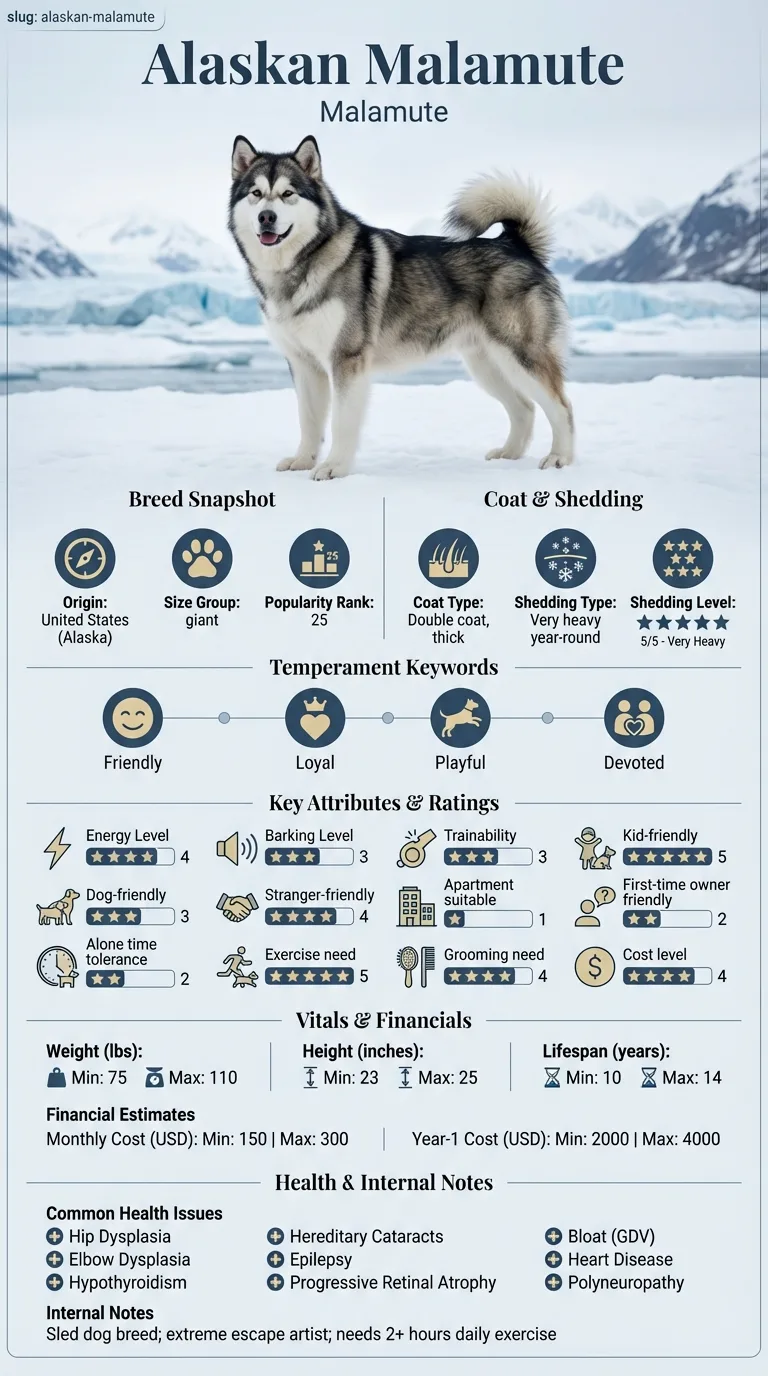
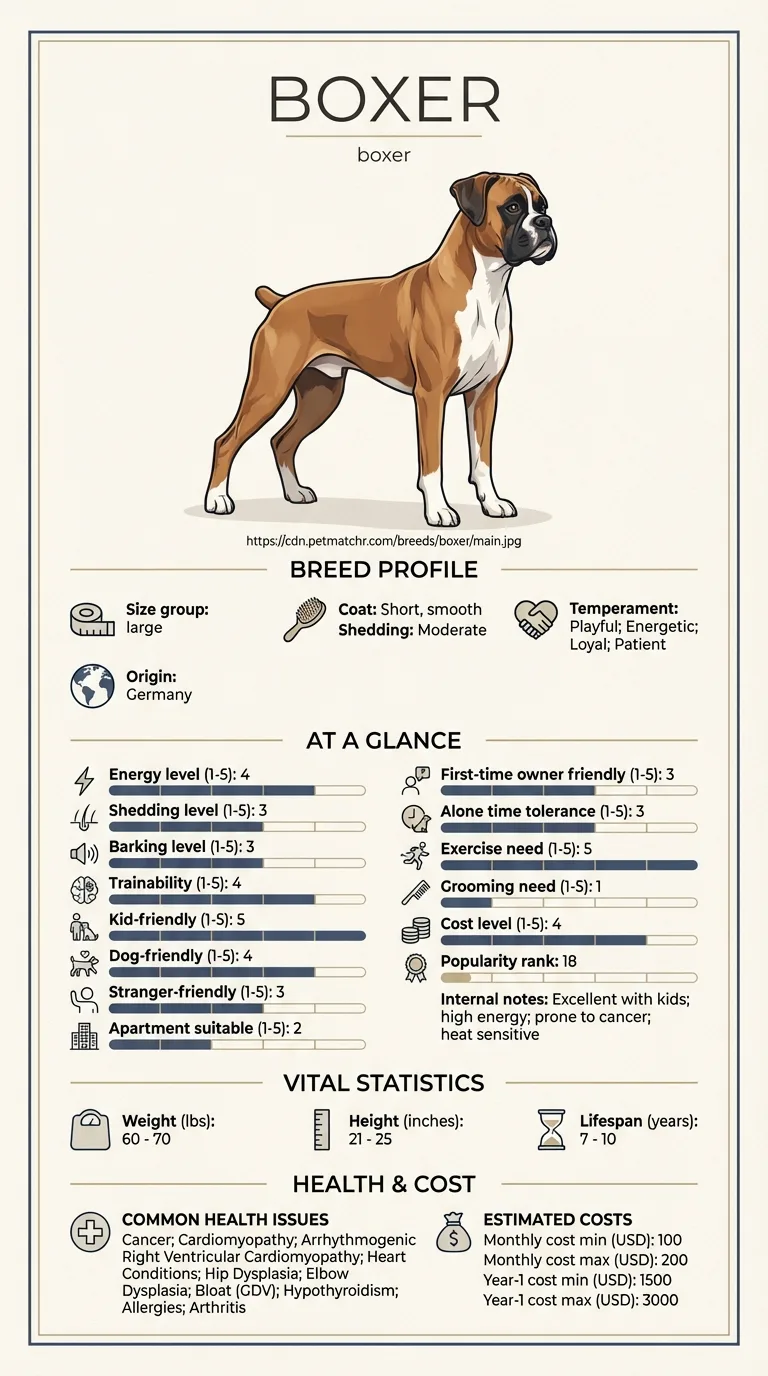
This page is for someone weighing two athletic large breeds and needing the health and climate picture stated plainly. It covers the exercise tie and what each wants from it, heat management for both, lifespan and cardiac risk, coat, and cost.
The Boxer is easier to groom, cheaper to run and better with people, and it is likely to be with you three or four years fewer; the Malamute is the hardier, hairier, more expensive dog.
Choose the Alaskan Malamute if longevity matters or you live somewhere cold. It lives 10 to 14 years against the Boxer's 7 to 10 and carries nothing like its cancer and cardiac burden. You are accepting $150–$300 a month against $100–$200, 5/5 shedding against 3/5, 4/5 grooming against 1/5 and a 1/5 apartment rating.
Choose the Boxer if you want a demonstrative family dog and can absorb a short life. It rates 5/5 with children, 4/5 with other dogs and trainability, grooms at 1/5, and tolerates being alone at 3/5 against 2/5. You are accepting 5/5 exercise, heat sensitivity, and one of the heaviest cardiac burdens in dogs.
| Feature | alaskan malamute | boxer | Winner |
|---|---|---|---|
| Weight | 75–110 lbs | 60–70 lbs | Equal |
| Height | 23–25 in | 21–25 in | Equal |
| Lifespan | 10–14 years | 7–10 years | alaskan malamute |
| Coat | Thick double coat | Short and smooth | Equal |
| Grooming need | High (4/5) | Very low (1/5) | boxer |
| Shedding | Very high (5/5) | Moderate (3/5) | boxer |
| Energy level | High (4/5) | High (4/5) | Equal |
| Exercise need | Very high (5/5) | Very high (5/5) | Equal |
| Trainability | Moderate (3/5) | High (4/5) | boxer |
| Barking | Moderate (3/5) | Moderate (3/5) | Equal |
| Good with kids | Very high (5/5) | Very high (5/5) | Equal |
| Good with other dogs | Moderate (3/5) | High (4/5) | boxer |
| Friendly to strangers | High (4/5) | Moderate (3/5) | alaskan malamute |
| Apartment suitability | Very low (1/5) | Low (2/5) | boxer |
| Good for first-time owners | Low (2/5) | Moderate (3/5) | boxer |
| Tolerates being alone | Low (2/5) | Moderate (3/5) | boxer |
| Typical monthly cost | $150–$300 | $100–$200 | boxer |
| Typical first-year cost | $2,000–$4,000 | $1,500–$3,000 | boxer |
This is the practical overlap most people miss: both of these dogs are heat sensitive, and both need their summer exercise moved to early morning and late evening.
The Malamute's problem is insulation. A thick Arctic double coat holds heat in, and a working sled dog in a warm climate has no efficient way to shed it. Long sessions become seasonal, shade and water are not optional, and the coat should never be clipped — it insulates against heat as well as cold and frequently regrows badly.
The Boxer's problem is airflow. A moderately shortened muzzle means it cools less efficiently than a long-nosed dog of the same size, and a Boxer that is genuinely working in warm weather can go from panting hard to being in trouble faster than owners expect.
Combining a 5/5 exercise requirement with poor heat tolerance is an awkward constraint, and both breeds have it.
In a hot climate, both are difficult. In a cold one, the Malamute is in its element and the Boxer needs a coat — a short smooth coat gives it almost no protection.
The exercise ratings match and the content does not.
A Malamute is tired by resistance. Weight-pulling, carting, scootering, canicross and loaded hikes are what the breed exists for, and two hours of that produces a dog that lies down properly. Walking beside you does very little.
A Boxer wants to sprint, wrestle and play hard, in bursts rather than at a steady haul. It also matures slowly — a two-year-old Boxer is fully grown and still adolescent in temperament, which is where most of the complaints about the breed come from.
The failure modes differ. An under-exercised Boxer becomes bouncy, mouthy and furniture-clearing — a nuisance rather than a project. An under-exercised Malamute excavates the garden and then leaves it; its own breed notes call it an extreme escape artist, and a fence dug in at the base with secured gates is the baseline.
On trainability the Boxer has the edge at 4/5 against 3/5, and it is willing rather than precise. The Malamute is not trying to be either.
Cancer heads the Boxer's condition list and cardiomyopathy sits immediately behind it, including the breed-specific form of arrhythmogenic right ventricular cardiomyopathy.
The practical point for an owner is what those diseases look like from the outside, which is often nothing at all until something dramatic. Boxer cardiomyopathy is an electrical disease of the heart muscle: it produces arrhythmias that a stethoscope in a busy consulting room will usually miss, and the first outward sign can be fainting, collapse during exercise, or sudden death in an apparently healthy young adult.
That is why screening in this breed uses a twenty-four hour Holter monitor and an echocardiogram rather than an annual listen, and why a fainting episode in a Boxer is a cardiology referral rather than a wait-and-see.
Ask a breeder for Holter and echo results on both parents, and for the ages and causes of death of the grandparents.
The Malamute's list is orthopaedic, endocrine and neurological rather than cardiac: hip and elbow dysplasia, hypothyroidism, hereditary cataracts, progressive retinal atrophy, epilepsy, bloat and inherited polyneuropathy, which has a DNA test.
Both carry a real bloat risk and both households should know the signs.
The Boxer runs $100–$200 a month against the Malamute's $150–$300, and $1,500–$3,000 against $2,000–$4,000 in the first year.
Grooming widens it further. The Boxer at 1/5 needs a rubber curry once a week and nothing else. The Malamute at 4/5 needs an undercoat rake and several long sessions during two heavy blows a year, on top of shedding constantly at 5/5.
What the Boxer's monthly figure hides is veterinary spend. Cardiac monitoring is a recurring cost in a breed where it actually matters, and oncology is expensive and realistic. Insurance is priced accordingly, and a policy taken out in puppyhood and kept unbroken is worth considerably more here than in most breeds.
The Malamute's expensive risks are orthopaedic surgery and a bloat emergency, both four-figure events in a dog this size.
On housing the Boxer rates 2/5 for apartments against 1/5 — better, but neither belongs in a flat, and in both cases the reason is output rather than footprint.
Energy, exercise, barking and children all tie — 4/5, 5/5, 3/5 and 5/5. Both are athletic, demonstrative, family-tolerant dogs that need serious daily work.
The Boxer is easier on the practical rows: 1/5 grooming against 4/5, 3/5 shedding against 5/5, 3/5 for first-time owners against 2/5, and it manages a working day at 3/5 against 2/5. It also costs a third less.
The Malamute is friendlier with strangers at 4/5 against 3/5 and better in cold weather by an enormous margin.
And then the lifespan row: 10 to 14 years against 7 to 10. At the pessimistic end that is a gap of seven years between two large athletic dogs, and it is driven by disease rather than size.
Everything else on this page sits underneath that number.

Both rate 5/5, and the content differs. The Malamute is tired by resistance — pulling, carting, loaded hikes — and walking does very little for it. The Boxer wants to sprint, wrestle and play hard in bursts. Two hours of the wrong kind leaves either dog fit and unsatisfied.
Yes, for different reasons. The Malamute's thick Arctic coat holds heat in; the Boxer's shortened muzzle means it cools less efficiently than a long-nosed dog. Both need summer exercise moved to early morning and late evening, which is an awkward combination with a 5/5 exercise requirement.
Cancer heads the breed's condition list, and cardiomyopathy sits behind it, including the breed-specific arrhythmogenic form. Between them they produce a 7 to 10 year lifespan in a fit athletic dog — three to four years fewer than the Malamute, which is the heavier breed.
With a twenty-four hour Holter monitor and an echocardiogram, not an annual stethoscope check. Boxer cardiomyopathy is an electrical disease producing intermittent arrhythmias, and the first outward sign can be fainting or collapse. Ask a breeder for Holter and echo results on both parents.
The Boxer by a wide margin — 1/5 against the Malamute's 4/5, with 3/5 shedding against 5/5. A rubber curry once a week covers a Boxer. The Malamute needs an undercoat rake and several long sessions during two heavy blows a year, and its coat should never be clipped.
The Boxer at 3/5 against the Malamute's 2/5, provided it has been properly exercised first. A bored Boxer is bouncy and destructive in a nuisance way; a bored Malamute digs up the garden and escapes, which is a different order of problem.
The Boxer, at $100–$200 a month against the Malamute's $150–$300, and $1,500–$3,000 against $2,000–$4,000 in the first year. Its lifetime veterinary spend usually runs above what the monthly figure suggests, because cardiac monitoring and oncology are both realistic.
The Boxer if you want a demonstrative family dog, a low-maintenance coat and lower running costs, and can accept 7 to 10 years. The Malamute if longevity matters or you live somewhere cold.
The Malamute runs $150–$300 a month and the Boxer $100–$200, with first-year totals of $2,000–$4,000 and $1,500–$3,000. Budget separately for Boxer cardiac screening.
The Malamute, overwhelmingly — it is comfortable in temperatures that keep most breeds indoors. The Boxer's short smooth coat gives almost no insulation and it needs a coat in winter.
A cardiology referral, not a wait-and-see. Collapse or fainting during exercise in this breed points at an arrhythmia, and the screening that finds it is a Holter monitor rather than a stethoscope.
Secure checkout on Stripe. We never see your card.
7-day money-back guarantee. Instant access.
Health information here is general and is not veterinary advice. If your dog shows pain, sudden behaviour change, or worsening symptoms, consult a licensed veterinarian.
Some links on this site are affiliate links. We may earn a commission at no extra cost to you, and we only suggest products we believe are helpful for dog owners.
We research and check what we publish, but we do not warrant that any figure, date, price, or statement is accurate, complete, or current, and we accept no liability for any loss, cost, injury, or other harm arising from the use of this site. Use it as one reference among several. You remain responsible for your own decisions and for your dog's care - confirm anything that matters with a licensed veterinarian or another qualified professional before you act on it. Full disclaimer.
Match your lifestyle to the right dog.
Take quizNot sure which breed is right for you? Take our 2-minute quiz to find out.
Take the quiz