Living
Which is the better overall choice?
If you want a lower-maintenance exercise routine and a dog suited to smaller homes, the Cocker Spaniel fits better; if you want less coat care and don't mind the extra exercise, go Boxer.

Quick answer
Which is the better overall choice?
If you want a lower-maintenance exercise routine and a dog suited to smaller homes, the Cocker Spaniel fits better; if you want less coat care and don't mind the extra exercise, go Boxer.
Boxer or Cocker Spaniel? On paper they differ most on grooming need, and on the scales Boxer is the heavier at 60–70 lbs. Here is how the two compare on everything that shapes an ordinary week.
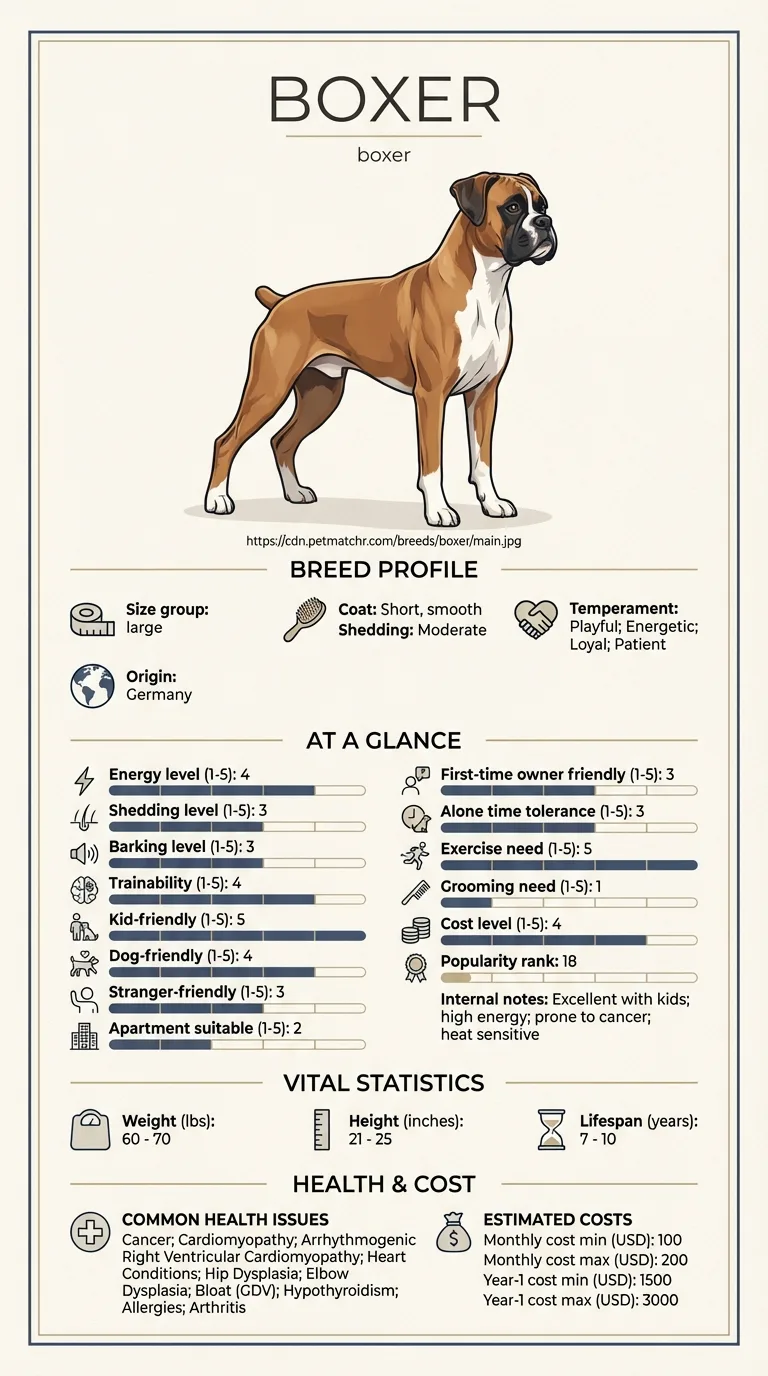
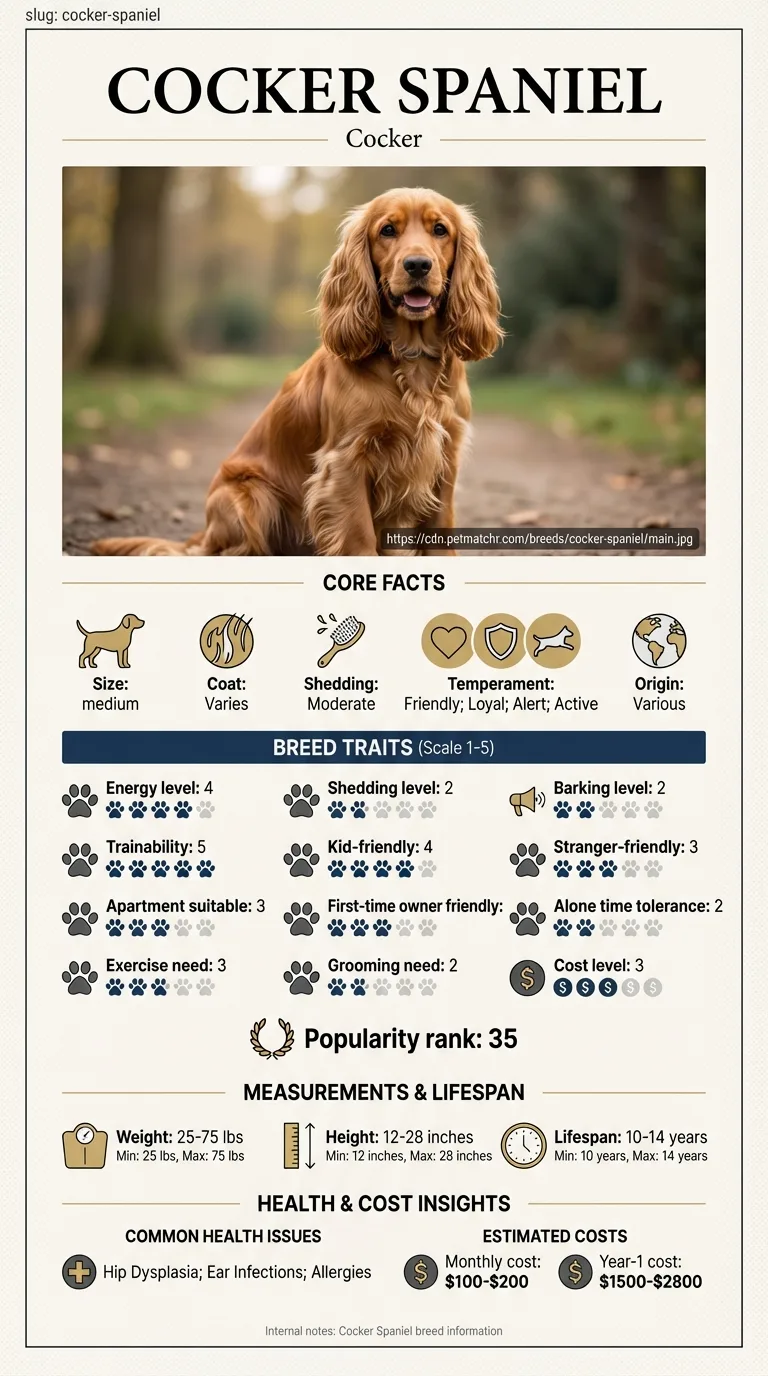
This is for someone already down to Boxer and Cocker Spaniel and deciding between them. For this pair the decision usually turns on grooming need and exercise need, so those are covered first and in most detail. Anyone choosing from a flat has a clear answer here: Cocker Spaniel rates 4/5 against 2/5. The focus throughout is on daily consequences rather than breed background.
Between Boxer and Cocker Spaniel, grooming need is what separates them; neither is the lower-effort dog overall.
Choose Boxer if you do not want a standing grooming appointment, the dog will be alone during the working day and you want a dog that can keep up with an active routine.
Choose Cocker Spaniel if you are in a flat or a smaller home, this is your first dog and your walking routine is modest.
| Feature | boxer | cocker spaniel | Winner |
|---|---|---|---|
| Size class | large | small | Equal |
| Weight | 60–70 lbs | 20–30 lbs | Equal |
| Height | 21–25 in | 13–16 in | Equal |
| Lifespan | 7–10 years | 10–14 years | cocker spaniel |
| Exercise need | Very high (5/5) | Moderate (3/5) | cocker spaniel |
| Grooming need | Very low (1/5) | Very high (5/5) | boxer |
| Shedding | Moderate (3/5) | Moderate (3/5) | Equal |
| Energy level | High (4/5) | Moderate (3/5) | Equal |
| Barking | Moderate (3/5) | Moderate (3/5) | Equal |
| Apartment suitability | Low (2/5) | High (4/5) | cocker spaniel |
| Good for first-time owners | Moderate (3/5) | High (4/5) | cocker spaniel |
| Tolerates being alone | Moderate (3/5) | Low (2/5) | boxer |
| Trainability | High (4/5) | High (4/5) | Equal |
| Good with kids | Very high (5/5) | Very high (5/5) | Equal |
| Good with other dogs | High (4/5) | High (4/5) | Equal |
| Friendly to strangers | Moderate (3/5) | High (4/5) | cocker spaniel |
| Cost level | High (4/5) | Moderate (3/5) | cocker spaniel |
| Coat | Short, smooth | Silky and feathered | Equal |
| Origin | Germany | Various | Equal |
| Typical monthly cost | $100–$200 | $80–$150 | Equal |
| Typical first-year cost | $1,500–$3,000 | $1,100–$2,300 | Equal |
The Cocker Spaniel is a genuinely small dog next to the Boxer - 20-30 lbs and 13-16 inches, against 60-70 lbs and 21-25 inches. That's roughly a third of the weight and a third less height. Anyone picturing a medium-sized Cocker will need to adjust; it sits solidly in the small-breed range on this comparison. The Boxer's frame is also far more muscular, built for movement rather than the Cocker's lower, sturdier gait.
The Boxer wants considerably more from you physically - 5/5 exercise need against the Cocker's moderate 3/5. Energy level narrows that gap slightly (4/5 vs 3/5), since Cockers are an active gun-dog breed underneath the show coat. Still, a Cocker's needs are satisfiable with a solid daily walk and some play, where the Boxer wants sustained, vigorous activity most days.
This is close to a mirror image of the exercise numbers: the Cocker Spaniel maxes out grooming need at 5/5 thanks to its silky, feathered coat, while the Boxer sits at a bare 1/5. Shedding, by contrast, ties at moderate (3/5) for both. You're choosing between a dog that needs regular brushing and trims, and one you can largely ignore coat-wise.
The Cocker fits smaller homes more comfortably - 4/5 for apartment suitability against the Boxer's 2/5 - while barking rates the same moderate 3/5 for both. Where it flips is alone tolerance: the Boxer handles solo time a bit better (3/5 vs 2/5). Cockers are known for attaching closely to their people, so plan around that if you're out of the house often.
Trainability ties at a solid 4/5 for both breeds, but first-time-owner suitability favors the Cocker (4/5 vs 3/5) - it's smaller, generally easier to physically manage, and its eager-to-please temperament makes early training sessions more forgiving. Neither breed will fight you on commands; the difference is more about overall ease of handling a first dog than raw trainability.
Both breeds tie at the top with kids (5/5 each) and with other dogs (4/5 each), which is unusual - most Boxer comparisons show a clear gap. The Cocker pulls ahead slightly with strangers (4/5 vs 3/5), fitting its gentle, merry, affectionate temperament. If household compatibility is your main concern, this pairing is closer than almost any other on the site.
Lifespan favors the Cocker meaningfully - 10-14 years against the Boxer's 7-10. Its health list is shorter too, at five conditions centered on eyes and ears (cataracts, progressive retinal atrophy, ear infections) plus hip dysplasia and autoimmune hemolytic anemia. The Boxer's ten-item list leans harder into cancer and cardiac risk, which tracks with its shorter average lifespan.
Cost level favors the Cocker slightly, moderate (3/5) versus the Boxer's high (4/5), and the dollar ranges follow: $80-150 monthly for the Cocker against $100-200 for the Boxer, with first-year totals of $1,100-2,300 versus $1,500-3,000. Factor in the Cocker's grooming needs, though - professional trims aren't free, and they'll eat into that apparent savings over a year.
Boxer weighs 60–70 lbs and lives 7–10 years; Cocker Spaniel weighs 20–30 lbs and lives 10–14 years. The two diverge most on grooming need, exercise need and apartment suitability. They are level on barking, good with other dogs and good with kids, so those cannot decide it. The table below marks a winner only where one breed is genuinely easier for a typical owner; size and origin are facts rather than merits and stay level. Ratings come from one source applied to both breeds, so they are meaningful against each other rather than as absolute scores.

Substantially - the Cocker's 20-30 lb range is less than half the Boxer's 60-70 lbs, and it stands 13-16 inches versus 21-25 inches.
The Cocker Spaniel, by a wide margin - 5/5 versus the Boxer's 1/5. Its silky, feathered coat needs regular brushing and periodic trims to stay manageable.
Slightly, at 4/5 versus the Boxer's 3/5, though both train equally well (4/5 each). The Cocker's smaller size and eager-to-please nature make it a gentler introduction to dog ownership.
Both score identically here, 5/5 for good-with-kids. This is one of the few Boxer comparisons where household compatibility scores tie rather than favor one breed.
About $100-200 for the Boxer and $80-150 for the Cocker, with the Cocker's regular grooming appointments likely narrowing that gap in practice.
Hip dysplasia appears on both lists. Otherwise the Boxer skews toward cancer and cardiac conditions, while the Cocker's risks center on eyes and ears - cataracts, progressive retinal atrophy, and chronic ear infections.
The Cocker Spaniel, at 10-14 years against the Boxer's 7-10 - a meaningful few extra years on average.
If you want a lower-maintenance exercise routine and a dog suited to smaller homes, the Cocker Spaniel fits better; if you want less coat care and don't mind the extra exercise, go Boxer.
Around $100-200 for the Boxer and $80-150 for the Cocker Spaniel - though the Cocker's grooming appointments can close that gap.
The Boxer needs more - a full 5/5 - against the Cocker's moderate 3/5. A daily walk plus playtime generally satisfies a Cocker.
The Cocker Spaniel, typically 10-14 years compared to the Boxer's 7-10 years.
Secure checkout on Stripe. We never see your card.
7-day money-back guarantee. Instant access.

Health information here is general and is not veterinary advice. If your dog shows pain, sudden behaviour change, or worsening symptoms, consult a licensed veterinarian.
Some links on this site are affiliate links. We may earn a commission at no extra cost to you, and we only suggest products we believe are helpful for dog owners.
We research and check what we publish, but we do not warrant that any figure, date, price, or statement is accurate, complete, or current, and we accept no liability for any loss, cost, injury, or other harm arising from the use of this site. Use it as one reference among several. You remain responsible for your own decisions and for your dog's care - confirm anything that matters with a licensed veterinarian or another qualified professional before you act on it. Full disclaimer.
Match your lifestyle to the right dog.
Take quizNot sure which breed is right for you? Take our 2-minute quiz to find out.
Take the quiz