Living
Boxer or Great Dane — which fits more households?
The Boxer, since it scores better for first-time owners (3/5 vs 2/5) and costs roughly half as much to keep.

Quick answer
Boxer or Great Dane — which fits more households?
The Boxer, since it scores better for first-time owners (3/5 vs 2/5) and costs roughly half as much to keep.
Boxer or Great Dane? On paper they differ most on exercise need, and on the scales Great Dane is the heavier at 110–175 lbs. Here is how the two compare on everything that shapes an ordinary week.
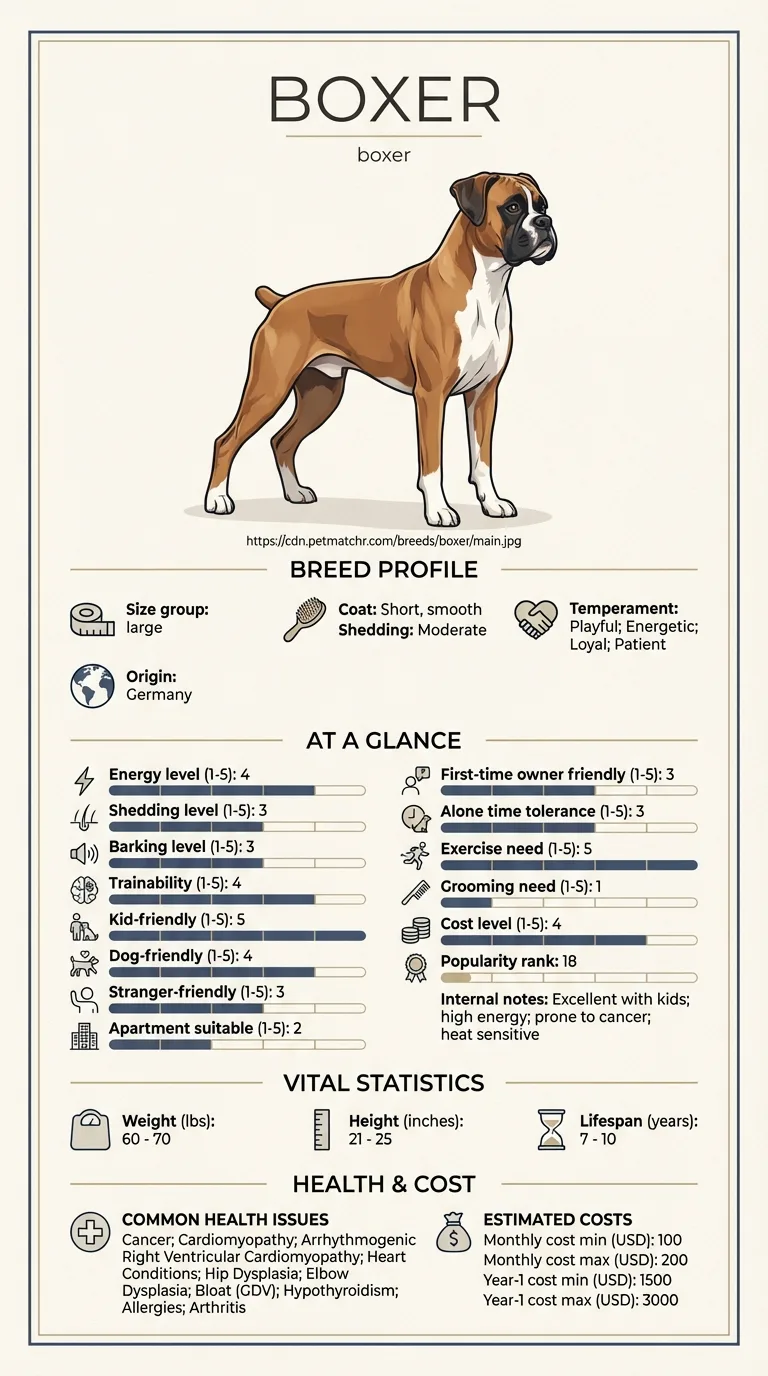
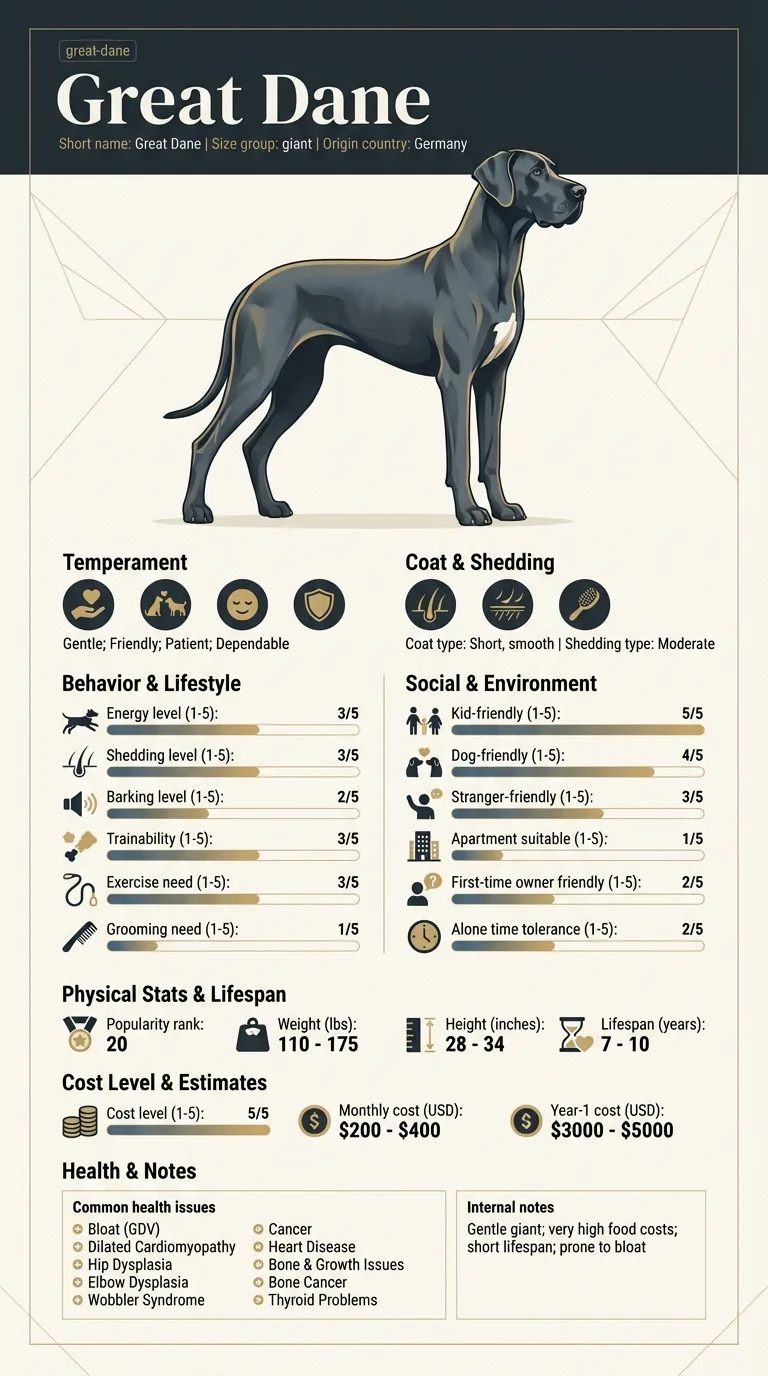
This is for someone already down to Boxer and Great Dane and deciding between them. For this pair the decision usually turns on exercise need, so those are covered first and in most detail. Anyone choosing from a flat has a clear answer here: Boxer rates 2/5 against 1/5. There is no origin story here — only what changes about your week.
Between Boxer and Great Dane, exercise need is what separates them, and Boxer is the lower-effort dog of the two to keep.
Choose Boxer if this is your first dog, the dog will be alone during the working day and you want a dog that picks up training quickly.
Choose Great Dane if your walking routine is modest.
| Feature | boxer | great dane | Winner |
|---|---|---|---|
| Size class | large | giant | Equal |
| Weight | 60–70 lbs | 110–175 lbs | Equal |
| Height | 21–25 in | 28–34 in | Equal |
| Lifespan | 7–10 years | 7–10 years | Equal |
| Exercise need | Very high (5/5) | Moderate (3/5) | great dane |
| Grooming need | Very low (1/5) | Very low (1/5) | Equal |
| Shedding | Moderate (3/5) | Moderate (3/5) | Equal |
| Energy level | High (4/5) | Moderate (3/5) | Equal |
| Barking | Moderate (3/5) | Low (2/5) | great dane |
| Apartment suitability | Low (2/5) | Very low (1/5) | boxer |
| Good for first-time owners | Moderate (3/5) | Low (2/5) | boxer |
| Tolerates being alone | Moderate (3/5) | Low (2/5) | boxer |
| Trainability | High (4/5) | Moderate (3/5) | boxer |
| Good with kids | Very high (5/5) | Very high (5/5) | Equal |
| Good with other dogs | High (4/5) | High (4/5) | Equal |
| Friendly to strangers | Moderate (3/5) | Moderate (3/5) | Equal |
| Cost level | High (4/5) | Very high (5/5) | boxer |
| Coat | Short, smooth | Short, smooth | Equal |
| Origin | Germany | Germany | Equal |
| Typical monthly cost | $100–$200 | $200–$400 | Equal |
| Typical first-year cost | $1,500–$3,000 | $3,000–$5,000 | Equal |
Numbers tell the story here: a 60-70 lb Boxer standing 21-25 inches shares a room with a Great Dane that can hit 175 lbs and 34 inches. That's not a size difference, it's a different weight class — large versus giant. Everything about living with a Dane, from doorway clearance to the size of its water bowl, scales up accordingly.
Despite the size gap, the Boxer is the one asking more of you: Very High (5/5) exercise need against the Great Dane's Moderate (3/5). Danes are famously happy to nap for long stretches once past puppyhood, while Boxers stay physically demanding well into adulthood. Don't assume the bigger dog needs more running — here it's the opposite.
Both breeds tie on grooming (Very Low, 1/5) and shedding (Moderate, 3/5) — short, smooth coats that need little more than a weekly wipe-down. This is one category where size doesn't change the math at all; a Dane's coat is just a larger version of the same low-maintenance package.
Neither dog is built for small spaces, but the Boxer's Low (2/5) apartment score actually beats the Dane's Very Low (1/5) — a giant breed simply takes up more physical room regardless of its calmer temperament. Barking runs Moderate (3/5) for the Boxer against Low (2/5) for the Dane, so the quieter dog is also the bigger one.
The Boxer outscores the Great Dane on both counts that matter to new owners: Moderate (3/5) versus Low (2/5) for first-timers, and High (4/5) versus Moderate (3/5) trainability. A Dane's sheer size means training mistakes carry bigger consequences — a poorly leash-trained 150-lb dog is a real problem in a way a poorly leash-trained Boxer isn't.
Kids, other dogs and strangers all land as ties or near-ties — both score Very High (5/5) with kids and High (4/5) with other dogs. The real household question with a Dane isn't temperament, it's logistics: can your home and car handle a dog that outweighs most adult humans.
Lifespan ties at 7-10 years for both, short for a large breed like the Boxer and short even for a giant like the Dane. The Boxer's list centers on cardiac disease and cancer; the Dane's includes Wobbler Syndrome and bone cancer alongside its own cardiac risk (DCM) — giant-breed-specific joint and bone stress the Boxer doesn't carry.
The Great Dane costs more to keep at every level: Very High (5/5) cost rating versus the Boxer's High (4/5), $200-$400 monthly against $100-$200, and a first year that can run $3,000-$5,000 versus $1,500-$3,000. Food alone for a 150-lb dog is a different budget line than for a 65-lb one.
Boxer weighs 60–70 lbs and lives 7–10 years; Great Dane weighs 110–175 lbs and lives 7–10 years. The two diverge most on exercise need. They are level on good with other dogs, grooming need and good with kids, so those cannot decide it. Where the table declares a winner it means less work for the owner, nothing more; descriptive rows are left as ties on purpose. The value here is in the differences between the two columns; treat any single score as approximate.

Considerably — a Dane can weigh 110-175 lbs and stand up to 34 inches, versus the Boxer's 60-70 lbs and 21-25 inches. It's a jump from large to giant breed classification.
The Boxer, at Very High (5/5) versus the Dane's Moderate (3/5). Great Danes are calmer once grown despite their size.
The Boxer, scoring Moderate (3/5) against the Dane's Low (2/5). A giant breed's size raises the stakes on training and handling.
Neither scores well, but the Boxer (Low, 2/5) beats the Dane (Very Low, 1/5) — a Dane's size alone makes small spaces harder regardless of temperament.
Roughly double at the low end — $200-$400 monthly versus $100-$200 for the Boxer, and $3,000-$5,000 in year one versus $1,500-$3,000.
Yes — both carry bloat (GDV), hip and elbow dysplasia, and cancer risk on their lists, though the Dane adds giant-breed issues like Wobbler Syndrome that the Boxer doesn't have.
Neither has an edge — both average 7-10 years, short for their respective size classes.
The Boxer, since it scores better for first-time owners (3/5 vs 2/5) and costs roughly half as much to keep.
The Great Dane runs $200-$400 monthly versus $100-$200 for the Boxer — close to double.
The Boxer, at Very High (5/5) versus the Dane's Moderate (3/5) — the smaller dog is the more demanding one here.
Both average 7-10 years — size doesn't create a gap in this pair.
Secure checkout on Stripe. We never see your card.
7-day money-back guarantee. Instant access.

Health information here is general and is not veterinary advice. If your dog shows pain, sudden behaviour change, or worsening symptoms, consult a licensed veterinarian.
Some links on this site are affiliate links. We may earn a commission at no extra cost to you, and we only suggest products we believe are helpful for dog owners.
We research and check what we publish, but we do not warrant that any figure, date, price, or statement is accurate, complete, or current, and we accept no liability for any loss, cost, injury, or other harm arising from the use of this site. Use it as one reference among several. You remain responsible for your own decisions and for your dog's care - confirm anything that matters with a licensed veterinarian or another qualified professional before you act on it. Full disclaimer.
Match your lifestyle to the right dog.
Take quizNot sure which breed is right for you? Take our 2-minute quiz to find out.
Take the quiz