Living
Boxer or Labradoodle — which is the safer choice overall?
The Labradoodle, given its edge in trainability, first-time-owner fit, and a lifespan several years longer.

Quick answer
Boxer or Labradoodle — which is the safer choice overall?
The Labradoodle, given its edge in trainability, first-time-owner fit, and a lifespan several years longer.
Boxer or Labradoodle? On paper they differ most on grooming need, and on the scales Boxer is the heavier at 60–70 lbs. Here is how the two compare on everything that shapes an ordinary week.
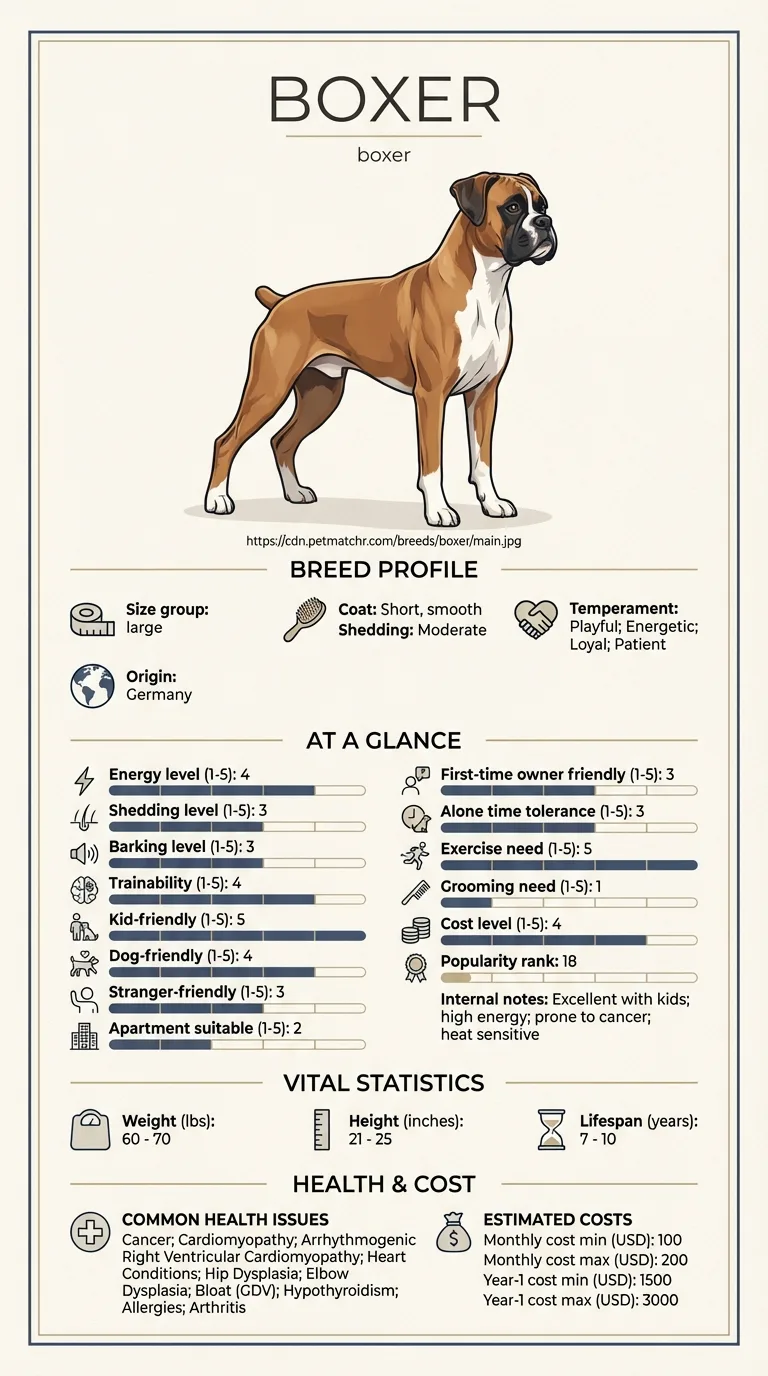
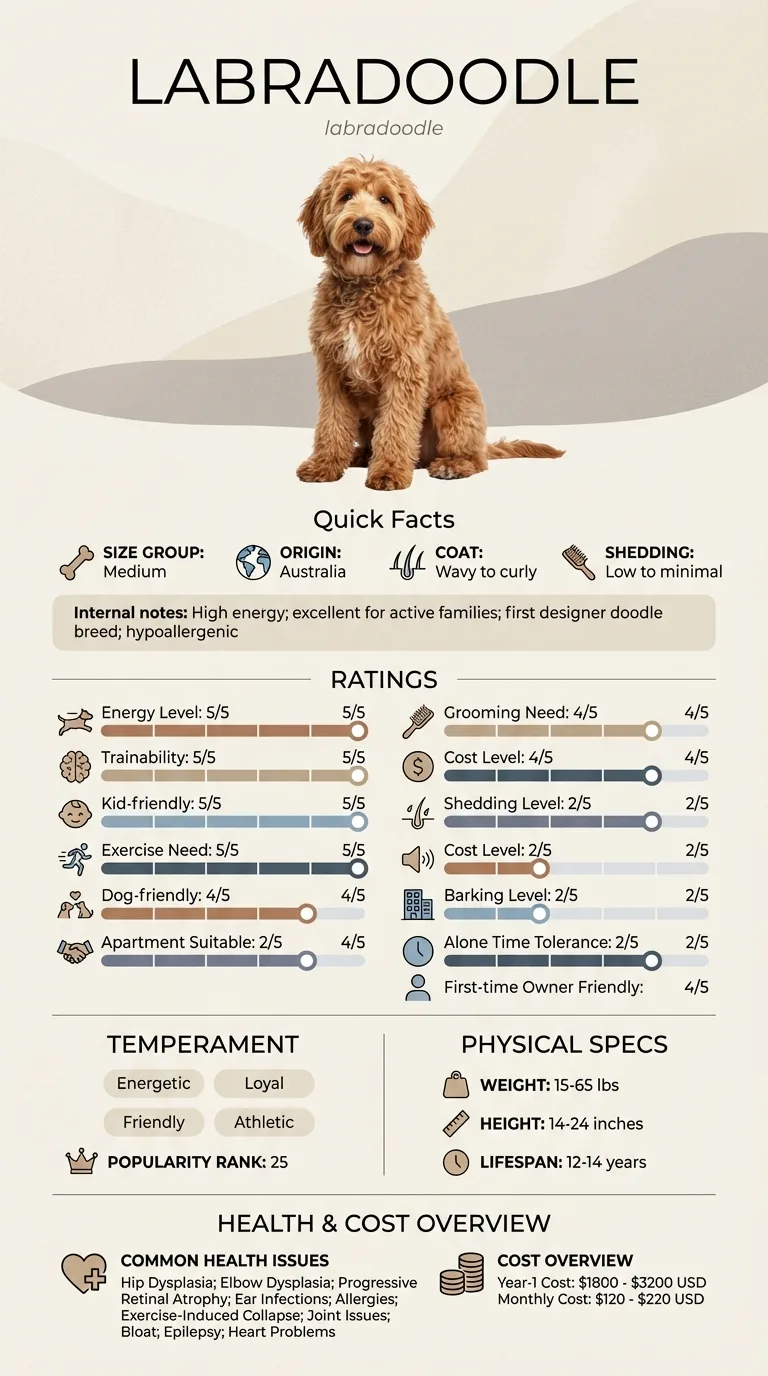
This is for someone already down to Boxer and Labradoodle and deciding between them. For this pair the decision usually turns on grooming need, so those are covered first and in most detail. Both rate 2/5 for flats, so housing does not settle this one. Breed history is left out; what follows is what you will actually live with.
Between Boxer and Labradoodle, grooming need is what separates them, and Boxer is the lower-effort dog of the two to keep.
Choose Boxer if you do not want a standing grooming appointment, the dog will be alone during the working day and you want a dog that is more watchful with visitors.
Choose Labradoodle if this is your first dog, shedding is a problem in your house and you want a dog that picks up training quickly.
| Feature | boxer | labradoodle | Winner |
|---|---|---|---|
| Size class | large | medium | Equal |
| Weight | 60–70 lbs | 15–65 lbs | Equal |
| Height | 21–25 in | 14–24 in | Equal |
| Lifespan | 7–10 years | 12–14 years | labradoodle |
| Exercise need | Very high (5/5) | Very high (5/5) | Equal |
| Grooming need | Very low (1/5) | High (4/5) | boxer |
| Shedding | Moderate (3/5) | Low (2/5) | labradoodle |
| Energy level | High (4/5) | Very high (5/5) | Equal |
| Barking | Moderate (3/5) | Low (2/5) | labradoodle |
| Apartment suitability | Low (2/5) | Low (2/5) | Equal |
| Good for first-time owners | Moderate (3/5) | High (4/5) | labradoodle |
| Tolerates being alone | Moderate (3/5) | Low (2/5) | boxer |
| Trainability | High (4/5) | Very high (5/5) | labradoodle |
| Good with kids | Very high (5/5) | Very high (5/5) | Equal |
| Good with other dogs | High (4/5) | High (4/5) | Equal |
| Friendly to strangers | Moderate (3/5) | High (4/5) | labradoodle |
| Cost level | High (4/5) | High (4/5) | Equal |
| Coat | Short, smooth | Wavy to curly | Equal |
| Origin | Germany | Australia | Equal |
| Typical monthly cost | $100–$200 | $120–$220 | Equal |
| Typical first-year cost | $1,500–$3,000 | $1,800–$3,200 | Equal |
The Labradoodle's range (15-65 lbs, 14-24 inches) sits mostly below the Boxer's fixed 60-70 lbs and 21-25 inches, but a standard-line Labradoodle can close much of that gap. Ask about parentage before committing — a mini Labradoodle and a standard one are barely the same breed by weight.
Both breeds max out at Very High (5/5) exercise need, another tie at the top of the scale. The Labradoodle edges slightly ahead on general energy level (Very High 5/5 versus the Boxer's High 4/5). Either dog needs a genuinely active owner — this isn't a pairing where one option lets you skip the daily run.
The Boxer needs almost nothing here (1/5 grooming) and sheds a moderate amount (3/5); the Labradoodle needs High (4/5) grooming for its wavy-to-curly coat but sheds only Low (2/5) in return. If you're choosing based on hair on your furniture versus time at the groomer, this section is your answer.
Both tie at Low (2/5) for apartment suitability, so neither is a natural fit for small spaces. Barking splits in the Labradoodle's favor — Low (2/5) versus the Boxer's Moderate (3/5) — making it the quieter housemate of the two, even if neither is ideally suited to close-quarters living.
The Labradoodle scores better for newer owners (High 4/5 versus Moderate 3/5) and for trainability (Very High 5/5 versus High 4/5). Labradoodles inherit the Labrador's biddability, which tends to make early training smoother than with a Boxer's more headstrong energy.
Both tie Very High (5/5) with kids and High (4/5) with other dogs — either breed slots into a busy multi-pet, multi-kid household without issue. The Labradoodle pulls ahead with strangers (High 4/5 versus Moderate 3/5), so if you host often or live somewhere with lots of foot traffic, that's worth weighing.
Labradoodles average 12-14 years against the Boxer's 7-10 — a substantial gap. The Boxer's risk list is cardiac-heavy (cardiomyopathy, ARVC, heart conditions) plus cancer and bloat; the Labradoodle's includes exercise-induced collapse and epilepsy alongside hip and elbow dysplasia. Different risks, but more years on average to manage them.
Costs run close but not identical — $120-$220 monthly for the Labradoodle versus $100-$200 for the Boxer, and $1,800-$3,200 in year one against $1,500-$3,000. Both sit at High (4/5) overall cost level; the doodle's grooming needs account for most of the gap between the two numbers.
Boxer weighs 60–70 lbs and lives 7–10 years; Labradoodle weighs 15–65 lbs and lives 12–14 years. The two diverge most on grooming need. They are level on apartment suitability, cost level and good with other dogs, so those cannot decide it. The comparison marks an easier option only where one exists. Facts like weight and country of origin are not scored. Both dogs are rated from the same dataset, which is what makes the numbers comparable with each other even though any individual dog sits somewhere inside its breed's range.

It depends on the Labradoodle's line — its 15-65 lb range can sit well below or close to the Boxer's fixed 60-70 lbs. Ask the breeder about parentage to know which you're getting.
They're essentially tied — both rate Very High (5/5), with the Labradoodle edging slightly ahead on overall energy level.
The Labradoodle, rated Low (2/5) shedding against the Boxer's Moderate (3/5), though it costs more in grooming to maintain that.
The Labradoodle, scoring High (4/5) versus the Boxer's Moderate (3/5) — its more biddable temperament tends to forgive early training mistakes.
$100-$200 for the Boxer, $120-$220 for the Labradoodle — close, with the doodle's grooming pushing its number slightly higher.
Partially — both list hip dysplasia, elbow dysplasia and bloat risk, but the Labradoodle adds exercise-induced collapse and epilepsy, conditions not on the Boxer's list.
The Labradoodle, at 12-14 years versus the Boxer's 7-10.
The Labradoodle, given its edge in trainability, first-time-owner fit, and a lifespan several years longer.
$120-$220 for the Labradoodle versus $100-$200 for the Boxer — a modest gap driven by grooming.
Both tie at Very High (5/5) — neither is the lower-effort option.
The Labradoodle, at 12-14 years against the Boxer's 7-10.
Secure checkout on Stripe. We never see your card.
7-day money-back guarantee. Instant access.
Health information here is general and is not veterinary advice. If your dog shows pain, sudden behaviour change, or worsening symptoms, consult a licensed veterinarian.
Some links on this site are affiliate links. We may earn a commission at no extra cost to you, and we only suggest products we believe are helpful for dog owners.
We research and check what we publish, but we do not warrant that any figure, date, price, or statement is accurate, complete, or current, and we accept no liability for any loss, cost, injury, or other harm arising from the use of this site. Use it as one reference among several. You remain responsible for your own decisions and for your dog's care - confirm anything that matters with a licensed veterinarian or another qualified professional before you act on it. Full disclaimer.
Match your lifestyle to the right dog.
Take quizNot sure which breed is right for you? Take our 2-minute quiz to find out.
Take the quiz