DogBreedCompass

Akita or Standard Poodle: Two Large Dogs, One Needs a Groomer

A Standard Poodle is a 45 to 70 pound working water retriever that rates 5/5 for trainability and 4/5 for exercise. The show clip has done its reputation enormous damage: this is a gundog, and treating it as an ornament is the fastest way to end up with a difficult one.

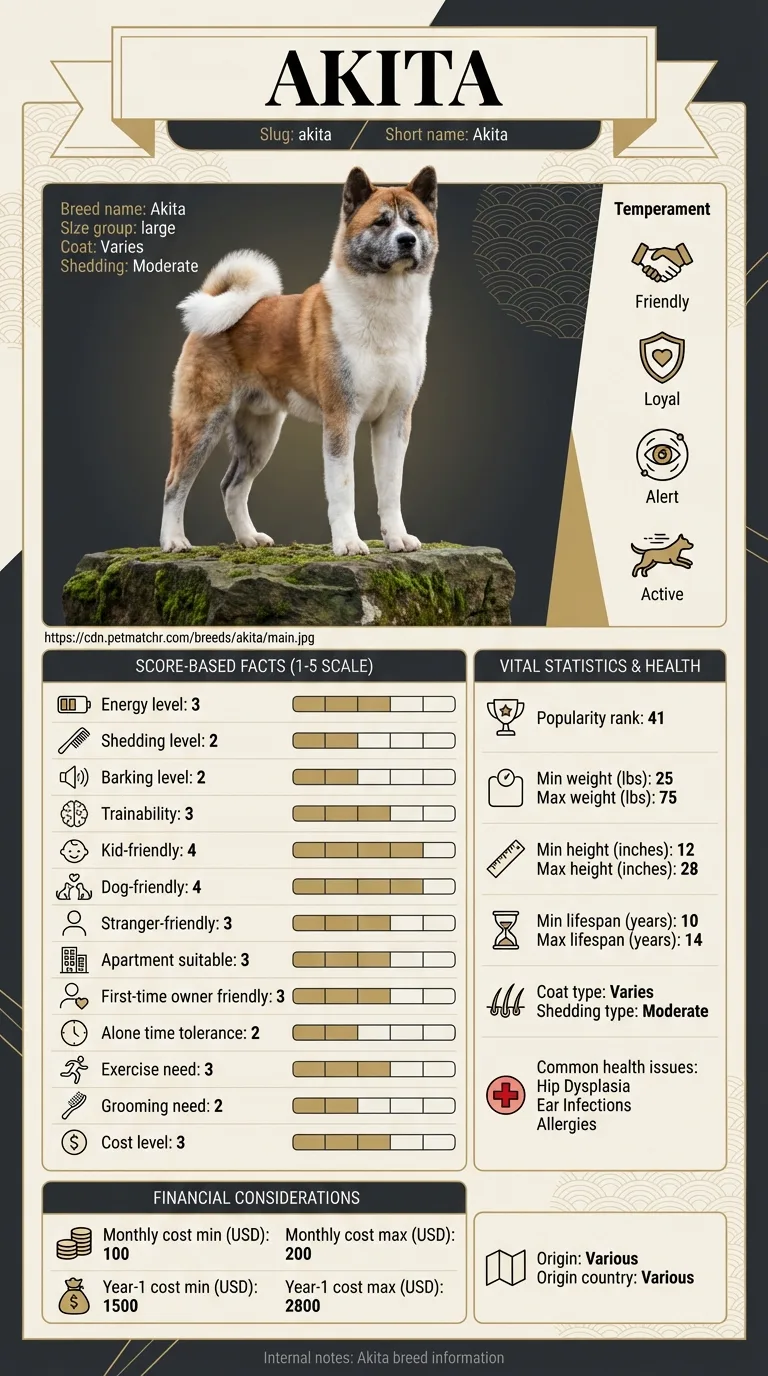
akita infographic
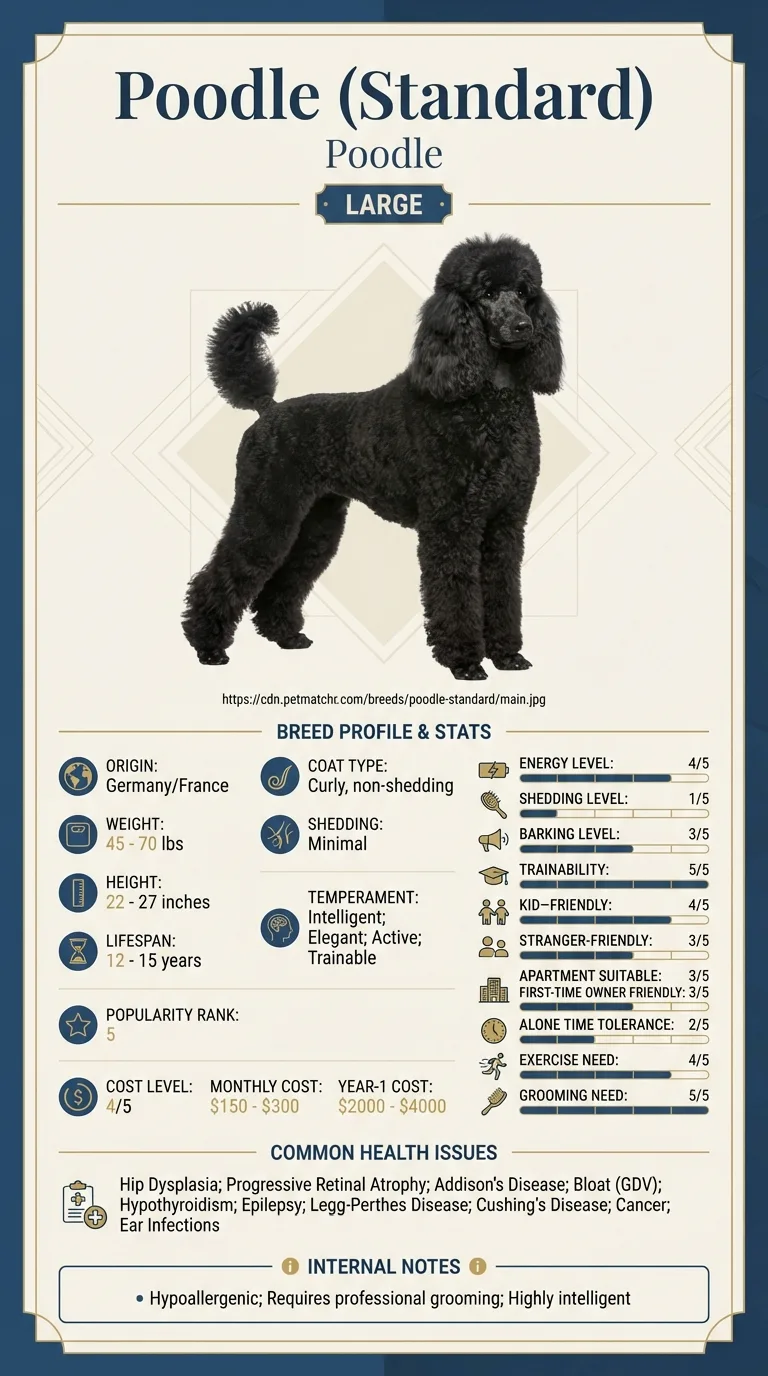
poodle standard infographic

This page is for someone weighing a large non-shedding dog against a large guardian. It covers the exercise and training requirement, what a 5/5 coat costs across a large dog's life, bloat risk, endocrine disease, and running costs.

Quick verdict

The Standard Poodle is the more capable and more expensive dog and it does not shed; the Akita sheds enormously, costs less, and asks for a fraction of the engagement.

Choose akita if...

Choose the Akita if you will not fund grooming or cannot provide daily mental work. It grooms at 3/5 against the Poodle's 5/5, needs 3/5 exercise against 4/5, tolerates being alone at 3/5 against 2/5, and costs $110–$240 a month against $150–$300. You are accepting 5/5 shedding and 1/5 for first-time owners.

Choose poodle standard if...

Choose the Standard Poodle if you want a large trainable dog that does not shed and you will work it properly. It rates 5/5 for trainability, 1/5 for shedding, 4/5 with children and other dogs, and lives 12 to 15 years. You are accepting a 5/5 coat, 4/5 exercise, a real bloat risk and the higher monthly cost.

Head-to-head comparison

Featureakitapoodle standardWinner
Weight70–130 lbs45–70 lbsEqual
Height24–28 in22–27 inEqual
Lifespan10–13 years12–15 yearspoodle standard
CoatDense double coatCurly, non-sheddingEqual
Grooming needModerate (3/5)Very high (5/5)akita
SheddingVery high (5/5)Very low (1/5)poodle standard
Energy levelModerate (3/5)High (4/5)Equal
Exercise needModerate (3/5)High (4/5)akita
TrainabilityModerate (3/5)Very high (5/5)poodle standard
BarkingLow (2/5)Moderate (3/5)akita
Good with kidsModerate (3/5)High (4/5)poodle standard
Good with other dogsLow (2/5)High (4/5)poodle standard
Friendly to strangersLow (2/5)Moderate (3/5)poodle standard
Apartment suitabilityLow (2/5)Moderate (3/5)poodle standard
Good for first-time ownersVery low (1/5)Moderate (3/5)poodle standard
Tolerates being aloneModerate (3/5)Low (2/5)akita
Typical monthly cost$110–$240$150–$300akita
Typical first-year cost$1,700–$3,200$2,000–$4,000akita

Deep dive

What the show clip hides

The continental trim looks decorative and began as function: pompons over the joints and chest to keep them warm in cold water, shaved elsewhere to reduce drag. This dog retrieved ducks.

Standards still do gundog work, and they compete at the top level in obedience, agility, tracking and scent sports. At 5/5 trainability they learn quickly, retain reliably and generalise well.

The consequence for an owner is that a Standard Poodle needs a job. An hour of walking plus fifteen or twenty minutes of structured work — retrieves, scent games, obedience, trick chains — produces a settled dog. An under-employed one becomes anxious, vocal at 3/5 and inclined to invent projects.

They are also sensitive. Poodles read household mood, dislike sharp correction and work best for someone consistent and cheerful.

The Akita is the opposite proposition. 3/5 exercise met by a walk, no requirement for occupation, no deterioration without one, and an independence that means it will not look to you for direction in the first place.

A 5/5 coat on a large dog, priced honestly

The Standard's coat sheds almost nothing at 1/5, and that is why many people choose it. The dead hair stays in the curl.

It therefore mats — densely, quickly, and worst behind the ears, in the armpits, on the collar line and around the tail. The routine is combing to the skin several times a week, with the test being whether a metal comb reaches the skin without catching, plus a professional groom every six to eight weeks.

On a large dog those appointments cost more than they do on a Miniature, and they run for twelve to fifteen years. It is the single biggest predictable expense in owning this breed and it belongs in the budget before purchase.

The eight-to-twelve-month coat change is where owners lose it. The adult coat pushes through under the puppy coat, the two felt together against the skin, and the dog has to be clipped off.

Ear hair grows in the canal and traps moisture — plucking or trimming and drying after swims is routine, since ear infections are on the list.

The Akita's alternative is 5/5 shedding, no mats, no groomer, and two raking periods a year.

The risk the smaller Poodles do not carry

Bloat appears on the Standard Poodle's condition list and not meaningfully on the Toy's or the Miniature's, and the reason is conformation: a deep, narrow chest on a tall dog.

In gastric dilatation-volvulus the stomach fills with gas and rotates, cutting off its own blood supply. Without surgery it is fatal, usually within hours. The signs are unproductive retching, a swelling or drum-tight abdomen, restlessness and inability to settle, drooling and pale gums.

Any Standard Poodle household should know those signs and know where the nearest out-of-hours surgery is before it is needed. A preventive gastropexy at the time of neutering is worth discussing with a vet for deep-chested breeds.

The Akita is also deep-chested and carries the same risk, so this is one of the few pieces of advice on this page that applies equally to both.

Beyond bloat the Poodle's list runs to hip dysplasia, progressive retinal atrophy, hypothyroidism, epilepsy, Cushing's disease, cancer, ear infections and Addison's disease — vague relapsing illness that resolves and returns, treatable and dangerous if missed.

The more expensive dog, and why

The Standard Poodle runs $150–$300 a month and $2,000–$4,000 in the first year, against the Akita's $110–$240 and $1,700–$3,200. It is the more expensive dog despite weighing less.

Grooming is not even in those figures. Add a large-dog appointment every six to eight weeks for twelve to fifteen years and the gap widens considerably.

Insurance is the other line. A deep-chested breed with bloat, cancer and endocrine disease on its list is not cheap to cover, and it is worth insuring from puppyhood and keeping the policy unbroken.

The Akita's costs are food-dominated and flat, with autoimmune disease and bloat as the large uncertain risks.

On housing the Poodle rates 3/5 for apartments against the Akita's 2/5 — better, but neither is a flat dog, and the Poodle's rating is limited by output rather than size.

Lifespan runs 12 to 15 years against 10 to 13.

Akita vs Standard Poodle: a gundog in disguise

Two large dogs of similar height, and almost everything else diverges.

The Poodle is the more trainable by a wide margin at 5/5 against 3/5, more sociable at 4/5 with children and other dogs against 3/5 and 2/5, and it does not shed — 1/5 against 5/5.

What it costs is engagement and money. 4/5 exercise plus mental work, 5/5 grooming for life, $150–$300 a month against $110–$240, and a 2/5 tolerance for being left alone.

The Akita is the cheaper, quieter, more self-sufficient animal: 2/5 barking against 3/5, 3/5 for solitude against 2/5, and no groomer ever.

The row people misread is exercise. A Standard Poodle is not a large lap dog. It is a retriever that swims, works and thinks, and its 4/5 rating means an hour or more of proper activity every day plus something to occupy the brain.

Frequently asked questions

How much exercise does a Standard Poodle need?

4/5 — an hour or more of proper activity a day plus fifteen to twenty minutes of structured mental work. It is a working water retriever, not a large lap dog. An under-employed Standard becomes anxious, vocal and inventive. The Akita at 3/5 is satisfied by a walk and nothing thought up for it.

Do Standard Poodles shed?

Almost not at all — 1/5, against the Akita's 5/5. The dead hair stays in the curl. The trade is 5/5 grooming: a coat that keeps its dead hair mats densely and fast, so it needs combing to the skin several times a week and a professional groom every six to eight weeks for life.

Is bloat a risk in Standard Poodles?

Yes, and it is the main way the Standard differs from the smaller Poodles on health. A deep narrow chest on a tall dog is the classic conformation for gastric dilatation-volvulus, which is fatal within hours without surgery. Learn the signs and discuss preventive gastropexy at neutering with a vet.

Why is a Standard Poodle more expensive than an Akita?

$150–$300 a month against $110–$240, despite weighing less. Insurance for a breed with bloat, cancer and endocrine disease on its list is priced accordingly, and neither figure includes grooming — a large-dog appointment every six to eight weeks for twelve to fifteen years.

Are Standard Poodles good family dogs?

Yes — 4/5 with children and 4/5 with other dogs, and 5/5 for trainability, which makes household manners straightforward to teach. They are sensitive rather than boisterous and do best with consistent, cheerful handling. The requirement is that the exercise and mental work actually happen.

Can a Standard Poodle live in a flat?

It rates 3/5 against the Akita's 2/5, so marginally better, but the rating is limited by output rather than size. It is workable for an owner whose routine is built around the dog's exercise and training, and poor for anyone hoping a large non-shedding dog will be low-effort indoors.

Which lives longer?

The Standard Poodle, at 12 to 15 years against the Akita's 10 to 13, and the smaller Poodle sizes live longer still. That extends the grooming commitment as well as the companionship, which is worth costing before you buy rather than after.

Quick answers

View more answers
Living

Akita vs Standard Poodle: which should I choose?

The Standard Poodle if you want a large trainable dog that does not shed and will work it daily and fund grooming. The Akita if you would rather rake a coat twice a year and want a dog that needs no occupation.

Costs

How much does each cost per month?

The Standard Poodle runs $150–$300 a month and the Akita $110–$240, with first-year totals of $2,000–$4,000 and $1,700–$3,200. Neither figure includes the Poodle's grooming.

Health

Do both breeds need bloat awareness?

Yes. Both are deep-chested and both carry a genuine gastric dilatation-volvulus risk. Learn the signs — unproductive retching, a distending abdomen, restlessness — and know where your nearest out-of-hours surgery is.

Training

Which is easier to train?

The Standard Poodle at 5/5 against the Akita's 3/5, and it is one of the most capable breeds in obedience, agility and gundog work. The Akita is independent rather than slow — it considers a request before agreeing to it.

Related DogBreedCompass guides

  • Akita breed guideThe Akita profile covers guardian temperament and the long socialisation window the breed needs.
  • Standard Poodle breed guideThe Standard Poodle profile covers working outlets, coat care and health screening.
  • Akita vs Poodle (all sizes)The all-sizes overview explains how the three Poodle sizes differ in daily life.
  • Akita vs LabradoodleThe Labradoodle is the retriever cross most often weighed against a Standard Poodle.
  • Standard Poodle bloat and GDVBloat is a genuine emergency in both of these deep-chested breeds.
  • Akita autoimmune diseasesAutoimmune disease is the Akita's most distinctive burden and the first question for a breeder.

Related guides

Important reminder

Health information here is general and is not veterinary advice. If your dog shows pain, sudden behaviour change, or worsening symptoms, consult a licensed veterinarian.

Some links on this site are affiliate links. We may earn a commission at no extra cost to you, and we only suggest products we believe are helpful for dog owners.

Find Your Perfect Breed

Match your lifestyle to the right dog.

Take quiz

Find your match

Not sure which breed is right for you? Take our 2-minute quiz to find out.

Take the quiz