Living
Which fits a small home better?
The Cocker fits smaller homes better here - High (4/5) apartment suitability against the Standard Poodle's Moderate (3/5), the one case where size favors the Cocker.

Quick answer
Which fits a small home better?
The Cocker fits smaller homes better here - High (4/5) apartment suitability against the Standard Poodle's Moderate (3/5), the one case where size favors the Cocker.
English Cocker Spaniel or Poodle (Standard)? On paper they differ most on shedding, and on the scales Poodle (Standard) is the heavier at 45–70 lbs. Here is how the two compare on everything that shapes an ordinary week.
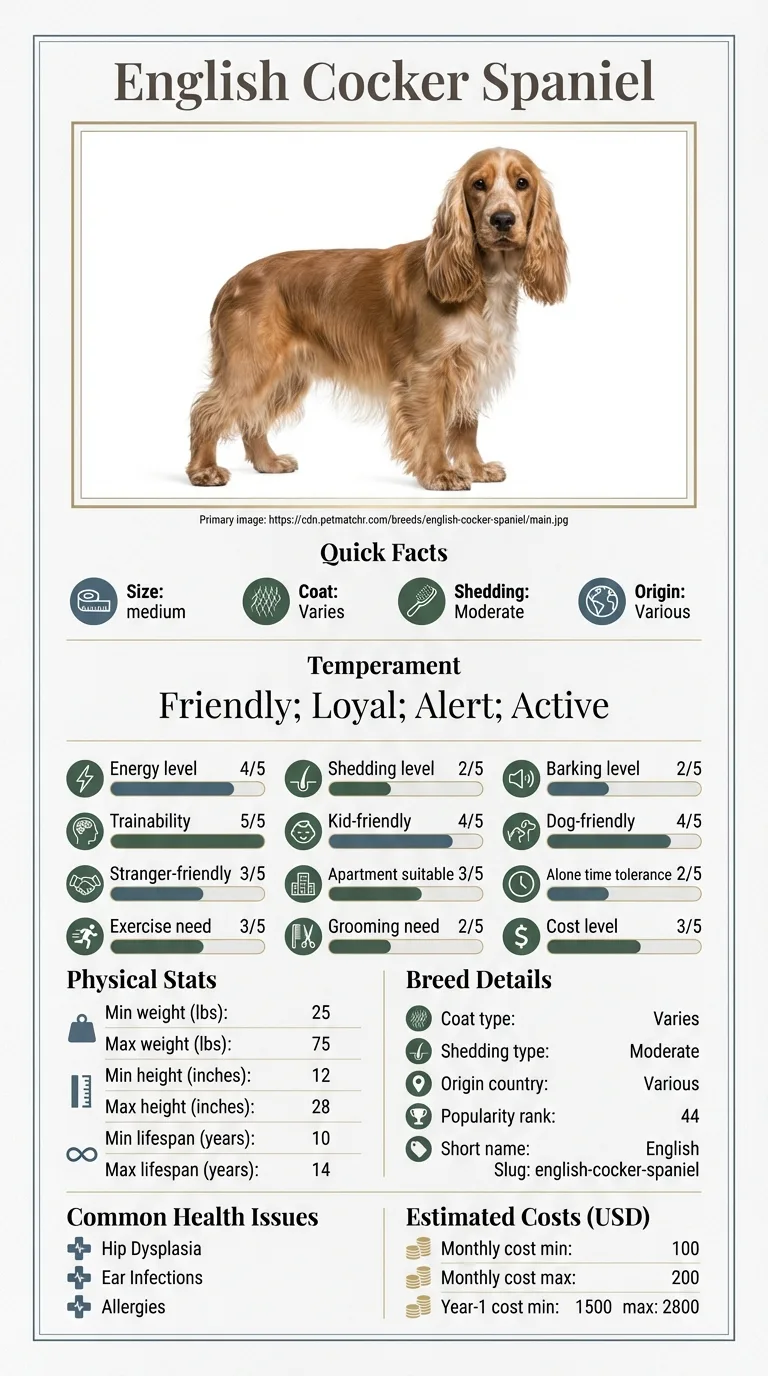
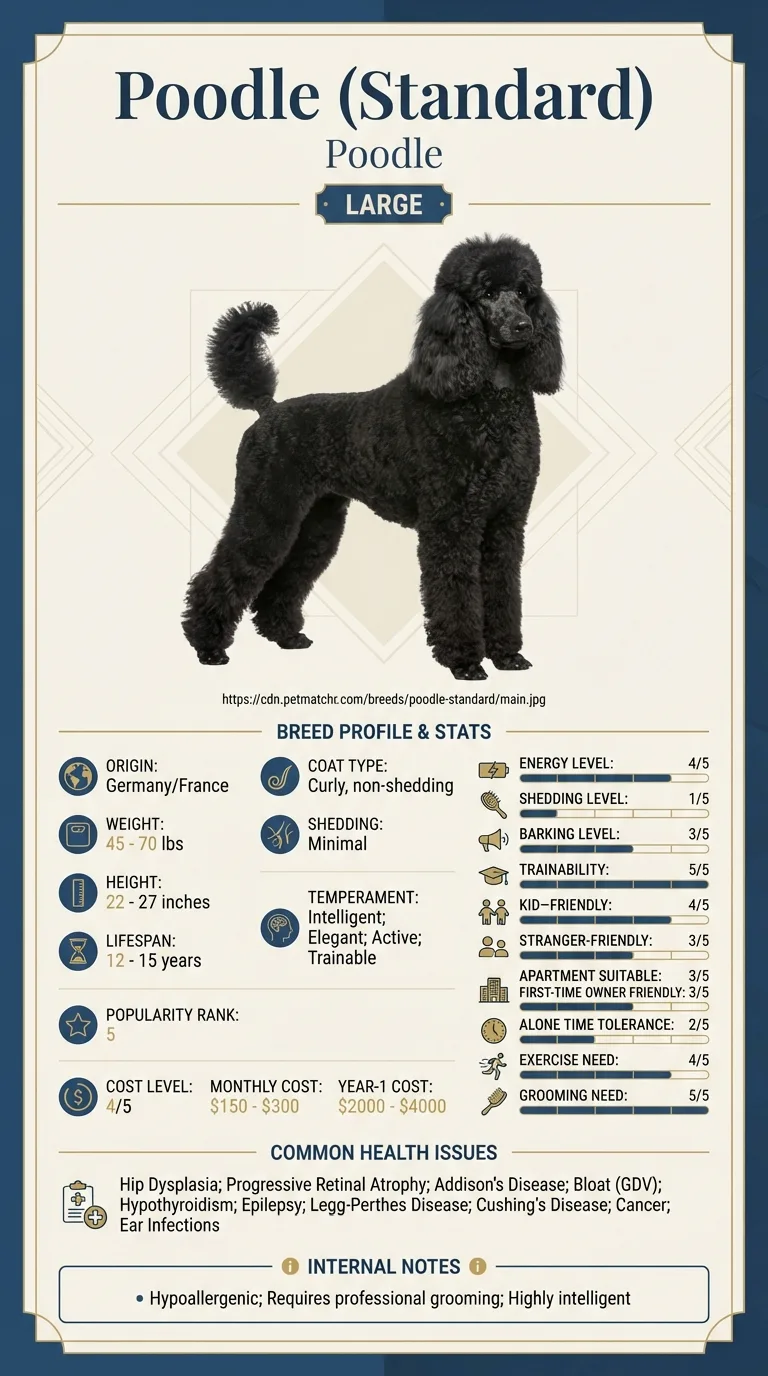
This is for someone already down to English Cocker Spaniel and Poodle (Standard) and deciding between them. For this pair the decision usually turns on shedding, so those are covered first and in most detail. Anyone choosing from a flat has a clear answer here: English Cocker Spaniel rates 4/5 against 3/5. The focus throughout is on daily consequences rather than breed background.
Between English Cocker Spaniel and Poodle (Standard), shedding is what separates them, and English Cocker Spaniel is the lower-effort dog of the two to keep.
Choose English Cocker Spaniel if you are in a flat or a smaller home, this is your first dog and you do not want a standing grooming appointment.
Choose Poodle (Standard) if shedding is a problem in your house, you want a dog that picks up training quickly and you want a dog that is more watchful with visitors.
| Feature | english cocker spaniel | poodle standard | Winner |
|---|---|---|---|
| Size class | medium | large | Equal |
| Weight | 26–34 lbs | 45–70 lbs | Equal |
| Height | 15–17 in | 22–27 in | Equal |
| Lifespan | 12–14 years | 12–15 years | poodle standard |
| Exercise need | High (4/5) | High (4/5) | Equal |
| Grooming need | High (4/5) | Very high (5/5) | english cocker spaniel |
| Shedding | Moderate (3/5) | Very low (1/5) | poodle standard |
| Energy level | High (4/5) | High (4/5) | Equal |
| Barking | Moderate (3/5) | Moderate (3/5) | Equal |
| Apartment suitability | High (4/5) | Moderate (3/5) | english cocker spaniel |
| Good for first-time owners | High (4/5) | Moderate (3/5) | english cocker spaniel |
| Tolerates being alone | Low (2/5) | Low (2/5) | Equal |
| Trainability | High (4/5) | Very high (5/5) | poodle standard |
| Good with kids | Very high (5/5) | High (4/5) | english cocker spaniel |
| Good with other dogs | High (4/5) | High (4/5) | Equal |
| Friendly to strangers | High (4/5) | Moderate (3/5) | english cocker spaniel |
| Cost level | Moderate (3/5) | High (4/5) | english cocker spaniel |
| Coat | Medium, silky and feathered | Curly, non-shedding | Equal |
| Origin | Various | Germany/France | Equal |
| Typical monthly cost | $100–$200 | $150–$300 | Equal |
| Typical first-year cost | $1,400–$2,900 | $2,000–$4,000 | Equal |
Flip the usual size assumption here - the Standard Poodle is the larger breed in this pairing, 45-70 lbs against the Cocker's 26-34 lbs, and taller too at 22-27 in versus 15-17 in. This is the one Poodle size that genuinely outsizes the Cocker rather than undersizing it, closer in build to a retriever than to the toy and miniature versions most people picture.
No daylight between them on activity level: both rate High (4/5) for energy and High (4/5) for exercise need. Standard Poodles were bred as substantial working retrievers, and it shows - this isn't a smaller, calmer version of the breed, it's a big dog that wants a job. Expect to match the Cocker's activity demands here rather than get a break from them.
The Standard Poodle's coat is even more of a commitment than a smaller Poodle's simply because there's more of it - Very High (5/5) grooming against the Cocker's High (4/5), on a bigger dog that takes longer at every appointment. The payoff is the same low-shed coat, Very Low (1/5) against the Cocker's Moderate (3/5), just scaled up to a larger animal.
Size finally works against the Poodle here: apartment suitability drops to Moderate (3/5) for the Standard, against the Cocker's High (4/5) - a 45-70 lb dog is simply a bigger ask in a small space. Barking and alone-tolerance match at Moderate (3/5) and Low (2/5) respectively for both breeds, so the apartment question really comes down to floor space and a landlord's weight limit.
The Standard Poodle trains faster on paper, Very High (5/5) against the Cocker's High (4/5) - it's widely considered one of the smartest breeds full stop. Yet the Cocker rates better for a first-timer, High (4/5) against Moderate (3/5); a large, extremely intelligent dog that gets bored is a bigger handful than a smaller, moderately smart one, simply due to size and strength.
The Cocker rates a bit higher with kids, Very High (5/5) against the Standard's High (4/5) - both good numbers, but worth noting for a household with very young children given the size difference alone. Both handle other dogs equally at High (4/5). Strangers split further, High (4/5) for the Cocker against Moderate (3/5) for the Standard, which tends to be more reserved and watchful with people it doesn't know.
The Standard Poodle's lifespan ceiling runs a year higher, 12-15 against the Cocker's 12-14 - a smaller gap than you'll see with the Toy or Miniature versions, which is typical for larger breeds. The two share hip dysplasia, progressive retinal atrophy, and ear infections as risks. The Standard's larger frame adds bloat (GDV) to the list, a real emergency risk in big, deep-chested dogs that the smaller Cocker doesn't carry in the same way.
The Standard Poodle is the clear pricier option: High (4/5) cost level against the Cocker's Moderate (3/5), $150-300 a month against $100-200, and a first-year range that can run to $4,000 against the Cocker's $2,900 ceiling. More dog means more food, more medication by weight, and bigger grooming bills - budget accordingly if the Standard is the one you want.
English Cocker Spaniel weighs 26–34 lbs and lives 12–14 years; Poodle (Standard) weighs 45–70 lbs and lives 12–15 years. The two diverge most on shedding. They are level on tolerates being alone, barking and good with other dogs, so those cannot decide it. The table below marks a winner only where one breed is genuinely easier for a typical owner; size and origin are facts rather than merits and stay level. Ratings come from one source applied to both breeds, so they are meaningful against each other rather than as absolute scores.

Yes, considerably - 45-70 lbs and 22-27 in against the Cocker's 26-34 lbs and 15-17 in.
The Standard Poodle, rated Very High (5/5) against the Cocker's High (4/5), and grooming sessions take longer simply because there's more coat.
The Cocker, rated High (4/5) against the Standard Poodle's Moderate (3/5) - size works against the bigger dog here.
Rated Moderate (3/5), a step below the Cocker's High (4/5). Its size and intelligence both call for a confident handler.
The Standard Poodle, by a wide margin - up to $4,000 in a first year against the Cocker's $2,900 ceiling.
Yes - hip dysplasia, progressive retinal atrophy, and ear infections appear on both lists. The Standard also carries a bloat risk tied to its deep chest.
The Standard Poodle, by about a year at the top end - 12-15 versus the Cocker's 12-14.
The Cocker fits smaller homes better here - High (4/5) apartment suitability against the Standard Poodle's Moderate (3/5), the one case where size favors the Cocker.
The Standard Poodle costs substantially more - up to $300 a month and $4,000 in year one, against the Cocker's $200 and $2,900 ceilings.
Exercise need matches exactly at High (4/5) - both are genuinely active breeds, not just energetic ones.
The Standard Poodle's lifespan tops out a year higher, 15 years against the Cocker's 14, but it also carries a bloat risk the Cocker doesn't.
Secure checkout on Stripe. We never see your card.
7-day money-back guarantee. Instant access.

Health information here is general and is not veterinary advice. If your dog shows pain, sudden behaviour change, or worsening symptoms, consult a licensed veterinarian.
Some links on this site are affiliate links. We may earn a commission at no extra cost to you, and we only suggest products we believe are helpful for dog owners.
We research and check what we publish, but we do not warrant that any figure, date, price, or statement is accurate, complete, or current, and we accept no liability for any loss, cost, injury, or other harm arising from the use of this site. Use it as one reference among several. You remain responsible for your own decisions and for your dog's care - confirm anything that matters with a licensed veterinarian or another qualified professional before you act on it. Full disclaimer.
Match your lifestyle to the right dog.
Take quizNot sure which breed is right for you? Take our 2-minute quiz to find out.
Take the quiz