Living
Which breed fits more living situations?
The Cocker Spaniel, mainly on size, it rates higher for apartment living and first-time owners, while the Standard Poodle needs more space and exercise commitment.

Quick answer
Which breed fits more living situations?
The Cocker Spaniel, mainly on size, it rates higher for apartment living and first-time owners, while the Standard Poodle needs more space and exercise commitment.
Cocker Spaniel or Poodle (Standard)? On paper they differ most on shedding, and on the scales Poodle (Standard) is the heavier at 45–70 lbs. Here is how the two compare on everything that shapes an ordinary week.
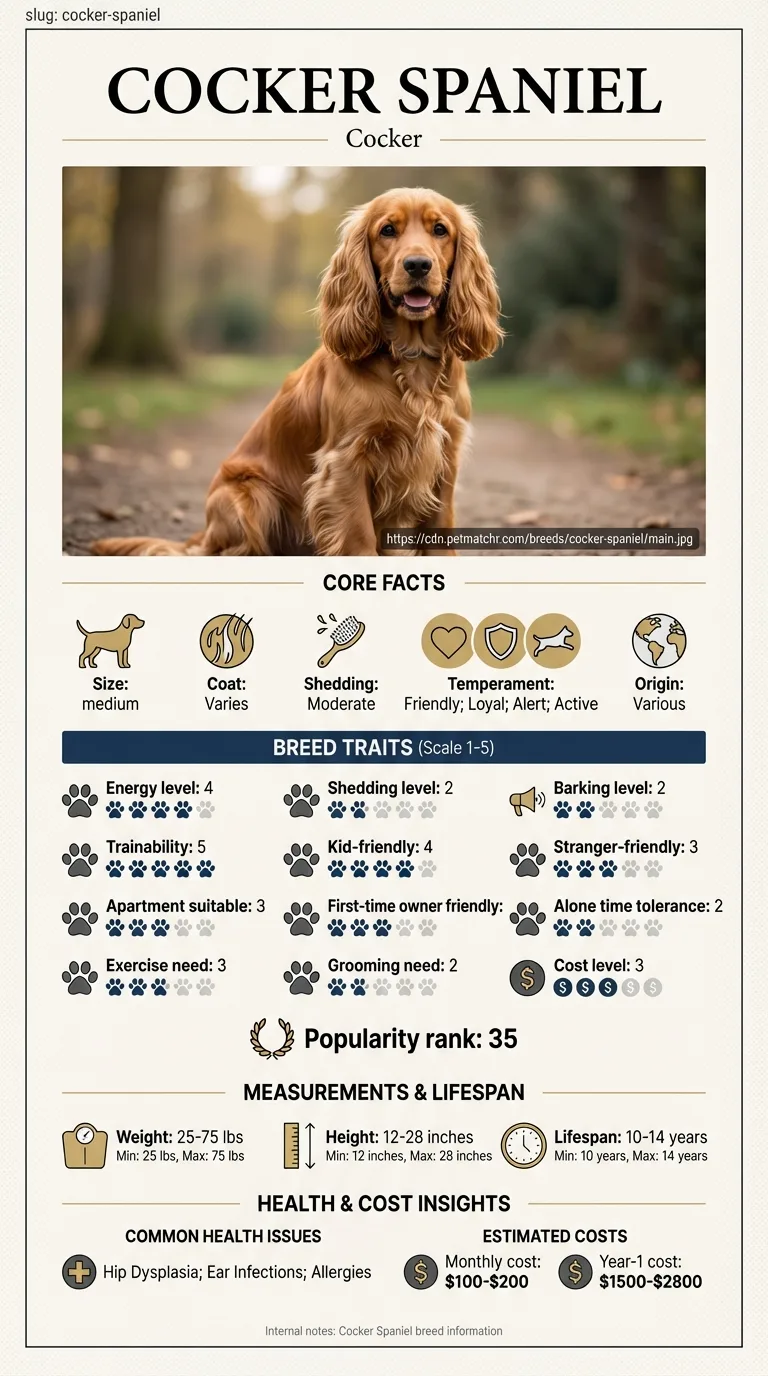
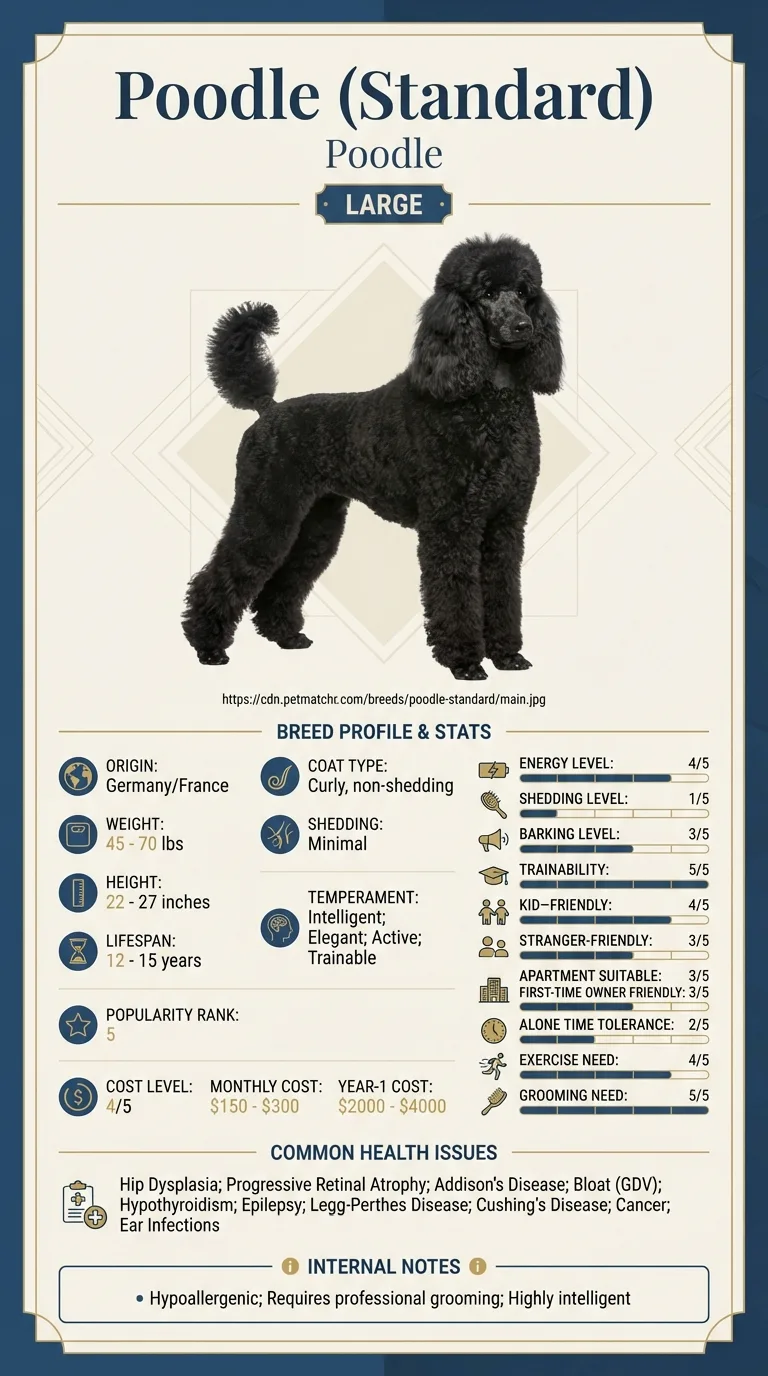
This is for someone already down to Cocker Spaniel and Poodle (Standard) and deciding between them. For this pair the decision usually turns on shedding, so those are covered first and in most detail. Anyone choosing from a flat has a clear answer here: Cocker Spaniel rates 4/5 against 3/5. It is written for the decision rather than the breed history.
Between Cocker Spaniel and Poodle (Standard), shedding is what separates them, and Cocker Spaniel is the lower-effort dog of the two to keep.
Choose Cocker Spaniel if you are in a flat or a smaller home, this is your first dog and your walking routine is modest.
Choose Poodle (Standard) if shedding is a problem in your house, you want a dog that picks up training quickly and you want a dog that can keep up with an active routine.
| Feature | cocker spaniel | poodle standard | Winner |
|---|---|---|---|
| Size class | small | large | Equal |
| Weight | 20–30 lbs | 45–70 lbs | Equal |
| Height | 13–16 in | 22–27 in | Equal |
| Lifespan | 10–14 years | 12–15 years | poodle standard |
| Exercise need | Moderate (3/5) | High (4/5) | cocker spaniel |
| Grooming need | Very high (5/5) | Very high (5/5) | Equal |
| Shedding | Moderate (3/5) | Very low (1/5) | poodle standard |
| Energy level | Moderate (3/5) | High (4/5) | Equal |
| Barking | Moderate (3/5) | Moderate (3/5) | Equal |
| Apartment suitability | High (4/5) | Moderate (3/5) | cocker spaniel |
| Good for first-time owners | High (4/5) | Moderate (3/5) | cocker spaniel |
| Tolerates being alone | Low (2/5) | Low (2/5) | Equal |
| Trainability | High (4/5) | Very high (5/5) | poodle standard |
| Good with kids | Very high (5/5) | High (4/5) | cocker spaniel |
| Good with other dogs | High (4/5) | High (4/5) | Equal |
| Friendly to strangers | High (4/5) | Moderate (3/5) | cocker spaniel |
| Cost level | Moderate (3/5) | High (4/5) | cocker spaniel |
| Coat | Silky and feathered | Curly, non-shedding | Equal |
| Origin | Various | Germany/France | Equal |
| Typical monthly cost | $80–$150 | $150–$300 | Equal |
| Typical first-year cost | $1,100–$2,300 | $2,000–$4,000 | Equal |
This is a genuine size mismatch: the Standard Poodle runs 45-70 lbs and 22-27 inches, more than double the Cocker Spaniel's 20-30 lbs and 13-16 inches. Don't let the shared Poodle name fool you into picturing something Cocker-sized, a Standard Poodle is a large dog by any definition, closer in scale to a Labrador than to its own Miniature and Toy relatives.
The Standard Poodle asks more of you physically, high (4/5) for both exercise need and energy level, against the Cocker's moderate (3/5) on both. It was bred as a working retriever, and that stamina hasn't bred out of the Standard variety the way it has in the smaller sizes.
Both breeds tie at very high (5/5) grooming need, so budget serious time or money for coat care either way. Shedding tells a different story: the Standard Poodle's curly coat rates very low (1/5), essentially non-shedding, against the Cocker's moderate (3/5), useful to know if allergies are part of your decision.
Here the Cocker actually comes out ahead, high (4/5) for apartment suitability against the Standard Poodle's moderate (3/5), a reversal of the pattern you see with Toy and Miniature Poodles. Size is the obvious reason: a 70-lb dog needs more room to move than a smaller apartment easily provides. Barking rates tied at moderate (3/5) for both.
The Standard Poodle rates very high (5/5) for trainability, a notch above the Cocker's high (4/5), consistent with the breed's reputation as one of the smartest around. First-time-owner suitability favors the Cocker, though, high (4/5) versus moderate (3/5), likely because a large, high-energy, highly intelligent dog asks more of a novice handler than its trainability score alone suggests.
The Cocker rates higher with kids (very high, 5/5, versus high, 4/5) and with strangers (high, 4/5, versus moderate, 3/5), while both breeds tie for compatibility with other dogs at high (4/5). Given the Standard Poodle's size, a lower score around young kids is also a practical safety consideration, not just a temperament note.
The Standard Poodle lives longer on average, 12-15 years against the Cocker's 10-14, but carries a much longer list of health risks, ten conditions including cancer, bloat, and Cushing's disease, several of them common concerns for large, deep-chested breeds. Three conditions overlap with the Cocker's list: hip dysplasia, progressive retinal atrophy, and ear infections.
The Standard Poodle costs meaningfully more to keep: $150-300 monthly against the Cocker's $80-150, and $2,000-4,000 in the first year versus $1,100-2,300, nearly double at the high end. Food volume for a 70-lb dog and professional grooming for that coat both drive the gap.
Cocker Spaniel weighs 20–30 lbs and lives 10–14 years; Poodle (Standard) weighs 45–70 lbs and lives 12–15 years. The two diverge most on shedding. They are level on tolerates being alone, barking and good with other dogs, so those cannot decide it. In the table, a "winner" means easier for an ordinary household — not better. Size, coat and origin are recorded without a verdict. Because both breeds are scored the same way, the gaps are reliable even where the absolute numbers are rough.

A lot, 45-70 lbs against 20-30 lbs, and 22-27 inches tall versus 13-16. The Standard Poodle is a large breed; only the name suggests otherwise.
The Cocker Spaniel, rated moderate (3/5). The Standard Poodle's curly coat rates very low (1/5), making it one of the more allergy-friendly large breeds.
Less so than a Cocker Spaniel, it rates moderate (3/5) for apartment suitability against the Cocker's high (4/5), mostly a function of its larger size.
The Cocker Spaniel, rated high (4/5) for first-time owners versus the Standard Poodle's moderate (3/5), even though the Poodle is technically more trainable.
Notably more, $150-300 a month versus $80-150 for the Cocker, and up to $4,000 in the first year versus $2,300.
Yes, three conditions overlap: hip dysplasia, progressive retinal atrophy, and ear infections. The Standard Poodle's remaining risks skew toward large-breed concerns like bloat and cancer.
The Standard Poodle, at 12-15 years versus the Cocker Spaniel's 10-14.
The Cocker Spaniel, mainly on size, it rates higher for apartment living and first-time owners, while the Standard Poodle needs more space and exercise commitment.
$150-300 for the Standard Poodle versus $80-150 for the Cocker Spaniel, close to double.
The Standard Poodle, rated high (4/5) against the Cocker's moderate (3/5).
The Standard Poodle, typically 12-15 years, versus 10-14 for the Cocker Spaniel.
Secure checkout on Stripe. We never see your card.
7-day money-back guarantee. Instant access.

Health information here is general and is not veterinary advice. If your dog shows pain, sudden behaviour change, or worsening symptoms, consult a licensed veterinarian.
Some links on this site are affiliate links. We may earn a commission at no extra cost to you, and we only suggest products we believe are helpful for dog owners.
We research and check what we publish, but we do not warrant that any figure, date, price, or statement is accurate, complete, or current, and we accept no liability for any loss, cost, injury, or other harm arising from the use of this site. Use it as one reference among several. You remain responsible for your own decisions and for your dog's care - confirm anything that matters with a licensed veterinarian or another qualified professional before you act on it. Full disclaimer.
Match your lifestyle to the right dog.
Take quizNot sure which breed is right for you? Take our 2-minute quiz to find out.
Take the quiz