Havanese vs Poodle (Standard): Which Suits Your Home?
Quick answer
Havanese or Standard Poodle -- which should you get?
If you want a low-shedding, highly trainable dog and can commit to daily exercise and larger-dog costs, the Poodle. If you want a low-exercise companion that fits apartment life on a smaller budget, the Havanese.
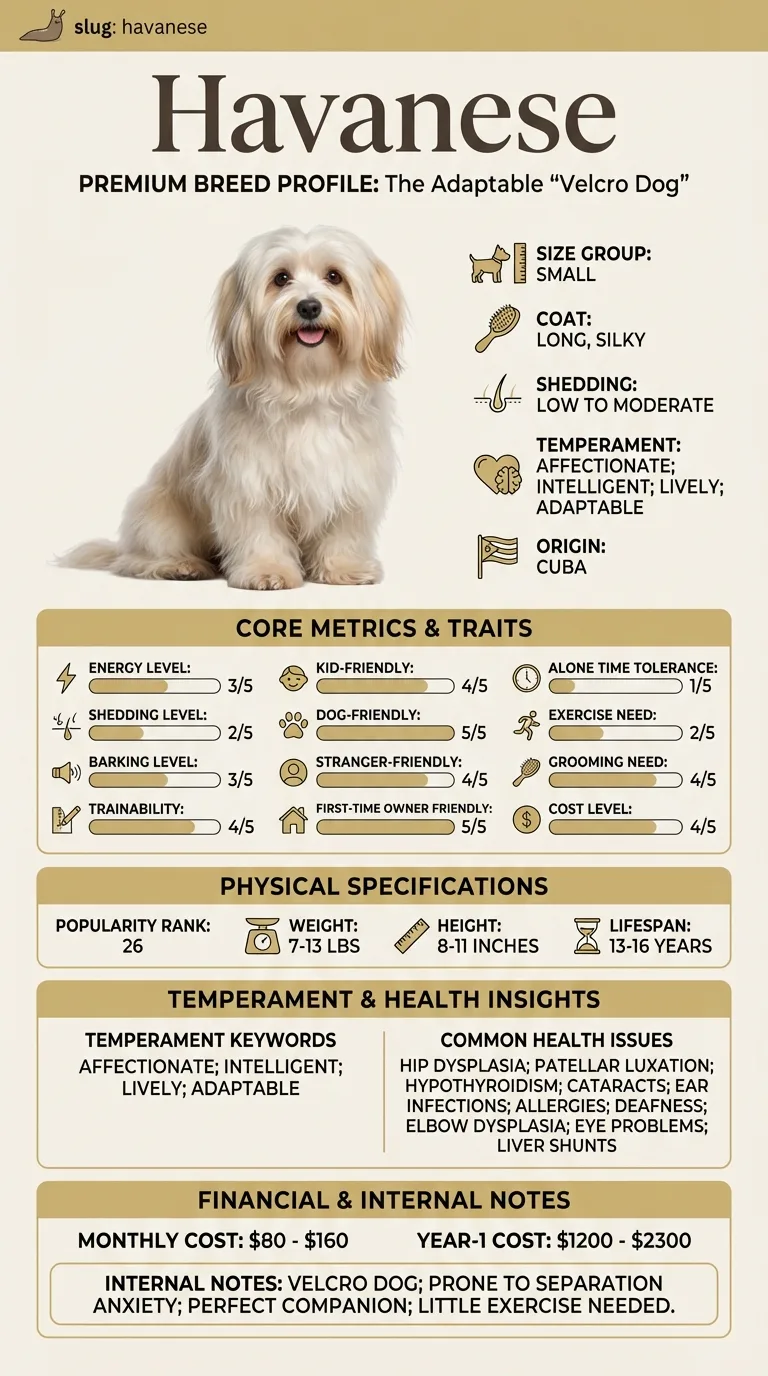
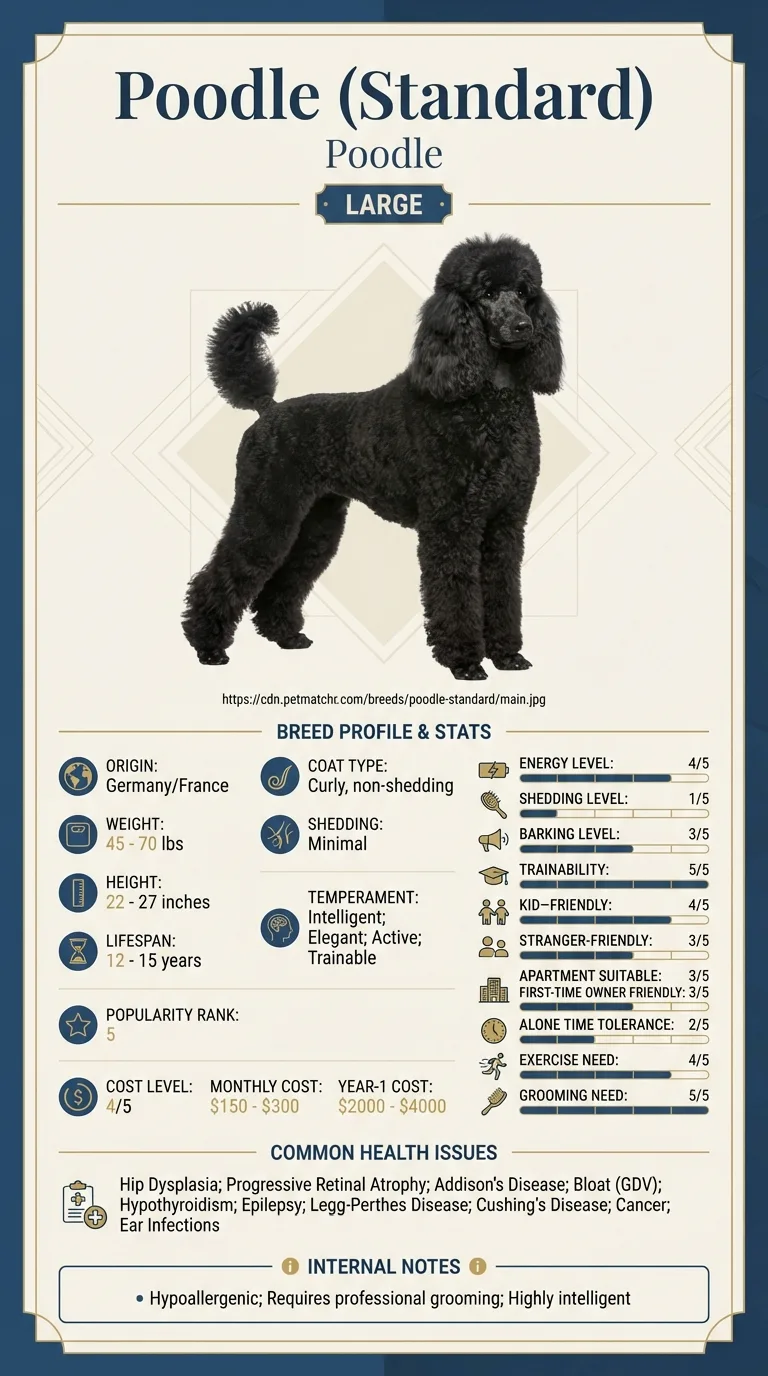
Havanese or Poodle (Standard)? On paper they differ most on exercise need, and on the scales Poodle (Standard) is the heavier at 45–70 lbs. Here is how the two compare on everything that shapes an ordinary week.
This is for someone already down to Havanese and Poodle (Standard) and deciding between them. For this pair the decision usually turns on exercise need and apartment suitability, so those are covered first and in most detail. Anyone choosing from a flat has a clear answer here: Havanese rates 5/5 against 3/5. The focus throughout is on daily consequences rather than breed background.
Quick verdict
Between Havanese and Poodle (Standard), exercise need is what separates them, and Havanese is the lower-effort dog of the two to keep.
Choose havanese if...
Choose Havanese if you are in a flat or a smaller home, this is your first dog and you do not want a standing grooming appointment.
Choose poodle standard if...
Choose Poodle (Standard) if shedding is a problem in your house, you want a dog that picks up training quickly and you want a dog that can keep up with an active routine.
Head-to-head comparison
Feature
havanese
poodle standard
Winner
Size class
small
large
Equal
Weight
7–13 lbs
45–70 lbs
Equal
Height
8–11 in
22–27 in
Equal
Lifespan
13–16 years
12–15 years
havanese
Exercise need
Low (2/5)
High (4/5)
havanese
Grooming need
High (4/5)
Very high (5/5)
havanese
Shedding
Low (2/5)
Very low (1/5)
poodle standard
Energy level
Moderate (3/5)
High (4/5)
Equal
Barking
Moderate (3/5)
Moderate (3/5)
Equal
Apartment suitability
Very high (5/5)
Moderate (3/5)
havanese
Good for first-time owners
Very high (5/5)
Moderate (3/5)
havanese
Tolerates being alone
Very low (1/5)
Low (2/5)
poodle standard
Trainability
High (4/5)
Very high (5/5)
poodle standard
Good with kids
High (4/5)
High (4/5)
Equal
Good with other dogs
Very high (5/5)
High (4/5)
havanese
Friendly to strangers
High (4/5)
Moderate (3/5)
havanese
Cost level
High (4/5)
High (4/5)
Equal
Coat
Long, silky
Curly, non-shedding
Equal
Origin
Cuba
Germany/France
Equal
Typical monthly cost
$80–$160
$150–$300
Equal
Typical first-year cost
$1,200–$2,300
$2,000–$4,000
Equal
Deep dive
Size and build
Havanese tops out around 13 lbs; a Standard Poodle is a genuinely large dog, 45 to 70 lbs, closer in scale to a Rottweiler than to a Havanese. Height tells the same story: 8-11 inches versus 22-27. The Poodle's build backs up its "Elegant" and "Active" temperament tags -- a tall, athletic frame meant to cover ground, not curl up on a lap. If living space or how much dog you can physically manage is the deciding factor, this comparison settles itself before temperament even enters the conversation.
Energy and exercise
Havanese sits at a 2/5 for exercise need -- short walks and indoor play cover it. Standard Poodle rates 4/5; bred originally as a working retriever, it wants real daily exercise, not a stroll around the block. Energy level itself is rated closer, 3/5 versus 4/5 and logged as a tie, but the exercise-need gap is the number that actually determines your weekly schedule. An owner used to a Havanese's pace would likely find a Poodle under-exercised and restless within days.
Grooming and shedding
Both coats need professional attention -- Havanese rates 4/5 for grooming, the Poodle 5/5, the top tier on this site's scale. Where they split is shedding: Havanese sheds low (2/5), the Poodle almost none (1/5), part of why Poodles get recommended to allergy households despite being the higher-maintenance breed to trim. The Havanese's coat is described as long and silky; the Poodle's as curly and essentially non-shedding -- different textures that both mat without regular brushing or clipping.
Apartment living, noise and time alone
Havanese scores a full 5/5 for apartment living and barks at a moderate 3/5. Standard Poodle drops to 3/5 for apartment suitability -- not because of noise, which is also rated moderate at 3/5, but because a dog this size and this active needs more room to burn off energy than most apartments realistically offer. Neither breed does well left completely alone for long stretches, though the Poodle tolerates it marginally better than the Havanese does.
Training and owner experience
Havanese rates 5/5 for first-time owners, the Poodle a more middling 3/5. That's not about intelligence -- the Poodle actually trains higher, 5/5 versus 4/5, and leans heavily on "Intelligent" and "Trainable" temperament tags -- it's the combination of size, exercise needs, and grooming upkeep that make it a bigger overall commitment for someone new to dogs. A first-time owner who can meet a Poodle's exercise and grooming demands will likely find it just as responsive to training as the Havanese.
Kids, other dogs and visitors
Both breeds score well with kids, 4/5 each. Havanese edges ahead with other dogs (5/5 vs 4/5) and with strangers (4/5 vs 3/5), consistent with its "Affectionate" and "Adaptable" temperament tags. Neither dog does well left alone for long stretches, though the Poodle tolerates it slightly better at 2/5 against the Havanese's very low 1/5. For a household with frequent visitors or other pets, the Havanese's higher scores across the board make it the more forgiving choice.
Health and lifespan
Havanese typically lives 13-16 years, a year or two longer than the Poodle's 12-15. The Poodle's ten-condition health list carries more serious systemic risk -- bloat, Addison's disease, Cushing's disease, and cancer alongside the more common hip dysplasia and hypothyroidism -- while the Havanese's equally long list leans toward more manageable issues like allergies, ear infections, cataracts, and liver shunts. Both share hip dysplasia, hypothyroidism, and ear infections, so routine screening for those matters regardless of which breed you choose.
Cost to keep
Monthly costs run $80-160 for the Havanese against $150-300 for the Poodle, and first-year costs roughly double that gap: $1,200-2,300 versus $2,000-4,000. Both land in the "high" cost tier on this site, but the Poodle's larger size and more demanding grooming schedule push the actual dollar figures well above the Havanese's at every stage. Budget for grooming specifically -- it's the line item most likely to surprise a new Poodle owner who hasn't priced professional coat care before.
Havanese vs Poodle (Standard) at a glance
Havanese weighs 7–13 lbs and lives 13–16 years; Poodle (Standard) weighs 45–70 lbs and lives 12–15 years. The two diverge most on exercise need, apartment suitability and good for first-time owners. They are level on barking, cost level and good with kids, so those cannot decide it. The table below marks a winner only where one breed is genuinely easier for a typical owner; size and origin are facts rather than merits and stay level. Ratings come from one source applied to both breeds, so they are meaningful against each other rather than as absolute scores.
Havanese vs Poodle (Standard): Which Suits Your Home? - Havanese vs Poodle (Standard) at a glance
Frequently asked questions
Which is smaller, the Havanese or the Standard Poodle?
The Havanese, by a wide margin -- 7-13 lbs and 8-11 inches versus the Poodle's 45-70 lbs and 22-27 inches. There's no medium-sized version of this Poodle in the comparison; it's built to a large-breed frame.
Which sheds less?
The Standard Poodle, rated 1/5 for shedding versus the Havanese's 2/5. Both are considered low-shedding breeds, but the Poodle's curly coat is the closer thing to non-shedding, at the cost of needing more frequent professional grooming.
Is either breed a good fit for a first-time owner?
The Havanese is rated 5/5 for first-time owners; the Poodle sits at 3/5. The Poodle isn't hard to train -- it actually scores higher on trainability -- but its size, exercise needs, and grooming bill add up to more responsibility for someone new to dog ownership.
Which is better for an apartment?
The Havanese, 5/5 versus the Poodle's 3/5. Barking levels are the same for both, moderate, so the difference comes down to the Poodle's need for daily exercise a small unit can't fully provide.
How much more does the Poodle cost to keep?
Close to double. Expect $150-300 a month for the Poodle against $80-160 for the Havanese, and a first year in the $2,000-4,000 range versus $1,200-2,300.
Do their health risks overlap?
Some -- both breeds can develop hip dysplasia, hypothyroidism, and ear infections. The Poodle's list also includes more serious conditions like bloat, Addison's, Cushing's, and cancer, which aren't on the Havanese's list.
Which lives longer?
The Havanese, typically 13-16 years against the Poodle's 12-15. It's a modest gap, but consistent with the general pattern of smaller dogs outliving larger ones.
Havanese or Standard Poodle -- which should you get?
If you want a low-shedding, highly trainable dog and can commit to daily exercise and larger-dog costs, the Poodle. If you want a low-exercise companion that fits apartment life on a smaller budget, the Havanese.
Costs
What's the monthly cost difference?
Havanese runs $80-160/month, Poodle $150-300 -- nearly double once food, grooming, and vet visits for a much bigger dog are factored in.
Behavior
Which needs more exercise?
The Poodle, rated 4/5 versus the Havanese's 2/5 -- it needs real daily activity, not just a walk around the block.
Health
Which breed lives longer?
The Havanese, at 13-16 years versus the Poodle's 12-15.
Related DogBreedCompass guides
Havanese breed guide – Readers comparing the two usually want the full profile of Havanese before deciding.
Poodle (Standard) breed guide – The same for Poodle (Standard), so the comparison can be checked against the detail.
Havanese vs Cavalier King Charles Spaniel – Cavalier King Charles Spaniel is the closest breed to Havanese on the measured axes, so it is the natural next comparison.
Health information here is general and is not veterinary advice. If your dog shows pain, sudden behaviour change, or worsening symptoms, consult a licensed veterinarian.
Some links on this site are affiliate links. We may earn a commission at no extra cost to you, and we only suggest products we believe are helpful for dog owners.
We research and check what we publish, but we do not warrant that any figure, date, price, or statement is accurate, complete, or current, and we accept no liability for any loss, cost, injury, or other harm arising from the use of this site. Use it as one reference among several. You remain responsible for your own decisions and for your dog's care - confirm anything that matters with a licensed veterinarian or another qualified professional before you act on it. Full disclaimer.