Living
Akita vs Old English Sheepdog: which should I choose?
The Old English Sheepdog if you want a sociable family dog and will commit to the coat. The Akita if you will not — the running costs are identical, so the coat is genuinely the decision.

Quick answer
Akita vs Old English Sheepdog: which should I choose?
The Old English Sheepdog if you want a sociable family dog and will commit to the coat. The Akita if you will not — the running costs are identical, so the coat is genuinely the decision.
These two breeds cost exactly the same to keep — $110 to $240 a month, $1,700 to $3,200 in the first year — and need exactly the same amount of exercise at 3/5. What differs is the grooming: 5/5 against 3/5, and that gap is measured in hours every single week.
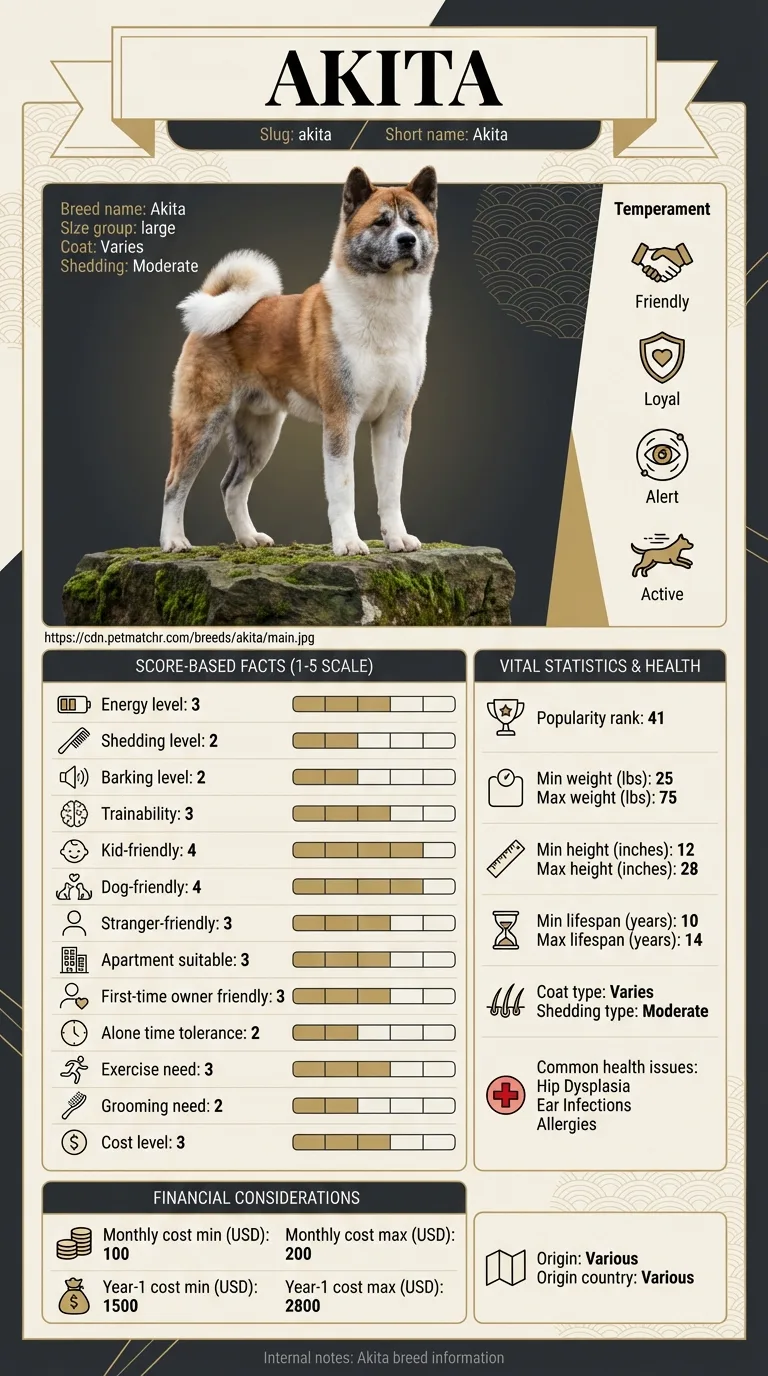
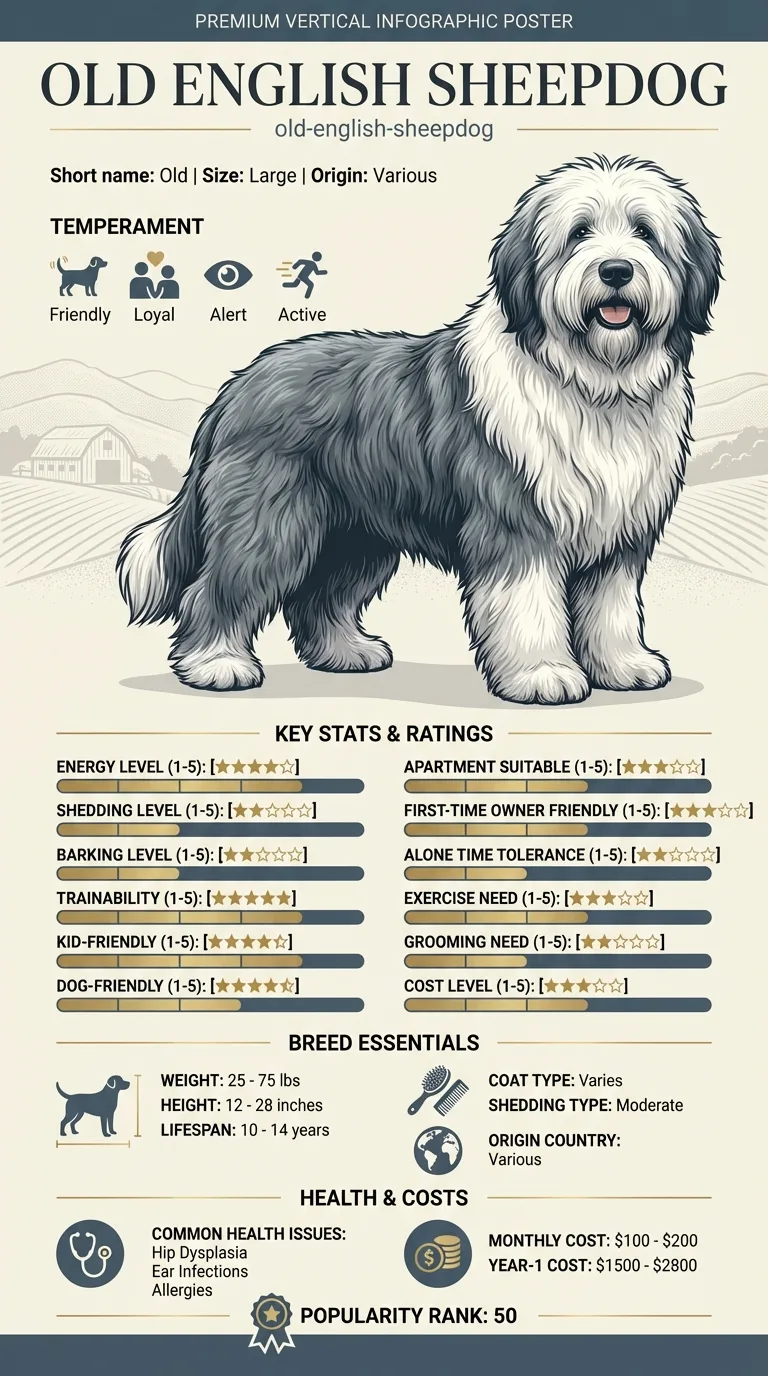
This page is for someone weighing a large shaggy family dog against a large guardian, with the budget already fixed. It covers the grooming difference in practical terms, temperament, an inherited respiratory condition, and where the identical costs actually go.
For the same money you can have a sociable family dog that needs several hours of coat work a week, or a guardian that needs almost none.
Choose the Akita if you will not do the grooming. It rates 3/5 against the Old English Sheepdog's 5/5, barks at 2/5 against 3/5, and tolerates being alone at 3/5 against 2/5. You are accepting 5/5 shedding rather than 4/5, 1/5 for first-time owners, and 2/5 with other dogs and strangers.
Choose the Old English Sheepdog if you want a sociable family dog and will commit to the coat. It rates 5/5 with children, 4/5 with other dogs and strangers, and needs the same 3/5 exercise as the Akita. You are accepting 5/5 grooming, a coat that mats to the skin if neglected, and a 2/5 tolerance for solitude.
| Feature | akita | old english sheepdog | Winner |
|---|---|---|---|
| Weight | 70–130 lbs | 60–100 lbs | Equal |
| Height | 24–28 in | 20–24 in | Equal |
| Lifespan | 10–13 years | 10–12 years | akita |
| Coat | Dense double coat | Long shaggy double coat | Equal |
| Grooming need | Moderate (3/5) | Very high (5/5) | akita |
| Shedding | Very high (5/5) | High (4/5) | old english sheepdog |
| Energy level | Moderate (3/5) | Moderate (3/5) | Equal |
| Exercise need | Moderate (3/5) | Moderate (3/5) | Equal |
| Trainability | Moderate (3/5) | Moderate (3/5) | Equal |
| Barking | Low (2/5) | Moderate (3/5) | akita |
| Good with kids | Moderate (3/5) | Very high (5/5) | old english sheepdog |
| Good with other dogs | Low (2/5) | High (4/5) | old english sheepdog |
| Friendly to strangers | Low (2/5) | High (4/5) | old english sheepdog |
| Apartment suitability | Low (2/5) | Low (2/5) | Equal |
| Good for first-time owners | Very low (1/5) | Low (2/5) | old english sheepdog |
| Tolerates being alone | Moderate (3/5) | Low (2/5) | akita |
| Typical monthly cost | $110–$240 | $110–$240 | Equal |
| Typical first-year cost | $1,700–$3,200 | $1,700–$3,200 | Equal |
The Old English Sheepdog's coat is long, profuse and double, and it mats faster than almost anything else on this site.
Maintained long, it needs brushing to the skin in sections — line brushing with a comb — for something in the region of three to four hours a week, split across sessions. Behind the ears, in the armpits, on the trousers and around the collar are where it fails first, and a coat that has matted to the skin cannot be brushed out. It has to be clipped off.
That is why so many pet Old English Sheepdogs are kept in a short trim, which is a completely reasonable choice and reduces the work to something manageable. It costs a professional appointment every six to eight weeks instead.
The hair around the eyes and over the hindquarters needs attention for hygiene as well as appearance, and a wet shaggy dog takes a long time to dry.
The Akita sheds more — 5/5 against 4/5 — and mats not at all. Its whole coat commitment is a weekly brush plus two or three weeks of raking, twice a year, and it never needs a groomer.
The Old English Sheepdog's 5/5 with children is well earned. It is patient, sturdy, tolerant of noise and genuinely fond of family life, and the breed's long association with children in advertising and film was not entirely invented.
The caveats are physical and behavioural. It is a big, bumping dog that does not always know where its back end is, and it retains a drovers' instinct to move things — which can mean leaning on, circling or nudging running children. That is worth interrupting early rather than finding charming.
Trainability is 3/5 and the honest description is independent and a little slow to be convinced. Consistency works; drilling does not.
At 2/5 for solitude it is a closely bonded breed and long absences produce vocalising and destruction. Absence training from the first week is the standard answer.
The Akita's 3/5 for solitude and 2/5 for barking are its two clearest advantages here. It does not need company and it does not comment on the neighbourhood.
Primary ciliary dyskinesia is the item on the Old English Sheepdog's list most people have never heard of and it is worth naming.
Cilia are microscopic hairs lining the airways that beat in a coordinated wave to move mucus and debris out of the lungs. In affected dogs they do not beat properly, so material accumulates and the dog gets recurrent respiratory infections from puppyhood onward — chronic nasal discharge, a persistent moist cough, and repeated pneumonia.
It is inherited, it is present from birth, and a puppy with a runny nose that never quite clears deserves investigation rather than another course of antibiotics. There is a DNA test available in this breed.
Hip dysplasia, cataracts, hypothyroidism and bloat complete the list. Ask for hip scores and eye certification on both parents.
Both breeds are deep-chested enough for gastric dilatation-volvulus to be a genuine emergency risk, and both households should know the signs: unproductive retching, a distending abdomen, restlessness.
The Akita's own burden is autoimmune and endocrine, with hip dysplasia and bloat, and it lives slightly longer at 10 to 13 years against 10 to 12.
$110–$240 a month and $1,700–$3,200 in the first year, for both. That is a genuine coincidence of two similarly sized dogs with similar food and veterinary profiles.
What the identical figures hide is grooming, which neither number includes. If you keep an Old English Sheepdog in full coat and do it yourself, the cost is hours. If you keep it trimmed, the cost is a professional appointment every six to eight weeks for ten to twelve years, and for a dog this size that is not a small line.
The Akita has no equivalent. A rake, a slicker and a garden, and nothing else for the life of the dog.
The expensive veterinary risks are comparable — bloat surgery and hip disease appear on both lists — with the Akita adding autoimmune disease and the Old English Sheepdog adding chronic respiratory management if it is unlucky.
So the honest summary is that the sticker price is the same and the total cost of ownership is not. The difference is entirely the coat, and it is entirely predictable before you buy.
Energy, exercise, trainability, apartment suitability and both cost figures all tie. That is more agreement than any other pairing in this batch.
The practical reading is that these two dogs make the same demand on your calendar and your bank account. Forty-five to sixty minutes of walking a day, a large dog's food bill, and neither suited to a flat.
The gap is grooming: 5/5 against 3/5. That is the difference between several hours a week for the life of the dog and a weekly brush with two intensive fortnights a year.
On temperament the Old English Sheepdog is much the friendlier animal — 5/5 with children, 4/5 with other dogs and strangers, against 3/5, 2/5 and 2/5. It is a drovers' dog, bred to work around people and livestock, not to assess visitors.
Both rate 3/5 for trainability, and in both cases the reason is a degree of independence rather than any lack of intelligence.

5/5 — in full coat, something like three to four hours a week of brushing to the skin in sections, split across sessions. A coat that has matted to the skin cannot be brushed out and has to be clipped off. Most pet owners keep the dog in a short trim with a professional groom every six to eight weeks instead.
On food and routine veterinary care, yes — both run $110–$240 a month and $1,700–$3,200 in the first year. Neither figure includes grooming, which is where the real difference sits: the Akita needs none at all, and the Old English Sheepdog needs either several hours a week or a regular groomer.
An inherited condition in which the microscopic hairs lining the airways fail to beat properly, so mucus and debris are not cleared. Affected dogs get recurrent respiratory infections from puppyhood — chronic nasal discharge, a persistent moist cough, repeated pneumonia. There is a DNA test in this breed.
The Old English Sheepdog at 5/5 against the Akita's 3/5 — patient, sturdy and genuinely fond of family life. The caveats are that it is a big bumping dog and that it retains a drovers' instinct to move things, which can mean leaning on or circling running children.
Yes — both rate 3/5 for exercise and 3/5 for energy, around forty-five to sixty minutes a day. Neither is a high-output breed. The difference in the walk is that an Akita needs securely fenced space and a route planned around unfamiliar dogs, and rates 2/5 with them.
The Akita at 3/5 against the Old English Sheepdog's 2/5. The sheepdog is a closely bonded breed and long absences produce vocalising and destruction, so absence training should start in the first week. The Akita is self-contained and does not experience an empty house as a loss.
The Akita at 5/5 against 4/5, though the difference matters less than the grooming rating. The Akita's shedding is concentrated into two intensive periods a year and its coat never mats; the sheepdog sheds somewhat less but into a coat that traps it, which is exactly why it mats.
The Old English Sheepdog if you want a sociable family dog and will commit to the coat. The Akita if you will not — the running costs are identical, so the coat is genuinely the decision.
Both run $110–$240 a month with first-year totals of $1,700–$3,200. Neither figure includes grooming, which the Old English Sheepdog needs for life and the Akita does not need at all.
Yes, and most pet Old English Sheepdogs are. A short trim reduces the work enormously and harms nothing. It costs a professional appointment every six to eight weeks instead of several hours a week.
Hip scores, eye certification, and the primary ciliary dyskinesia DNA result. Ask whether any puppy from these parents has had recurrent respiratory infections.
Secure checkout on Stripe. We never see your card.
7-day money-back guarantee. Instant access.
Health information here is general and is not veterinary advice. If your dog shows pain, sudden behaviour change, or worsening symptoms, consult a licensed veterinarian.
Some links on this site are affiliate links. We may earn a commission at no extra cost to you, and we only suggest products we believe are helpful for dog owners.
We research and check what we publish, but we do not warrant that any figure, date, price, or statement is accurate, complete, or current, and we accept no liability for any loss, cost, injury, or other harm arising from the use of this site. Use it as one reference among several. You remain responsible for your own decisions and for your dog's care - confirm anything that matters with a licensed veterinarian or another qualified professional before you act on it. Full disclaimer.
Match your lifestyle to the right dog.
Take quizNot sure which breed is right for you? Take our 2-minute quiz to find out.
Take the quiz