Living
Which is the better overall choice?
Go Maltese for apartment living, an easier first-timer experience, and lower overall cost. Go OES if you have space, want a dog that's especially good with kids, and can commit to serious grooming time.

Quick answer
Which is the better overall choice?
Go Maltese for apartment living, an easier first-timer experience, and lower overall cost. Go OES if you have space, want a dog that's especially good with kids, and can commit to serious grooming time.
Maltese or Old English Sheepdog? On paper they differ most on apartment suitability, and on the scales Old English Sheepdog is the heavier at 60–100 lbs. Here is how the two compare on everything that shapes an ordinary week.
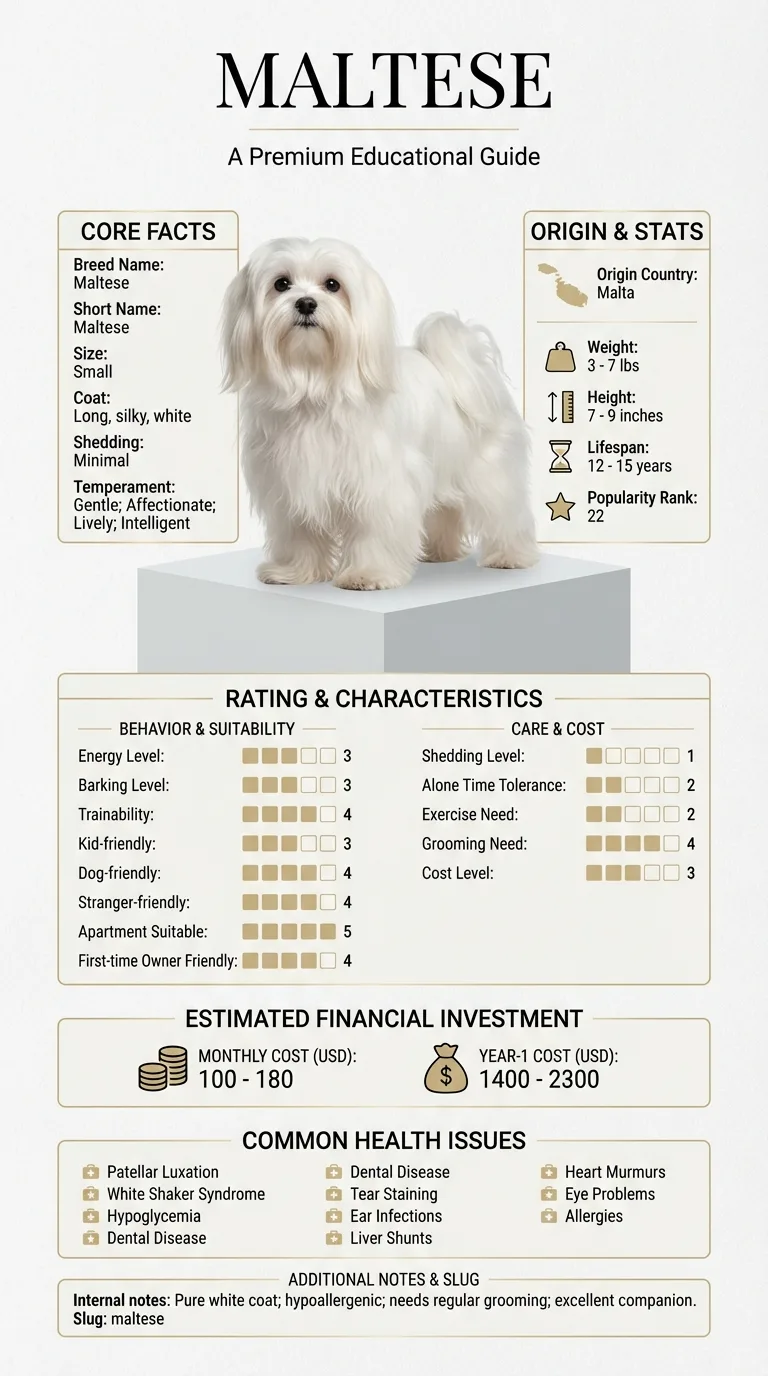
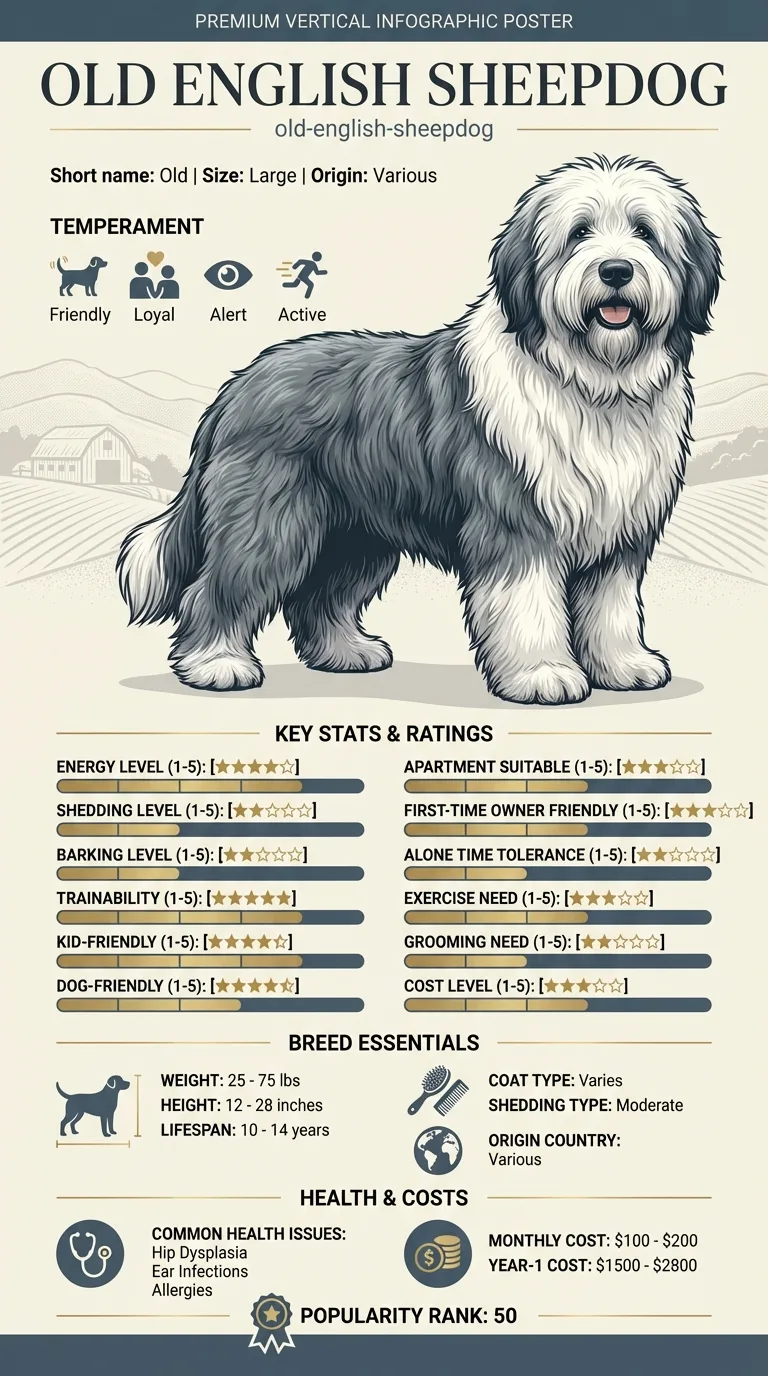
This is for someone already down to Maltese and Old English Sheepdog and deciding between them. For this pair the decision usually turns on apartment suitability and shedding, so those are covered first and in most detail. Anyone choosing from a flat has a clear answer here: Maltese rates 5/5 against 2/5. Breed history is left out; what follows is what you will actually live with.
Between Maltese and Old English Sheepdog, apartment suitability is what separates them, and Maltese is the lower-effort dog of the two to keep.
Choose Maltese if you are in a flat or a smaller home, this is your first dog and you do not want a standing grooming appointment.
Choose Old English Sheepdog if there are young children at home and you want a dog that can keep up with an active routine.
| Feature | maltese | old english sheepdog | Winner |
|---|---|---|---|
| Size class | small | large | Equal |
| Weight | 3–7 lbs | 60–100 lbs | Equal |
| Height | 7–9 in | 20–24 in | Equal |
| Lifespan | 12–15 years | 10–12 years | maltese |
| Exercise need | Low (2/5) | Moderate (3/5) | maltese |
| Grooming need | High (4/5) | Very high (5/5) | maltese |
| Shedding | Very low (1/5) | High (4/5) | maltese |
| Energy level | Moderate (3/5) | Moderate (3/5) | Equal |
| Barking | Moderate (3/5) | Moderate (3/5) | Equal |
| Apartment suitability | Very high (5/5) | Low (2/5) | maltese |
| Good for first-time owners | High (4/5) | Low (2/5) | maltese |
| Tolerates being alone | Low (2/5) | Low (2/5) | Equal |
| Trainability | High (4/5) | Moderate (3/5) | maltese |
| Good with kids | Moderate (3/5) | Very high (5/5) | old english sheepdog |
| Good with other dogs | High (4/5) | High (4/5) | Equal |
| Friendly to strangers | High (4/5) | High (4/5) | Equal |
| Cost level | Moderate (3/5) | High (4/5) | maltese |
| Coat | Long, silky, white | Long, shaggy double coat | Equal |
| Origin | Malta | Various | Equal |
| Typical monthly cost | $100–$180 | $110–$240 | Equal |
| Typical first-year cost | $1,400–$2,300 | $1,700–$3,200 | Equal |
The Old English Sheepdog dwarfs the Maltese, 60 to 100 pounds and 20 to 24 inches tall, against the Maltese's 3 to 7 pounds and 7 to 9 inches. This is a large, shaggy herding breed next to a toy companion breed, and the size difference alone will dictate a lot of practical decisions, from crate size to how much you're lifting into the car.
The Old English Sheepdog needs somewhat more activity than the Maltese, a moderate 3 out of 5 against the Maltese's low 2 out of 5, which tracks with its herding-dog roots. Neither breed is an extreme-exercise dog, but the OES benefits from having a job or at least a consistent daily routine, more so than the more contentedly low-key Maltese.
Both breeds need serious coat care, 4 out of 5 for the Maltese, an even higher 5 out of 5 for the OES, but shedding tells a different story. The Maltese sheds almost nothing (1 out of 5), while the OES sheds heavily (4 out of 5) despite all that brushing. The OES asks for the most total coat-care commitment of any breed in this comparison, on both fronts at once.
The Maltese is rated ideal for apartments (5 out of 5); the OES is a poor fit (2 out of 5), unsurprising given its size and moderate exercise needs. Barking ties at a moderate 3 out of 5 for both, so noise isn't the deciding factor here, space and shedding are. Both breeds also tie for tolerating time alone (2 out of 5), so neither is a great match for a household gone most of the day.
The Maltese is the stronger choice for first-time owners, rating high (4 out of 5) against the OES's low 2 out of 5, and it holds a modest trainability edge too (4 versus 3 out of 5). Old English Sheepdogs are intelligent herders with a playful, sometimes stubborn streak, and their sheer size means training lapses carry more real-world consequences than they would with a toy breed.
The OES pulls ahead sharply with kids, 5 out of 5, very high, against the Maltese's moderate 3 out of 5, reflecting its long history as a family and herding companion. Everything else ties: both breeds score 4 out of 5 with other dogs and strangers. This comparison really comes down to two things, space, which favors the Maltese, and kid tolerance, which favors the OES.
The Maltese lives notably longer, 12 to 15 years against the OES's 10 to 12, a gap that widens the usual small-versus-large lifespan pattern by a couple of years. The OES's health list is short but serious: hip dysplasia, cataracts, hypothyroidism, primary ciliary dyskinesia, and bloat. The Maltese's longer list of ten conditions skews toward smaller-scale issues like tear staining and dental disease rather than more systemic risks.
The OES costs more to keep, a high 4 out of 5 cost rating and $110 to $240 monthly, against the Maltese's moderate 3 out of 5 and $100 to $180. First-year totals follow the same pattern: $1,700 to $3,200 for the OES versus $1,400 to $2,300 for the Maltese, a gap that reflects both size and that heavier grooming commitment.
Maltese weighs 3–7 lbs and lives 12–15 years; Old English Sheepdog weighs 60–100 lbs and lives 10–12 years. The two diverge most on apartment suitability, shedding and good for first-time owners and 1 other rated axes. They are level on tolerates being alone, barking and good with other dogs, so those cannot decide it. The comparison marks an easier option only where one exists. Facts like weight and country of origin are not scored. Both dogs are rated from the same dataset, which is what makes the numbers comparable with each other even though any individual dog sits somewhere inside its breed's range.

Substantial, the OES runs 60 to 100 pounds against the Maltese's 3 to 7 pounds, roughly a fifteen-to-twenty-times difference in body weight.
The Maltese sheds almost nothing (1 out of 5); the OES sheds heavily (4 out of 5), and needs even more grooming time on top of that (5 out of 5, the maximum).
The Maltese is the easier first-timer pick, rated 4 out of 5 against the OES's low 2 out of 5. The OES's size and grooming demands ask more of a new owner.
The Maltese fits apartments well (5 out of 5); the OES doesn't (2 out of 5), its size and moderate exercise needs make small-space living a real stretch.
The OES runs more expensive, $110 to $240 monthly against the Maltese's $100 to $180, with a similar gap across first-year totals.
There's no direct overlap in the listed conditions. The OES's list centers on hip dysplasia and bloat, more typical of a large working breed, while the Maltese's list is longer and leans toward smaller-scale eye and dental issues.
The OES, clearly, 5 out of 5 against the Maltese's moderate 3 out of 5, consistent with its long reputation as a patient family and herding dog.
Go Maltese for apartment living, an easier first-timer experience, and lower overall cost. Go OES if you have space, want a dog that's especially good with kids, and can commit to serious grooming time.
The Maltese runs $100-$180 a month; the OES runs $110-$240, moderately more expensive.
Modest on both sides, 2 out of 5 for the Maltese, 3 out of 5 for the OES. Neither is a high-exercise breed.
The Maltese, by two to three years, 12 to 15 years against the OES's 10 to 12.
Secure checkout on Stripe. We never see your card.
7-day money-back guarantee. Instant access.
Health information here is general and is not veterinary advice. If your dog shows pain, sudden behaviour change, or worsening symptoms, consult a licensed veterinarian.
Some links on this site are affiliate links. We may earn a commission at no extra cost to you, and we only suggest products we believe are helpful for dog owners.
We research and check what we publish, but we do not warrant that any figure, date, price, or statement is accurate, complete, or current, and we accept no liability for any loss, cost, injury, or other harm arising from the use of this site. Use it as one reference among several. You remain responsible for your own decisions and for your dog's care - confirm anything that matters with a licensed veterinarian or another qualified professional before you act on it. Full disclaimer.
Match your lifestyle to the right dog.
Take quizNot sure which breed is right for you? Take our 2-minute quiz to find out.
Take the quiz