DogBreedCompass

Akita or Springer Spaniel: Ninety Minutes or Ninety Miles

The English Springer rates 5/5 for energy, 5/5 for exercise and 5/5 for trainability. Very few breeds carry all three. It means a dog that can absorb almost any amount of work, learns almost anything, and becomes a genuine problem when neither is provided.

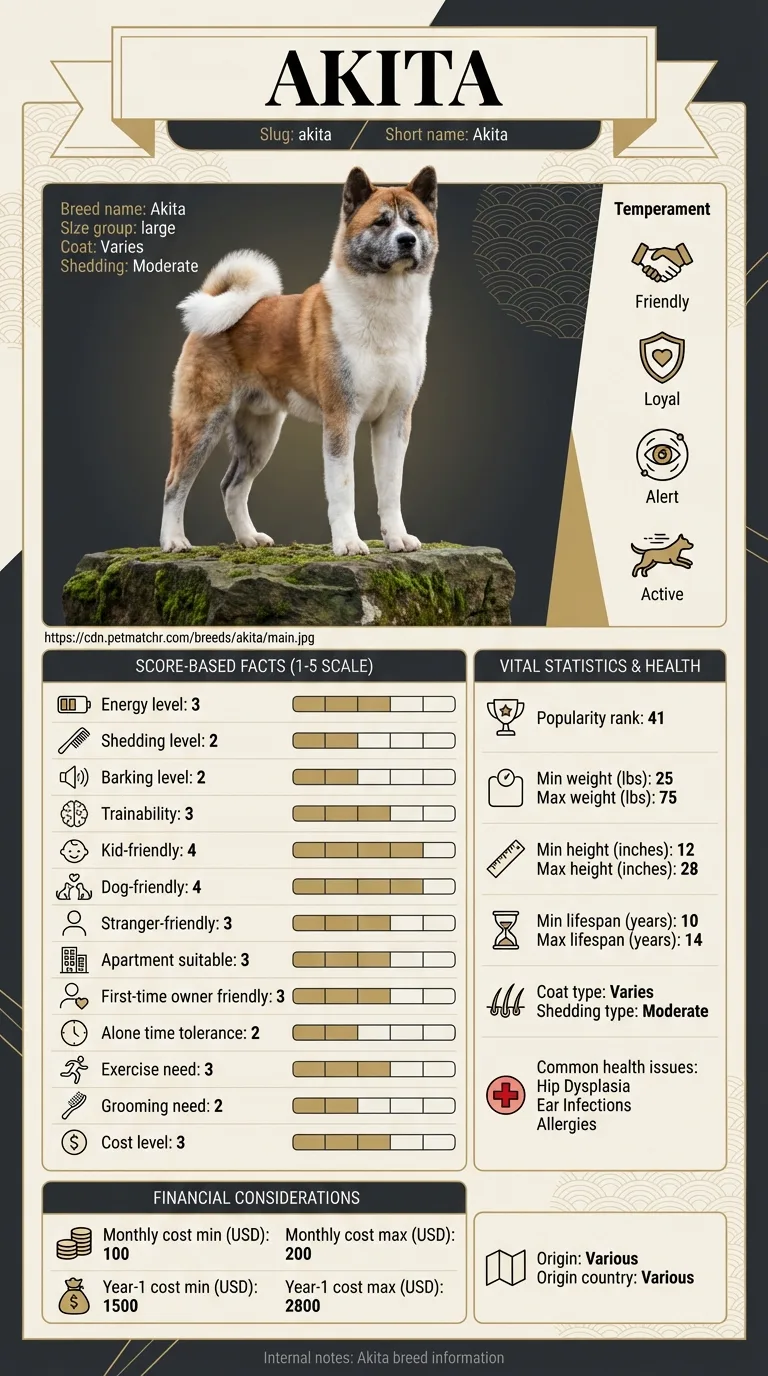
akita infographic
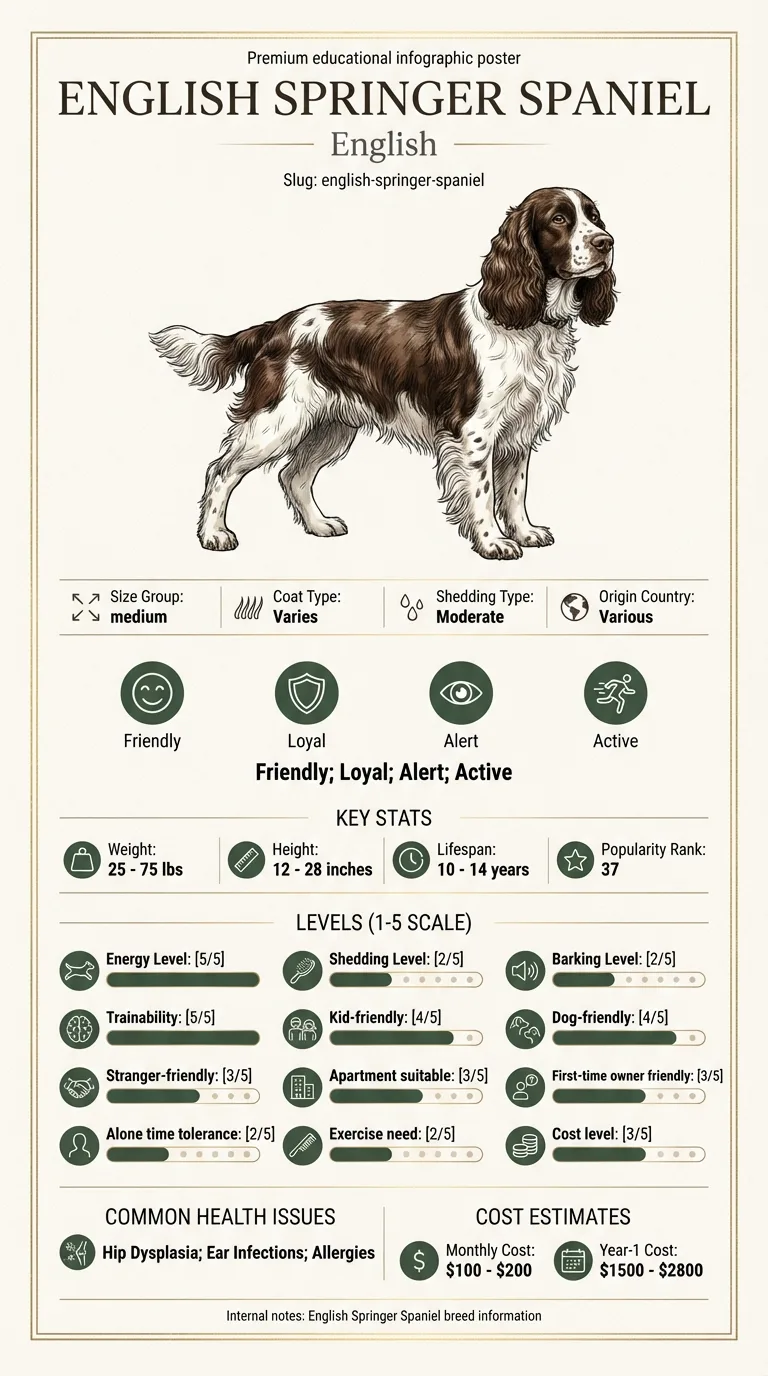
english springer spaniel infographic

This page is for someone weighing a high-drive sporting breed against a low-drive guardian. It covers what a 5/5 exercise requirement really means, the large difference between field-bred and show-bred Springers, ear and coat maintenance, a DNA-testable metabolic disease, and cost.

Quick verdict

The Springer is one of the most capable and most demanding dogs on this site; the Akita asks for a walk and a fence, and the honest question is which of those two weeks you actually have.

Choose akita if...

Choose the Akita if you cannot commit two hours a day. It needs 3/5 exercise against the Springer's 5/5, grooms at 3/5 against 4/5, tolerates being alone at 3/5 against 2/5, and barks at 2/5 against 3/5. You are accepting 1/5 for first-time owners, 2/5 with other dogs and strangers, and 5/5 shedding.

Choose english springer spaniel if...

Choose the English Springer if you are genuinely active and want a dog that can train to a high standard. It rates 5/5 for trainability, 5/5 with children, 4/5 with other dogs and strangers, and lives 12 to 14 years at $100–$200 a month. You are accepting 5/5 exercise, weekly grooming, daily ear care and a dog that hates being left.

Head-to-head comparison

Featureakitaenglish springer spanielWinner
Weight70–130 lbs40–50 lbsEqual
Height24–28 in19–20 inEqual
Lifespan10–13 years12–14 yearsenglish springer spaniel
CoatDense double coatFeathered double coatEqual
Grooming needModerate (3/5)High (4/5)akita
SheddingVery high (5/5)Moderate (3/5)english springer spaniel
Energy levelModerate (3/5)Very high (5/5)Equal
Exercise needModerate (3/5)Very high (5/5)akita
TrainabilityModerate (3/5)Very high (5/5)english springer spaniel
BarkingLow (2/5)Moderate (3/5)akita
Good with kidsModerate (3/5)Very high (5/5)english springer spaniel
Good with other dogsLow (2/5)High (4/5)english springer spaniel
Friendly to strangersLow (2/5)High (4/5)english springer spaniel
Apartment suitabilityLow (2/5)Low (2/5)Equal
Good for first-time ownersVery low (1/5)Moderate (3/5)english springer spaniel
Tolerates being aloneModerate (3/5)Low (2/5)akita
Typical monthly cost$110–$240$100–$200english springer spaniel
Typical first-year cost$1,700–$3,200$1,400–$2,900english springer spaniel

Deep dive

What a 5/5 spaniel actually needs

Two hours a day is realistic for a fit adult Springer, and — as with all the flushing spaniels — it should be hunting rather than plodding. The breed's satisfaction comes from using its nose in cover, not from distance covered on a lead.

That is good news for owners without a farm. Forty minutes of scent work, retrieves and searching in a wood does more for a Springer than two hours of pavement. The requirement is engagement, and engagement is cheaper than mileage.

An under-worked Springer is not a mildly annoying dog. It develops a busy, frantic quality — spinning, mouthing, obsessive ball fixation, hunting the house, and barking that rises steadily. Because the breed is 5/5 trainable it also learns unwanted routines faster than most.

The Akita at 3/5 wants forty-five to sixty minutes and then lies down. That single difference is why so many Springers are rehomed at eighteen months and so few Akitas are rehomed for the same reason.

Both need secure fencing, for different reasons: the Springer will follow a scent through a gap, the Akita will follow a decision.

Field-bred and show-bred are not the same dog

The English Springer has divided further than most breeds into working and show lines, and the difference is large enough to affect this comparison directly.

Field-bred Springers are lighter, shorter-coated, higher-drive and faster. They are exceptional working dogs and they are a great deal of dog for a pet home — the 5/5 exercise rating describes them accurately, and it may understate them.

Show-bred Springers are heavier, more profusely coated, calmer and slower to mature. Grooming demands are higher; drive is lower. For most family homes this is the more realistic type.

Neither is better. But asking a breeder which type their dogs are — and being told confidently and specifically — matters more in this breed than almost any other, and a puppy sold as an all-rounder from an unspecified line is worth more questions rather than fewer.

The Akita has no comparable split. What you see in the ratings is what the breed is.

Feathering, ears and grass seeds

Grooming is 4/5. The feathering on ears, legs, chest and belly mats where it rubs and picks up everything a hedgerow contains. Two or three brushing sessions a week that reach the skin, plus periodic trimming, is a realistic routine — more for a show-bred coat.

Ear infections sit high on the breed's condition list for the same reason they do in every spaniel: a long, heavy, feathered ear leaf lying over the canal, sealing in warmth and moisture. A Springer that swims — and most will, given the chance — needs its ears dried every time. Repeated infections thicken the canal and each episode becomes harder to treat than the last.

Grass seeds are the seasonal hazard. Barbed and unable to back out, they migrate inward from between the toes, from the armpit, or from an ear. A two-minute check after summer walks prevents most of the minor surgery they cause.

The Akita's upright ears ventilate themselves. Its coat work is a weekly brush for most of the year and two intensive shedding periods at 5/5, with an undercoat rake and bin bags.

A metabolic disease worth testing for, and the money

Phosphofructokinase deficiency is the entry on the Springer's list most owners have never heard of, and it is the one with the cleanest answer.

It is an inherited enzyme deficiency that leaves red blood cells fragile under stress. Affected dogs can have episodes of red or brown urine, weakness, fever and pale gums after hard exercise, excitement or panting in heat — precisely the situations a working spaniel is in constantly. There is a DNA test, and no reason for a breeder not to have used it. Ask for the result by name.

Hip and elbow dysplasia and progressive retinal atrophy complete the list, with hip scores and eye certification the corresponding questions.

The Akita's burden is autoimmune and endocrine: immune-mediated disease of skin, eyes and blood, hypothyroidism, progressive retinal atrophy, hip dysplasia and bloat.

On money the Springer is cheaper at $100–$200 a month against $110–$240, and $1,400–$2,900 against $1,700–$3,200 in the first year — though grooming and recurring ear treatment narrow that in practice.

Lifespan runs 12 to 14 years against 10 to 13.

Akita vs English Springer Spaniel: two 5/5 ratings against three 3/5s

The Springer's profile is unusual in carrying 5/5 for energy, exercise and trainability at once. Most breeds with that much drive are less biddable, and most breeds that biddable are less driven.

The Akita sits at 3/5 for all three. It is not a lazy dog and not an unintelligent one; it is a dog with a modest daily requirement and its own opinions about instruction.

Apartments tie at 2/5, which is one of the few honest agreements here — the Springer's problem is drive and the Akita's is size, and neither should be a flat dog.

The social gap is the familiar one: 5/5 with children against 3/5, 4/5 with other dogs and strangers against 2/5 and 2/5.

If you take one number from this page, take the exercise row. Everything else about living with a Springer follows from whether that requirement is met.

Frequently asked questions

How much exercise does an English Springer Spaniel really need?

Around two hours a day for a fit adult, and it should involve hunting and scent work rather than plodding. Forty minutes of searching in a wood satisfies a Springer better than two hours on pavement. The Akita at 3/5 needs forty-five to sixty minutes of walking and nothing structured at all.

What happens if a Springer is under-exercised?

It becomes frantic rather than merely bored — spinning, mouthing, obsessive ball fixation, hunting the house and barking that rises steadily. Because the breed rates 5/5 for trainability it also learns unwanted routines faster than most dogs, which is why these habits become entrenched so quickly.

What is the difference between field-bred and show-bred Springers?

Field-bred dogs are lighter, shorter-coated, faster and higher-drive; show-bred dogs are heavier, more profusely coated, calmer and slower to mature. The gap is large enough to change what kind of home suits. Ask a breeder which type theirs are and expect a confident, specific answer.

What is PFK deficiency?

Phosphofructokinase deficiency is an inherited enzyme disorder that makes red blood cells fragile under stress, producing episodes of dark urine, weakness, fever and pale gums after hard exercise or heat. There is a DNA test and no good reason for a breeder not to have used it — ask for the result by name.

Which is better with children?

The Springer at 5/5 against the Akita's 3/5 — it is genuinely tolerant, sturdy and enthusiastic about family life. The caveat is exuberance: an under-exercised forty-pound spaniel is a lot of bouncing energy around a toddler, and the fix is the exercise rather than the dog.

Why do spaniels get ear infections so often?

The long, heavy, feathered ear leaf lies flat over the canal and traps warmth and moisture, and Springers swim whenever they can. Each infection thickens the canal lining and makes the next one likelier and harder to treat. Drying the ears after every swim is the single most useful habit.

Which is cheaper to keep?

The Springer on headline figures — $100–$200 a month against the Akita's $110–$240 — but grooming and recurring ear treatment narrow the gap. The Akita's costs are less frequent and larger when they arrive: autoimmune disease and bloat are the expensive risks.

Quick answers

View more answers
Living

Akita vs English Springer Spaniel: which should I choose?

The Springer if you are genuinely active and want a dog that trains to a high standard. The Akita if you cannot commit two hours a day and want a quiet guardian that fits around an ordinary week.

Costs

How much does each cost per month?

The Springer runs $100–$200 a month and the Akita $110–$240, with first-year totals of $1,400–$2,900 and $1,700–$3,200. Add regular grooming and ear treatment for the Springer.

Living

Can a Springer live in a flat?

It rates 2/5, the same as the Akita, for opposite reasons — drive rather than size. It is possible with an owner whose whole routine is built around the dog's exercise, but it is not a sensible default.

Training

Which is easier to train?

The Springer at 5/5 against the Akita's 3/5, and it is one of the most trainable gundogs there is. Recall still needs proofing against live scent specifically, because a spaniel that has found game stops listening.

Related DogBreedCompass guides

  • Akita breed guideThe Akita profile covers guardian temperament and the long socialisation window the breed needs.
  • English Springer Spaniel guideThe Springer profile covers working drive, line differences and coat care.
  • Akita vs English Cocker SpanielThe English Cocker is the smaller flushing spaniel with a lower exercise requirement.
  • Akita vs Welsh Springer SpanielThe Welsh Springer is the calmer, less common alternative to the English Springer.
  • Springer Spaniel ear infectionsChronic ear disease is the condition most spaniel owners will deal with at some point.
  • Akita autoimmune diseasesAutoimmune disease is the Akita's most distinctive burden and the first question for a breeder.

Related guides

Important reminder

Health information here is general and is not veterinary advice. If your dog shows pain, sudden behaviour change, or worsening symptoms, consult a licensed veterinarian.

Some links on this site are affiliate links. We may earn a commission at no extra cost to you, and we only suggest products we believe are helpful for dog owners.

Find Your Perfect Breed

Match your lifestyle to the right dog.

Take quiz

Find your match

Not sure which breed is right for you? Take our 2-minute quiz to find out.

Take the quiz