Living
Which is bigger?
The English Springer Spaniel, at 40-50 lbs versus the Cavalier's 13-18 lbs.

Quick answer
Which is bigger?
The English Springer Spaniel, at 40-50 lbs versus the Cavalier's 13-18 lbs.
Cavalier King Charles Spaniel or English Springer Spaniel? On paper they differ most on apartment suitability, and on the scales English Springer Spaniel is the heavier at 40–50 lbs. Here is how the two compare on everything that shapes an ordinary week.
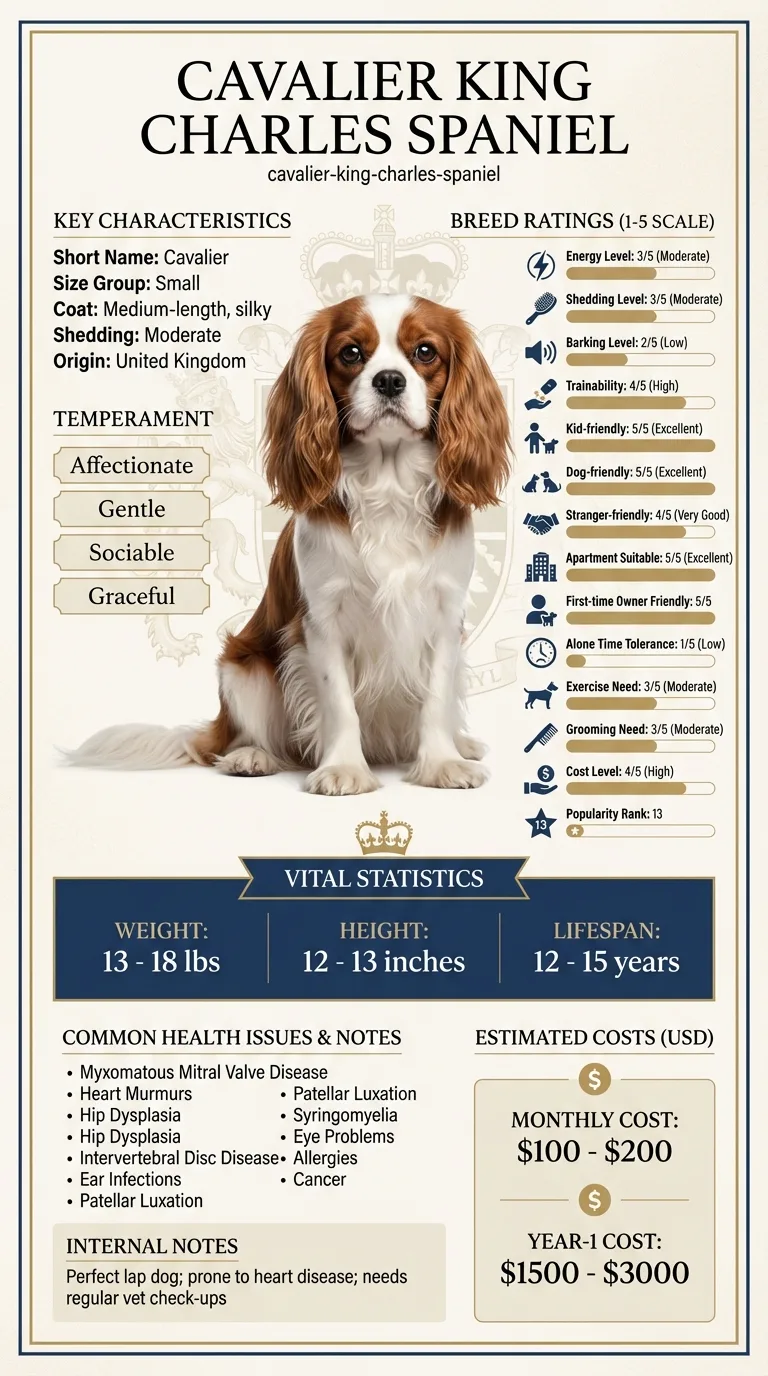
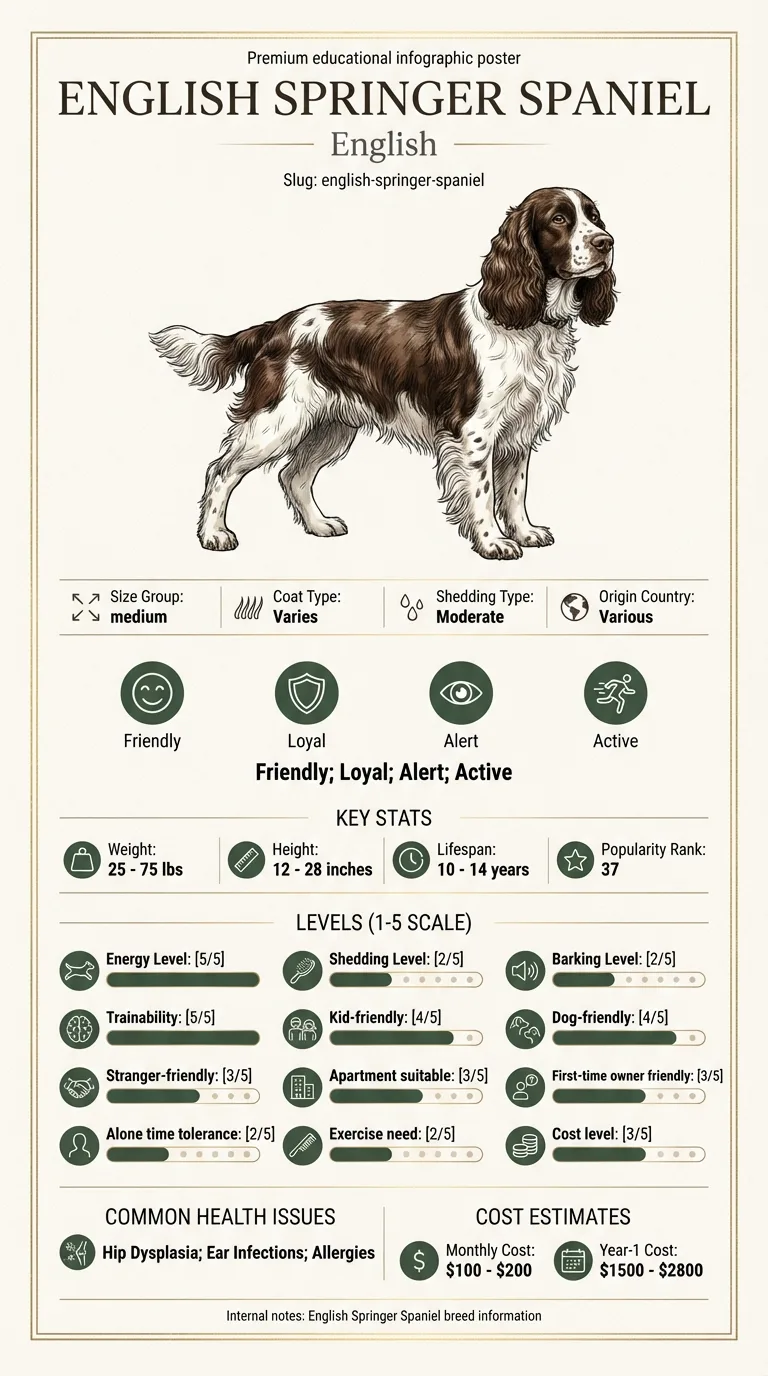
This is for someone already down to Cavalier King Charles Spaniel and English Springer Spaniel and deciding between them. For this pair the decision usually turns on apartment suitability and exercise need, so those are covered first and in most detail. Anyone choosing from a flat has a clear answer here: Cavalier King Charles Spaniel rates 5/5 against 2/5. It is written for the decision rather than the breed history.
Between Cavalier King Charles Spaniel and English Springer Spaniel, apartment suitability is what separates them, and Cavalier King Charles Spaniel is the lower-effort dog of the two to keep.
Choose Cavalier King Charles Spaniel if you are in a flat or a smaller home, this is your first dog and you do not want a standing grooming appointment.
Choose English Springer Spaniel if you want a dog that picks up training quickly and you want a dog that can keep up with an active routine.
| Feature | cavalier king charles spaniel | english springer spaniel | Winner |
|---|---|---|---|
| Size class | small | medium | Equal |
| Weight | 13–18 lbs | 40–50 lbs | Equal |
| Height | 12–13 in | 19–20 in | Equal |
| Lifespan | 12–15 years | 12–14 years | cavalier king charles spaniel |
| Exercise need | Moderate (3/5) | Very high (5/5) | cavalier king charles spaniel |
| Grooming need | Moderate (3/5) | High (4/5) | cavalier king charles spaniel |
| Shedding | Moderate (3/5) | Moderate (3/5) | Equal |
| Energy level | Moderate (3/5) | Very high (5/5) | Equal |
| Barking | Low (2/5) | Moderate (3/5) | cavalier king charles spaniel |
| Apartment suitability | Very high (5/5) | Low (2/5) | cavalier king charles spaniel |
| Good for first-time owners | Very high (5/5) | Moderate (3/5) | cavalier king charles spaniel |
| Tolerates being alone | Very low (1/5) | Low (2/5) | english springer spaniel |
| Trainability | High (4/5) | Very high (5/5) | english springer spaniel |
| Good with kids | Very high (5/5) | Very high (5/5) | Equal |
| Good with other dogs | Very high (5/5) | High (4/5) | cavalier king charles spaniel |
| Friendly to strangers | High (4/5) | High (4/5) | Equal |
| Cost level | High (4/5) | Moderate (3/5) | english springer spaniel |
| Coat | Medium-length, silky | Medium, feathered double coat | Equal |
| Origin | United Kingdom | Various | Equal |
| Typical monthly cost | $100–$200 | $100–$200 | Equal |
| Typical first-year cost | $1,500–$3,000 | $1,400–$2,900 | Equal |
An English Springer Spaniel can weigh nearly three times as much as a Cavalier -- 40 to 50 pounds against 13 to 18 -- and stands a full 6 to 8 inches taller at 19-20 inches versus 12-13. This is the largest size gap among the Cavalier's spaniel-family comparisons: where the Cavalier stays a small, portable lap dog its whole life, the Springer grows into a solidly built, medium-to-large sporting dog with real athletic presence. Both carry feathered coats reflecting shared spaniel ancestry, but the Springer's frame was built for a full day working fields and hedgerows, not an afternoon on the sofa.
The exercise gap here is the widest in this batch: Very high (5/5) for the English Springer Spaniel against Moderate (3/5) for the Cavalier, with energy level showing the identical spread. Springers were bred to flush game for hours at a stretch, and that drive persists strongly in the breed today -- an under-exercised Springer is a genuinely difficult housemate, prone to restlessness and destructive behavior. A Cavalier's moderate needs are a completely different proposition, satisfied by a couple of daily walks. Anyone drawn to the Springer's biddable, friendly nature needs to be honest about whether they can realistically deliver an hour or more of vigorous exercise most days.
Both breeds share a Moderate (3/5) shedding score, but grooming need runs High (4/5) for the Springer against Moderate (3/5) for the Cavalier. The Springer's medium, feathered double coat picks up field debris readily and needs regular brushing plus trimming around the ears, legs, and tail to stay manageable, especially for a dog getting the vigorous exercise its energy rating calls for. The Cavalier's silkier, shorter coat is comparatively low-effort. Ear Infections appear on both health lists, and both breeds' long, floppy ears need regular airing and cleaning -- a grooming task that doesn't shrink no matter which of the two you choose.
Apartment suitability is the clearest split in this comparison: Very high (5/5) for the Cavalier against just Low (2/5) for the English Springer Spaniel, driven by the Springer's very high exercise and energy needs rather than its barking, which rates a moderate 3/5 versus the Cavalier's low 2/5. Alone tolerance also favors neither breed much -- Very low (1/5) for the Cavalier, Low (2/5) for the Springer -- meaning both need a plan for long absences regardless of living situation. A Springer confined to apartment life without serious daily exercise is set up to struggle in a way its temperament alone can't fix.
Trainability favors the Springer, Very high (5/5), edging out the Cavalier's still-strong High (4/5), consistent with a biddable, eager working-dog temperament built to take direction from a handler in the field. First-time-owner suitability tells a different story, though -- Very high (5/5) for the Cavalier against just Moderate (3/5) for the Springer -- because trainability alone doesn't offset the Springer's high exercise demands and size, both of which raise the bar for a first dog. A newcomer drawn to the Springer's quick learning should pair it with a firm exercise commitment; the Cavalier remains the gentler on-ramp into dog ownership generally.
Both breeds rate Very high (5/5) with kids and tie High (4/5) for friendliness to strangers, reflecting shared friendly, sociable spaniel temperaments. The Cavalier edges ahead with other dogs, Very high (5/5) against the Springer's High (4/5), a modest gap. In practice, the Springer's energetic, eager nature can mean boisterous play that's great fun for active older kids but occasionally too much for toddlers or elderly relatives without supervision, while the Cavalier's gentler energy tends to suit a wider range of ages without adjustment. Neither breed shows any real caution flag here -- the differences are about intensity, not friendliness.
Lifespan matches closely, 12-15 years for the Cavalier against 12-14 for the Springer, but health-list length again favors the Springer's shorter roster -- five conditions against the Cavalier's ten. The Springer's list includes Phosphofructokinase Deficiency, a rare enzyme disorder specific to the breed affecting red blood cells, alongside Hip and Elbow Dysplasia, Ear Infections, and Progressive Retinal Atrophy. The Cavalier's longer list is dominated by cardiac and neurological risk -- Myxomatous Mitral Valve Disease, Heart Murmurs, Syringomyelia. Both share Hip Dysplasia, Ear Infections, and PRA. A Springer breeder should be asked about PFK testing; a Cavalier breeder should be asked about cardiac clearances.
Both breeds land at Moderate (3/5) cost level for the Springer against High (4/5) for the Cavalier, though the monthly ranges nearly overlap at $100-200 for both and first-year costs of $1,400-2,900 for the Springer versus $1,500-3,000 for the Cavalier. The larger Springer eats more and needs more grooming time given its High (4/5) rating, but the Cavalier's cardiac-heavy health list tends to drive higher long-term veterinary and insurance costs that outlast the first year. A Springer owner should also budget for exercise-related gear -- a long line, a properly fitted harness -- that a Cavalier's lower activity level makes less essential.
Cavalier King Charles Spaniel weighs 13–18 lbs and lives 12–15 years; English Springer Spaniel weighs 40–50 lbs and lives 12–14 years. The two diverge most on apartment suitability, exercise need and energy level and 1 other rated axes. They are level on good with kids, shedding and friendly to strangers, so those cannot decide it. In the table, a "winner" means easier for an ordinary household — not better. Size, coat and origin are recorded without a verdict. Because both breeds are scored the same way, the gaps are reliable even where the absolute numbers are rough.

Possibly -- it rates Very high (5/5) for both exercise need and energy level, well above the Cavalier's Moderate (3/5) on both, so it demands a genuinely different daily commitment.
The Cavalier, rated Very high (5/5) against the Springer's Low (2/5), driven mainly by the Springer's high exercise needs.
The Springer, rated Very high (5/5) against the Cavalier's High (4/5), reflecting its biddable working-dog background.
Phosphofructokinase Deficiency, an enzyme disorder affecting red blood cells, appears on the Springer's list but not the Cavalier's.
The Cavalier, rated Very high (5/5) for first-time owners against the Springer's Moderate (3/5), largely due to the Springer's exercise demands.
Yes, both rate Very high (5/5) with kids.
The Springer is rated Moderate (3/5) cost level against the Cavalier's High (4/5), though monthly ranges are close.
The English Springer Spaniel, at 40-50 lbs versus the Cavalier's 13-18 lbs.
The Springer, rated Very high (5/5) against the Cavalier's Moderate (3/5).
The Cavalier, rated Low (2/5) barking against the Springer's Moderate (3/5).
The Cavalier, at 12-15 years versus the Springer's 12-14 years -- nearly identical.
Secure checkout on Stripe. We never see your card.
7-day money-back guarantee. Instant access.
Health information here is general and is not veterinary advice. If your dog shows pain, sudden behaviour change, or worsening symptoms, consult a licensed veterinarian.
Some links on this site are affiliate links. We may earn a commission at no extra cost to you, and we only suggest products we believe are helpful for dog owners.
We research and check what we publish, but we do not warrant that any figure, date, price, or statement is accurate, complete, or current, and we accept no liability for any loss, cost, injury, or other harm arising from the use of this site. Use it as one reference among several. You remain responsible for your own decisions and for your dog's care - confirm anything that matters with a licensed veterinarian or another qualified professional before you act on it. Full disclaimer.
Match your lifestyle to the right dog.
Take quizNot sure which breed is right for you? Take our 2-minute quiz to find out.
Take the quiz