English Springer Spaniel vs Havanese: Which Suits Your Home?
Quick answer
Springer or Havanese -- which fits your life better?
If you're active, have outdoor space, and want a dog that'll join you on long walks or runs, the Springer fits. If you're in an apartment with a lighter activity schedule, the Havanese is built for exactly that.
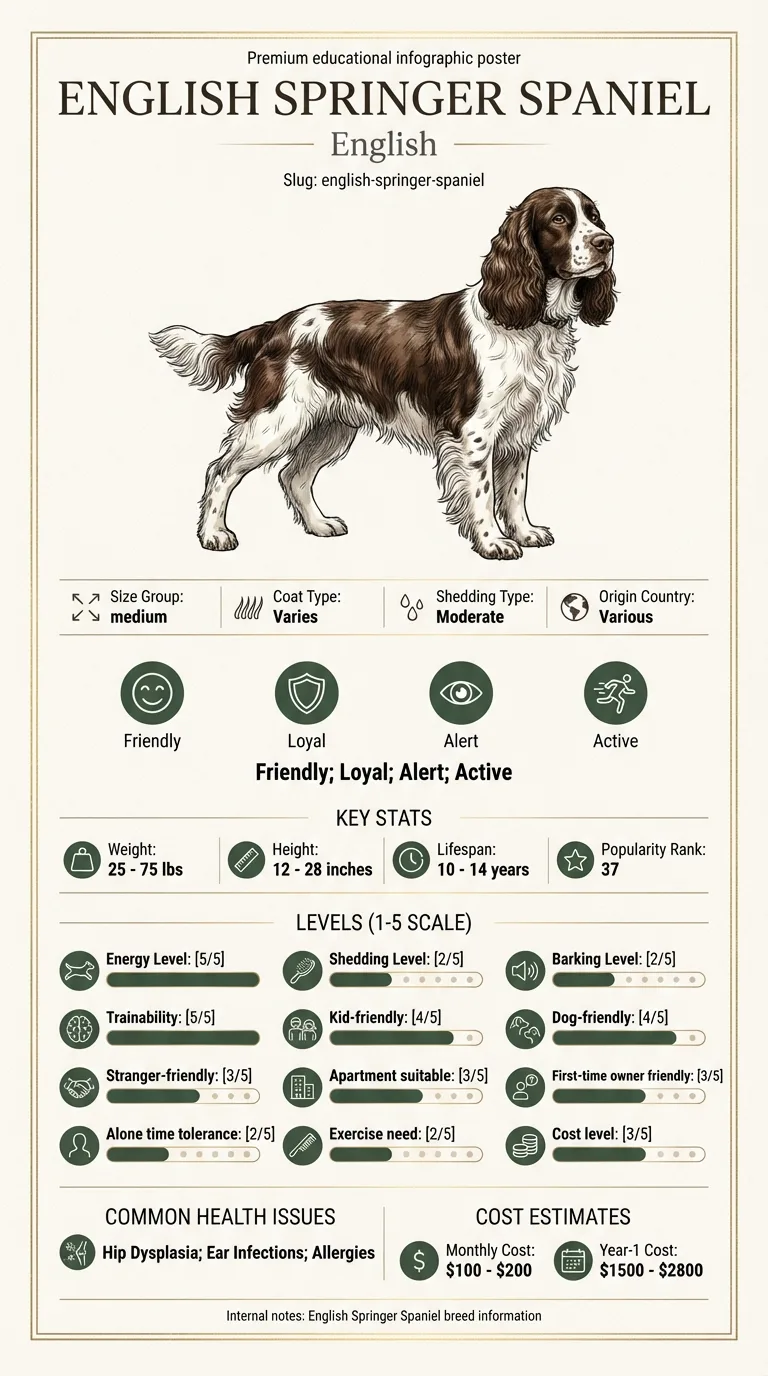
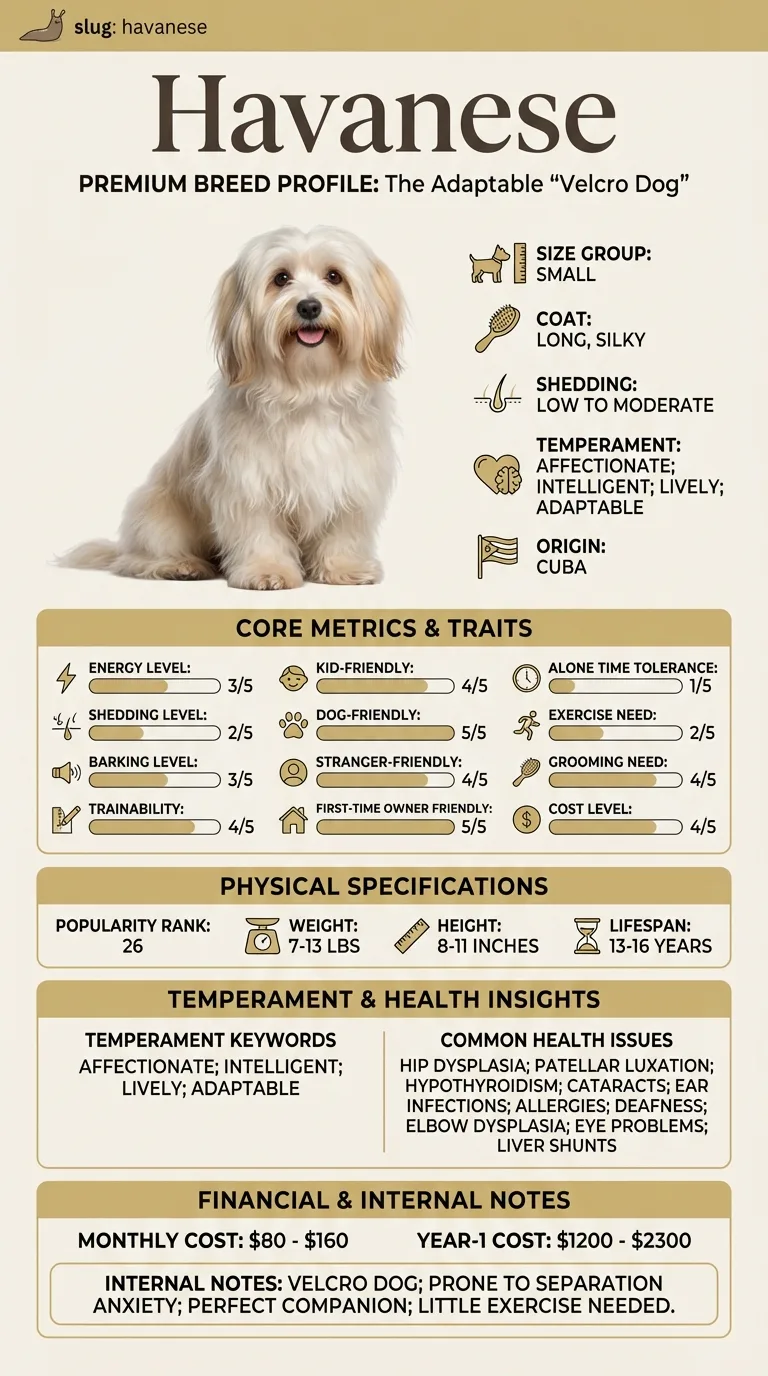
English Springer Spaniel or Havanese? On paper they differ most on exercise need, and on the scales English Springer Spaniel is the heavier at 40–50 lbs. Here is how the two compare on everything that shapes an ordinary week.
This is for someone already down to English Springer Spaniel and Havanese and deciding between them. For this pair the decision usually turns on exercise need and apartment suitability, so those are covered first and in most detail. Anyone choosing from a flat has a clear answer here: Havanese rates 5/5 against 2/5. It is written for the decision rather than the breed history.
Quick verdict
Between English Springer Spaniel and Havanese, exercise need is what separates them, and Havanese is the lower-effort dog of the two to keep.
Choose english springer spaniel if...
Choose English Springer Spaniel if there are young children at home, you want a dog that picks up training quickly and you want a dog that can keep up with an active routine.
Choose havanese if...
Choose Havanese if you are in a flat or a smaller home, this is your first dog and shedding is a problem in your house.
Head-to-head comparison
Feature
english springer spaniel
havanese
Winner
Size class
medium
small
Equal
Weight
40–50 lbs
7–13 lbs
Equal
Height
19–20 in
8–11 in
Equal
Lifespan
12–14 years
13–16 years
havanese
Exercise need
Very high (5/5)
Low (2/5)
havanese
Grooming need
High (4/5)
High (4/5)
Equal
Shedding
Moderate (3/5)
Low (2/5)
havanese
Energy level
Very high (5/5)
Moderate (3/5)
Equal
Barking
Moderate (3/5)
Moderate (3/5)
Equal
Apartment suitability
Low (2/5)
Very high (5/5)
havanese
Good for first-time owners
Moderate (3/5)
Very high (5/5)
havanese
Tolerates being alone
Low (2/5)
Very low (1/5)
english springer spaniel
Trainability
Very high (5/5)
High (4/5)
english springer spaniel
Good with kids
Very high (5/5)
High (4/5)
english springer spaniel
Good with other dogs
High (4/5)
Very high (5/5)
havanese
Friendly to strangers
High (4/5)
High (4/5)
Equal
Cost level
Moderate (3/5)
High (4/5)
english springer spaniel
Coat
Medium, feathered double coat
Long, silky
Equal
Origin
Various
Cuba
Equal
Typical monthly cost
$100–$200
$80–$160
Equal
Typical first-year cost
$1,400–$2,900
$1,200–$2,300
Equal
Deep dive
Size and build
Few match-ups on this site show a starker size gap than this one: the Havanese weighs just 7-13 pounds and stands 8-11 inches, while the Springer runs 40-50 pounds and 19-20 inches -- the Springer can outweigh a Havanese fivefold. One is a lap dog in the literal sense, the other needs a proper walk to burn energy. If you're choosing based on how much dog you want physically underfoot, this comparison answers itself quickly.
Energy and exercise
Exercise need is about as far apart as this scale allows: very high (5/5) for the Springer against low (2/5) for the Havanese. A Havanese is content with a couple of short walks and indoor play; a Springer wants sustained daily activity that a Havanese's frame and history simply weren't built for. Energy level tells a similar story, though the gap there (very high versus moderate) is a touch less extreme.
Grooming and shedding
Grooming need ties at high (4/5) for both -- surprising given the size difference, but the Havanese's long, silky coat takes real regular brushing to stay mat-free. Shedding does differ, moderate (3/5) for the Springer against low (2/5) for the Havanese. So the Havanese sheds less but doesn't save you any actual grooming time -- you're trading hair on the floor for time with a brush either way.
Apartment living, noise and time alone
This is close to a clean sweep for small-space living: the Havanese rates very high (5/5) on apartment suitability against the Springer's low (2/5), and very high (5/5) for first-time owners against the Springer's moderate (3/5). Barking ties at moderate (3/5) for both, so don't assume the smaller dog is automatically quieter. Alone-tolerance is a rare exception where the Springer actually rates slightly better, low (2/5) against very low (1/5) for the Havanese, a breed known for attaching closely to its people.
Training and owner experience
Trainability favors the Springer, very high (5/5) against the Havanese's high (4/5), a fairly small gap given how different the breeds otherwise are. Both are intelligent, biddable dogs that respond well to consistent training; the Havanese's slightly lower score doesn't mean difficult, just marginally less eager to work compared to a breed literally developed for taking direction in the field.
Kids, other dogs and visitors
The Springer rates a bit higher with kids, very high (5/5) against high (4/5), while the Havanese edges ahead with other dogs, very high (5/5) against high (4/5) for the Springer. Temperament words diverge in intensity more than substance: eager, friendly, energetic, biddable for the Springer against affectionate, intelligent, lively, adaptable for the Havanese. Both read as genuinely people-oriented breeds, just scaled to very different households.
Health and lifespan
The Havanese actually lives longer on paper, 13-16 years against the Springer's 12-14, a common pattern where smaller breeds outlive larger ones. Health lists run close in length, five conditions for the Springer, ten for the Havanese, sharing hip dysplasia and ear infections. The Havanese's list adds deafness, liver shunts and cataracts, conditions worth screening for with a reputable breeder given how much they can affect quality of life.
Cost to keep
Cost level rates high (4/5) for the Havanese against moderate (3/5) for the Springer, though the actual dollar ranges run the other way: $80-$160 monthly for the Havanese against $100-$200 for the Springer, and $1,200-$2,300 versus $1,400-$2,900 in year one. Smaller dogs generally eat less, which likely explains why the raw dollar figures favor the Havanese even where the overall cost rating doesn't.
English Springer Spaniel vs Havanese at a glance
English Springer Spaniel weighs 40–50 lbs and lives 12–14 years; Havanese weighs 7–13 lbs and lives 13–16 years. The two diverge most on exercise need, apartment suitability and energy level and 1 other rated axes. They are level on barking, grooming need and friendly to strangers, so those cannot decide it. In the table, a "winner" means easier for an ordinary household — not better. Size, coat and origin are recorded without a verdict. Because both breeds are scored the same way, the gaps are reliable even where the absolute numbers are rough.
English Springer Spaniel vs Havanese: Which Suits Your Home? - English Springer Spaniel vs Havanese at a glance
Frequently asked questions
How much smaller is a Havanese than a Springer Spaniel?
Dramatically smaller -- 7-13 pounds and 8-11 inches for the Havanese against 40-50 pounds and 19-20 inches for the Springer. A Springer can outweigh a Havanese by roughly five times.
Which needs less exercise?
The Havanese, by far -- low (2/5) exercise need against the Springer's very high (5/5). A couple of short walks and indoor play cover a Havanese's needs.
Which is better for a first-time owner?
The Havanese, rated very high (5/5) against the Springer's moderate (3/5). Its lower exercise demands and strong apartment suitability make it the gentler introduction to dog ownership.
Which fits apartment living better?
The Havanese, clearly -- very high (5/5) apartment suitability against the Springer's low (2/5). Just don't expect a quieter dog: barking ties at moderate (3/5) for both.
Which costs less monthly?
The Havanese, at $80-$160 against the Springer's $100-$200 -- smaller dogs generally cost less to feed, even though the Havanese's overall cost rating is listed higher due to grooming and purchase price factors.
Do the two breeds share health risks?
Hip dysplasia and ear infections appear on both lists. The Havanese's list adds deafness and liver shunts, conditions worth discussing with a breeder.
Which lives longer?
The Havanese, at 13-16 years against the Springer's 12-14 -- smaller breeds typically outlive larger ones, and this pair follows that pattern.
Springer or Havanese -- which fits your life better?
If you're active, have outdoor space, and want a dog that'll join you on long walks or runs, the Springer fits. If you're in an apartment with a lighter activity schedule, the Havanese is built for exactly that.
Costs
Which is cheaper monthly?
The Havanese, at $80-$160 against the Springer's $100-$200 -- a modest but real gap tied mostly to how much less a small dog eats.
Behavior
How different are their exercise needs?
About as different as this scale allows -- 5/5 for the Springer, 2/5 for the Havanese. This is likely the single biggest deciding factor between the two.
Health
Which lives longer?
The Havanese, at 13-16 years against the Springer's 12-14 years, following the common pattern of smaller dogs living longer than larger ones.
Havanese breed guide – The same for Havanese, so the comparison can be checked against the detail.
English Springer Spaniel vs Labradoodle – Labradoodle is the closest breed to English Springer Spaniel on the measured axes, so it is the natural next comparison.
Health information here is general and is not veterinary advice. If your dog shows pain, sudden behaviour change, or worsening symptoms, consult a licensed veterinarian.
Some links on this site are affiliate links. We may earn a commission at no extra cost to you, and we only suggest products we believe are helpful for dog owners.
We research and check what we publish, but we do not warrant that any figure, date, price, or statement is accurate, complete, or current, and we accept no liability for any loss, cost, injury, or other harm arising from the use of this site. Use it as one reference among several. You remain responsible for your own decisions and for your dog's care - confirm anything that matters with a licensed veterinarian or another qualified professional before you act on it. Full disclaimer.