Living
Which should I choose, the Springer Spaniel or the Labradoodle?
If shedding bothers you more than price, go Labradoodle. If your budget is tighter, go Springer, the temperament scores are otherwise nearly identical.

Quick answer
Which should I choose, the Springer Spaniel or the Labradoodle?
If shedding bothers you more than price, go Labradoodle. If your budget is tighter, go Springer, the temperament scores are otherwise nearly identical.
English Springer Spaniel or Labradoodle? On paper they differ most on shedding, and on the scales English Springer Spaniel is the heavier at 40–50 lbs. Here is how the two compare on everything that shapes an ordinary week.
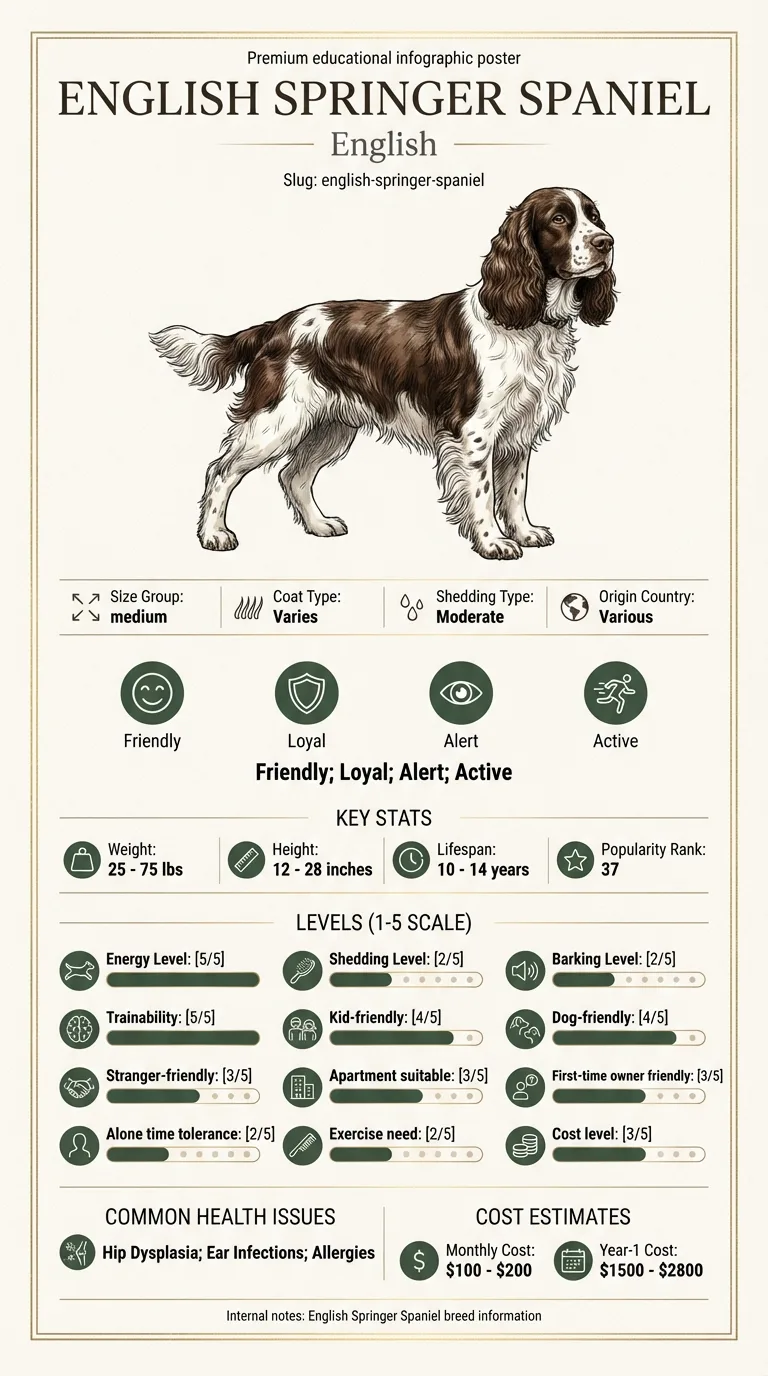
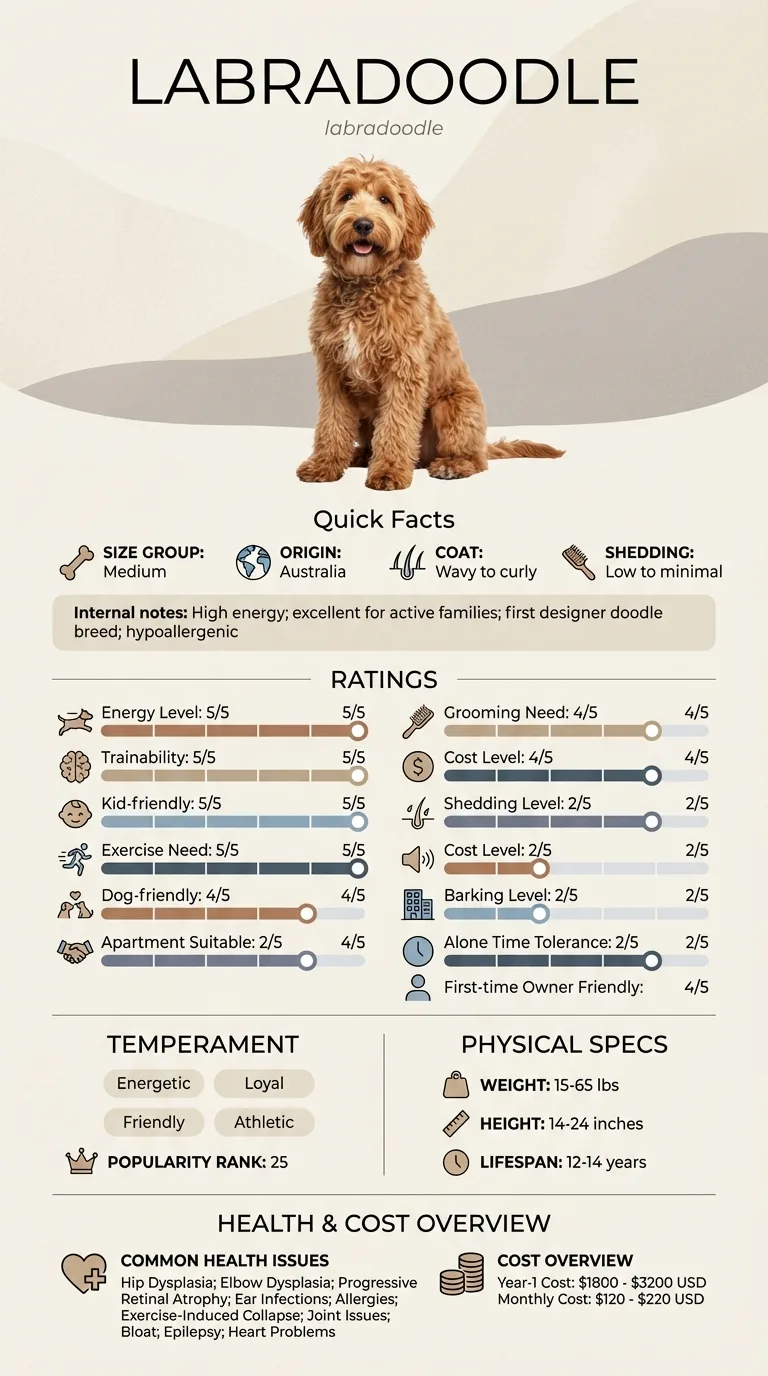
This is for someone already down to English Springer Spaniel and Labradoodle and deciding between them. Because the two are so evenly matched, the page works through every axis rather than leading with one. Both rate 2/5 for flats, so housing does not settle this one. It is written for the decision rather than the breed history.
Between English Springer Spaniel and Labradoodle, they are closer than most pairings, and the choice comes down to temperament, and Labradoodle is the lower-effort dog of the two to keep.
Choose English Springer Spaniel if its temperament and look are what you want; on the measurable axes it gives up nothing to the other.
Choose Labradoodle if this is your first dog, shedding is a problem in your house and a smaller dog suits your car, your home or your back.
| Feature | english springer spaniel | labradoodle | Winner |
|---|---|---|---|
| Size class | medium | medium | Equal |
| Weight | 40–50 lbs | 15–65 lbs | Equal |
| Height | 19–20 in | 14–24 in | Equal |
| Lifespan | 12–14 years | 12–14 years | Equal |
| Exercise need | Very high (5/5) | Very high (5/5) | Equal |
| Grooming need | High (4/5) | High (4/5) | Equal |
| Shedding | Moderate (3/5) | Low (2/5) | labradoodle |
| Energy level | Very high (5/5) | Very high (5/5) | Equal |
| Barking | Moderate (3/5) | Low (2/5) | labradoodle |
| Apartment suitability | Low (2/5) | Low (2/5) | Equal |
| Good for first-time owners | Moderate (3/5) | High (4/5) | labradoodle |
| Tolerates being alone | Low (2/5) | Low (2/5) | Equal |
| Trainability | Very high (5/5) | Very high (5/5) | Equal |
| Good with kids | Very high (5/5) | Very high (5/5) | Equal |
| Good with other dogs | High (4/5) | High (4/5) | Equal |
| Friendly to strangers | High (4/5) | High (4/5) | Equal |
| Cost level | Moderate (3/5) | High (4/5) | english springer spaniel |
| Coat | Medium, feathered double coat | Wavy to curly | Equal |
| Origin | Various | Australia | Equal |
| Typical monthly cost | $100–$200 | $120–$220 | Equal |
| Typical first-year cost | $1,400–$2,900 | $1,800–$3,200 | Equal |
Both breeds fall into the medium class, but the numbers hide different stories. The Springer Spaniel holds a tight 40-50 lb, 19-20 in frame, predictable across the breed. The Labradoodle's 15-65 lb, 14-24 in spread reflects the mini, medium, and standard splits within the breed, so the dog you meet depends entirely on which line you buy. Ask a breeder which size category you're getting before you fall for a puppy photo.
Exercise need sits at 5/5 for both dogs, and neither breed compromises on that number. The Springer was bred to flush and retrieve birds all day; the Labradoodle inherits the Labrador's stamina and the Poodle's athleticism. Expect to fill 60-90 minutes daily with real activity, not just leash walks. Skip a day and you'll likely see it in the behavior column, not just the energy column.
Grooming sits at 4/5 for both, so neither is a wash-and-go dog. Where they split is shedding: the Springer's feathered double coat sheds moderately (3/5) year-round, while the Labradoodle's wavy-to-curly coat sheds low (2/5), closer to the Poodle side of its ancestry. If a fur-free couch matters more to you than brushing time, the Labradoodle edges it, but budget for professional grooming appointments either way.
Apartment suitability scores low (2/5) for both, and the exercise numbers above explain why, a 5/5 energy dog in a studio is a recipe for a hole in the drywall. Barking differs more: the Springer sits at moderate (3/5) while the Labradoodle rates low (2/5). Both dogs tolerate being alone poorly (2/5 each), so this is a pairing for houses with yards and people who work from home, not compact rentals.
Trainability is maxed out at 5/5 for both breeds, which is good news for a nervous first-timer. Where they diverge is the first-time-owner rating: the Springer sits at moderate (3/5) while the Labradoodle rates high (4/5), likely reflecting a more even temperament under pressure. Neither dog punishes a new owner for inexperience, but the Labradoodle is the slightly more forgiving pick on paper.
With kids, both breeds score a full 5/5, and both rate high (4/5) with other dogs and friendly to strangers (4/5), about as close to a tie as the data gets. Pick either one for a busy household with children and visitors and you're on safe ground. The only meaningful gap in this section shows up elsewhere: cost, not temperament, is what separates these two.
Both breeds are projected to live 12-14 years, so lifespan won't decide this for you. The health lists diverge sharply in length: the Springer's five flagged conditions include hip and elbow dysplasia, ear infections, PRA, and phosphofructokinase deficiency. The Labradoodle's list runs to ten items, adding bloat, epilepsy, heart problems, and exercise-induced collapse on top of shared joint and eye issues. More conditions listed doesn't guarantee more vet visits, but it's worth a conversation with a breeder.
The Springer is the cheaper dog to own by the numbers: cost level rates moderate (3/5) against the Labradoodle's high (4/5). Monthly costs run $100-$200 for the Springer versus $120-$220 for the Labradoodle, and that gap compounds in year one, $1,400-$2,900 versus $1,800-$3,200. None of that is dramatic, but over a 12-14 year lifespan it adds up to a real difference in what you'll spend.
English Springer Spaniel weighs 40–50 lbs and lives 12–14 years; Labradoodle weighs 15–65 lbs and lives 12–14 years. No rated axis separates them by more than a single point, which makes this one of the closer pairings on the site. They are level on tolerates being alone, apartment suitability and good with other dogs, so those cannot decide it. In the table, a "winner" means easier for an ordinary household — not better. Size, coat and origin are recorded without a verdict. Because both breeds are scored the same way, the gaps are reliable even where the absolute numbers are rough.

They're both medium dogs on paper, but the Labradoodle's 15-65 lb range is far wider than the Springer's tight 40-50 lb band. A mini Labradoodle can be smaller than a Springer; a standard one can be noticeably bigger. Check which size line a breeder is working with before you commit.
The Labradoodle, rated low (2/5) shedding against the Springer's moderate (3/5). Neither is shedding-free, and both still need regular brushing given their 4/5 grooming needs.
The Labradoodle rates higher for first-time owners (4/5 vs 3/5), though both are highly trainable (5/5) and neither will fight you on commands. A first-timer can succeed with either as long as they can meet the 5/5 exercise demand.
No, both score low (2/5) for apartment suitability and low (2/5) for tolerating time alone. These are high-energy dogs that want a yard and company, not a studio apartment.
The Springer, on every cost metric given: lower cost rating (3/5 vs 4/5), lower typical monthly spend ($100-$200 vs $120-$220), and a smaller first-year bill ($1,400-$2,900 vs $1,800-$3,200).
Yes, both breeds' lists include hip dysplasia, elbow dysplasia, progressive retinal atrophy, and ear infections. The Labradoodle's list is longer overall, adding bloat, epilepsy, and heart problems that don't appear on the Springer's list.
Both are projected at 12-14 years, identical on paper, so lifespan isn't a factor in choosing between them.
If shedding bothers you more than price, go Labradoodle. If your budget is tighter, go Springer, the temperament scores are otherwise nearly identical.
Springer runs $100-$200/month, Labradoodle $120-$220/month, a modest but real gap.
Both need serious daily exercise, 5/5 on the scale, expect at least an hour of real activity.
Both breeds average 12-14 years, so lifespan won't tip this decision.
Secure checkout on Stripe. We never see your card.
7-day money-back guarantee. Instant access.
Health information here is general and is not veterinary advice. If your dog shows pain, sudden behaviour change, or worsening symptoms, consult a licensed veterinarian.
Some links on this site are affiliate links. We may earn a commission at no extra cost to you, and we only suggest products we believe are helpful for dog owners.
We research and check what we publish, but we do not warrant that any figure, date, price, or statement is accurate, complete, or current, and we accept no liability for any loss, cost, injury, or other harm arising from the use of this site. Use it as one reference among several. You remain responsible for your own decisions and for your dog's care - confirm anything that matters with a licensed veterinarian or another qualified professional before you act on it. Full disclaimer.
Match your lifestyle to the right dog.
Take quizNot sure which breed is right for you? Take our 2-minute quiz to find out.
Take the quiz