The Basset for almost any ordinary household — it takes sociability, first-time suitability, apartments, exercise and cost. Choose the Akita only if you specifically want a guardian breed and can commit to years of socialisation.
The Basset Hound rates 5/5 with children, 5/5 with other dogs and 5/5 with strangers — a clean sweep almost no breed manages. The Akita rates 3/5, 2/5 and 2/5. If sociability is what you are buying, this comparison is over before it starts.
This is for someone weighing two very different large-ish dogs and probably attracted to the Akita's looks. It covers the sociability gap, the exercise requirements, the ears and the back that make the Basset a higher-maintenance dog than its lazy reputation suggests, the coat difference, and what each costs to keep.
Quick verdict
The Basset is the easier dog by a wide margin on temperament, cost and exercise; the Akita is the choice only if you specifically want a guardian and can do the socialisation work.
Choose akita if...
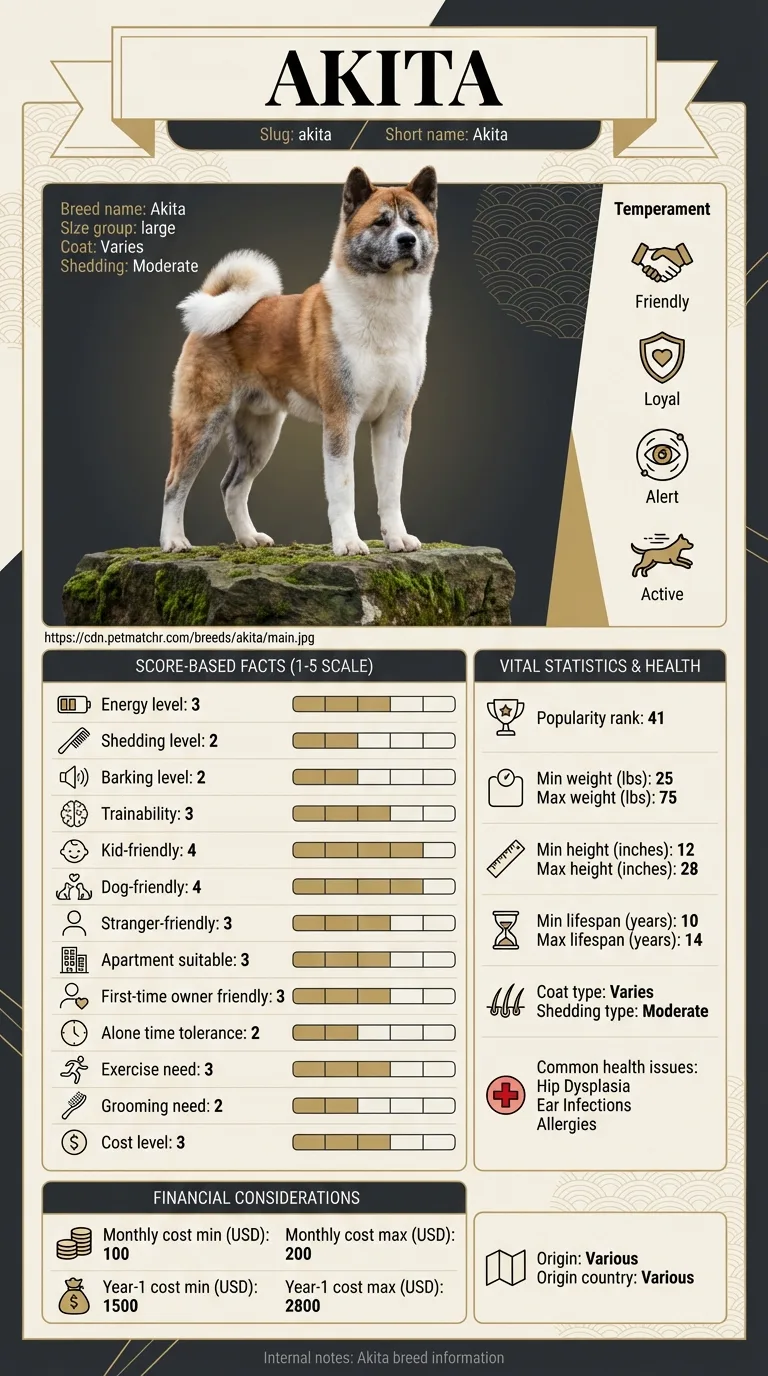
Choose the Akita if you want a guardian breed and a quiet, dignified house dog. You are taking on 1/5 first-time suitability, 2/5 with strangers and other dogs, a double coat shedding at 5/5, and $110–$240 a month. Nothing about this dog is casual.
Choose basset hound if...
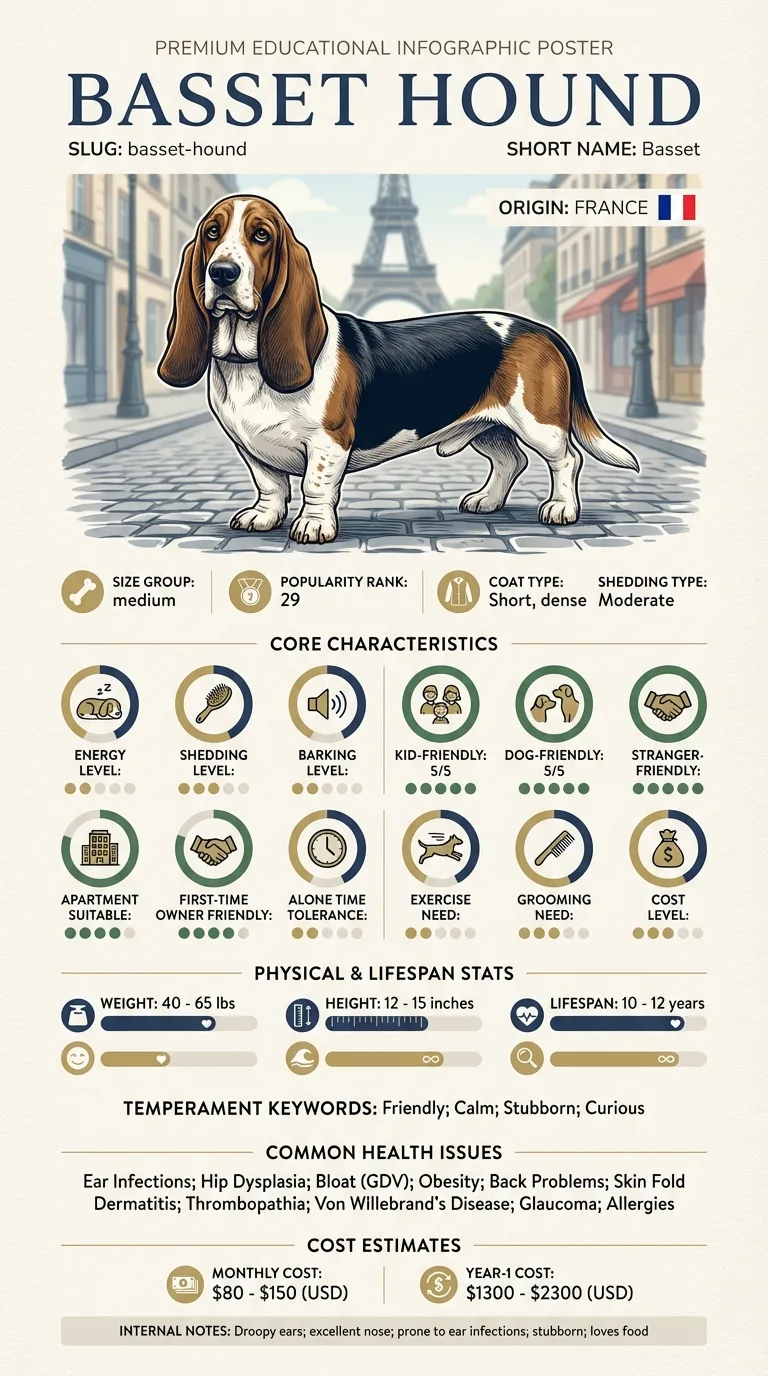
Choose the Basset Hound if you want a genuinely easy-tempered family dog: 5/5 with children, other dogs and strangers, 4/5 for first-time owners, 4/5 for apartments, only 2/5 exercise, and $80–$150 a month. Accept the ears, the drool, the back, and a recall that a scent hound will abandon the moment it finds something interesting.
Head-to-head comparison
Feature
akita
basset hound
Winner
Weight
70–130 lbs
40–65 lbs
Equal
Height
24–28 in
12–15 in
Equal
Lifespan
10–13 years
10–12 years
akita
Coat
Dense double coat
Short, dense
Equal
Grooming need
Moderate (3/5)
Moderate (3/5)
Equal
Shedding
Very high (5/5)
Moderate (3/5)
basset hound
Energy level
Moderate (3/5)
Low (2/5)
Equal
Exercise need
Moderate (3/5)
Low (2/5)
basset hound
Trainability
Moderate (3/5)
Low (2/5)
akita
Barking
Low (2/5)
Low (2/5)
Equal
Good with kids
Moderate (3/5)
Very high (5/5)
basset hound
Good with other dogs
Low (2/5)
Very high (5/5)
basset hound
Friendly to strangers
Low (2/5)
Very high (5/5)
basset hound
Apartment suitability
Low (2/5)
High (4/5)
basset hound
Good for first-time owners
Very low (1/5)
High (4/5)
basset hound
Tolerates being alone
Moderate (3/5)
Low (2/5)
akita
Typical monthly cost
$110–$240
$80–$150
basset hound
Typical first-year cost
$1,700–$3,200
$1,300–$2,300
basset hound
Deep dive
Pack hound against household guardian
The Basset was bred to hunt in a pack — dozens of hounds working a trail together at walking pace, with handlers on foot. A pack hound that fought its kennelmates or distrusted people was not bred from. Generations of that produced a dog whose default assumption about any living creature is that it is fine.
That is what the three 5/5 ratings mean in practice: a Basset introduced to a strange dog usually just wags, and a Basset meeting a stranger usually leans on them. It is the closest thing on this site to a dog with no social defences at all, which is also why it is useless as a deterrent.
The Akita was bred to guard a household and to hold large game. It assesses visitors rather than greeting them, and its dog intolerance — 2/5, frequently same-sex — is a breed characteristic that typically sharpens at social maturity around two years old, not a training failure. Owners who socialise heavily from eight weeks still end up with a dog that has opinions; the work makes those opinions proportionate rather than absent.
If you have children in and out of the house, or another dog, or a busy front door, the Basset is the obvious answer.
The Basset is not the low-maintenance dog it looks like
The 2/5 exercise rating and the famous sloth are real, but they hide three genuine ongoing jobs.
The ears. Long, heavy, poorly ventilated ears sit at the top of the breed's condition list for a reason. Ear infections are close to a default state in an unmanaged Basset, and weekly cleaning and drying is a lifetime routine rather than an occasional chore.
The back. A long spine on short legs is a structural compromise, and back problems are on the list. Keeping a Basset lean matters more than in most breeds, and stairs and jumping down from furniture are worth limiting.
The skin folds. Facial and body folds trap moisture and become dermatitis if they are not cleaned and dried.
Add obesity — also listed, and a breed that will eat anything indefinitely — and the Basset needs more daily attention than an Akita does, just not in the form of walking.
2/5 and 3/5, both for the same underlying reason
Neither of these is a biddable dog and both ratings are honest, but the resistance is different.
The Basset at 2/5 is a scent hound. Once a nose that good locks onto a trail, the rest of the world including you effectively stops existing. This is not stubbornness in any meaningful sense; it is a dog doing precisely what it was engineered to do. The practical consequence is that most Bassets never have a reliable off-lead recall, and a securely fenced garden is not optional.
The Akita at 3/5 is independent rather than distracted. It understands, considers, and decides. What it needs is early consistent positive training and years of deliberate socialisation, and what it does not need is heavy-handed correction of a hundred-pound guardian dog.
Both rate 2/5 for barking, so neither is noisy — though a Basset that has found a scent will bay, and it carries.
Weight, coat and what you actually clean up
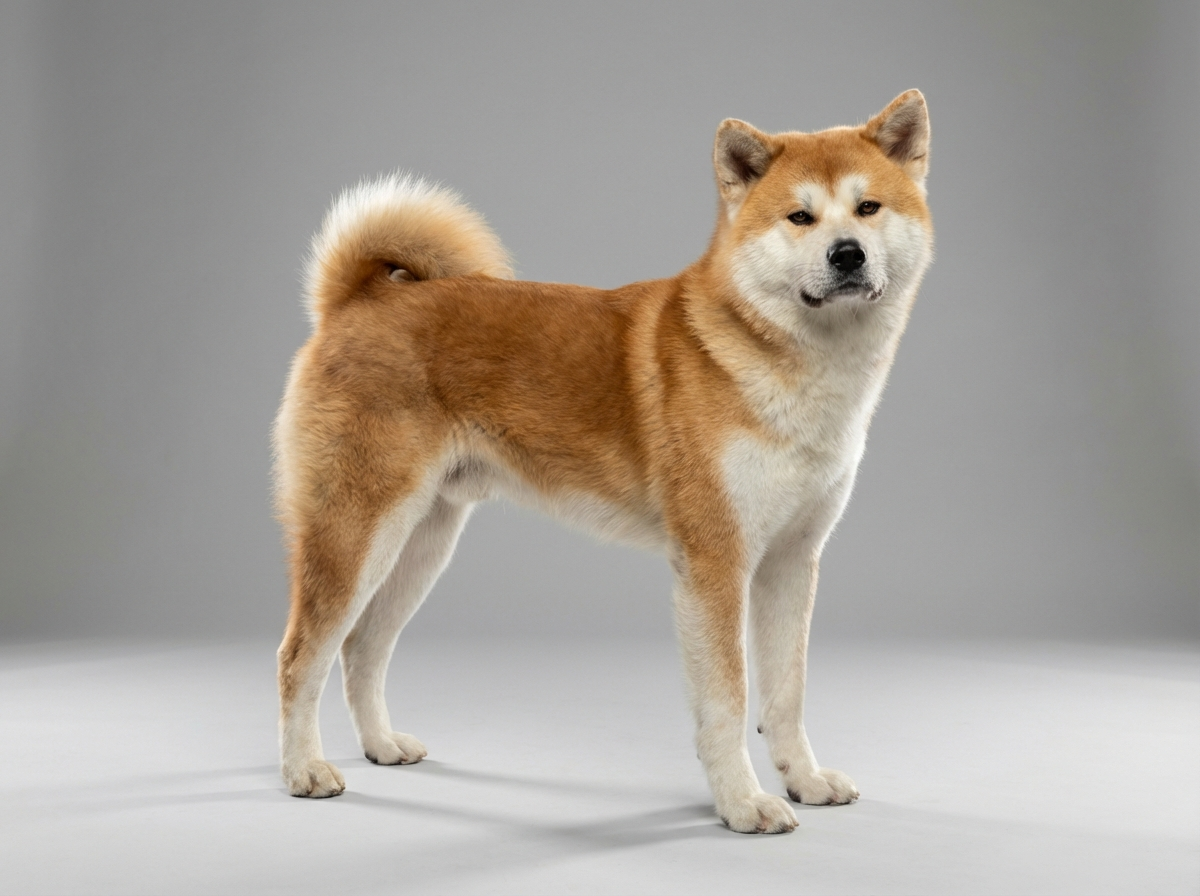
The Akita is 70 to 130 pounds and 24 to 28 inches. The Basset is 40 to 65 pounds and 12 to 15 inches — it is a heavy dog on very short legs, which is why lifting one into a car is more awkward than the weight suggests.
On coat the Akita sheds at 5/5, blowing its double coat spectacularly twice a year, with an undercoat rake required through the moult. The Basset sheds at 3/5 — short dense hair, constant, unglamorous, and it gets into everything.
Grooming rates 3/5 for both, but for different work. For the Akita it is the moult. For the Basset it is ears, folds and drool, and the drool is worth mentioning honestly: a Basset shakes its head and redecorates the wall.
On housing the Basset takes apartments at 4/5 against 2/5, helped by the low exercise need and short stature. Neither is a barker.
One shared emergency, different chronic burdens
Both are deep-chested and both carry bloat on their condition lists. Gastric dilatation-volvulus is the emergency every owner of either breed should be able to recognise: unproductive retching, a tight distended abdomen, restlessness and distress. It is measured in hours, not days.
Both also carry hip dysplasia and should come from hip-scored parents.
Beyond that the Basset's burden is structural and inflammatory — ear infections, back problems, skin fold dermatitis, obesity — all chronic, all manageable, all requiring routine rather than heroics.
The Akita's is autoimmune and endocrine: immune-mediated disease affecting skin, eyes and blood, hypothyroidism, progressive retinal atrophy. The breed also carries a known sensitivity to anaesthesia that is worth flagging to any vet unfamiliar with it.
Lifespans are close, 10 to 13 against 10 to 12.
Cost and time alone
The Basset is cheaper on both measures: $80–$150 a month against $110–$240, and $1,300–$2,300 in year one against $1,700–$3,200. Size explains most of it, though the ear and skin routine means a Basset's vet spend is less predictable than the monthly figure suggests.
On time alone the Akita is the better bet at 3/5 against 2/5. Bassets are pack animals and tend to be vocal about solitude — a Basset that bays at an empty house is a neighbour problem in a way a silent Akita is not.
If the dog will be alone across a working day, neither is ideal, but plan company for the Basset in particular.
Akita vs Basset Hound: a clean sweep on temperament
The Basset takes 5/5 on all three sociability rows — children, other dogs, strangers. Very few breeds on this site manage that. The Akita takes 3/5, 2/5 and 2/5.
The Basset also takes first-time suitability 4/5 against 1/5, apartments 4/5 against 2/5, exercise 2/5 against 3/5 (less is easier here), and cost on both measures.
The Akita takes trainability 3/5 against 2/5, time alone 3/5 against 2/5, and a marginally longer life. It is also the breed with the guardian temperament, which is the only reason most people considering both end up choosing it.
This is not a close comparison unless deterrence is what you want.
Akita or Basset Hound: A Guardian or a Greeter? - Akita vs Basset Hound: a clean sweep on temperament
Frequently asked questions
Which is friendlier, an Akita or a Basset Hound?
The Basset, decisively — it rates 5/5 with children, 5/5 with other dogs and 5/5 with strangers, which very few breeds manage. Pack hunting selected against any dog that resented company. The Akita rates 3/5, 2/5 and 2/5, because it was bred to guard a household rather than to work in a pack.
Is a Basset Hound really low maintenance?
Low exercise, yes, at 2/5. Low maintenance, no. The long heavy ears make ear infections close to a default state without weekly cleaning and drying, the long spine on short legs makes back problems a real risk that demands keeping the dog lean, and the skin folds need cleaning to prevent dermatitis. It is a dog with daily jobs that are not walking.
Which is easier to train?
The Akita at 3/5 against the Basset's 2/5, though neither is biddable. The Basset is a scent hound: once its nose locks onto a trail, the rest of the world stops existing, and most Bassets never achieve a reliable off-lead recall. The Akita is independent rather than distracted — it understands you and then decides.
Which sheds more?
The Akita, at 5/5 against the Basset's 3/5. The Akita blows a dense double coat spectacularly twice a year and needs an undercoat rake through the moult. The Basset sheds short dense hair constantly at a lower volume, which gets into fabric. Grooming rates 3/5 for both but the work is entirely different.
Can either live in an apartment?
The Basset can, at 4/5, helped by a 2/5 exercise requirement, short stature and 2/5 barking. The Akita rates 2/5 — it is quiet, but it is a very large dog. The Basset's caveat is that it tolerates being alone poorly at 2/5 and will bay about it, which a shared wall notices.
Which costs more to keep?
The Akita, at $110–$240 a month against the Basset's $80–$150, with first-year totals of $1,700–$3,200 against $1,300–$2,300. Size accounts for most of the gap, though the Basset's ear and skin routine makes its actual vet spend less predictable than the monthly figure.
What emergency should owners of both know about?
Bloat. Both are deep-chested breeds carrying gastric dilatation-volvulus on their condition lists. Unproductive retching, a tight swollen abdomen, restlessness and distress means an emergency vet immediately — it is measured in hours rather than days.
The Basset for almost any ordinary household — it takes sociability, first-time suitability, apartments, exercise and cost. Choose the Akita only if you specifically want a guardian breed and can commit to years of socialisation.
Costs
How much does each cost per month?
The Akita runs $110–$240 a month and the Basset Hound $80–$150, with first-year totals of $1,700–$3,200 and $1,300–$2,300.
Living
Which needs more exercise?
The Akita at 3/5 against the Basset's 2/5, though neither is demanding. The Basset's real daily work is ear cleaning and weight control rather than walking.
Behavior
Which is better with other dogs?
The Basset at 5/5 against the Akita's 2/5. Akita dog intolerance is often same-sex and typically appears at social maturity around two years old.
Related DogBreedCompass guides
Akita breed guide – The Akita profile covers the guardian temperament and the socialisation window in detail.
Basset Hound breed guide – The Basset profile covers ear, skin and back care, which is the real daily work of the breed.
Basset Hound vs Beagle – The Beagle is the other scent hound buyers weigh here, and it is far more energetic.
Akita vs Alaskan Malamute – The Malamute is the large northern alternative to the Akita and is markedly more sociable.
Basset Hound ear infections – Ear infections are the single most common ongoing complaint in the breed.
Akita autoimmune diseases – Autoimmune disease is the Akita's most distinctive health burden and the first thing to ask a breeder.
Health information here is general and is not veterinary advice. If your dog shows pain, sudden behaviour change, or worsening symptoms, consult a licensed veterinarian.
Some links on this site are affiliate links. We may earn a commission at no extra cost to you, and we only suggest products we believe are helpful for dog owners.
We research and check what we publish, but we do not warrant that any figure, date, price, or statement is accurate, complete, or current, and we accept no liability for any loss, cost, injury, or other harm arising from the use of this site. Use it as one reference among several. You remain responsible for your own decisions and for your dog's care - confirm anything that matters with a licensed veterinarian or another qualified professional before you act on it. Full disclaimer.