Akita or Australian Shepherd: Guard Dog or Working Dog?
Quick answer
Akita vs Australian Shepherd: which should I choose?
Choose the Aussie if you want a dog to actively do things with most days and can meet a 5/5 exercise and 5/5 mental requirement. Choose the Akita if your week has no room for that and you specifically want a quiet guardian breed.
The gap between these two is the widest kind on this site: not size, but drive. The Australian Shepherd rates 5/5 for both energy and exercise and 5/5 for trainability — it is a working dog that needs a job. The Akita rates 3/5 for exercise and lies down heavily in a hallway. Choosing wrongly here does not produce a slightly unhappy dog; it produces a destroyed house or a bored guardian.
This is for someone whose shortlist has ended up with two dogs that have almost nothing in common, which usually means the choice is really about what kind of week you have. It covers the exercise gap in practical terms, how each treats strangers and children, the coat and shedding realities, one drug sensitivity that Aussie owners must know about, and what each costs.
Quick verdict
The Australian Shepherd is the right dog if your life has room for daily structured work; the Akita is the right dog if it does not, provided you can take on a guardian breed.
Choose akita if...
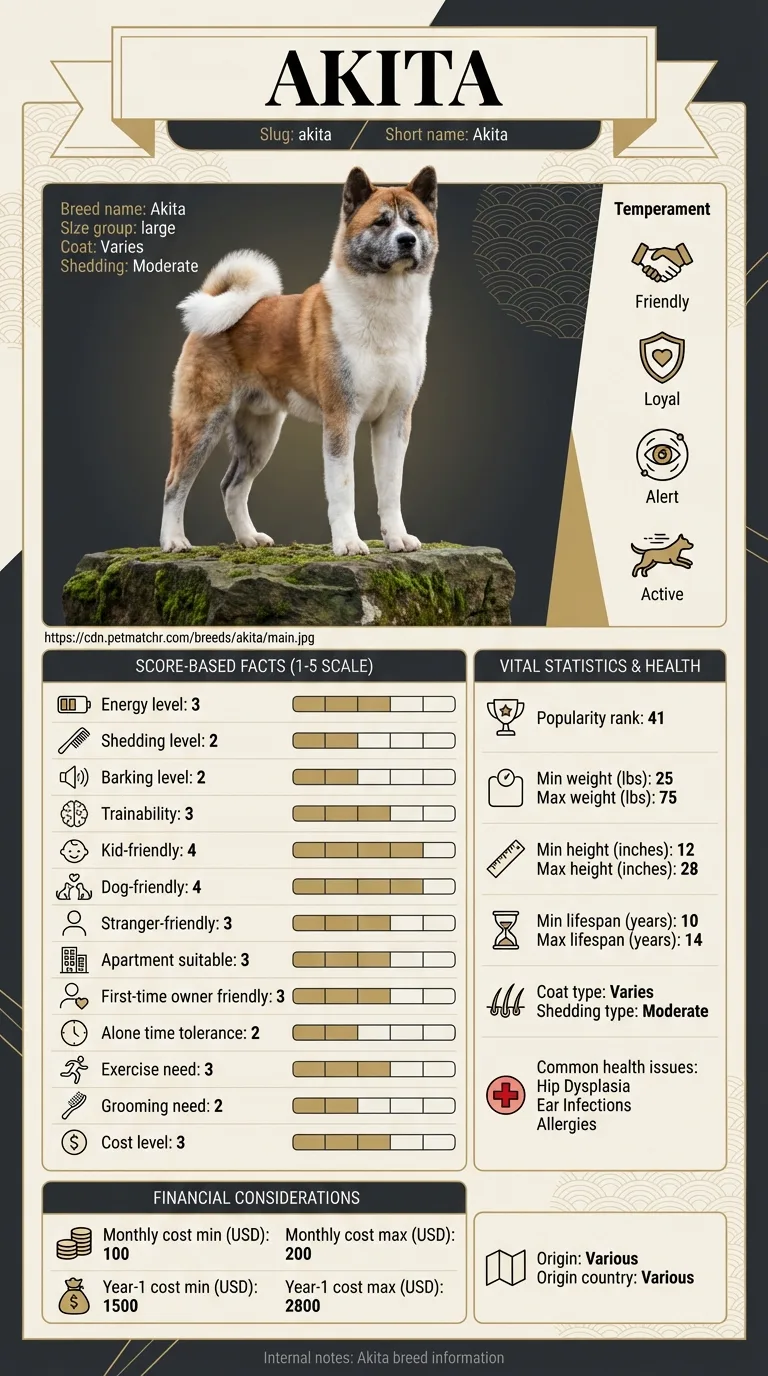
Choose the Akita if you want a calm, quiet, self-contained dog: 3/5 exercise, 2/5 barking, 3/5 for time alone. You are accepting a guardian temperament rating 1/5 for first-time owners, 2/5 with strangers and 2/5 with other dogs, plus a double coat at 5/5 shedding and a shorter life of 10–13 years.
Choose australian shepherd if...
Choose the Australian Shepherd if you genuinely want a dog to do things with — training, agility, hiking, herding, scent work — and can commit to it most days. It rates 5/5 for trainability and 4/5 with both children and other dogs, lives 12–15 years, and costs $100–$200 a month. It rates 1/5 for apartments and 2/5 for time alone, and an under-worked Aussie becomes a neurotic, nipping, barking problem.
Head-to-head comparison
Feature
akita
australian shepherd
Winner
Weight
70–130 lbs
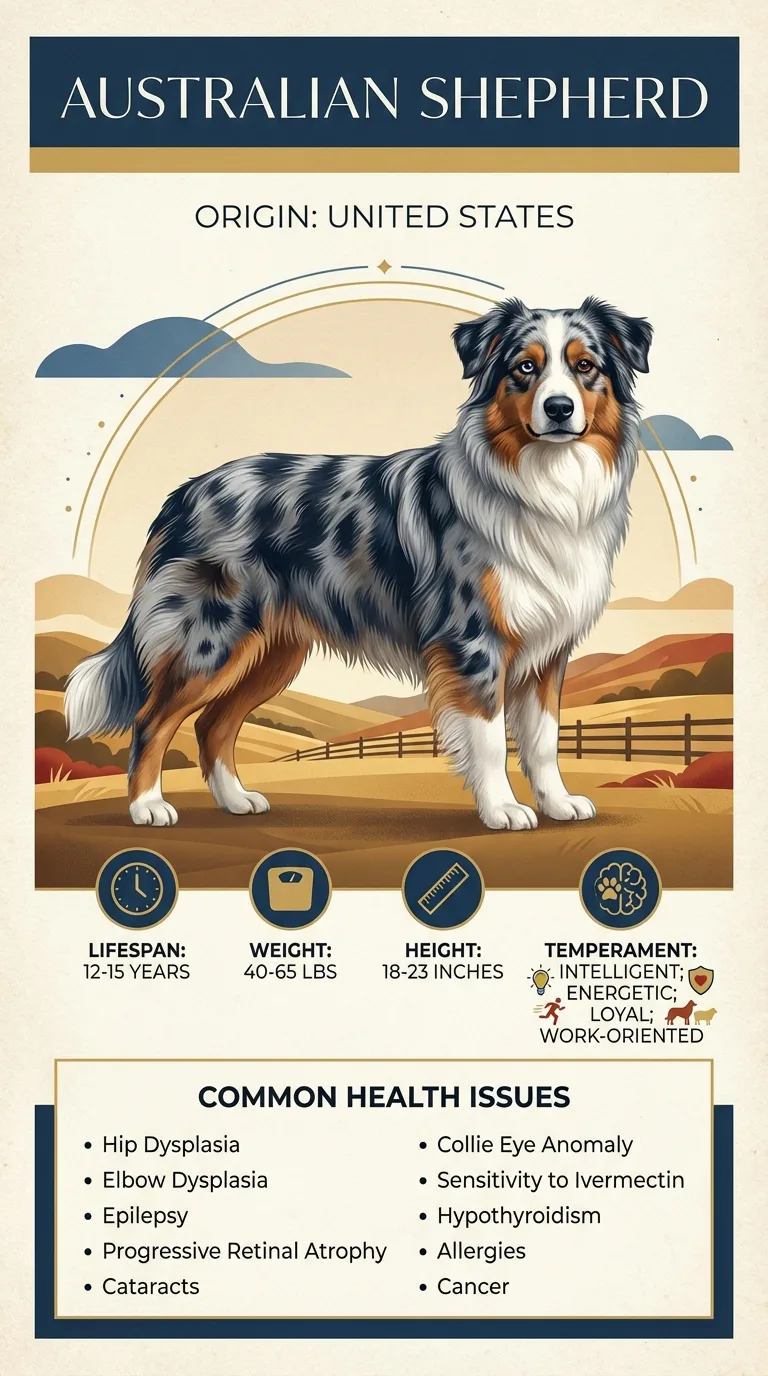
40–65 lbs
Equal
Height
24–28 in
18–23 in
Equal
Lifespan
10–13 years
12–15 years
australian shepherd
Coat
Dense double coat
Medium-length double coat
Equal
Grooming need
Moderate (3/5)
Moderate (3/5)
Equal
Shedding
Very high (5/5)
High (4/5)
australian shepherd
Energy level
Moderate (3/5)
Very high (5/5)
Equal
Exercise need
Moderate (3/5)
Very high (5/5)
akita
Trainability
Moderate (3/5)
Very high (5/5)
australian shepherd
Barking
Low (2/5)
Moderate (3/5)
akita
Good with kids
Moderate (3/5)
High (4/5)
australian shepherd
Good with other dogs
Low (2/5)
High (4/5)
australian shepherd
Friendly to strangers
Low (2/5)
Low (2/5)
Equal
Apartment suitability
Low (2/5)
Very low (1/5)
akita
Good for first-time owners
Very low (1/5)
Low (2/5)
australian shepherd
Tolerates being alone
Moderate (3/5)
Low (2/5)
akita
Typical monthly cost
$110–$240
$100–$200
australian shepherd
Typical first-year cost
$1,700–$3,200
$1,500–$2,800
australian shepherd
Deep dive
5/5 against 3/5 is the whole comparison
The Australian Shepherd rates 5/5 for energy and 5/5 for exercise need. Those are ceiling values and they mean what they say: this breed was developed to work livestock across a ranch all day and it retains the engine and the brain that went with it.
What satisfies an Aussie is not distance alone. It is structured work — training sessions, agility, scent games, herding if you have access to it, a long hike with tasks built in. A two-hour walk with no thinking in it produces a fitter dog with the same unmet need. This is the breed's defining characteristic and it is why the apartment rating is 1/5.
The Akita at 3/5 wants a decent daily walk and is then done. Its 3/5 energy indoors is accurate: it lies down and stays there. In a household with limited time, that difference is not a preference, it is the entire question.
Be honest about your worst week, not your best one. An Aussie owned by someone with good intentions and a demanding job is a common and unhappy animal.
The most trainable breed here, against one of the least
The Aussie rates 5/5 for trainability, at the top of the scale with the retrievers and the German Shepherd. It learns fast, works willingly, and is a genuine pleasure to train — which is fortunate, because it needs the training as an outlet rather than as a nicety.
The flip side of a 5/5 brain is that it learns unintended things equally fast. Aussies are famous for inventing jobs when none is provided: herding children or other pets, patrolling fence lines, becoming reactive to movement — bicycles, cars, joggers. That is under-employment showing up as behaviour.
The Akita at 3/5 is not slow, it is independent. It understands and then decides. Harsh correction of a large guardian breed is a poor plan, and what works is early positive training plus a long socialisation programme that continues well past puppyhood, because the guarding instinct sharpens rather than fades with maturity.
First-time suitability is 2/5 for the Aussie and 1/5 for the Akita. Neither is a beginner's dog, for entirely different reasons.
Both shed; the Akita more, the Aussie messier
Grooming rates 3/5 for both, but the coats behave differently.
The Akita's dense double coat sheds at 5/5, seasonally and dramatically — two moults a year that fill bin bags, with quieter months in between. An undercoat rake through the moult is the whole job.
The Aussie's medium-length double coat sheds at 4/5 and comes with feathering on the legs and britches that mats and collects burrs, mud and grass seed in a way the Akita's tighter coat does not. Weekly brushing is genuinely required rather than optional, more during the seasonal blow.
Neither should be shaved. Both double coats insulate against summer heat as well as winter cold.
Children, other dogs and visitors
The Aussie rates 4/5 with children and 4/5 with other dogs; the Akita rates 3/5 and 2/5. On sociability with other animals the Aussie is clearly the easier dog, and if you already own a dog that gap should carry weight.
The Aussie's caveat with children is not aggression but herding: a working-bred dog with no stock may try to move running children, and heel-nipping is a common and correctable but genuinely annoying behaviour. It needs interrupting early rather than being found funny.
Both rate 2/5 with strangers. The Akita's reserve is guardian instinct and it is territorial. The Aussie's is a herding breed's natural watchfulness — it tends to hang back and assess rather than to place itself between you and the door.
On noise the Akita wins clearly at 2/5 against 3/5. Aussies bark, particularly when under-exercised.
One drug sensitivity every Aussie owner must know
The Australian Shepherd carries the MDR1 mutation at high frequency — the gene that governs how the blood-brain barrier handles certain drugs. Dogs with two copies can react severely, sometimes fatally, to ivermectin and to a list of other common medications including some anti-parasitics, sedatives and chemotherapy agents. Sensitivity to ivermectin appears explicitly on the breed's condition list here.
There is a cheap DNA test. Every Aussie should have it, the result should be on the file at your vet, and no Aussie should receive a drug on the MDR1 list without the status being known. This is the most actionable single fact on this page.
The breed also carries hip and elbow dysplasia, epilepsy, and a set of inherited eye conditions including Collie eye anomaly, progressive retinal atrophy and cataracts, all of which a breeder should have screened.
The Akita's burden is autoimmune and endocrine — immune-mediated disease, hypothyroidism, progressive retinal atrophy — plus bloat as a deep-chested breed, and a known sensitivity to anaesthesia worth flagging to any unfamiliar vet.
The Aussie lives longer: 12 to 15 years against 10 to 13.
Cost and the merle warning
The Aussie is the cheaper dog at $100–$200 a month against $110–$240, with first-year totals of $1,500–$2,800 against $1,700–$3,200. Size accounts for most of it.
One buying warning specific to the Aussie, because the breed's popularity has produced bad practice: never buy a double merle. Breeding merle to merle produces puppies with a high risk of deafness and serious eye defects, and it is done because the coats sell. A responsible breeder will not pair two merles and will tell you the coat colour genetics of both parents without being pushed. If a seller cannot explain this, walk away.
For the Akita, the equivalent question is autoimmune and thyroid history in the line, and hip scores for both.
Akita vs Australian Shepherd: opposite problems
Both of these breeds are commonly returned to rescue, and for exactly opposite reasons.
Akitas come back because the guardian temperament arrived at social maturity and the household was not prepared for a hundred-pound dog with opinions about visitors. Aussies come back because a family bought a beautiful merle puppy and discovered they had acquired a working dog with a 5/5 exercise requirement and a 5/5 brain, and that a bored one herds children, nips heels, and barks.
One shared row: both rate 2/5 with strangers, though for different reasons — the Akita is a guardian, the Aussie is a herding breed that is naturally reserved and watchful.
Everything else is a mirror image.
Akita or Australian Shepherd: Guard Dog or Working Dog? - Akita vs Australian Shepherd: opposite problems
Frequently asked questions
Which needs more exercise, an Akita or an Australian Shepherd?
The Australian Shepherd, and the gap is the largest on this page — 5/5 against the Akita's 3/5, with energy at 5/5 against 3/5. The Aussie needs structured work rather than distance: training, agility, scent games or herding. The Akita is content with a decent daily walk and then lies down.
Which is easier to train?
The Australian Shepherd, decisively, at 5/5 against the Akita's 3/5. It is one of the most trainable breeds there is. The catch is that the same brain invents its own jobs when under-employed — herding children, patrolling, reacting to bicycles. The Akita is not slow, it is independent, and it weighs whether it agrees with you.
What is MDR1 and why does it matter for Australian Shepherds?
MDR1 is a genetic mutation carried at high frequency in the breed that affects how the blood-brain barrier handles certain drugs. Affected dogs can react severely, sometimes fatally, to ivermectin and a range of other common medications. A cheap DNA test exists, every Aussie should have it, and the result should be on file at your vet before any of those drugs is given.
Which is better with other dogs and children?
The Aussie, at 4/5 with both against the Akita's 2/5 with dogs and 3/5 with children. The Aussie's caveat around children is herding rather than aggression — a working-bred dog may try to move running children and nip at heels, which needs interrupting early. The Akita's dog intolerance is territorial and often same-sex.
Which sheds more?
The Akita at 5/5 against the Aussie's 4/5, though grooming rates 3/5 for both. The Akita's shedding is dramatic and seasonal with quiet months in between. The Aussie sheds more continuously and its feathering mats and collects burrs and mud, so weekly brushing is genuinely required.
Can either live in an apartment?
Neither well, though the Akita is the more plausible at 2/5 against the Aussie's 1/5 — it is quieter at 2/5 barking and needs far less exercise. An Australian Shepherd in a flat works only for an owner whose life is built around getting the dog out and working it daily.
Which lives longer?
The Australian Shepherd, at 12 to 15 years against the Akita's 10 to 13, reflecting both its smaller size and the Akita's heavier autoimmune and endocrine disease burden.
Akita vs Australian Shepherd: which should I choose?
Choose the Aussie if you want a dog to actively do things with most days and can meet a 5/5 exercise and 5/5 mental requirement. Choose the Akita if your week has no room for that and you specifically want a quiet guardian breed.
Costs
How much does each cost per month?
The Akita runs $110–$240 a month and the Australian Shepherd $100–$200, with first-year totals of $1,700–$3,200 and $1,500–$2,800.
Health
What is the single most important health fact here?
MDR1 drug sensitivity in the Australian Shepherd. Affected dogs can react fatally to ivermectin and several other common drugs. Test for it and put the result on your vet's file.
Behavior
Which is quieter?
The Akita at 2/5 barking against the Aussie's 3/5. Aussie barking rises sharply when the dog is under-exercised, so the rating understates a badly matched household.
Related DogBreedCompass guides
Akita breed guide – The Akita profile covers the guardian temperament and the long socialisation window.
Australian Shepherd breed guide – The Aussie profile goes further into work requirements and the merle genetics buyers need to understand.
Australian Shepherd vs Border Collie – The Border Collie is the breed people weigh against the Aussie when they want even more drive.
Akita vs Alaskan Malamute – The Malamute is the other large northern dog compared against the Akita, and it is far more sociable.
Australian Shepherd genetic disorders – The genetic-disorder page covers MDR1 alongside the inherited eye conditions a breeder should have screened.
Akita autoimmune diseases – Autoimmune disease is the Akita's most distinctive burden and the first question for a breeder.
Health information here is general and is not veterinary advice. If your dog shows pain, sudden behaviour change, or worsening symptoms, consult a licensed veterinarian.
Some links on this site are affiliate links. We may earn a commission at no extra cost to you, and we only suggest products we believe are helpful for dog owners.
We research and check what we publish, but we do not warrant that any figure, date, price, or statement is accurate, complete, or current, and we accept no liability for any loss, cost, injury, or other harm arising from the use of this site. Use it as one reference among several. You remain responsible for your own decisions and for your dog's care - confirm anything that matters with a licensed veterinarian or another qualified professional before you act on it. Full disclaimer.