Behavior
Which breed should you pick overall?
Want a dog that's still athletic but easier to socialize and train for a first-timer? English Cocker. Want maximum drive and don't mind a more reserved temperament? Aussie.

Quick answer
Which breed should you pick overall?
Want a dog that's still athletic but easier to socialize and train for a first-timer? English Cocker. Want maximum drive and don't mind a more reserved temperament? Aussie.
Australian Shepherd or English Cocker Spaniel? On paper they differ most on apartment suitability, and on the scales Australian Shepherd is the heavier at 40–65 lbs. Here is how the two compare on everything that shapes an ordinary week.
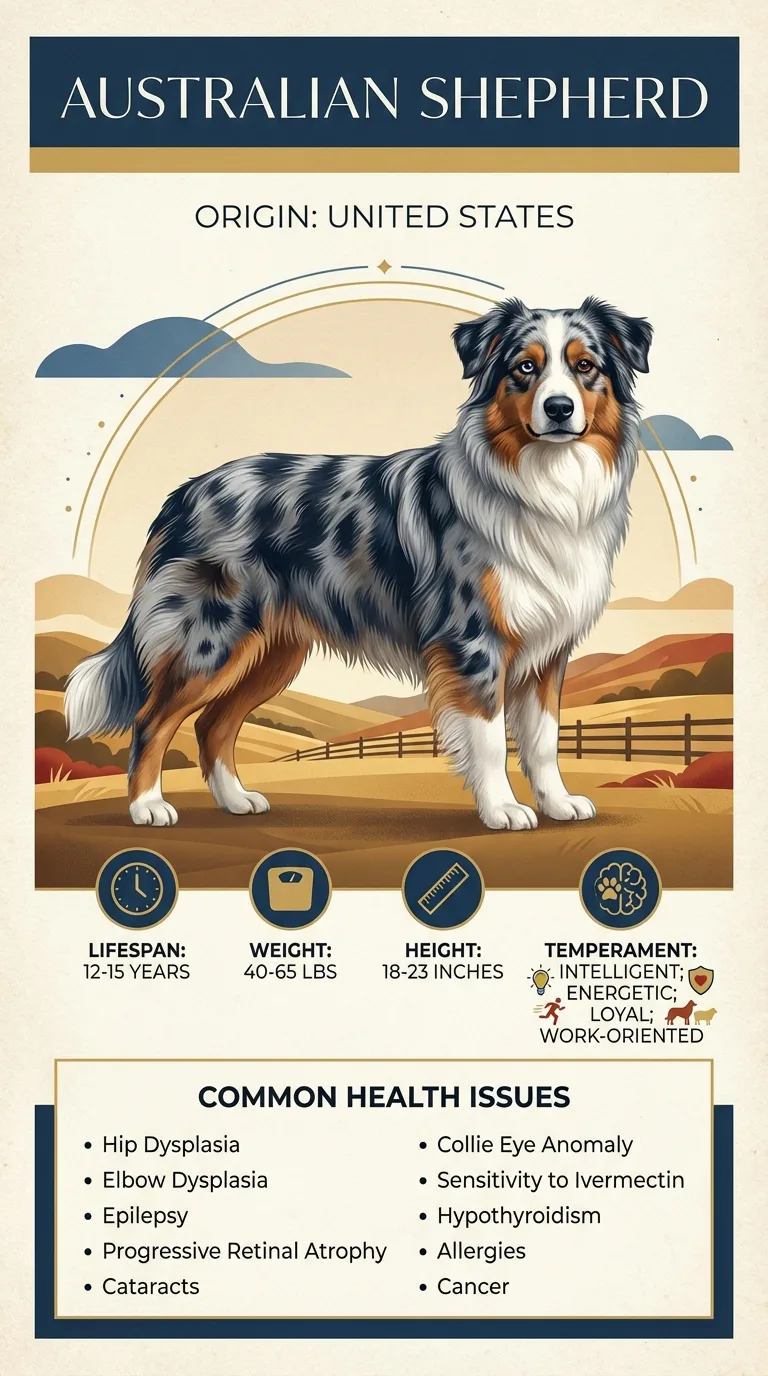
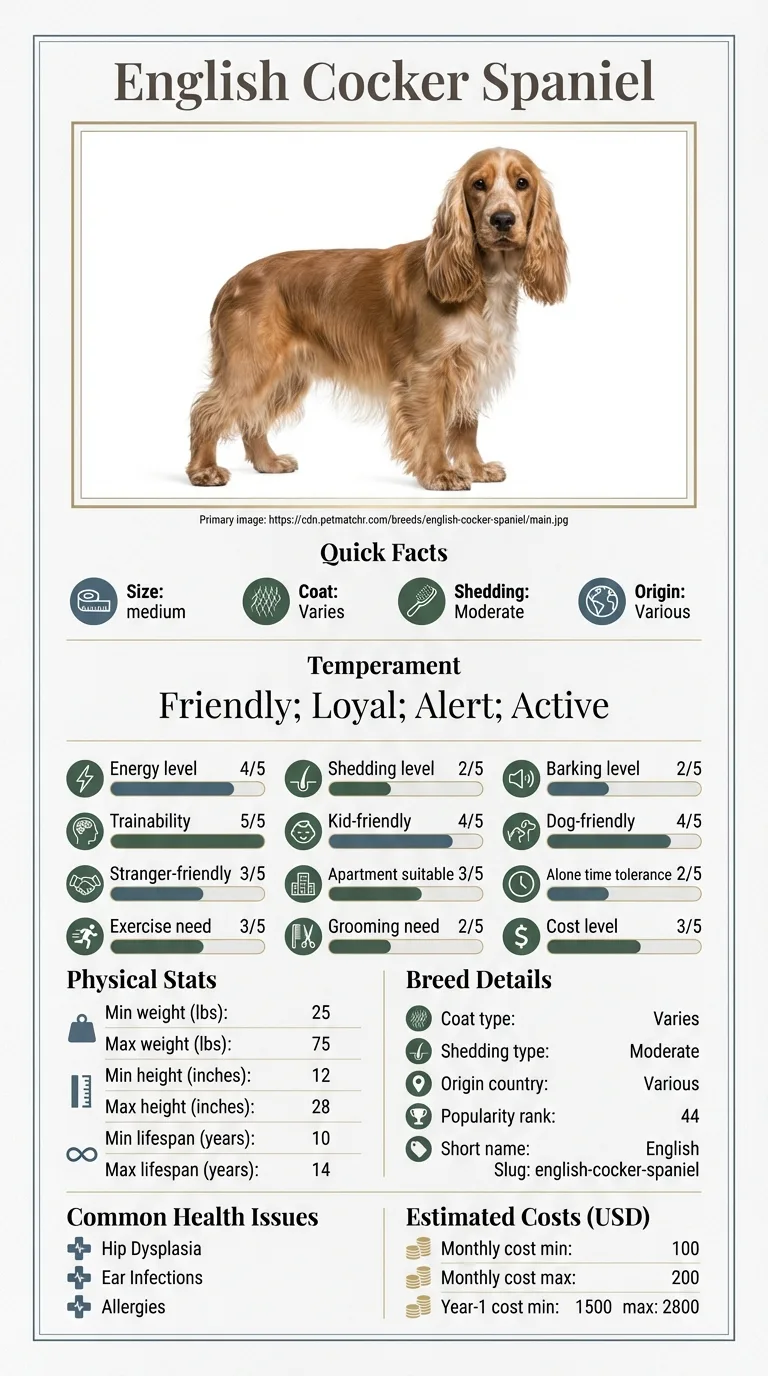
This is for someone already down to Australian Shepherd and English Cocker Spaniel and deciding between them. For this pair the decision usually turns on apartment suitability and good for first-time owners, so those are covered first and in most detail. Anyone choosing from a flat has a clear answer here: English Cocker Spaniel rates 4/5 against 1/5. It is written for the decision rather than the breed history.
Between Australian Shepherd and English Cocker Spaniel, apartment suitability is what separates them, and English Cocker Spaniel is the lower-effort dog of the two to keep.
Choose Australian Shepherd if you do not want a standing grooming appointment, you want a dog that picks up training quickly and you want a dog that can keep up with an active routine.
Choose English Cocker Spaniel if you are in a flat or a smaller home, this is your first dog and shedding is a problem in your house.
| Feature | australian shepherd | english cocker spaniel | Winner |
|---|---|---|---|
| Size class | medium | medium | Equal |
| Weight | 40–65 lbs | 26–34 lbs | Equal |
| Height | 18–23 in | 15–17 in | Equal |
| Lifespan | 12–15 years | 12–14 years | australian shepherd |
| Exercise need | Very high (5/5) | High (4/5) | english cocker spaniel |
| Grooming need | Moderate (3/5) | High (4/5) | australian shepherd |
| Shedding | High (4/5) | Moderate (3/5) | english cocker spaniel |
| Energy level | Very high (5/5) | High (4/5) | Equal |
| Barking | Moderate (3/5) | Moderate (3/5) | Equal |
| Apartment suitability | Very low (1/5) | High (4/5) | english cocker spaniel |
| Good for first-time owners | Low (2/5) | High (4/5) | english cocker spaniel |
| Tolerates being alone | Low (2/5) | Low (2/5) | Equal |
| Trainability | Very high (5/5) | High (4/5) | australian shepherd |
| Good with kids | High (4/5) | Very high (5/5) | english cocker spaniel |
| Good with other dogs | High (4/5) | High (4/5) | Equal |
| Friendly to strangers | Low (2/5) | High (4/5) | english cocker spaniel |
| Cost level | Moderate (3/5) | Moderate (3/5) | Equal |
| Coat | Medium-length double coat | Medium, silky and feathered | Equal |
| Origin | United States | Various | Equal |
| Typical monthly cost | $100–$200 | $100–$200 | Equal |
| Typical first-year cost | $1,500–$2,800 | $1,400–$2,900 | Equal |
Both breeds sit in the medium size class, but the Aussie runs noticeably bigger -- 40-65 lbs and 18-23 inches against the English Cocker's 26-34 lbs and 15-17 inches. Don't confuse this breed with the American Cocker Spaniel; the English version is a taller, more athletic build suited to fieldwork, which shows up in its exercise numbers.
This is one of the tighter exercise match-ups on the site: 5/5 for the Aussie against a high 4/5 for the English Cocker, a genuine sporting breed rather than a lap dog. Energy level runs close too (5 versus 4, marked a tie). If you wanted a low-key alternative to the Aussie, this isn't quite it -- the English Cocker still wants real daily activity.
The English Cocker actually out-grooms the Aussie here -- a high 4/5 against the Aussie's moderate 3/5, thanks to its silky, feathered coat that needs regular trimming and ear care. Shedding runs the other way, moderate (3/5) for the Cocker against high (4/5) for the Aussie, so less hair on the furniture but more time with scissors and a comb.
Apartment suitability favors the English Cocker clearly, 4/5 against the Aussie's 1/5, even with its higher-than-typical exercise needs for a spaniel. Barking ties at a moderate 3/5 for both. Just remember that a good apartment score here still assumes you're covering a real daily exercise requirement, not skipping it.
Both train well -- 5/5 for the Aussie, 4/5 for the English Cocker -- but the ownership gap is bigger than the training gap. First-time owners score high (4/5) with the Cocker against the Aussie's low (2/5), making the English Cocker the more forgiving choice for someone newer to dog ownership despite its own real exercise demands.
The English Cocker rates very high with kids (5/5 versus the Aussie's 4/5) and high with strangers (4/5 versus a low 2/5), while both tie for compatibility with other dogs at 4/5. Its merry, affectionate, biddable temperament leans more social than the Aussie's more work-focused, reserved disposition.
Lifespan slightly favors the Aussie, 12-15 years against 12-14 for the English Cocker. Two conditions overlap -- progressive retinal atrophy and hip dysplasia -- while the Cocker's shorter five-item list adds familial nephropathy and adult-onset neuropathy, both specific to the breed and absent from the Aussie's profile.
Cost lands close to identical: both breeds rate a moderate 3/5, both run $100-$200 monthly, and the Cocker's first-year range ($1,400-$2,900) nearly matches the Aussie's ($1,500-$2,800). Grooming bills for the Cocker's coat likely offset its smaller food bill relative to the larger Aussie.
Australian Shepherd weighs 40–65 lbs and lives 12–15 years; English Cocker Spaniel weighs 26–34 lbs and lives 12–14 years. The two diverge most on apartment suitability, good for first-time owners and friendly to strangers. They are level on tolerates being alone, barking and cost level, so those cannot decide it. In the table, a "winner" means easier for an ordinary household — not better. Size, coat and origin are recorded without a verdict. Because both breeds are scored the same way, the gaps are reliable even where the absolute numbers are rough.

This comparison covers the English Cocker Spaniel specifically, which is taller and more athletic than the American variety, at 26-34 lbs and 15-17 inches, with genuine field-dog exercise needs (4/5) rather than a low-energy lap-dog profile.
The English Cocker Spaniel, rated a high 4/5 against the Aussie's moderate 3/5, due to its silky, feathered coat.
Yes, more so than the Aussie -- it rates a high 4/5 for first-time owners against the Aussie's low 2/5, though its own exercise needs (4/5) are still substantial.
The English Cocker Spaniel, at 4/5 for apartment suitability against the Aussie's 1/5, provided its daily exercise needs are still met.
Very close -- both run $100-$200 monthly, and first-year costs are within $100 of each other ($1,400-$2,900 for the Cocker versus $1,500-$2,800 for the Aussie).
Two: progressive retinal atrophy and hip dysplasia appear on both lists. The Cocker's remaining risks -- familial nephropathy and adult-onset neuropathy -- are breed-specific and don't affect the Aussie.
The English Cocker, by a wide margin -- 4/5 against the Aussie's 2/5, consistent with its merry, biddable temperament.
Want a dog that's still athletic but easier to socialize and train for a first-timer? English Cocker. Want maximum drive and don't mind a more reserved temperament? Aussie.
Both run $100-$200 a month -- one of the closest cost match-ups on this site.
Close but not equal: 5/5 for the Aussie against a high 4/5 for the English Cocker.
The Aussie edges ahead slightly, 12-15 years against the English Cocker's 12-14.
Secure checkout on Stripe. We never see your card.
7-day money-back guarantee. Instant access.
Health information here is general and is not veterinary advice. If your dog shows pain, sudden behaviour change, or worsening symptoms, consult a licensed veterinarian.
Some links on this site are affiliate links. We may earn a commission at no extra cost to you, and we only suggest products we believe are helpful for dog owners.
We research and check what we publish, but we do not warrant that any figure, date, price, or statement is accurate, complete, or current, and we accept no liability for any loss, cost, injury, or other harm arising from the use of this site. Use it as one reference among several. You remain responsible for your own decisions and for your dog's care - confirm anything that matters with a licensed veterinarian or another qualified professional before you act on it. Full disclaimer.
Match your lifestyle to the right dog.
Take quizNot sure which breed is right for you? Take our 2-minute quiz to find out.
Take the quiz