Behavior
Aussie or Jack Russell, which should you get?
If you have another dog at home, lean Aussie, JRTs score low for getting along with other dogs. If noise isn't a concern and you want the cheaper dog, the JRT holds its own.

Quick answer
Aussie or Jack Russell, which should you get?
If you have another dog at home, lean Aussie, JRTs score low for getting along with other dogs. If noise isn't a concern and you want the cheaper dog, the JRT holds its own.
Australian Shepherd or Jack Russell Terrier? On paper they differ most on barking, and on the scales Australian Shepherd is the heavier at 40–65 lbs. Here is how the two compare on everything that shapes an ordinary week.
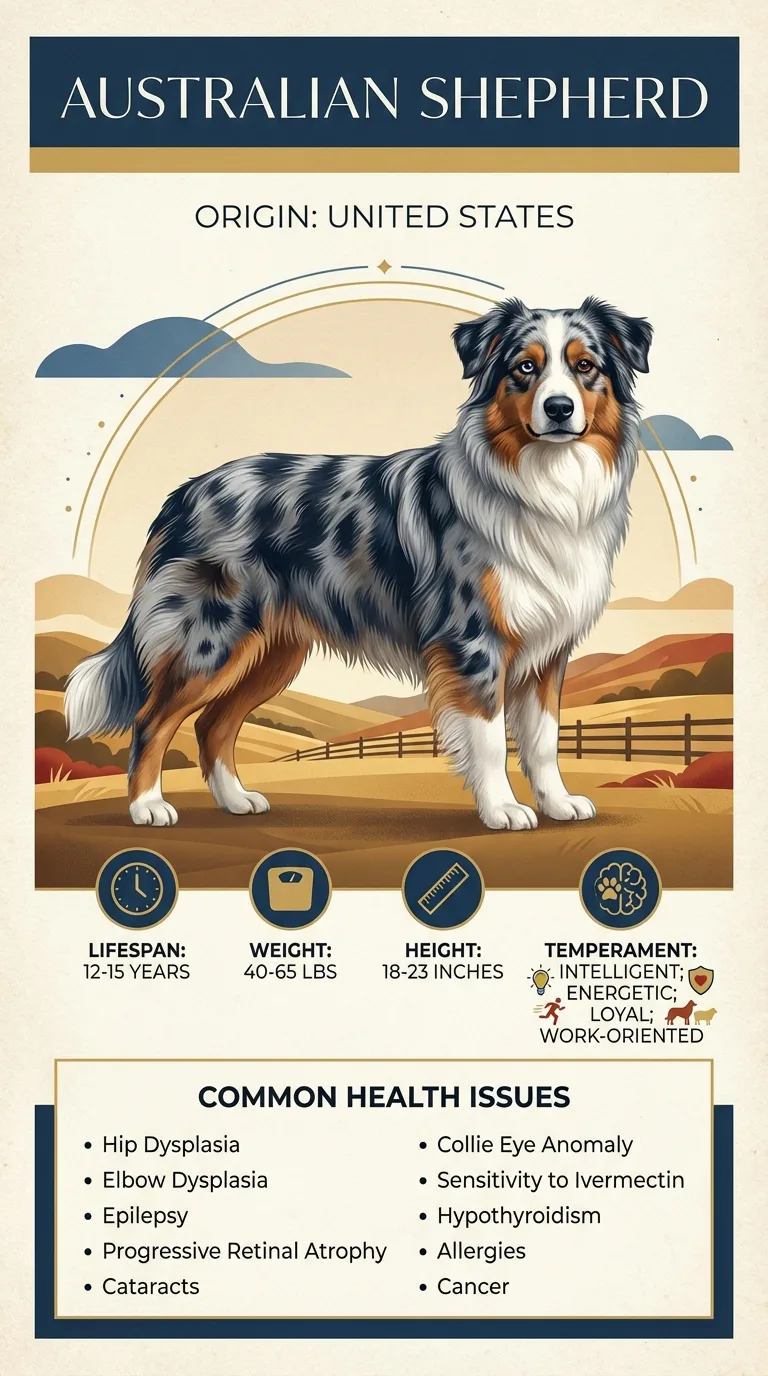
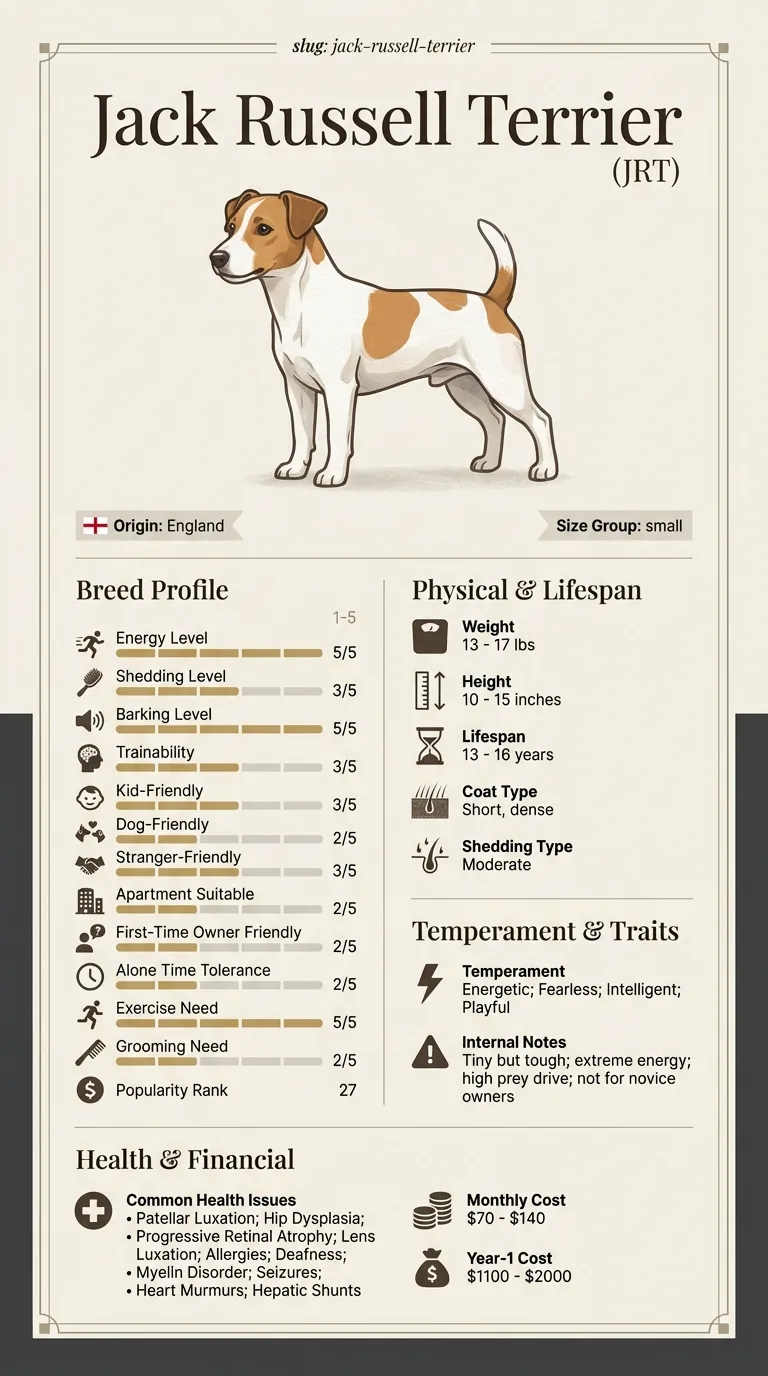
This is for someone already down to Australian Shepherd and Jack Russell Terrier and deciding between them. For this pair the decision usually turns on barking and trainability, so those are covered first and in most detail. Anyone choosing from a flat has a clear answer here: Jack Russell Terrier rates 2/5 against 1/5. There is no origin story here — only what changes about your week.
Between Australian Shepherd and Jack Russell Terrier, barking is what separates them, and Jack Russell Terrier is the lower-effort dog of the two to keep.
Choose Australian Shepherd if there are young children at home, you already have another dog and you want a dog that picks up training quickly.
Choose Jack Russell Terrier if you do not want a standing grooming appointment, shedding is a problem in your house and a smaller dog suits your car, your home or your back.
| Feature | australian shepherd | jack russell terrier | Winner |
|---|---|---|---|
| Size class | medium | small | Equal |
| Weight | 40–65 lbs | 13–17 lbs | Equal |
| Height | 18–23 in | 10–15 in | Equal |
| Lifespan | 12–15 years | 13–16 years | jack russell terrier |
| Exercise need | Very high (5/5) | Very high (5/5) | Equal |
| Grooming need | Moderate (3/5) | Low (2/5) | jack russell terrier |
| Shedding | High (4/5) | Moderate (3/5) | jack russell terrier |
| Energy level | Very high (5/5) | Very high (5/5) | Equal |
| Barking | Moderate (3/5) | Very high (5/5) | australian shepherd |
| Apartment suitability | Very low (1/5) | Low (2/5) | jack russell terrier |
| Good for first-time owners | Low (2/5) | Low (2/5) | Equal |
| Tolerates being alone | Low (2/5) | Low (2/5) | Equal |
| Trainability | Very high (5/5) | Moderate (3/5) | australian shepherd |
| Good with kids | High (4/5) | Moderate (3/5) | australian shepherd |
| Good with other dogs | High (4/5) | Low (2/5) | australian shepherd |
| Friendly to strangers | Low (2/5) | Moderate (3/5) | jack russell terrier |
| Cost level | Moderate (3/5) | Low (2/5) | jack russell terrier |
| Coat | Medium-length double coat | Short, dense | Equal |
| Origin | United States | England | Equal |
| Typical monthly cost | $100–$200 | $70–$140 | Equal |
| Typical first-year cost | $1,500–$2,800 | $1,100–$2,000 | Equal |
Both are compact dogs, but not the same kind of compact. The Aussie runs 40-65 lbs and up to 23 inches; the Jack Russell tops out at 17 lbs and 15 inches, small enough to fit through a rabbit hole, which is more or less its original job description.
This is a rare tie: both breeds rate 5/5 for exercise need and 5/5 for energy level. Don't let the JRT's small frame fool you, it was bred to run down foxes and go to ground after them, and it needs real daily output just as much as the Aussie does. Neither dog is a low-key option.
Grooming favors the JRT, 2/5 against the Aussie's 3/5, and its short coat is easy upkeep. Shedding tells a similar story, moderate (3/5) for the JRT versus high (4/5) for the Aussie. If coat maintenance is your deciding factor, the terrier wins outright.
Apartment suitability is low for both, 2/5 for the JRT, 1/5 for the Aussie, but barking is where the JRT stands out: a 5/5, very high, against the Aussie's moderate 3/5. A Jack Russell in a thin-walled building is a real noise-complaint risk in a way the Aussie generally isn't.
Trainability clearly favors the Aussie, 5/5 versus the JRT's 3/5, terriers are smart but famously independent-minded, bred to make split-second decisions underground without waiting on a handler. Both rate a low 2/5 for first-time owners, so neither is an easy starter dog, just difficult in different ways.
The Aussie pulls ahead with kids (4/5 vs 3/5) and with other dogs (4/5 vs a low 2/5), Jack Russells have a real terrier prey drive and don't reliably get along with other dogs. Strangers slightly favor the JRT (3/5 vs 2/5). If you already have another dog in the house, that other-dogs number is worth taking seriously.
The JRT edges out the Aussie on lifespan, 13-16 years against 12-15. Both share hip dysplasia, progressive retinal atrophy and allergies on their risk lists, though the JRT's list also includes lens luxation and seizure risk that the Aussie's doesn't.
Cost level rates 3/5 for the Aussie and 2/5 for the JRT, and the dollar ranges follow, $100-200 monthly for the Aussie against $70-140 for the JRT, with first-year costs of $1,500-2,800 versus $1,100-2,000. The terrier is the cheaper dog to keep on every measure here.
Australian Shepherd weighs 40–65 lbs and lives 12–15 years; Jack Russell Terrier weighs 13–17 lbs and lives 13–16 years. The two diverge most on barking, trainability and good with other dogs. They are level on tolerates being alone, energy level and exercise need, so those cannot decide it. Where the table declares a winner it means less work for the owner, nothing more; descriptive rows are left as ties on purpose. The value here is in the differences between the two columns; treat any single score as approximate.

They're tied, both rated 5/5, neither is a casual, low-activity dog despite the JRT's small size.
The Jack Russell, rated 5/5 against the Aussie's 3/5. It's one of the biggest practical differences between the two if you have close neighbors.
No, both score a low 2/5. The Aussie needs a job to stay settled; the JRT needs firm, consistent handling to manage its independent streak.
Maybe not easily, JRTs rate only 2/5 for getting along with other dogs, well below the Aussie's 4/5, due to a strong terrier prey drive.
The Jack Russell, at $70-140 a month against the Aussie's $100-200, and $1,100-2,000 versus $1,500-2,800 in the first year.
Some, hip dysplasia, progressive retinal atrophy and allergies show up on both lists, though each breed also carries risks the other doesn't.
The Jack Russell, typically 13-16 years against the Aussie's 12-15.
If you have another dog at home, lean Aussie, JRTs score low for getting along with other dogs. If noise isn't a concern and you want the cheaper dog, the JRT holds its own.
The Jack Russell, at $70-140 against the Aussie's $100-200.
Yes, both rate a maxed 5/5 for exercise need, a true tie despite the size difference.
The Jack Russell, at 13-16 years versus the Aussie's 12-15.
Secure checkout on Stripe. We never see your card.
7-day money-back guarantee. Instant access.
Health information here is general and is not veterinary advice. If your dog shows pain, sudden behaviour change, or worsening symptoms, consult a licensed veterinarian.
Some links on this site are affiliate links. We may earn a commission at no extra cost to you, and we only suggest products we believe are helpful for dog owners.
We research and check what we publish, but we do not warrant that any figure, date, price, or statement is accurate, complete, or current, and we accept no liability for any loss, cost, injury, or other harm arising from the use of this site. Use it as one reference among several. You remain responsible for your own decisions and for your dog's care - confirm anything that matters with a licensed veterinarian or another qualified professional before you act on it. Full disclaimer.
Match your lifestyle to the right dog.
Take quizNot sure which breed is right for you? Take our 2-minute quiz to find out.
Take the quiz