Behavior
Aussie or Great Dane, which is the better overall pick?
Go Aussie if you want an active partner for years of hiking and training; go Dane if you want a calm, kid-friendly giant and are prepared for a shorter lifespan and higher costs.

Quick answer
Aussie or Great Dane, which is the better overall pick?
Go Aussie if you want an active partner for years of hiking and training; go Dane if you want a calm, kid-friendly giant and are prepared for a shorter lifespan and higher costs.
Australian Shepherd or Great Dane? On paper they differ most on exercise need, and on the scales Great Dane is the heavier at 110–175 lbs. Here is how the two compare on everything that shapes an ordinary week.
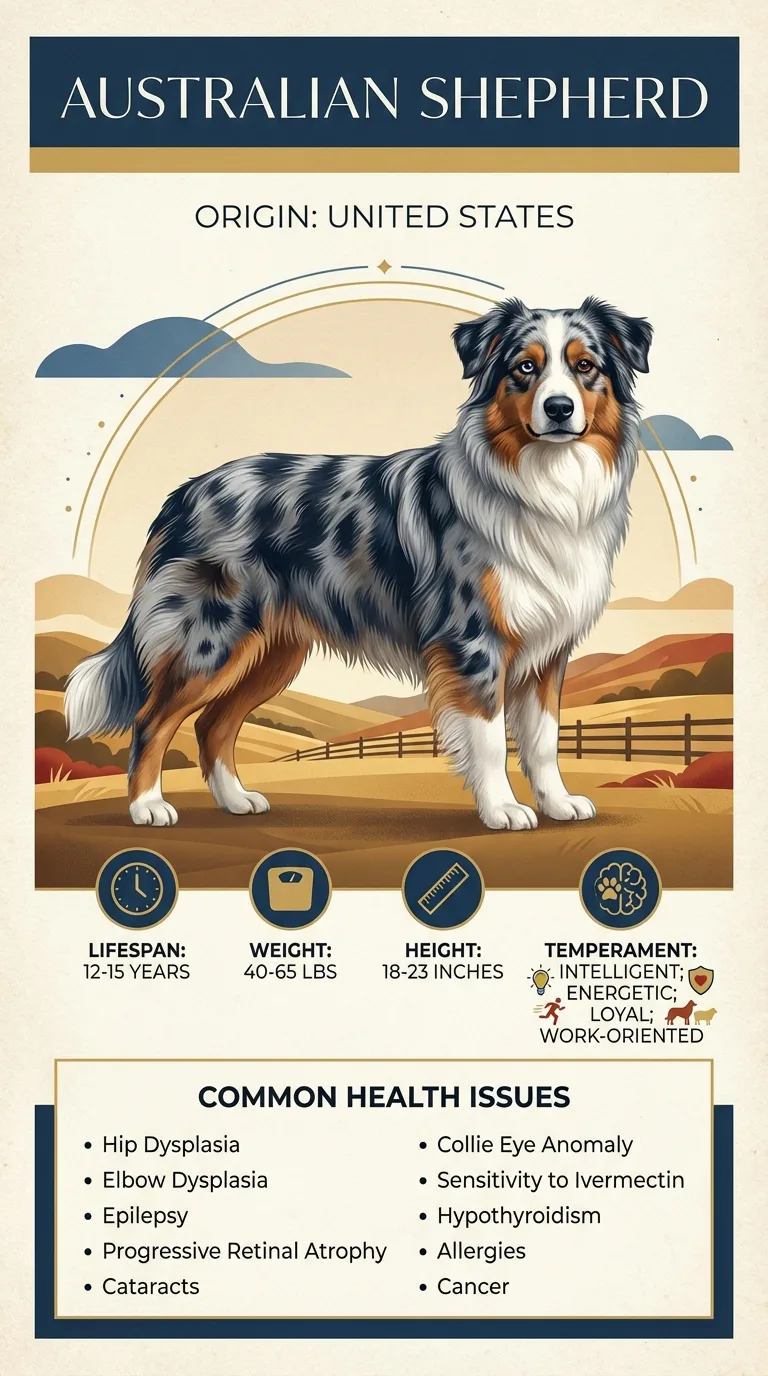
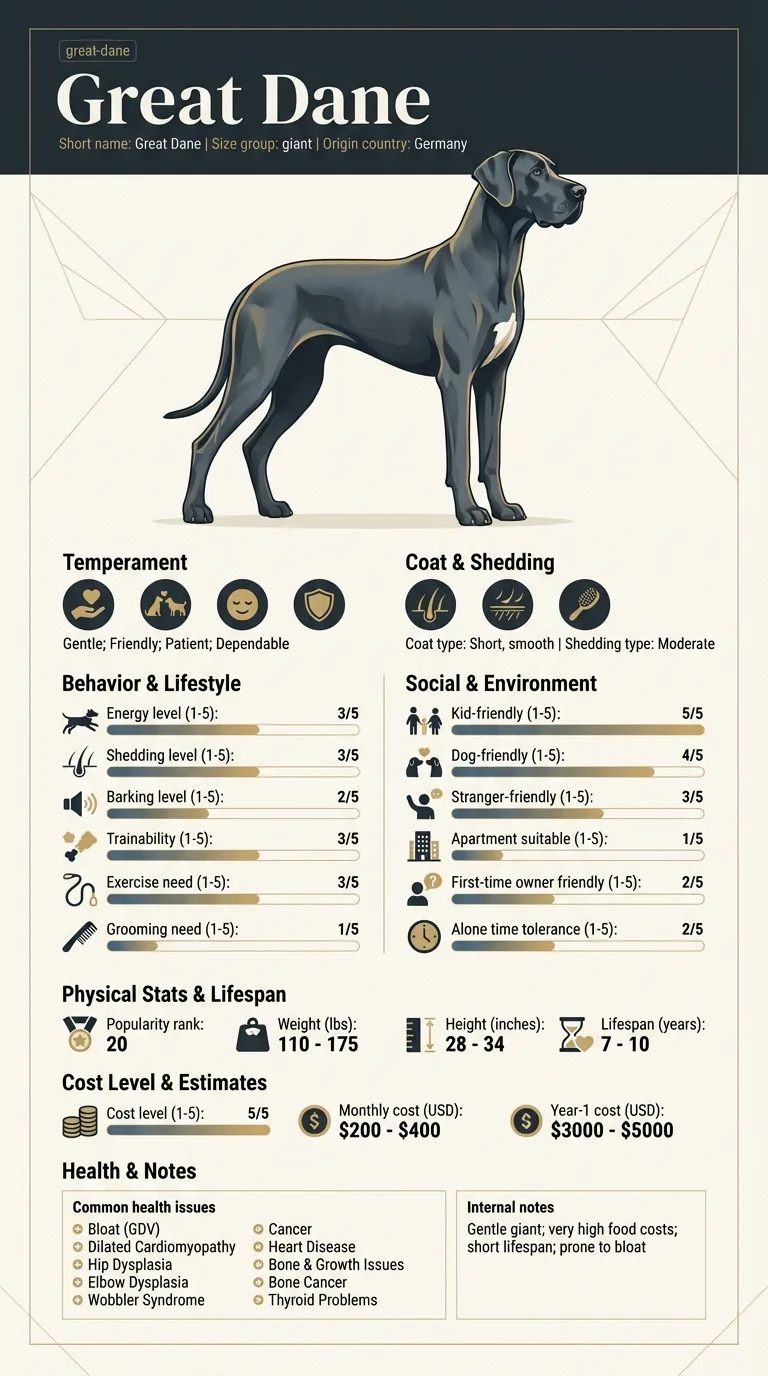
This is for someone already down to Australian Shepherd and Great Dane and deciding between them. For this pair the decision usually turns on exercise need and grooming need, so those are covered first and in most detail. Both rate 1/5 for flats, so housing does not settle this one. The focus throughout is on daily consequences rather than breed background.
Between Australian Shepherd and Great Dane, exercise need is what separates them, and Great Dane is the lower-effort dog of the two to keep.
Choose Australian Shepherd if you want a dog that picks up training quickly, a smaller dog suits your car, your home or your back and you want a dog that can keep up with an active routine.
Choose Great Dane if you do not want a standing grooming appointment, shedding is a problem in your house and your walking routine is modest.
| Feature | australian shepherd | great dane | Winner |
|---|---|---|---|
| Size class | medium | giant | Equal |
| Weight | 40–65 lbs | 110–175 lbs | Equal |
| Height | 18–23 in | 28–34 in | Equal |
| Lifespan | 12–15 years | 7–10 years | australian shepherd |
| Exercise need | Very high (5/5) | Moderate (3/5) | great dane |
| Grooming need | Moderate (3/5) | Very low (1/5) | great dane |
| Shedding | High (4/5) | Moderate (3/5) | great dane |
| Energy level | Very high (5/5) | Moderate (3/5) | Equal |
| Barking | Moderate (3/5) | Low (2/5) | great dane |
| Apartment suitability | Very low (1/5) | Very low (1/5) | Equal |
| Good for first-time owners | Low (2/5) | Low (2/5) | Equal |
| Tolerates being alone | Low (2/5) | Low (2/5) | Equal |
| Trainability | Very high (5/5) | Moderate (3/5) | australian shepherd |
| Good with kids | High (4/5) | Very high (5/5) | great dane |
| Good with other dogs | High (4/5) | High (4/5) | Equal |
| Friendly to strangers | Low (2/5) | Moderate (3/5) | great dane |
| Cost level | Moderate (3/5) | Very high (5/5) | australian shepherd |
| Coat | Medium-length double coat | Short, smooth | Equal |
| Origin | United States | Germany | Equal |
| Typical monthly cost | $100–$200 | $200–$400 | Equal |
| Typical first-year cost | $1,500–$2,800 | $3,000–$5,000 | Equal |
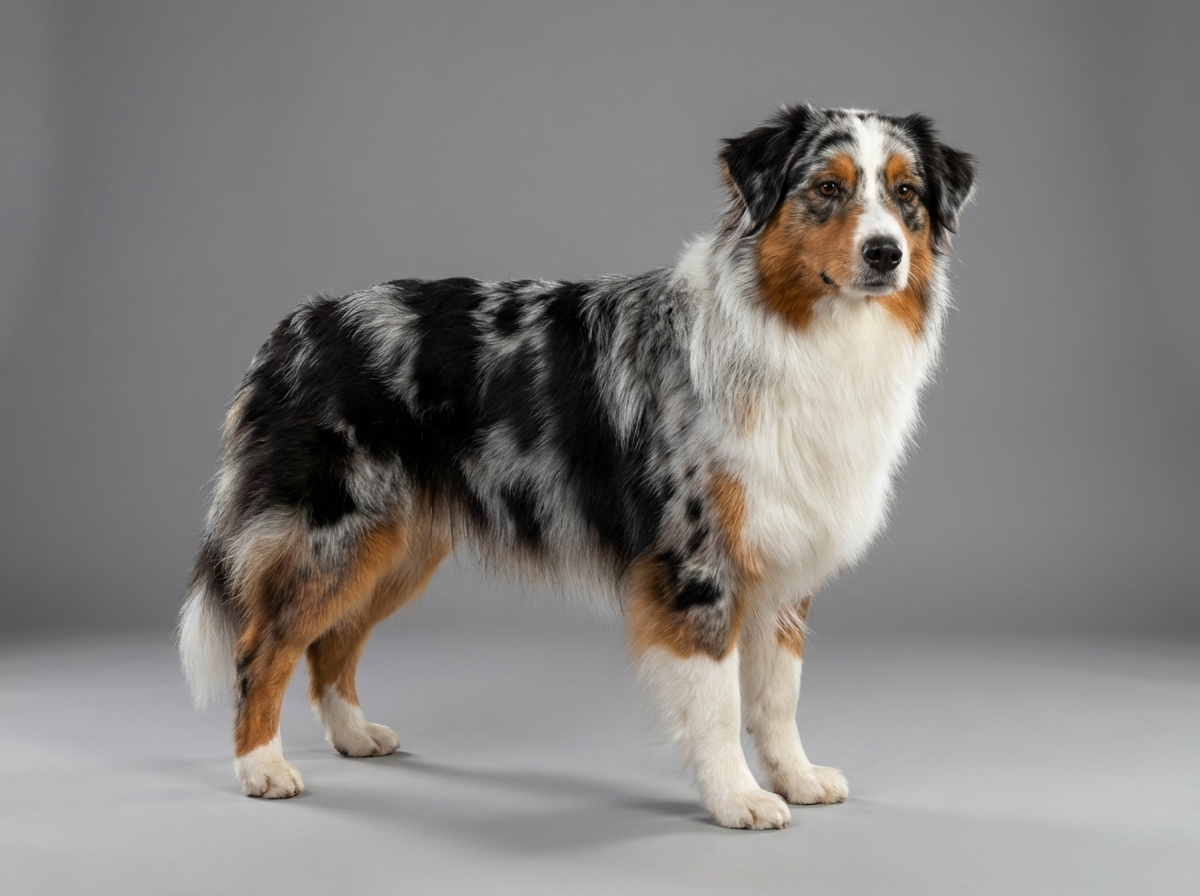
The gap here isn't subtle. An Australian Shepherd tops out around 65 lbs and 23 inches at the shoulder, a compact, athletic herder. A Great Dane can weigh up to 175 lbs and stand 34 inches tall, easily eye-level with a seated adult. You're not choosing between two dog sizes so much as two different animals to live with: one you can lift into a car, one that takes up a full back seat by itself.
On paper the Aussie rates a 5/5 for exercise need against the Dane's 3/5, and that tracks with what each breed was bred to do. The Aussie wants a job, herding runs, agility, hours of structured activity, while the Great Dane is content with a couple of solid walks and then a long nap. Don't mistake the Dane's size for endless stamina; those long legs cover ground fast but tire out sooner than you'd expect.
Grooming favors the Dane outright, a 1/5 need against the Aussie's 3/5, since a short smooth coat needs little more than an occasional wipe-down. Shedding tells a similar story: the Aussie's double coat rates 4/5, the Dane's 3/5. Neither is hypoallergenic, but you'll spend far less time with a brush in hand if you go with the Dane.
Both breeds score a 1/5 for apartment suitability, so neither is a realistic small-space dog regardless of which one you pick. Barking runs moderate for the Aussie (3/5) and low for the Dane (2/5). Alone time is the bigger shared problem: both sit at 2/5 for tolerating solitude, meaning a Dane's calm demeanor doesn't translate into independence, it still wants you around.
Trainability splits clearly in the Aussie's favor, 5/5 versus the Dane's 3/5, and both rate a 2/5 for first-time-owner suitability. That means neither is a beginner's dog, but for different reasons, the Aussie needs an owner who can channel its intelligence and drive, while the Dane needs one who can manage sheer size and impulse control in a body that outweighs most adults.
Great Danes edge out Aussies with kids (5/5 vs 4/5) and with strangers (3/5 vs 2/5), fitting their reputation as gentle giants who lean toward everyone they meet. Both handle other dogs well at 4/5. The Aussie's reserve around new people is worth planning for if you host often, it's not unfriendly, just watchful.
Lifespan is where the Aussie pulls ahead hard: 12-15 years against the Dane's 7-10. Both share hip dysplasia, elbow dysplasia and cancer risk, but the Dane adds bloat (GDV), dilated cardiomyopathy and Wobbler syndrome, conditions tied directly to its size and deep chest. A Great Dane's health risks are largely a function of scale; there's no getting around that with a giant breed.
Cost level rates 3/5 for the Aussie and 5/5 for the Dane, and the monthly ranges back it up, $100-200 versus $200-400. First-year costs run $1,500-2,800 for the Aussie against $3,000-5,000 for the Dane, mostly food volume and larger-dog vet pricing. Budget for the Dane like you would a second car payment in year one.
Australian Shepherd weighs 40–65 lbs and lives 12–15 years; Great Dane weighs 110–175 lbs and lives 7–10 years. The two diverge most on exercise need, grooming need and energy level and 2 other rated axes. They are level on tolerates being alone, apartment suitability and good with other dogs, so those cannot decide it. The table below marks a winner only where one breed is genuinely easier for a typical owner; size and origin are facts rather than merits and stay level. Ratings come from one source applied to both breeds, so they are meaningful against each other rather than as absolute scores.

A lot, the Dane can weigh 110-175 lbs against the Aussie's 40-65 lbs, and stands up to 11 inches taller. Expect to plan furniture, car space and doorways around a Dane in a way you wouldn't for an Aussie.
The Great Dane, rated 3/5 for shedding against the Aussie's 4/5, though its short coat still sheds year-round. Neither breed is a good match if you want a shed-free home.
Not really, both rate a low 2/5. The Aussie's challenge is its intelligence and work drive; the Dane's is managing a 150-lb dog with basic obedience in place before it's fully grown.
Neither. Both score 1/5 for apartment suitability, and both also struggle to tolerate being left alone (2/5 each), so small-space, long-hours-away households should look elsewhere.
Plan on $100-200 for an Aussie and $200-400 for a Great Dane, with first-year costs of roughly $1,500-2,800 and $3,000-5,000 respectively once initial vet work and gear are factored in.
Yes, hip dysplasia, elbow dysplasia and cancer show up on both lists. The Dane carries extra size-linked risks like bloat and Wobbler syndrome that the Aussie doesn't share.
The Aussie, usually by several years, 12-15 years against the Dane's 7-10. That's the single biggest practical difference between these two dogs.
Go Aussie if you want an active partner for years of hiking and training; go Dane if you want a calm, kid-friendly giant and are prepared for a shorter lifespan and higher costs.
The Aussie runs $100-200 a month, the Dane $200-400, roughly double, mostly food volume.
The Aussie by a wide margin, it rates 5/5 for exercise need against the Dane's 3/5, so it wants real work, not just a stroll.
The Aussie, at 12-15 years versus the Dane's 7-10, plan for a much shorter time with a Great Dane.
Secure checkout on Stripe. We never see your card.
7-day money-back guarantee. Instant access.
Health information here is general and is not veterinary advice. If your dog shows pain, sudden behaviour change, or worsening symptoms, consult a licensed veterinarian.
Some links on this site are affiliate links. We may earn a commission at no extra cost to you, and we only suggest products we believe are helpful for dog owners.
We research and check what we publish, but we do not warrant that any figure, date, price, or statement is accurate, complete, or current, and we accept no liability for any loss, cost, injury, or other harm arising from the use of this site. Use it as one reference among several. You remain responsible for your own decisions and for your dog's care - confirm anything that matters with a licensed veterinarian or another qualified professional before you act on it. Full disclaimer.
Match your lifestyle to the right dog.
Take quizNot sure which breed is right for you? Take our 2-minute quiz to find out.
Take the quiz