Health
Is this a documented condition in Welsh Springer Spaniels?
Not separately documented, but this breed's documented hip dysplasia risk is a reason to screen the elbows too.

Quick answer
Is this a documented condition in Welsh Springer Spaniels?
Not separately documented, but this breed's documented hip dysplasia risk is a reason to screen the elbows too.
A young dog favoring a front leg, or one that seems stiffer in the front end than expected for its age, is showing the kind of pattern that points toward the elbows rather than the more commonly discussed hips.
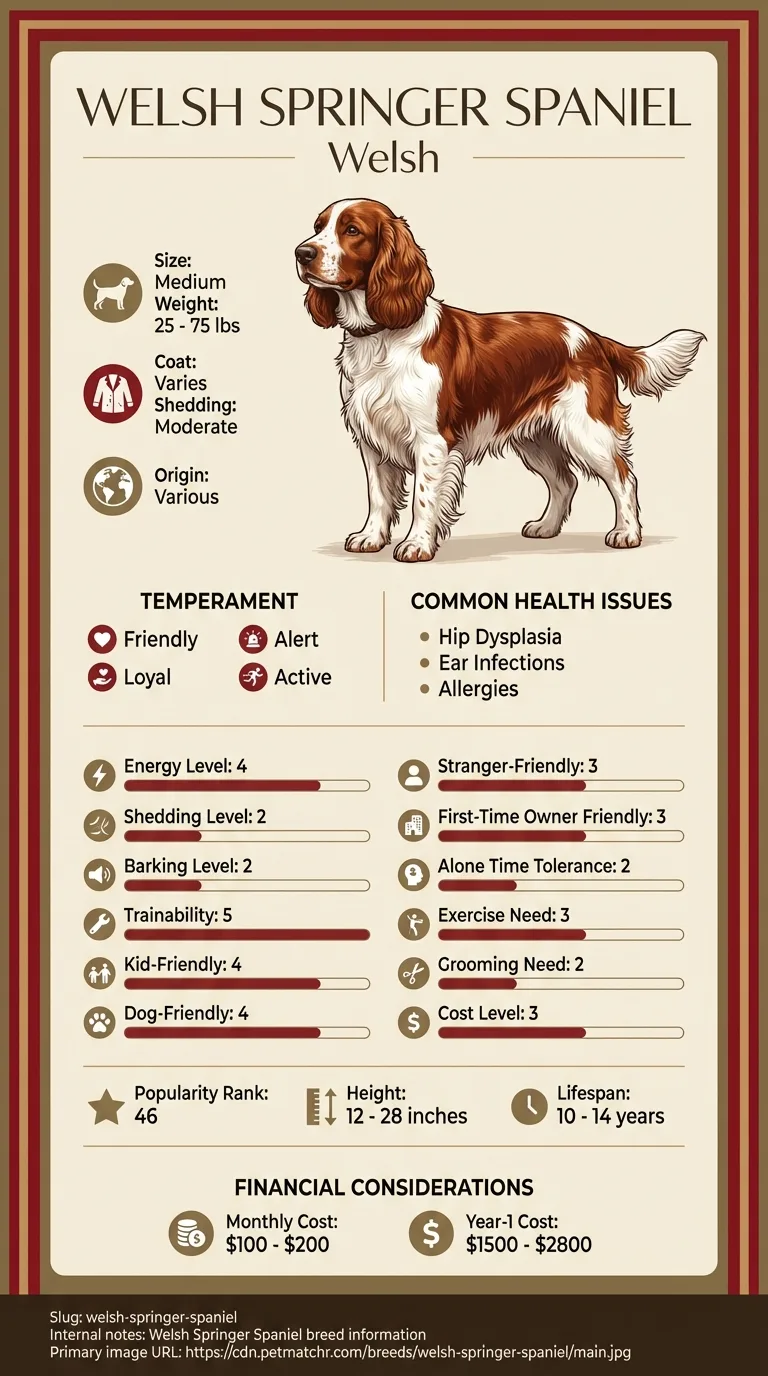
Owners who've already had a dog screened for hip dysplasia, a documented issue in this breed, sometimes don't realize the elbows deserve the same scrutiny, since the two joints can develop independently of each other.
This guide is not medical advice. If your dog shows pain, sudden behavior change, or worsening symptoms, consult a licensed veterinarian.
Some links may be affiliate links. We may earn a commission at no extra cost to you. We only suggest products we believe are helpful for dog owners.
Elbow dysplasia is a group of developmental abnormalities affecting the elbow's three-bone joint, causing uneven growth, cartilage damage, and eventual arthritis. It isn't separately documented as a health issue for the Welsh Springer Spaniel, but the breed's documented hip dysplasia risk reflects the same underlying growth and genetic factors, making elbow screening a reasonable precaution.
Elbow dysplasia isn't among the Welsh Springer Spaniel's five specifically documented health issues. It's included here because it shares underlying developmental biology with the breed's documented hip dysplasia risk, and responsible screening programs often evaluate both joints together in medium and larger active breeds.
There's no separately documented elbow dysplasia rate for this breed in breeds.json, but the documented hip dysplasia risk reflects similar underlying genetic and developmental growth factors that can also affect the elbow joint in individual dogs.
Puppy nutrition and growth rate management are the most significant modifiable factors, since overly rapid growth from excess calories or calcium can worsen an underlying genetic tendency. Controlled exercise during the growth period, avoiding repetitive high-impact activity, is also protective.
See your vet if a young dog shows front-leg lameness that comes and goes, stiffness after rest, or reluctance to fully extend a front leg during play. Early diagnosis through X-rays gives more treatment options than waiting until arthritis has already developed.
See all Welsh Springer Spaniel health problems, which breeds are prone to elbow dysplasia, or the full Welsh Springer Spaniel breed guide for temperament, exercise needs and ownership costs.
Diagnosis typically happens within the first year of life when lameness first appears. Surgical treatment, where appropriate, generally involves 8 to 12 weeks of recovery, while non-surgical management is an ongoing, lifelong approach to minimizing further joint wear.
Success looks like a dog that moves comfortably through daily life, even if some joint changes remain, achieved through early detection, appropriate treatment, and consistent long-term weight and activity management.
Hip dysplasia is documented as a health issue for the Welsh Springer Spaniel, and while elbow dysplasia isn't separately listed, the two conditions share enough underlying biology, abnormal joint development during growth, influenced by genetics, growth rate, and nutrition, that breeds prone to one are often screened for both in responsible breeding programs.
Unlike hip dysplasia, which affects the large ball-and-socket joint at the top of the hind leg, elbow dysplasia involves a more complex joint made up of three bones that all need to grow and align together precisely. Even small growth mismatches between these bones can cause abnormal pressure points, leading to cartilage damage and, eventually, arthritis in the joint.
There's no documented breed-wide elbow dysplasia rate for this breed specifically, but because it's a medium, active, athletic dog with a documented tendency toward hip joint issues, owners are reasonably encouraged to have both hips and elbows screened, particularly if a dog is intended for breeding or heavy working use.
Elbow dysplasia most often becomes noticeable during the rapid growth period of puppyhood, which is why these signs matter most in dogs under a year old.

When Aled adopted his Welsh Springer Spaniel puppy, Cai, he'd read about the breed's documented hip dysplasia risk and asked the breeder for hip screening results on both parents. The breeder mentioned that elbow screening was done too, something Aled hadn't thought to ask about specifically. At Cai's one-year checkup, a mild front-leg stiffness prompted X-rays that showed early, mild elbow changes, caught well before any significant lameness had developed. Aled's vet recommended weight management and a controlled exercise plan rather than surgery given how mild the finding was. Two years later, Cai remains active and comfortable, with follow-up X-rays showing the condition has stayed stable rather than progressing.
Key takeaway: Asking about elbow screening alongside the more commonly discussed hip screening gave Aled the information needed to catch a mild issue early, before it became a bigger problem.
Not separately documented the way hip dysplasia is for this breed, but the two conditions share enough underlying biology that responsible screening programs often check both joints together.
X-rays are the standard screening tool, sometimes supplemented with CT imaging for a more detailed view of the joint surfaces, particularly if surgery is being considered.
There's no guaranteed prevention, but controlling growth rate through appropriate puppy nutrition, avoiding excessive high-impact exercise during rapid growth, and choosing a puppy from health-screened parents can all reduce risk.
Not always. Mild cases may be managed with weight control, joint-supportive supplements, and controlled exercise, while more significant joint incongruity is often treated surgically for the best long-term outcome.
Diagnostic imaging and consultation typically run a few hundred dollars, while surgical treatment can range from $1,500 to $4,000 or more per elbow depending on the specific procedure needed.
Yes, uneven wear from a poorly formed elbow joint commonly leads to arthritis over time, similar to the pattern seen with hip dysplasia in this breed.
Not separately documented, but this breed's documented hip dysplasia risk is a reason to screen the elbows too.
Most cases become noticeable between four and twelve months of age, during the puppy's rapid growth period.
X-rays are the standard screening method, sometimes supplemented with CT imaging for surgical planning.
Surgical treatment commonly ranges from $1,500 to $4,000 or more per elbow depending on the procedure.
Yes, uneven joint wear commonly leads to arthritis over time, similar to the pattern seen with hip dysplasia.
A one-page prep sheet for this condition: the signs, the questions to ask, what to get priced. Unlocks here.
You get: Vet visit prep sheet
No spam. One-click unsubscribe. See our privacy policy.
Preview page 1 before you decide.