Health
What gait pattern is characteristic of Wobbler syndrome?
A wide-based, swaying, uncoordinated gait most pronounced in the back legs, sometimes described as walking on ice.

Quick answer
What gait pattern is characteristic of Wobbler syndrome?
A wide-based, swaying, uncoordinated gait most pronounced in the back legs, sometimes described as walking on ice.
The 'wobble' in this condition's name is literal — a specific, recognizable gait that traces back to the neck, not the legs.
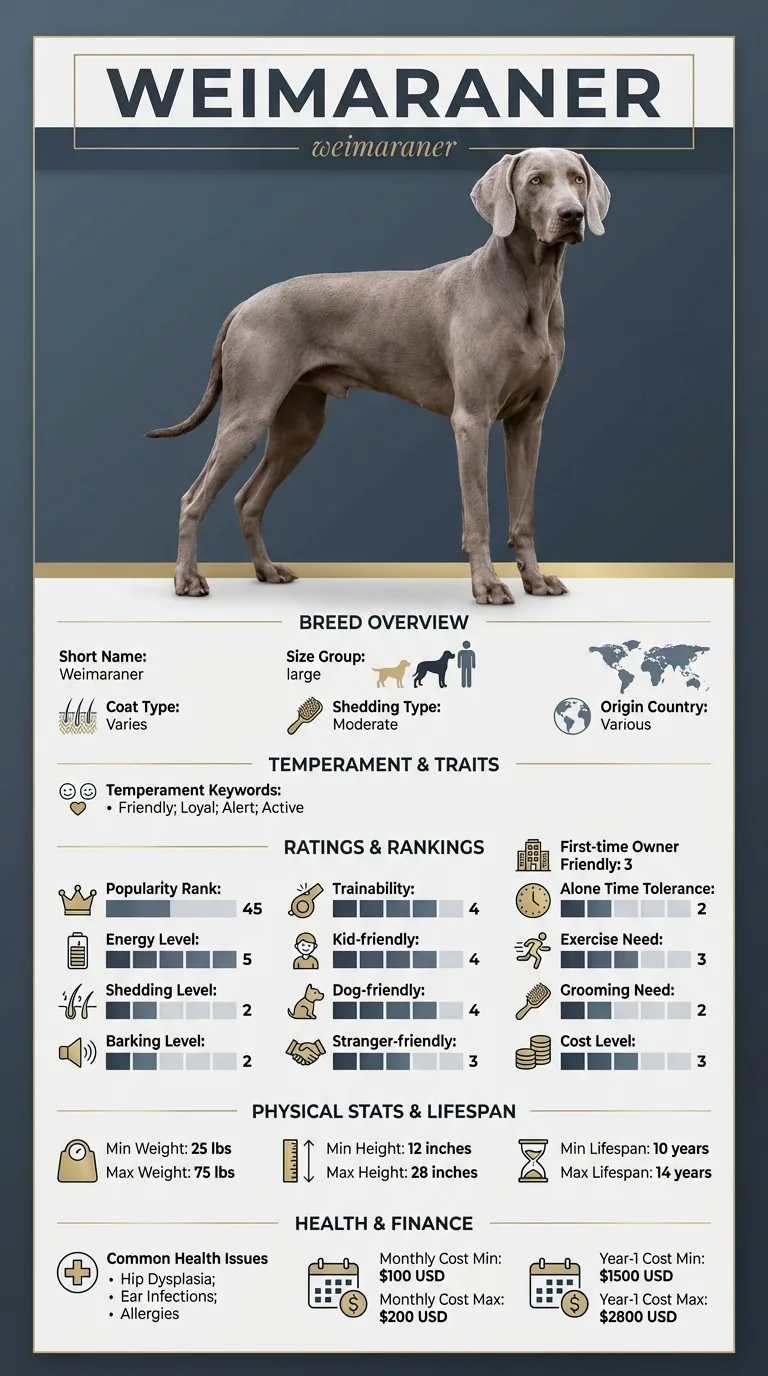
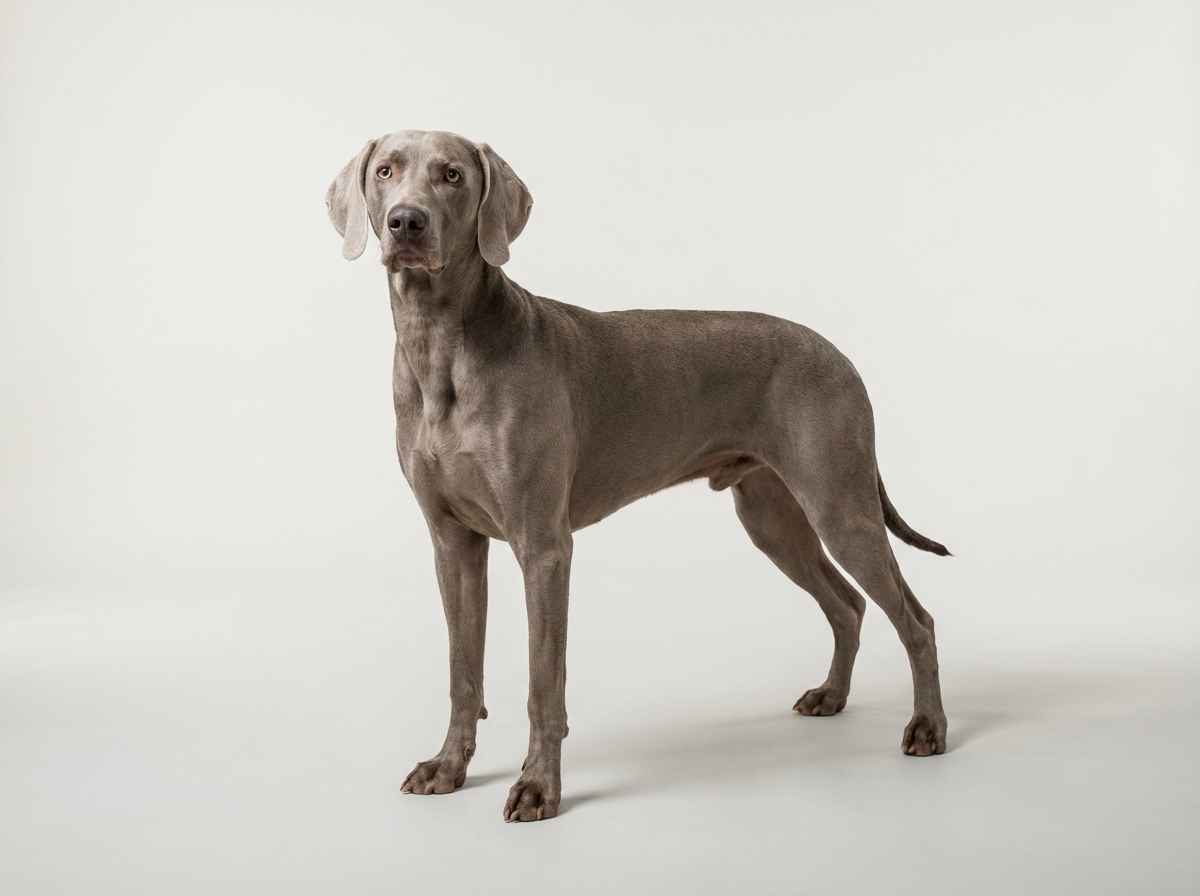
This most often affects large-breed dogs, including Weimaraners, in mid-to-late adulthood, and it's most relevant to owners noticing an unsteady, swaying gait that doesn't look like ordinary joint stiffness.
This guide is not medical advice. If your dog shows pain, sudden behavior change, or worsening symptoms, consult a licensed veterinarian.
Some links may be affiliate links. We may earn a commission at no extra cost to you. We only suggest products we believe are helpful for dog owners.
We research and check what we publish, but we do not warrant that any figure, date, price, or statement is accurate, complete, or current, and we accept no liability for any loss, cost, injury, or other harm arising from the use of this site. Use it as one reference among several. You remain responsible for your own decisions and for your dog's care - confirm anything that matters with a licensed veterinarian or another qualified professional before you act on it. Full disclaimer.
Wobbler syndrome is a cervical spine condition where malformed or unstable neck vertebrae compress the spinal cord, producing a distinctive wide-based, swaying gait, most pronounced in the back legs. It's more classically associated with certain large and giant breeds, but is a relevant large-breed cervical spine risk worth recognizing in Weimaraners, with treatment costs ranging widely from conservative management to surgical correction.
Wobbler syndrome is more classically documented in certain large and giant breeds, and while it isn't among the most frequently cited conditions for Weimaraners specifically, it remains a recognized cervical spine risk within the broader category of large, active breeds this dog belongs to.
As a large breed reaching up to 90 pounds, Weimaraners fall within the general size category most commonly associated with cervical spondylomyelopathy, since larger vertebrae and a longer spine under sustained mechanical load over a decade-plus lifespan create more opportunity for this kind of structural instability to develop.
Continued high-impact activity or trauma to the neck once instability is present can worsen spinal cord compression and symptom severity, making activity modification, including switching to a harness, a meaningful practical consideration once this condition is suspected or confirmed.
See a vet for a new, unsteady, swaying gait, especially if paired with neck pain or reluctance to move the head normally. Sudden inability to walk or paralysis is an emergency requiring immediate veterinary attention.
See all Weimaraner health problems, which breeds are prone to wobbler syndrome, or the full Weimaraner breed guide for temperament, exercise needs and ownership costs.
Diagnosis with a neurological exam and MRI typically takes place within one to two visits once a gait change is noticed. Conservative management may show some stabilization within weeks; surgical recovery, if pursued, generally spans several weeks to a few months.
Success looks like stabilizing or slowing the progression of the gait abnormality and keeping the dog comfortable and as mobile as the specific severity allows, rather than expecting a full reversal of any existing spinal cord damage.
In Wobbler syndrome, vertebrae in the neck become malformed or unstable in a way that compresses the spinal cord passing through them, and because the spinal cord at that level controls signals to all four legs, the resulting symptoms show up in the legs even though the actual problem is in the neck. The classic presentation is a wide-based, swaying, uncoordinated gait, most pronounced in the back legs, sometimes described as looking like the dog is walking on ice even on solid ground.
This pattern is genuinely distinct from a typical orthopedic limp or the stiffness of arthritis — it's less about pain-driven favoring of one leg and more about a loss of coordinated control affecting the whole rear end, sometimes both the front and back legs in more severe cases. Some dogs also show neck pain, reluctance to lower the head to eat, or a reluctance to turn the head sharply, which are useful additional clues pointing toward the cervical spine specifically rather than a lower back or leg problem.
Diagnosis requires advanced imaging, typically MRI, to visualize the specific area and degree of spinal cord compression in the neck, since X-rays alone don't show this level of detail. Treatment options span a real range: mild cases are sometimes managed conservatively with strict activity restriction, a supportive harness instead of a neck collar, and anti-inflammatory medication, while more significantly compressed cases are often treated surgically to relieve the pressure on the spinal cord.
Cost varies enormously with this range, roughly spanning $500 for conservative management and monitoring up to $7,000 or more for surgical treatment at a specialty referral center, reflecting the significant difference between managing symptoms and directly addressing the structural compression. This is a genuinely important budgeting consideration to discuss candidly with your vet once a diagnosis is suspected, since the appropriate treatment path depends heavily on severity, and the cost range is wide enough to plan for in advance rather than be surprised by.

If you think your Weimaraner has wobbler syndrome, the plan is three steps: write down what you have seen and when it started, book a veterinary appointment rather than waiting for the next flare, and take video of the behaviour or symptom before you go — the thing you are worried about rarely happens in the consulting room. Screening in the parents covers bloat (gdv), hip dysplasia, hypertrophic osteodystrophy.
What the vet visit should produce is a diagnosis and a written plan, not just reassurance: what is being ruled out, what the monitoring interval is, and which signs mean you come back sooner. Ask what the treatment costs across a year rather than per visit, because that is the number that decides whether you are managing this condition or reacting to it.
Between appointments, keep a short log — dates, what you saw, what changed. It is the single most useful thing an owner brings to a follow-up, and for wobbler syndrome it is often what separates a clear pattern from a guess.
Loki's owner Nadia first noticed something odd about his gait during a routine evening walk — a wide, swaying sway in his back end that made him look almost drunk, though he showed no obvious pain and was otherwise eating and behaving normally. She initially wondered if he'd simply strained something. A neurological exam pointed toward the cervical spine rather than the hips or lower back, and an MRI confirmed Wobbler syndrome with moderate spinal cord compression in his neck. Given the degree of compression, Nadia's vet recommended surgical decompression rather than conservative management alone. The surgery and recovery cost was significant, but Loki's gait improved substantially over the following months of structured rehabilitation, moving with far more coordination than before the surgery.
Key takeaway: A swaying, uncoordinated gait that doesn't look like a typical limp is worth a neurological exam specifically — the cause can trace back to the neck even when the symptoms show up entirely in the legs.
A wide-based, swaying, uncoordinated gait, most pronounced in the back legs, sometimes described as looking like the dog is walking on ice. It's distinct from typical joint stiffness or a one-sided limp.
The spinal cord passing through the compressed area of the neck carries signals controlling all four legs, so compression at that level disrupts coordinated leg movement even though the structural problem itself is in the cervical spine.
Through a neurological exam followed by advanced imaging, typically MRI, since X-rays alone don't show the degree of spinal cord compression clearly enough to confirm the diagnosis.
It varies widely by severity and treatment path, roughly from around $500 for conservative management to $7,000 or more for surgical treatment at a specialty referral center.
No, milder cases are sometimes managed conservatively with activity restriction, a supportive harness, and medication. More significantly compressed cases are more likely to be recommended for surgical treatment.
Yes, a harness avoids putting pressure directly on the neck during walks, which is generally recommended for a dog with confirmed or suspected cervical spine instability.
It's more classically associated with certain large and giant breeds, and while it isn't among the most frequently cited conditions for Weimaraners, it's a genuine cervical spine risk relevant to large breeds generally, including this one.
A wide-based, swaying, uncoordinated gait most pronounced in the back legs, sometimes described as walking on ice.
Spinal cord compression in the neck disrupts nerve signals controlling all four legs, even though the structural problem is cervical.
MRI, since it shows spinal cord compression in detail that standard X-rays cannot.
Roughly $500 for conservative management up to $7,000 or more for surgical treatment at a specialty center.
Yes, a harness avoids direct pressure on the neck, which is generally recommended for cervical spine instability.
A one-page prep sheet for this condition: the signs, the questions to ask, what to get priced. Unlocks here.
You get: Vet visit prep sheet
No spam. One-click unsubscribe. See our privacy policy.
Preview page 1 before you decide.