Behavior
Which needs more exercise?
The Weimaraner, rated Very High (5/5) versus the Schnauzer's High (4/5).

Quick answer
Which needs more exercise?
The Weimaraner, rated Very High (5/5) versus the Schnauzer's High (4/5).
Schnauzer (Standard) or Weimaraner? On paper they differ most on grooming need, and on the scales Weimaraner is the heavier at 55–90 lbs. Here is how the two compare on everything that shapes an ordinary week.
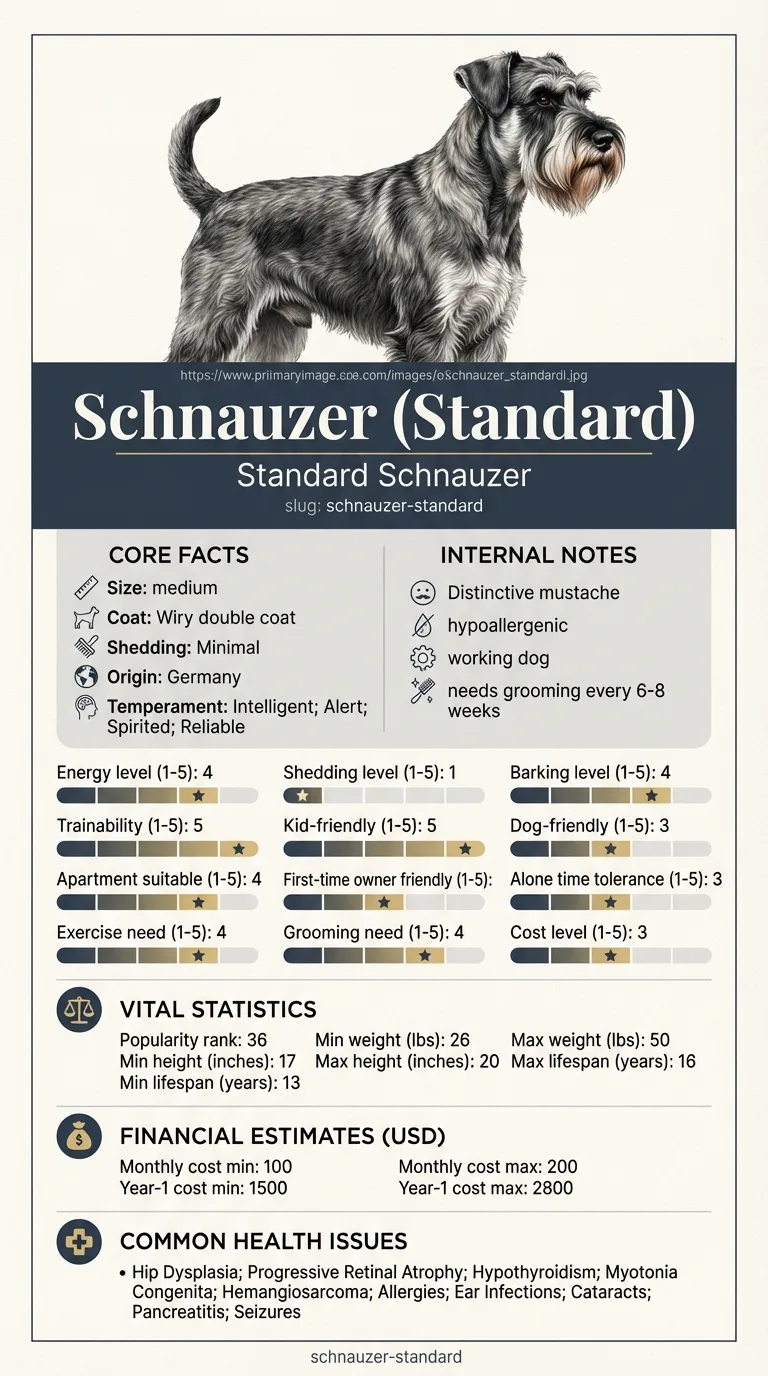
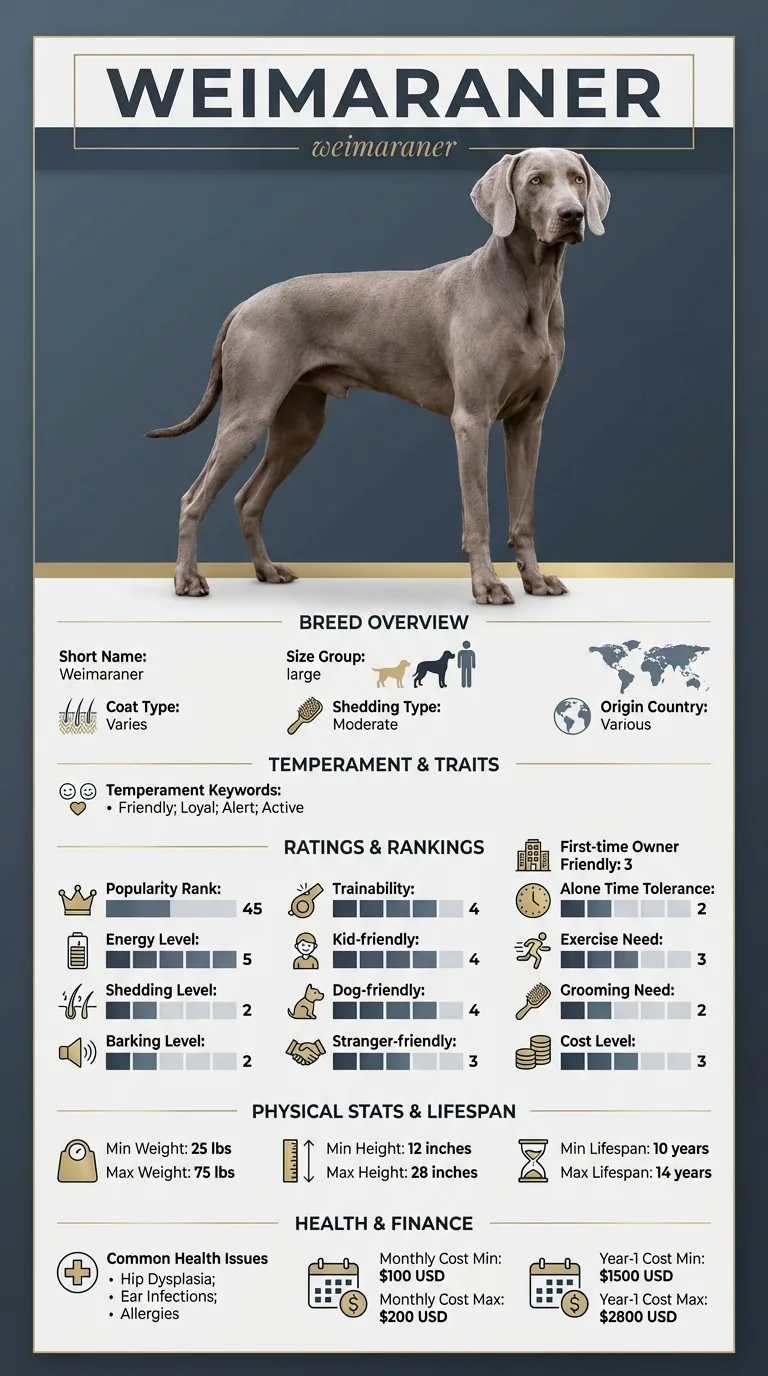
This is for someone already down to Schnauzer (Standard) and Weimaraner and deciding between them. For this pair the decision usually turns on grooming need and apartment suitability, so those are covered first and in most detail. Anyone choosing from a flat has a clear answer here: Schnauzer (Standard) rates 4/5 against 1/5. There is no origin story here — only what changes about your week.
Between Schnauzer (Standard) and Weimaraner, grooming need is what separates them, and Schnauzer (Standard) is the lower-effort dog of the two to keep.
Choose Schnauzer (Standard) if you are in a flat or a smaller home, this is your first dog and shedding is a problem in your house.
Choose Weimaraner if you do not want a standing grooming appointment and you want a dog that can keep up with an active routine.
| Feature | schnauzer standard | weimaraner | Winner |
|---|---|---|---|
| Size class | medium | large | Equal |
| Weight | 26–50 lbs | 55–90 lbs | Equal |
| Height | 17–20 in | 23–27 in | Equal |
| Lifespan | 13–16 years | 10–13 years | schnauzer standard |
| Exercise need | High (4/5) | Very high (5/5) | schnauzer standard |
| Grooming need | High (4/5) | Very low (1/5) | weimaraner |
| Shedding | Very low (1/5) | Low (2/5) | schnauzer standard |
| Energy level | High (4/5) | Very high (5/5) | Equal |
| Barking | High (4/5) | Moderate (3/5) | weimaraner |
| Apartment suitability | High (4/5) | Very low (1/5) | schnauzer standard |
| Good for first-time owners | Moderate (3/5) | Low (2/5) | schnauzer standard |
| Tolerates being alone | Moderate (3/5) | Very low (1/5) | schnauzer standard |
| Trainability | Very high (5/5) | High (4/5) | schnauzer standard |
| Good with kids | Very high (5/5) | High (4/5) | schnauzer standard |
| Good with other dogs | Moderate (3/5) | Moderate (3/5) | Equal |
| Friendly to strangers | Moderate (3/5) | Moderate (3/5) | Equal |
| Cost level | Moderate (3/5) | Moderate (3/5) | Equal |
| Coat | Wiry double coat | Short and sleek | Equal |
| Origin | Germany | Various | Equal |
| Typical monthly cost | $100–$200 | $110–$240 | Equal |
| Typical first-year cost | $1,500–$2,800 | $1,700–$3,200 | Equal |
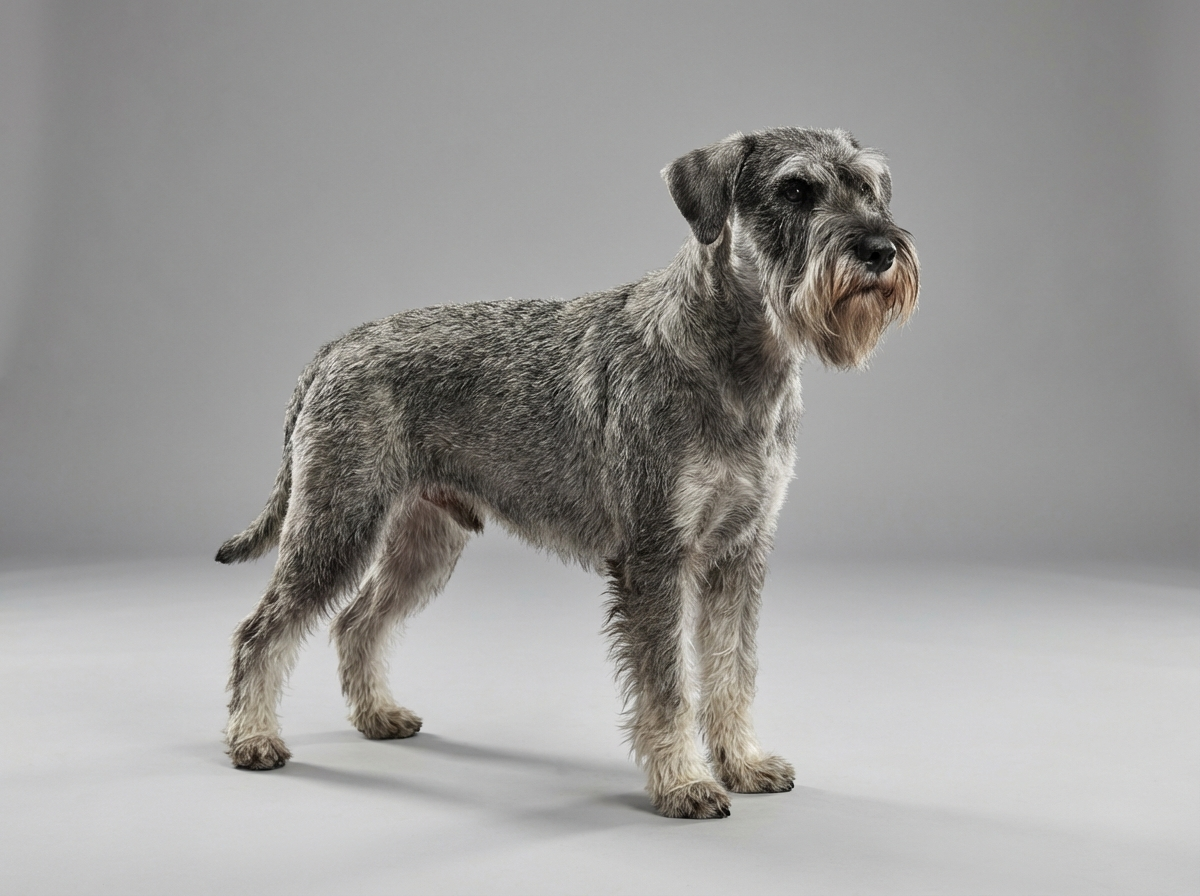
Fifty-five pounds separates the low end of the Weimaraner's weight range from the Schnauzer's — the Weimaraner runs 55–90 lbs and 23–27 inches, decisively into large-breed territory, while the Schnauzer holds at a medium 26–50 lbs and 17–20 inches. The 'Grey Ghost's' long-legged, athletic build was designed for hours of tracking large game across open country, giving it a leaner, taller silhouette than the Schnauzer's compact, square frame. Anyone with a smaller home or car should note that a full-grown Weimaraner can be nearly double the Schnauzer's weight and several inches taller at the shoulder.
The Weimaraner rates Very High (5/5) for exercise need against the Schnauzer's High (4/5), and its Energetic, Headstrong temperament backs that up — this is a breed developed to hunt for hours and it does not switch off easily. Underexercised Weimaraners are prone to destructive behavior, a pattern tied to their Devoted, high-drive nature and, per their health profile, Separation Anxiety. The Schnauzer's High exercise needs are demanding but more manageable with structured daily walks. Anyone considering the Weimaraner should plan on serious off-leash running time or dedicated activities like jogging or field work.
The Weimaraner is remarkably low-maintenance to groom, rating Very Low (1/5) thanks to its short, sleek coat that needs little more than an occasional wipe-down. The Schnauzer sits at High (4/5), requiring regular hand-stripping or clipping to manage its wiry double coat. Shedding flips the advantage back toward the Schnauzer, which rates Very Low (1/5) versus the Weimaraner's Low (2/5) — a small but real difference for anyone sensitive to loose hair. Overall, the Weimaraner asks for far less grooming time and expense, even though it sheds a touch more.
The Schnauzer's High (4/5) apartment suitability towers over the Weimaraner's Very Low (1/5), and the same pattern holds for alone-tolerance — Moderate (3/5) versus Very Low (1/5). Given the Weimaraner's documented Separation Anxiety risk and Very High exercise needs, small-space or long-hours living situations are genuinely difficult for this breed. On barking, the Schnauzer actually scores higher (High, 4/5) than the Weimaraner (Moderate, 3/5), so noise alone doesn't favor the Schnauzer — it's the combination of space, exercise and companionship needs that makes the Weimaraner a poor apartment match.
The Schnauzer edges the Weimaraner on both counts here: Very High (5/5) trainability versus High (4/5), and Moderate (3/5) suitability for first-time owners versus Low (2/5). The Weimaraner's Headstrong streak, paired with its intense drive, means training sessions need to be engaging and consistent or the dog will find its own entertainment — often destructively. It's still a highly capable, Alert breed that responds well to experienced handling, just less forgiving of a hesitant first-time owner than the more biddable Schnauzer. Both benefit from early socialization and structured obedience work.
The Schnauzer rates higher with kids, Very High (5/5) versus the Weimaraner's High (4/5), while both land at Moderate (3/5) for compatibility with other dogs and with strangers — a genuine tie in two of three categories. The Weimaraner's Devoted nature makes it deeply attached to its family, which can translate into excellent bonds with children it's raised alongside, even if its raw score trails the Schnauzer's. Families should weigh the Weimaraner's size and exuberance around small kids, since a large, high-energy dog can unintentionally knock over a toddler during play.
The Schnauzer's 13–16 year lifespan comfortably beats the Weimaraner's 10–13 years, a gap partly explained by the Weimaraner's larger size, which typically shortens canine lifespans. The Weimaraner's health list is shorter but serious: Bloat (GDV), a life-threatening stomach condition common in deep-chested large breeds, along with Hip Dysplasia, Hypertrophic Osteodystrophy and Von Willebrand Disease, a bleeding disorder. The Schnauzer's list runs longer and includes Hemangiosarcoma, Pancreatitis and Seizures alongside Hip Dysplasia. Weimaraner owners in particular should learn Bloat's warning signs and consider slow-feed bowls given the breed's deep chest.
Both breeds rate Moderate (3/5) for overall cost, but the numbers lean higher for the Weimaraner: $110–$240 monthly versus the Schnauzer's $100–$200, and a first-year total of $1,700–$3,200 against the Schnauzer's $1,500–$2,800. The gap likely reflects the Weimaraner's larger size driving up food costs, plus potential emergency-fund considerations given its Bloat risk, which can require costly surgery. The Schnauzer's savings show up mainly in food volume, though its grooming needs partially offset that advantage over the Weimaraner's essentially maintenance-free coat.
Schnauzer (Standard) weighs 26–50 lbs and lives 13–16 years; Weimaraner weighs 55–90 lbs and lives 10–13 years. The two diverge most on grooming need, apartment suitability and tolerates being alone. They are level on cost level, good with other dogs and friendly to strangers, so those cannot decide it. Where the table declares a winner it means less work for the owner, nothing more; descriptive rows are left as ties on purpose. The value here is in the differences between the two columns; treat any single score as approximate.

Yes, significantly — the Weimaraner reaches 55–90 lbs and 23–27 inches, compared to the Schnauzer's 26–50 lbs and 17–20 inches.
The Weimaraner, rated Very Low (1/5) for grooming need versus the Schnauzer's High (4/5), thanks to its short, sleek coat.
Yes, it's listed among its known health and behavior concerns, which aligns with its Very Low (1/5) alone-tolerance rating and Devoted temperament.
The Standard Schnauzer, rated Moderate (3/5) for first-time-owner suitability versus the Weimaraner's Low (2/5).
Bloat (GDV) is a life-threatening stomach condition listed specifically on the Weimaraner's health profile, tied to its deep chest — it's not listed for the Schnauzer.
The Schnauzer, with a 13–16 year lifespan versus the Weimaraner's 10–13 years.
The Weimaraner, with typical monthly costs of $110–$240 versus the Schnauzer's $100–$200.
The Weimaraner, rated Very High (5/5) versus the Schnauzer's High (4/5).
The Standard Schnauzer, rated Very Low (1/5) versus the Weimaraner's Low (2/5).
The Standard Schnauzer, rated High (4/5) versus the Weimaraner's Very Low (1/5).
The Standard Schnauzer, rated Very High (5/5) versus the Weimaraner's High (4/5).
Secure checkout on Stripe. We never see your card.
7-day money-back guarantee. Instant access.
Health information here is general and is not veterinary advice. If your dog shows pain, sudden behaviour change, or worsening symptoms, consult a licensed veterinarian.
Some links on this site are affiliate links. We may earn a commission at no extra cost to you, and we only suggest products we believe are helpful for dog owners.
We research and check what we publish, but we do not warrant that any figure, date, price, or statement is accurate, complete, or current, and we accept no liability for any loss, cost, injury, or other harm arising from the use of this site. Use it as one reference among several. You remain responsible for your own decisions and for your dog's care - confirm anything that matters with a licensed veterinarian or another qualified professional before you act on it. Full disclaimer.
Match your lifestyle to the right dog.
Take quizNot sure which breed is right for you? Take our 2-minute quiz to find out.
Take the quiz