Health
What is stage B2 MMVD?
A leaking mitral valve that has caused measurable enlargement of the heart chambers. It is the point at which medication is usually started, before symptoms appear.

Quick answer
What is stage B2 MMVD?
A leaking mitral valve that has caused measurable enlargement of the heart chambers. It is the point at which medication is usually started, before symptoms appear.
This is the disease behind almost every murmur found in an older Sheltie, and it has a staging system that turns a vague worry into a decision tree.
Owners who have had an echocardiogram and been handed a letter full of stage designations, chamber measurements and abbreviations, and want to know which numbers actually change what happens next.
This guide is not medical advice. If your dog shows pain, sudden behavior change, or worsening symptoms, consult a licensed veterinarian.
Some links may be affiliate links. We may earn a commission at no extra cost to you. We only suggest products we believe are helpful for dog owners.
Myxomatous mitral valve disease is the progressive thickening and deformation of the mitral valve flaps, so they no longer seal and blood leaks backward into the left atrium with every beat. In Shetland Sheepdogs it is an ageing phenomenon rather than an inherited predisposition. It is staged from A to D, and the practical experience for an owner moves from annual listening, to periodic imaging, to daily medication and a weekly breathing count.
The most common acquired heart disease in small dogs, and correspondingly common in older Shelties, though not at the exaggerated rates seen in a few genuinely predisposed breeds. Many affected dogs remain in the earliest stages for years and a substantial proportion die of something else with the valve disease never having become clinically important.
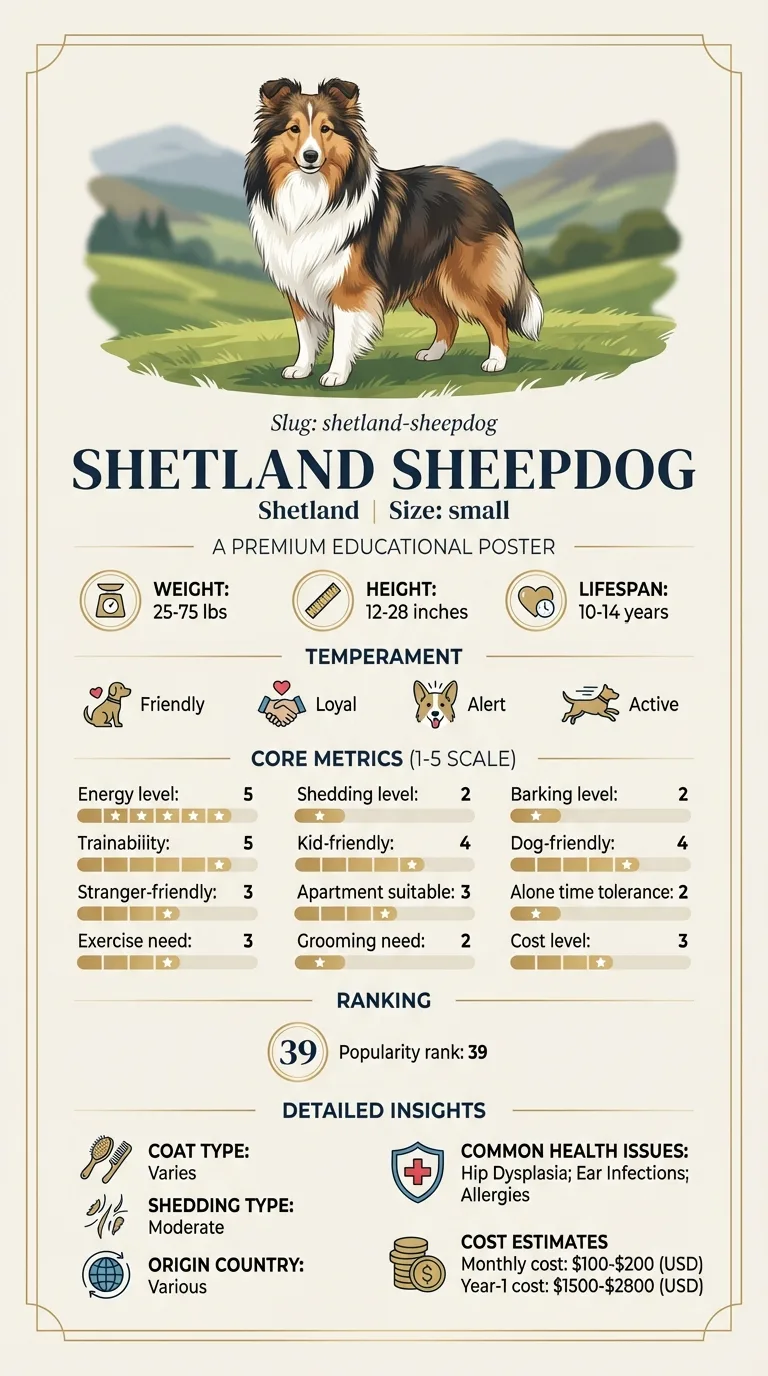
Size rather than breed is doing the work. At fifteen to twenty five pounds and thirteen to sixteen inches, the Shetland Sheepdog sits in the small-dog range where mitral valve tissue degenerates with age, and its twelve to fourteen year lifespan gives that process time to matter. The breed's documented conditions lie elsewhere entirely. What the breed adds is MDR1 drug sensitivity, which turns every sedation over years of imaging and dental care into a decision that must be made with the genotype in hand rather than assumed.
Body condition is the dominant factor an owner controls, and a Sheltie's dense double coat conceals gains of two or three pounds, which at this size is a substantial extra load on every beat. Dental disease adds a chronic inflammatory burden and is easy to neglect in a small mouth. Heat is a stressor rather than a cause, but a heavily coated dog with a compromised heart working in humidity has less reserve than the same dog in cool weather.
Go immediately, as an emergency: fast or laboured breathing at rest, standing with the elbows out and the neck extended, gums that look grey or blue, restlessness that will not resolve overnight, a cough that prevents the dog from lying down, or collapse. That picture is fluid on the lungs and it kills quickly. Call within days: a sleeping breathing count that has risen above baseline across several consecutive readings, a new or worsening cough, reduced appetite, or an abdomen that appears to be filling. Book routinely: the recheck interval your cardiologist set, and annual auscultation for any Sheltie over eight even without a known murmur.
See all Shetland Sheepdog health problems, which breeds are prone to myxomatous mitral valve disease mmvd, or the full Shetland Sheepdog breed guide for temperament, exercise needs and ownership costs.
Stage B1 commonly lasts years and some dogs never leave it. The transition to B2, once it happens, is the point at which daily medication starts and it typically continues for the rest of the dog's life. Dogs reaching congestive failure enter a phase measured in months, with medication adjustments made over weeks and monitoring intervals shortening. Throughout, the disease is slow, and the pace of decision-making is set by rechecks rather than by crises when it is being monitored properly.
Success is a dog that never has an emergency admission, because every change was caught on a recheck or in the breathing log first. It is a Sheltie in stage B2 that still walks, still eats, still barks at the door, and takes tablets twice a day without fuss. It is not a normal echocardiogram. The valve will keep degenerating; the aim is that the dog never has a bad night because of it.
Veterinary cardiologists use a staged framework, and it is genuinely useful because each stage carries a different action. Ask which stage your Sheltie is in and the rest of the letter becomes readable.
Everything above is measured in a clinic. There is exactly one clinically meaningful measurement an owner takes at home, and it is the sleeping respiratory rate.
Count your Sheltie's breaths while it is genuinely asleep, thirty seconds doubled, and record the number and the date. Do it weekly, in the same place. Establish it while the dog is well so you know its own baseline rather than a textbook average.
The reason this matters more than any other home observation is mechanical. When the left atrium can no longer accommodate the backwash, pressure rises in the pulmonary veins and fluid begins seeping into lung tissue. The lungs stiffen slightly before there is any cough, and the earliest response is a small, sustained increase in breathing rate during sleep, when nothing else can explain it.
A dog whose count has run at twenty for months and now sits in the high twenties across several nights is telling you something is changing, and it is telling you before it looks unwell. In stage B2 and stage C dogs this is the number that triggers a phone call, and it is also the number cardiologists use to judge whether treatment is holding.
For a Shetland Sheepdog there is one extra note to keep alongside it: the MDR1 genotype. Echocardiography sometimes requires sedation, dentistry certainly does, and a cardiac patient in this breed will meet an anaesthetist sooner or later.

Duncan's Sheltie, Mhairi, was diagnosed with a grade 3 murmur at nine and referred for an echo. The report described her as stage B1, with a leaking valve and normal chamber dimensions, and recommended a recheck in a year. Duncan started the weekly breathing count that same week. At the recheck her measurements had crossed the thresholds and she was reclassified as B2. Nothing about Mhairi had changed. She was still running the garden fence at the postman, still eating, still counted at twenty breaths a minute asleep. She started medication that day purely on the strength of two numbers on a scan. Duncan admitted he found it hard to medicate a dog that seemed entirely well. His cardiologist's answer stuck with him: the point of treating at B2 is that you are buying time from a heart that has not yet run out of it. Mhairi went into congestive failure at thirteen and a half. Duncan noticed it because her sleeping count went from twenty to thirty across four nights, and she was treated as an outpatient rather than admitted.
Key takeaway: The stage, not the symptom, drives treatment in mitral valve disease. Get the echo that identifies the B1 to B2 transition, and keep the one number at home that catches the transition to failure before the dog looks ill.
Not as a breed. The Shetland Sheepdog's documented conditions are Collie Eye Anomaly, MDR1 drug sensitivity, dermatomyositis, hypothyroidism and patellar luxation. MMVD is a small-dog disease driven by size and age, and Shelties are affected at roughly the rate their size predicts, not at the elevated rate seen in Cavalier King Charles Spaniels.
Because trials in stage B2 dogs showed that beginning treatment at the point of measurable enlargement, rather than waiting for heart failure, meaningfully delays the onset of that failure. It is one of the clearer examples in veterinary medicine of treating a number rather than a symptom, and the number is chamber size on imaging.
Commonly every six to twelve months, since the point of the recheck is to catch the transition to B2. Your cardiologist sets the interval based on how much the valve is leaking and how close the measurements already are to the thresholds. Keep the home breathing log running between visits.
No, and in this breed particularly not. Shelties are extremely vocal and a dog that barks hard on a flat collar irritates its own airway. Airway disease and heart disease can also coexist in an older dog. The sleeping breathing rate is a better discriminator than the cough itself.
Variable and often long. Many dogs spend years in stage B1 and never progress. Dogs reaching stage B2 typically have a considerable period on medication before failure occurs, and dogs in stage C can do well for a further period. Ask for your dog's stage and its measurements rather than relying on general figures.
Extreme sodium restriction is not appropriate at every stage and has its own risks, so it should be directed by your vet. What does matter at every stage is keeping the dog lean, and avoiding grain-free or unconventional diets without discussing them, since diet-associated heart muscle disease is a separate and real concern.
The standard drugs used in MMVD are not the primary MDR1 concern. The relevance is that a cardiac patient will be sedated for imaging and dentistry over the years, and some sedative and anti-nausea agents are affected. Have the genotype tested and recorded prominently rather than mentioned in passing.
A leaking mitral valve that has caused measurable enlargement of the heart chambers. It is the point at which medication is usually started, before symptoms appear.
Most healthy dogs sit comfortably below thirty breaths a minute asleep. Your own dog's established baseline matters more than the general figure.
No. Surgical valve repair exists at a handful of specialist centres worldwide but is not a realistic option for most owners. It is a managed, progressive disease.
A specialist echo commonly runs several hundred dollars. Since it is the only way to identify the B1 to B2 transition, it is the test that earns its price.
Yes, at its own pace, unless your vet has restricted it. Keeping a herding breed active is good for weight, muscle and mood.
A one-page prep sheet for this condition: the signs, the questions to ask, what to get priced. Unlocks here.
You get: Vet visit prep sheet
No spam. One-click unsubscribe. See our privacy policy.
Preview page 1 before you decide.