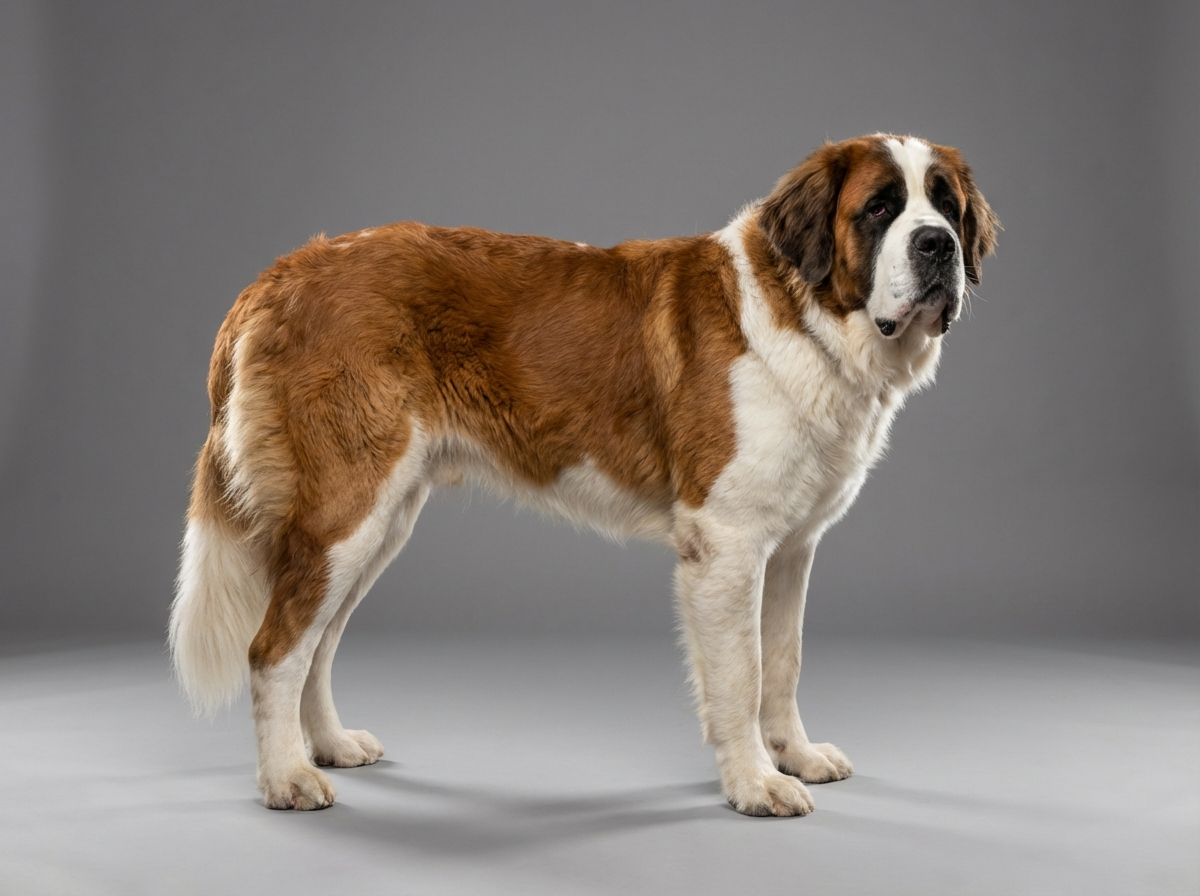
Behavior
Why are Saint Bernards prone to separation anxiety?
Their strong, people-oriented attachment instinct, rooted in their history as watchful rescue dogs, makes deep bonding and related separation distress common.

Quick answer
Why are Saint Bernards prone to separation anxiety?
Their strong, people-oriented attachment instinct, rooted in their history as watchful rescue dogs, makes deep bonding and related separation distress common.
A dog this size having a panic response to being left alone isn't just inconvenient, it can mean genuine physical distress and, in some cases, real property damage or self-injury from a dog trying desperately to get back to its people.
This is common among owners whose schedules have recently changed, a return to office work after time at home, a new baby taking attention away, or a household move, all of which can trigger or worsen separation anxiety in a dog already prone to strong attachment.
This guide is not medical advice. If your dog shows pain, sudden behavior change, or worsening symptoms, consult a licensed veterinarian.
Some links may be affiliate links. We may earn a commission at no extra cost to you. We only suggest products we believe are helpful for dog owners.
We research and check what we publish, but we do not warrant that any figure, date, price, or statement is accurate, complete, or current, and we accept no liability for any loss, cost, injury, or other harm arising from the use of this site. Use it as one reference among several. You remain responsible for your own decisions and for your dog's care - confirm anything that matters with a licensed veterinarian or another qualified professional before you act on it. Full disclaimer.
Separation anxiety in Saint Bernards is closely tied to the same gentle, watchful, people-oriented temperament that makes them such devoted family dogs. That deep attachment instinct, rooted in their history as alert alpine rescue dogs, can turn into real panic when a dog this bonded to its people is suddenly left completely alone, and given the breed's size, the resulting distress behaviors, chewing, pacing, house-soiling, can cause more significant damage than in a smaller dog.
Separation anxiety is a commonly reported behavioral concern in Saint Bernards, consistent with the breed's well-documented tendency toward strong attachment and a watchful, people-oriented temperament.
The Saint Bernard's temperament, gentle, patient, and watchful, developed through a history of close working partnership with people during alpine rescue work, which selected strongly for dogs attuned and attached to their humans. That same trait, valuable in a working context, can translate into genuine distress when the dog is abruptly separated from its attachment figures.
Sudden changes in routine, insufficient early exposure to being alone, and a lack of mental or physical stimulation before departures all contribute to separation anxiety developing or worsening, particularly in a breed already predisposed toward strong attachment.
A trainer or veterinary behaviorist experienced with separation anxiety specifically can design and guide a structured desensitization plan, which is often more effective than general obedience training alone for this particular issue.
Talk to your vet or a veterinary behaviorist if separation anxiety is severe, if training alone isn't improving things, or if you're considering anti-anxiety medication as part of a treatment plan. Self-injury from frantic escape attempts, or ingestion of a chewed object, need prompt veterinary attention.
See all Saint Bernard health problems, which breeds are prone to separation anxiety, or the full Saint Bernard breed guide for temperament, exercise needs and ownership costs.
Meaningful improvement through a structured desensitization plan often takes several weeks to a few months of consistent practice, with progress typically gradual rather than sudden.
Success means a dog that can settle calmly during normal daily absences without destructive behavior or significant distress signs, achieved through patient, gradual training rather than expecting a quick fix for a genuinely anxiety-driven behavior.
Separation anxiety often gets worse specifically because of well-intentioned but counterproductive responses.
Most separation anxiety, even in its more severe forms, is a behavioral welfare issue rather than a medical emergency, but a few specific consequences can become urgent: self-injury from frantic attempts to escape a crate or room, ingestion of a chewed and swallowed object, or a dog that seems to be overheating or in physical distress from prolonged panic all warrant prompt veterinary attention.
Typical separation anxiety signs, destructive chewing at doors or windows, excessive barking or howling, house-soiling despite being otherwise house-trained, and pacing, are distressing and worth addressing but don't need emergency care. These call for a structured training plan and, in more severe cases, a conversation with a vet about anti-anxiety support.
The practical distinction is whether the dog is causing physical harm to itself or ingesting something dangerous, versus simply expressing distress through noise or property damage. The first needs immediate veterinary attention; the second needs a genuine behavior modification plan, not just management alone.

When Aaron returned to working in an office after a long stretch working from home, his Saint Bernard, Daisy, began destroying door frames and howling within minutes of being left alone. A trainer experienced with separation anxiety helped Aaron design a gradual desensitization plan, starting with departures of just a minute or two. Over several weeks, Aaron slowly built up Daisy's tolerance for longer absences, pairing departures with a food puzzle and keeping goodbyes low-key. By the two-month mark, Daisy could comfortably handle a full workday alone with no destructive behavior.
Key takeaway: Daisy's anxiety wasn't solved by a single change, it took a genuinely gradual, structured retraining process to rebuild her confidence being alone after her routine changed so abruptly.
Their history as attentive, people-oriented rescue dogs bred to stay close and watchful over their charges contributes to a strong attachment instinct, which can become distress-driven when a dog this bonded is suddenly left completely alone.
Destructive chewing, especially around doors and windows, excessive barking or howling, house-soiling despite good house-training, pacing, and drooling are all common signs, and given this breed's size, the resulting damage can be more significant than in a smaller dog.
A vet or veterinary behaviorist typically assesses behavior patterns and rules out other medical or behavioral causes, sometimes using video monitoring to observe what actually happens while the dog is alone.
Gradual desensitization to being alone, building up tolerance in small increments, is the core approach, sometimes combined with anti-anxiety medication prescribed by a vet for more severe cases to help the dog be receptive to training.
Teaching a puppy to be comfortable with brief, gradually increasing periods alone from an early age can reduce the likelihood of severe separation anxiety developing later, though some dogs remain more prone to it regardless.
It depends on the individual dog; a properly introduced crate can become a safe, comforting space for some dogs, while a dog that panics in confinement may do worse in a crate, making an open, dog-proofed room a better option instead.
Working with a trainer or veterinary behaviorist, along with possible medication, represents a moderate ongoing cost, though many owners see meaningful improvement without needing extensive professional intervention for milder cases.
Their strong, people-oriented attachment instinct, rooted in their history as watchful rescue dogs, makes deep bonding and related separation distress common.
Destructive chewing around doors and windows, along with excessive barking, are classic signs.
Gradual desensitization to being alone, sometimes combined with vet-prescribed anti-anxiety support for severe cases.
No, punishment doesn't address the underlying anxiety and can make the problem worse.
Gradual alone-time training starting in puppyhood can reduce the likelihood of severe anxiety developing later.
Behaviour changes often start with pain. The prep sheet for this page covers what to rule out, and what to ask.
You get: Vet visit prep sheet
No spam. One-click unsubscribe. See our privacy policy.
Preview page 1 before you decide.