DogBreedCompass
← Back to breed profileEvery breed’s cost in Indianapolis

Saint Bernard Cost in Indianapolis

See Saint Bernard price across all cities →

Quick answer

Saint Bernard cost in Indianapolis

About $140–$288 a month and $2,046–$3,906 in year one, below the national average — with the local point being that Indiana's crowded breeding market makes asking for the parents' hip and elbow certificates the highest-value thing a buyer does.

A Saint Bernard in Indianapolis costs about $140 to $288 a month, with the opening twelve months landing near $2,046 to $3,906 — under the national average, as central Indiana's general cost of living runs below the US line. The most consequential number on this page, though, is not in that range. It is whatever the breeder charges, and what they can show you about the puppy's parents.

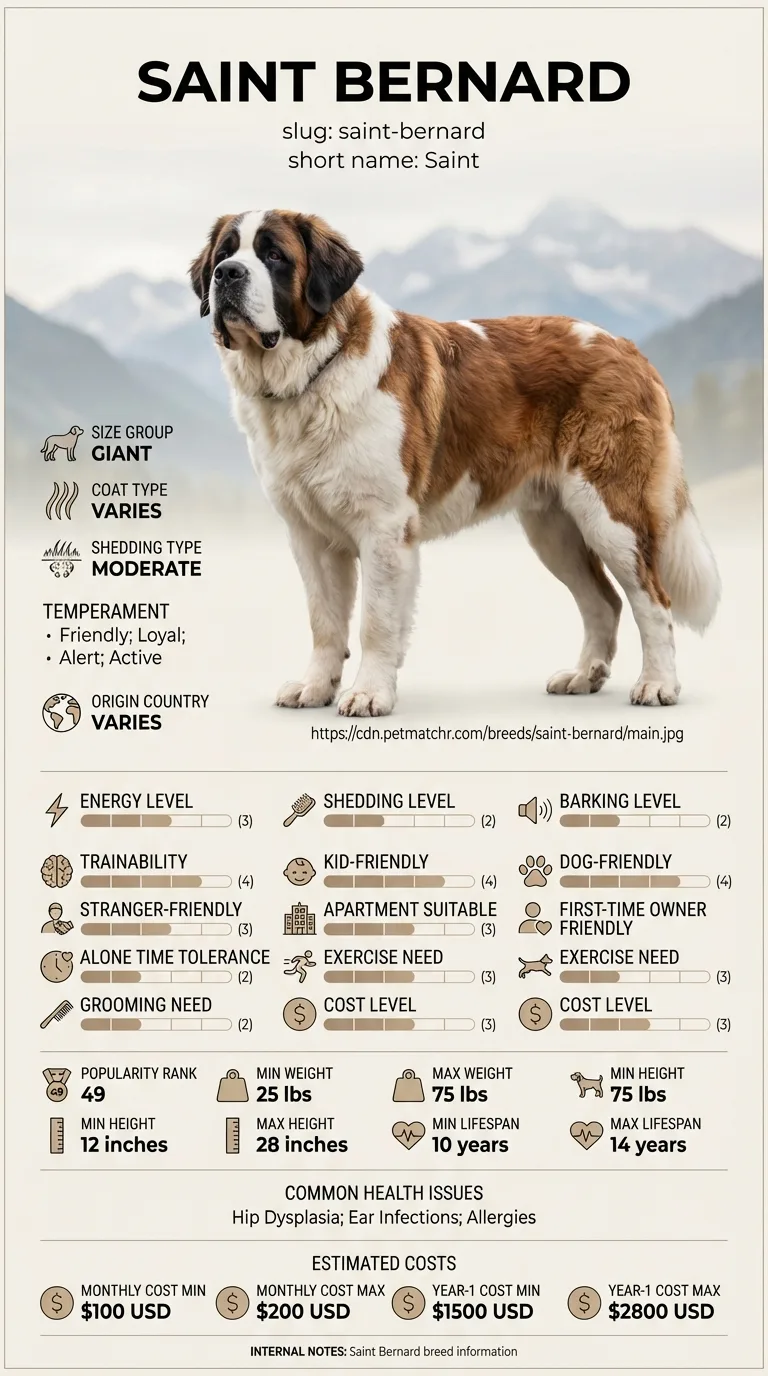
Saint Bernard Cost in Indianapolis infographic

Why costs vary

Hip Dysplasia and Elbow Dysplasia are both documented in this breed and both are heritable. Alongside them sit Dilated Cardiomyopathy, Entropion and Bloat. What makes any of them expensive here is not Indiana's pricing, which is moderate, but the fact that surgical correction on a 120-to-180-pound patient consumes more anesthetic time, more drug and larger hardware than the same operation on an average dog.

Cost summary

Indianapolis prices below the national average across services, with a clearly seasonal eight-month prevention window and no coastal premium on the space this breed needs.

Estimate · source: estimation · confidence: medium · updated 2026-09-06 · not a quote

First year
$2046 - $3906
Ongoing monthly
$140 - $288

First-year expenses

ItemCost range
One-time setup (giant crate, bed, first exam, spay/neuter)
Ask your veterinarian how they prefer to time an elective sterilisation in a slow-maturing giant breed, since the answer affects the schedule more than the price.
$485 - $840

Monthly expenses

ItemCost range
Food (measured portions during the growth years)
The largest recurring line. Feeding a giant puppy for steady rather than rapid growth is standard guidance and costs nothing extra.
$67 - $120
Parasite prevention (eight-month Indiana season)
A bounded season rather than a year-round one, though each dose sits in the top weight bracket the product is sold in.
$28 - $50

Is pet insurance worth it?

In a moderate market like this one, insurance is worth pricing specifically for the orthopedic tail rather than for the routine care, which is affordable outright.

When insurance makes sense

Buy early if a joint operation and its long rehabilitation would strain the household. Hereditary conditions are typically covered only when the policy predates any sign of them.

When you might skip it

Owners who bought from screened parents and hold a genuine surgical reserve can reasonably self-fund, provided the reserve is untouched money rather than available credit.

Ways to save without cutting essentials

The largest saving available in Indianapolis is made before the puppy arrives, and the rest is ordinary discipline.

  • Ask for both parents' hip and elbow evaluations and verify them in the public database rather than accepting a photo.
  • Feed for steady growth rather than fast growth through the first eighteen months.
  • Buy prevention against Indiana's eight-month window instead of defaulting to a twelve-month supply.
  • Learn a basic weekly deshedding routine at home so professional grooming is occasional rather than monthly.
  • Compare boarding on run dimensions first, since a giant only fits the top tier and that is what you will be quoted.

Indianapolis Cost Factors: Ask for the Parents' Certificates

Joint dysplasia is not caused by breeding alone, but breeding is the part of it a buyer can influence before the dog exists. The Orthopedic Foundation for Animals maintains public hip and elbow databases; PennHIP offers a separate quantitative hip assessment. A breeder who screens will hand you the sire and dam's evaluations without being asked, and those results are searchable rather than something you have to take on trust.

In a state with this much breeding activity, that request is also a filter. A hobby breeder producing one or two giant litters a year, keeping puppies until eight weeks, and holding certificates on both parents is a different proposition from a volume operation, and the conversation separates them quickly. Nothing about this is adversarial — good breeders enjoy the question, because it is the one that tells them you have read something.

The rest of an Indianapolis budget is genuinely comfortable. Routine veterinary pricing sits under the national average, the parasite-prevention season runs a clearly bounded eight months rather than the year-round schedule a southern city carries, and there is enough space in the metro's housing stock that a giant breed's most basic requirement — floor area — does not carry a coastal premium.

What Screening Buys, and What It Does Not

Be honest about the limits. Certified parents shift the odds; they do not issue a guarantee, and no reputable breeder will pretend otherwise. Growth rate, body condition and the surfaces a puppy spends its first eighteen months on all matter too, and giant breeds keep growing long after a spaniel has finished. Overfeeding a giant puppy to make it grow faster is one of the few genuinely counterproductive things an owner can do.

What screening does buy is a much better starting point on the two line items with the largest tails. An orthopedic consultation, imaging and surgery on a dog of this size is a four-figure event in a moderate market like this one, and the recovery is measured in months of restricted movement rather than weeks.

Budget-wise, Indianapolis rewards the ordinary disciplines. Food is the largest recurring cost and it does not compress. Grooming is a real line for a heavy seasonal shedder even at a modest coat-care level. Boarding is priced by run size, and the largest run is always the most expensive one on the tariff.

Saint Bernard Cost in Indianapolis - What Screening Buys, and What It Does Not

Two Litters, Two Very Different Conversations

An Indianapolis buyer visited two Saint Bernard litters in the same month. The first breeder produced both parents' evaluations before being asked and talked at length about growth rate and flooring. The second said the parents were 'never had any trouble' and changed the subject. The puppies looked identical at eight weeks and the prices were within a few hundred dollars of each other. The buyer chose the first, and describes the extra questions as the cheapest orthopedic decision available.

Key takeaway: In a state this thick with litters, the certificates are the differentiator. They cost the buyer nothing and they narrow the field faster than any other question.

Frequently asked questions

How much is a Saint Bernard per month in Indianapolis?

Around $140 to $288, comfortably below the national average, tracking central Indiana's moderate cost of living.

What does the first year come to?

Close to $2,046 to $3,906, which folds the initial exam, spay or neuter and giant-sized equipment into the ongoing monthly figure.

Why does breeder screening get so much attention on this page?

Because Indiana has one of the country's larger concentrations of licensed breeding kennels, so the quality range is unusually wide, and this breed's two costliest documented conditions are both inherited joint problems.

What exactly should I ask to see?

Hip and elbow evaluations on both parents. The Orthopedic Foundation for Animals publishes results in a searchable database, so the claim can be checked rather than believed.

Does certification mean my dog will not develop dysplasia?

No. It improves the odds meaningfully and honestly, but growth rate, weight and early exercise all play a part, and no breeder can promise an outcome.

What emergency reserve makes sense here?

About $1,150, which reflects Indianapolis's below-average service pricing set against how much more a giant patient consumes during a crisis.

Quick answers

View more answers
Costs

Saint Bernard cost in Indianapolis

About $140–$288 a month and $2,046–$3,906 in year one, below the national average — with the local point being that Indiana's crowded breeding market makes asking for the parents' hip and elbow certificates the highest-value thing a buyer does.

Related DogBreedCompass guides

Important reminder

This guide is not medical advice. If your dog shows pain, sudden behavior change, or worsening symptoms, consult a licensed veterinarian.

Some links may be affiliate links. We may earn a commission at no extra cost to you. We only suggest products we believe are helpful for dog owners.

Get the 12-month budget for this breed in your city

One sheet with every line item, the emergency fund and when insurance pays off - unlocks on this page.

You get: 12-month budget sheet

No spam. One-click unsubscribe. See our privacy policy.

Preview page 1 before you decide.

Related guides