Costs
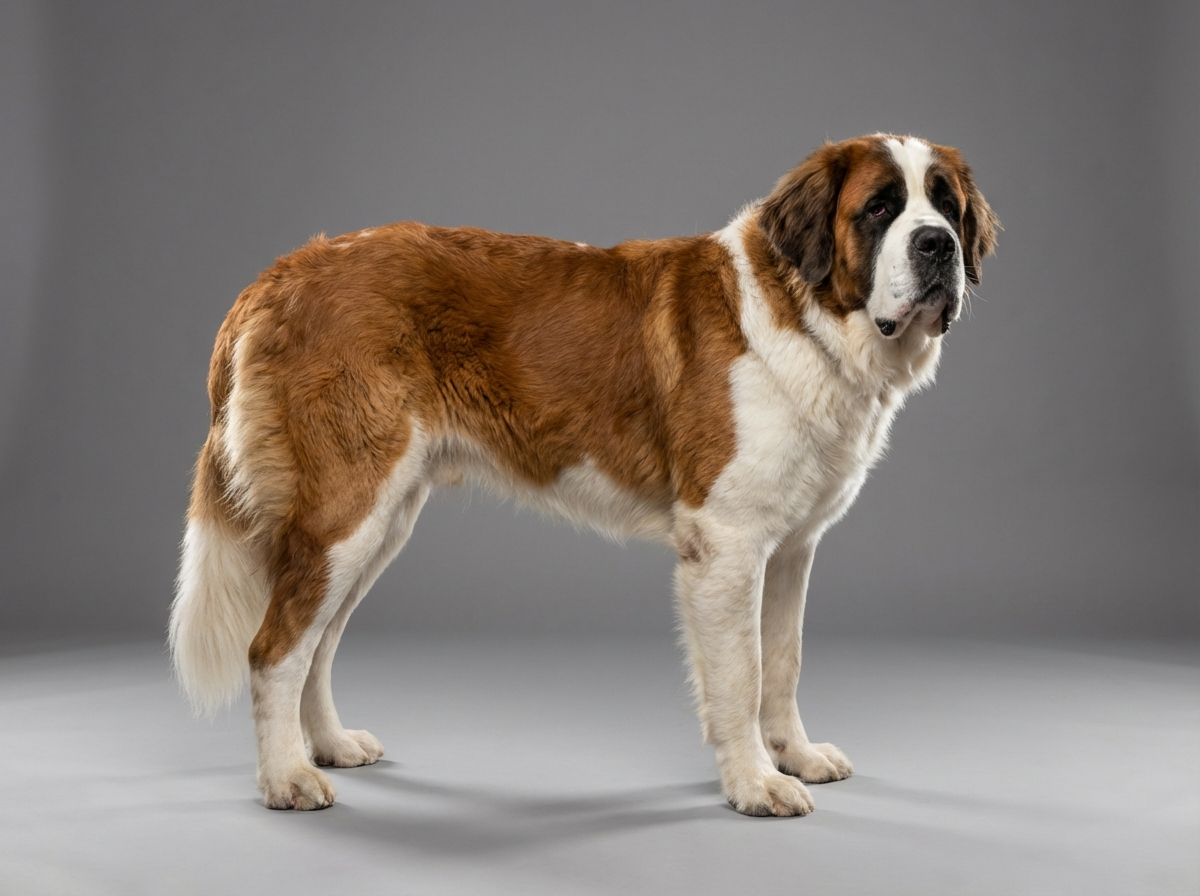
Saint Bernard cost in Des Moines
About $138–$285/month and $2,024–$3,864 for year one — below average, with specialist orthopedic capability about thirty-five miles north and a recovery period most owners badly underestimate.

See Saint Bernard price across all cities →
Quick answer
Saint Bernard cost in Des Moines
About $138–$285/month and $2,024–$3,864 for year one — below average, with specialist orthopedic capability about thirty-five miles north and a recovery period most owners badly underestimate.
A Saint Bernard in Des Moines costs about $138 to $285 a month, with the first year near $2,024 to $3,864 — under the national average, in line with Iowa's modest cost of living. The thing worth understanding before you own this breed here is what a joint operation looks like, because Hip Dysplasia and Elbow Dysplasia are both documented in Saint Bernards and Des Moines sits roughly thirty-five miles south of the veterinary teaching hospital at Iowa State in Ames.
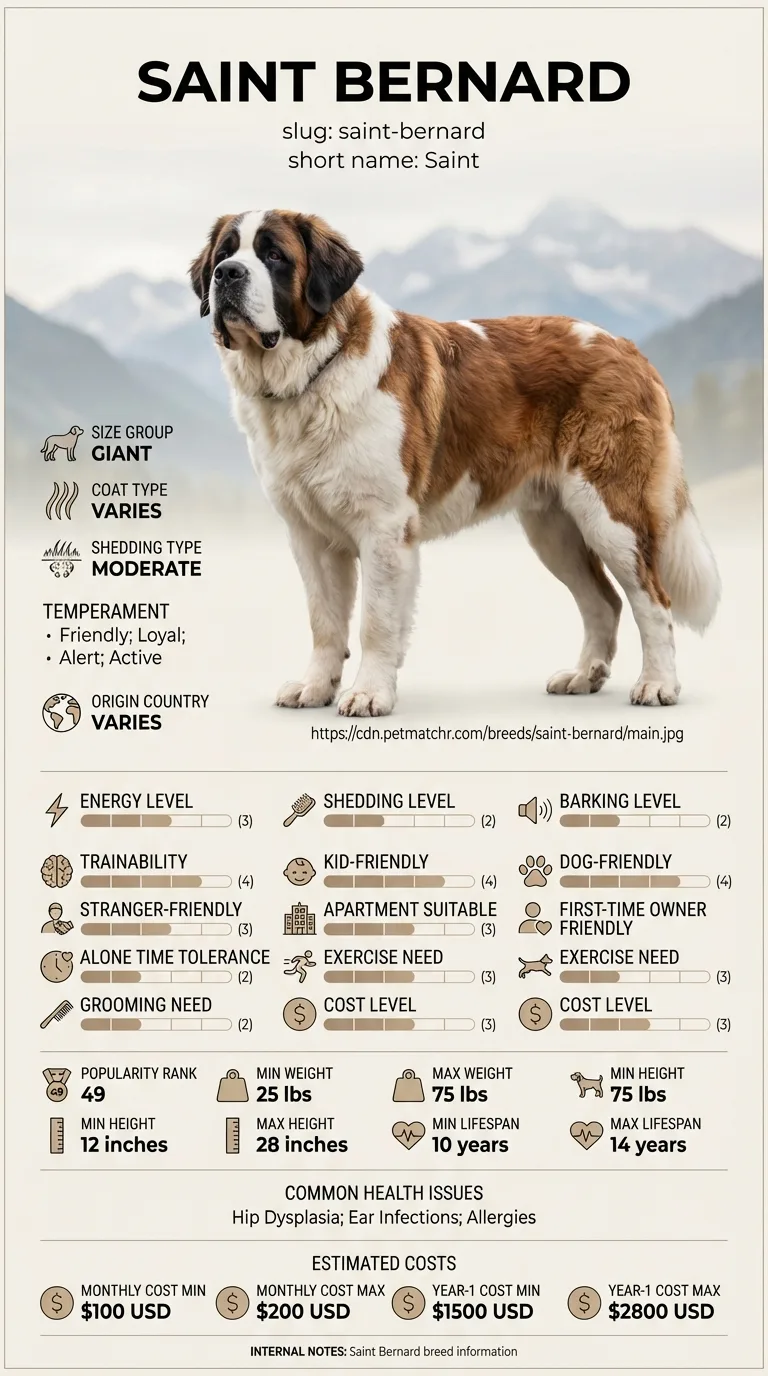
Alongside the joints, this breed carries documented Dilated Cardiomyopathy, Entropion and Bloat (GDV). Iowa's affordable pricing softens the routine end of that list considerably, but the surgical end is expensive in absolute terms because it is priced against the size of the patient rather than the cost of the town.
Des Moines prices below the national average on routine care, with the meaningful risk sitting in an orthopedic event whose cost is set by the dog's size rather than the local market.
Estimate · source: estimation · confidence: medium · updated 2026-09-06 · not a quote
| Item | Cost range |
|---|---|
One-time setup (giant crate, lifting sling, floor runners, first exam, spay/neuter) The sling and runners double as recovery equipment, which is why they belong in the initial purchase rather than in a panic later. | $478 - $828 |
| Item | Cost range |
|---|---|
Food (measured to protect the joints) Iowa's retail pricing is favourable, and every pound kept off a giant frame is load removed from hips and elbows with documented risk. | $66 - $118 |
Parasite prevention (seven-month Iowa window) A real winter closes the schedule for part of the year, which is worth more at this breed's top dosing weight. | $29 - $53 |
Each range starts from a national baseline for this breed's size class and is then adjusted for local cost of living and veterinary pricing. The baselines, and the source each one came from, are listed on our sources page (dataset 2026.09). Two inputs, the purchase price and the emergency reserve, have no published national figure we could verify, so we leave them to you rather than invent them.
These are planning estimates, not quotes. Your own numbers will move with the individual dog, your vet and your insurer. Build a budget with your own figures.
Orthopedics is the single strongest argument for insuring this breed, and it is the one most likely to be excluded if you wait.
Enrol before any lameness, gait abnormality or joint note appears in the record. Once a joint is mentioned, that joint is usually off the table.
An owner with a large reserve, a single-level home and the flexibility to supervise a long recovery is in a genuinely stronger position to self-fund than most.
Iowa's prices are already gentle. The savings that matter here are the ones that reduce the chance of needing a surgeon at all.
Iowa's general costs sit under the national line, and central Iowa's veterinary pricing follows. Yards are the norm rather than the exception here, which removes the paid-walking line that dense cities impose, and the seven-month parasite window reflects a real Iowa winter closing the season for a meaningful stretch.
What Des Moines has that most affordable markets do not is a veterinary teaching hospital about thirty-five miles up the interstate in Ames. For a breed with two documented joint conditions, having board-certified surgical capability within an easy morning's drive is a genuine practical advantage. It means a second opinion is a day trip rather than a project, and it means a complex case does not have to be shipped across a region.
None of that makes the surgery cheap. What it does is remove travel and delay from a decision that is already difficult, and in orthopedics delay has a cost of its own.
Ask anyone who has taken a giant breed through a joint operation what the hard part was and they will not say the bill. They will say weeks nine through twelve.
Restricted activity in a 150-pound dog means no stairs, no jumping, no slick floors and no unsupervised movement. In practice that means a room set up on one level, runners over every hard surface, a sling or lifting harness for supported toilet trips, and someone available during the day. If the household works full days, that turns into paid help or time off, and either is a real number.
The Iowa advantage is that the physical space to do this well is easier to find here than in a dense city. A single-level room with a door, a yard three steps from it, and no staircase in the route is an ordinary feature of Des Moines housing, and it is worth more during a recovery than any equipment you can buy.

A Des Moines household went through an elbow procedure with their five-year-old Saint Bernard and found the surgery itself was the simple part. The twelve weeks afterwards required moving a bed into the dining room, carpeting the route to the back door, and one adult reorganising their working week to be home. They got through it, and afterwards said the only thing they would change is buying the sling and the runners before the operation instead of during it.
Key takeaway: In Des Moines the specialist care is close and the prices are fair. The part to plan for is three months of a very large dog that is not allowed to move.
About $138–$285, below the national average, reflecting Iowa's modest cost of living.
Roughly $2,024–$3,864, including the initial exam, spay/neuter and the giant-size gear.
Implant sizing, longer anesthetic time and a longer, more demanding recovery all scale with the animal. A 150-pound patient consumes far more of everything than a spaniel does.
Eight to twelve weeks of strictly restricted movement — no stairs, no jumping, no slick floors — with a sling for supported toilet trips and someone around during the day.
It does. Board-certified surgical capability roughly thirty-five miles away means a second opinion or a referral is a day trip rather than a logistical project.
Around $1,150, which reflects Iowa's affordable pricing set against the genuinely high cost of any surgery on a giant-breed patient.
About $138–$285/month and $2,024–$3,864 for year one — below average, with specialist orthopedic capability about thirty-five miles north and a recovery period most owners badly underestimate.
This guide is not medical advice. If your dog shows pain, sudden behavior change, or worsening symptoms, consult a licensed veterinarian.
Some links may be affiliate links. We may earn a commission at no extra cost to you. We only suggest products we believe are helpful for dog owners.
We research and check what we publish, but we do not warrant that any figure, date, price, or statement is accurate, complete, or current, and we accept no liability for any loss, cost, injury, or other harm arising from the use of this site. Use it as one reference among several. You remain responsible for your own decisions and for your dog's care - confirm anything that matters with a licensed veterinarian or another qualified professional before you act on it. Full disclaimer.
One sheet with every line item, the emergency fund and when insurance pays off - unlocks on this page.
You get: 12-month budget sheet
No spam. One-click unsubscribe. See our privacy policy.
Preview page 1 before you decide.