Living
Drools more?
Saint Bernard.

Quick answer
Drools more?
Saint Bernard.
Cavalier King Charles Spaniel or Saint Bernard? On paper they differ most on apartment suitability, and on the scales Saint Bernard is the heavier at 120–180 lbs. Here is how the two compare on everything that shapes an ordinary week.
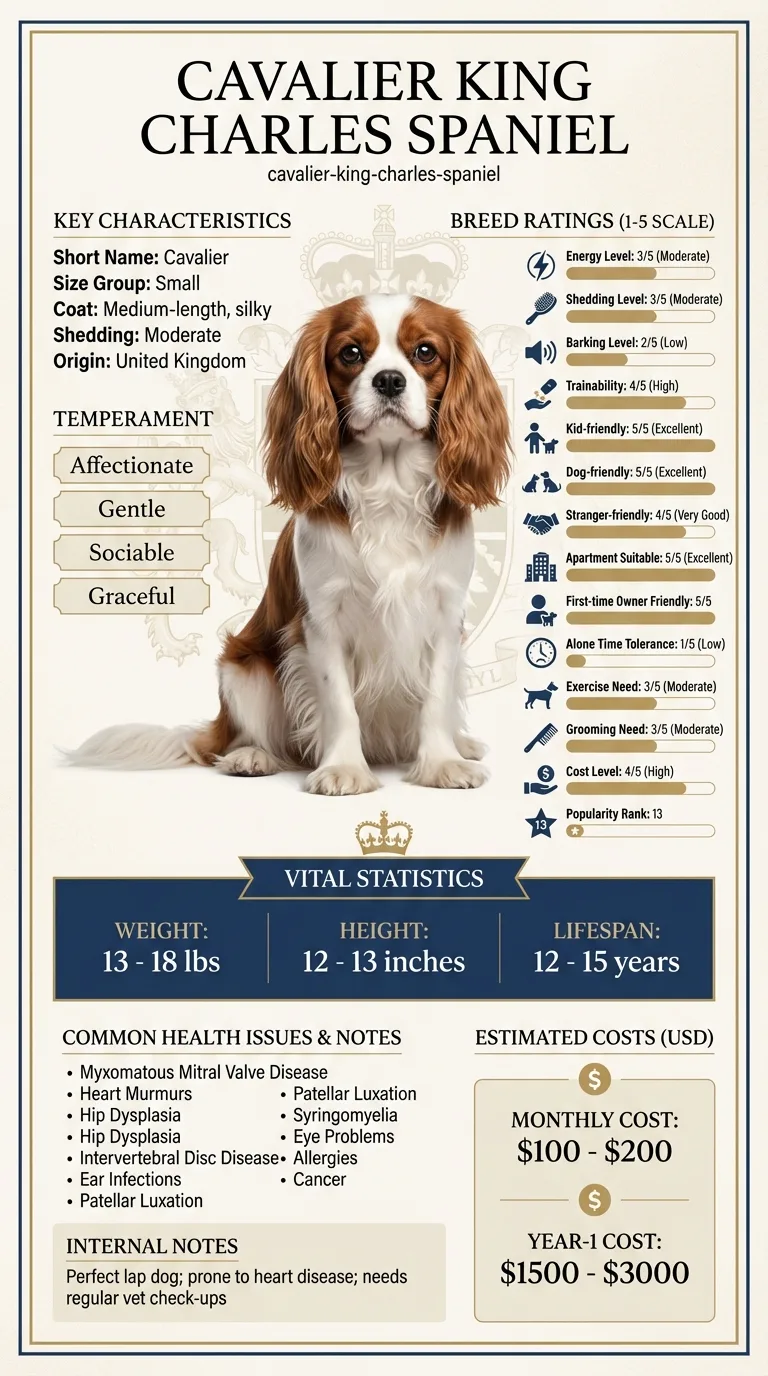
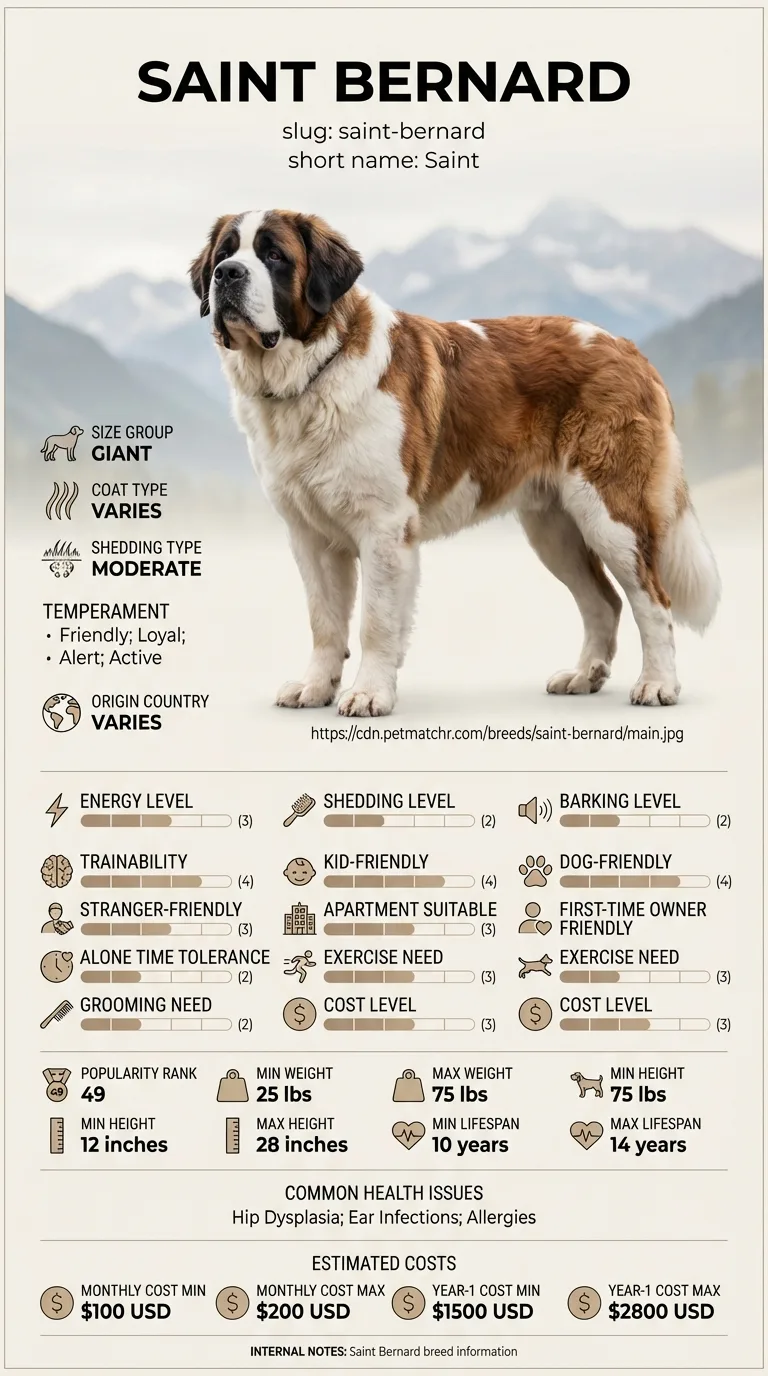
This is for someone already down to Cavalier King Charles Spaniel and Saint Bernard and deciding between them. For this pair the decision usually turns on apartment suitability and good for first-time owners, so those are covered first and in most detail. Anyone choosing from a flat has a clear answer here: Cavalier King Charles Spaniel rates 5/5 against 1/5. Breed history is left out; what follows is what you will actually live with.
Between Cavalier King Charles Spaniel and Saint Bernard, apartment suitability is what separates them, and Cavalier King Charles Spaniel is the lower-effort dog of the two to keep.
Choose Cavalier King Charles Spaniel if you are in a flat or a smaller home, this is your first dog and shedding is a problem in your house.
Choose Saint Bernard if your walking routine is modest and the dog will be alone during the working day.
| Feature | cavalier king charles spaniel | saint bernard | Winner |
|---|---|---|---|
| Size class | small | giant | Equal |
| Weight | 13–18 lbs | 120–180 lbs | Equal |
| Height | 12–13 in | 26–30 in | Equal |
| Lifespan | 12–15 years | 8–10 years | cavalier king charles spaniel |
| Exercise need | Moderate (3/5) | Low (2/5) | saint bernard |
| Grooming need | Moderate (3/5) | Moderate (3/5) | Equal |
| Shedding | Moderate (3/5) | High (4/5) | cavalier king charles spaniel |
| Energy level | Moderate (3/5) | Low (2/5) | Equal |
| Barking | Low (2/5) | Low (2/5) | Equal |
| Apartment suitability | Very high (5/5) | Very low (1/5) | cavalier king charles spaniel |
| Good for first-time owners | Very high (5/5) | Moderate (3/5) | cavalier king charles spaniel |
| Tolerates being alone | Very low (1/5) | Moderate (3/5) | saint bernard |
| Trainability | High (4/5) | Moderate (3/5) | cavalier king charles spaniel |
| Good with kids | Very high (5/5) | Very high (5/5) | Equal |
| Good with other dogs | Very high (5/5) | High (4/5) | cavalier king charles spaniel |
| Friendly to strangers | High (4/5) | High (4/5) | Equal |
| Cost level | High (4/5) | Very high (5/5) | cavalier king charles spaniel |
| Coat | Medium-length, silky | Short or long double coat | Equal |
| Origin | United Kingdom | Various | Equal |
| Typical monthly cost | $100–$200 | $150–$310 | Equal |
| Typical first-year cost | $1,500–$3,000 | $2,200–$4,200 | Equal |
At 120-180 lbs and 26-30 inches tall, a Saint Bernard outweighs a 13-18 lb, 12-13 inch Cavalier by roughly ten times its own body weight - a comparison that sounds absurd until you're standing next to both. The Saint Bernard's gentle, patient temperament is famous precisely because a dog that size needs to be calm by nature; a giant breed with an excitable temperament would be unmanageable. The Cavalier's small, graceful build means it can live comfortably in spaces where a Saint Bernard's sheer footprint - plus the drool radius - simply won't fit.
Exercise need actually favors the giant breed here, Low (2/5) for the Saint Bernard against Moderate (3/5) for the Cavalier, since Saint Bernards were bred to work in short, purposeful bursts through snow rather than run for miles. That doesn't mean no exercise - joint health in a dog this size depends on controlled, low-impact movement rather than high-intensity play, especially as a puppy. The Cavalier's moderate needs are easier to meet in less space, but pound for pound it's actually the more active of the two despite weighing a fraction as much.
Grooming ties at Moderate (3/5) for both breeds, but the experience differs: a Cavalier's silky coat needs regular brushing to prevent matting, while a Saint Bernard's short or long double coat needs regular brushing to manage sheer shedding volume. That shedding gap is real - Moderate (3/5) for the Cavalier against High (4/5) for the Saint Bernard - and a giant breed's shed simply produces more fur by mass. Add in the Saint Bernard's well-known drool, which the Cavalier doesn't produce at all, and grooming becomes as much about cleanup as coat care.
Apartment suitability rates Very high (5/5) for the Cavalier against Very low (1/5) for the Saint Bernard, and barking ties at Low (2/5) for both, so the space issue here is about size, not noise. Tolerating time alone actually favors the Saint Bernard, Moderate (3/5) against the Cavalier's Very low (1/5), which fits its more independent, watchful nature compared to the Cavalier's need for constant companionship. Still, a dog approaching 180 lbs needs real square footage to move comfortably regardless of how well it handles solitude.
The Cavalier rates Very high (5/5) for first-time owners and High (4/5) for trainability, while the Saint Bernard rates Moderate (3/5) on both counts. A gentle, friendly Saint Bernard is rarely aggressive or hard to motivate, but its sheer size means training has to start early and stay consistent - a giant breed that hasn't learned leash manners as a puppy becomes genuinely difficult to control as an adult. First-time owners who choose a Saint Bernard should plan for structured puppy classes from the start rather than assuming its famously patient temperament will carry it through untrained.
Good with kids ties at Very high (5/5) for both breeds, and gentle and patient describe the Saint Bernard just as affectionate and gentle describe the Cavalier - both are considered classic family dogs. Friendly to strangers also ties, at High (4/5), though the Saint Bernard's watchful streak means it's a little more discerning before warming up. The Cavalier edges ahead slightly with other dogs, Very high (5/5) against High (4/5). Supervision around small children matters more with the Saint Bernard simply because of its bulk, not its temperament.
Lifespan strongly favors the Cavalier, 12-15 years against just 8-10 for the Saint Bernard, one of the steeper gaps among giant-breed comparisons on this site. The Saint Bernard's health list - Hip Dysplasia, Elbow Dysplasia, Dilated Cardiomyopathy, and Bloat (GDV) - reflects classic giant-breed vulnerabilities, with bloat in particular being a fast-moving emergency owners need to recognize immediately. The Cavalier's risk profile centers on Myxomatous Mitral Valve Disease and syringomyelia instead, chronic conditions managed over years rather than sudden emergencies. Both breeds warrant cardiac screening, just for very different underlying reasons.
Cost level rates High (4/5) for the Cavalier and Very high (5/5) for the Saint Bernard, with monthly costs of $100-200 versus $150-310 and first-year costs of $1,500-3,000 versus $2,200-4,200. Food volume alone explains much of the gap for a dog that can weigh nearly 180 lbs, and giant-breed veterinary care - from anesthesia dosing to imaging equipment - typically costs more per visit. A Saint Bernard owner should also budget for emergency bloat surgery as a real possibility, a cost category the Cavalier's health profile doesn't carry in the same way.
Cavalier King Charles Spaniel weighs 13–18 lbs and lives 12–15 years; Saint Bernard weighs 120–180 lbs and lives 8–10 years. The two diverge most on apartment suitability, good for first-time owners and tolerates being alone. They are level on barking, grooming need and good with kids, so those cannot decide it. The comparison marks an easier option only where one exists. Facts like weight and country of origin are not scored. Both dogs are rated from the same dataset, which is what makes the numbers comparable with each other even though any individual dog sits somewhere inside its breed's range.

Roughly ten times the weight - 120-180 lbs versus 13-18 lbs - and more than double the height at the shoulder.
Yes, they rate Low (2/5) against the Cavalier's Moderate (3/5), though controlled low-impact activity still matters for joint health.
The Saint Bernard on both counts - it rates High (4/5) for shedding against the Cavalier's Moderate (3/5), and is well known for heavy drooling the Cavalier doesn't produce.
It's not recommended - the breed rates Very low (1/5) for apartment suitability against the Cavalier's Very high (5/5).
The Cavalier, at 12-15 years against 8-10 years for the Saint Bernard.
Yes, Bloat (GDV) appears on its health list and is a genuine emergency giant-breed owners need to recognize quickly.
The Cavalier, with a cost level of High (4/5) against Very high (5/5) for the Saint Bernard and roughly half the first-year cost.
Saint Bernard.
Saint Bernard.
Cavalier King Charles Spaniel.
Cavalier King Charles Spaniel.
Secure checkout on Stripe. We never see your card.
7-day money-back guarantee. Instant access.

Health information here is general and is not veterinary advice. If your dog shows pain, sudden behaviour change, or worsening symptoms, consult a licensed veterinarian.
Some links on this site are affiliate links. We may earn a commission at no extra cost to you, and we only suggest products we believe are helpful for dog owners.
We research and check what we publish, but we do not warrant that any figure, date, price, or statement is accurate, complete, or current, and we accept no liability for any loss, cost, injury, or other harm arising from the use of this site. Use it as one reference among several. You remain responsible for your own decisions and for your dog's care - confirm anything that matters with a licensed veterinarian or another qualified professional before you act on it. Full disclaimer.
Match your lifestyle to the right dog.
Take quizNot sure which breed is right for you? Take our 2-minute quiz to find out.
Take the quiz