Living
What is the safest way to pick up a Papillon?
One hand flat under the chest between the front legs, the other supporting the rear, and lift both ends together so the spine stays level. Never scoop under the armpits and let the back end hang.

Quick answer
What is the safest way to pick up a Papillon?
One hand flat under the chest between the front legs, the other supporting the rear, and lift both ends together so the spine stays level. Never scoop under the armpits and let the back end hang.
The dangerous vertebra in a toy dog is usually the second one, in the neck, not one of the ones in the middle of the back that Dachshund owners worry about.
Owners of a Papillon that has started holding its head low and still, cries when lifted under the chest, or came off worse from a fall off a bed or a chair arm.
This guide is not medical advice. If your dog shows pain, sudden behavior change, or worsening symptoms, consult a licensed veterinarian.
Some links may be affiliate links. We may earn a commission at no extra cost to you. We only suggest products we believe are helpful for dog owners.
We research and check what we publish, but we do not warrant that any figure, date, price, or statement is accurate, complete, or current, and we accept no liability for any loss, cost, injury, or other harm arising from the use of this site. Use it as one reference among several. You remain responsible for your own decisions and for your dog's care - confirm anything that matters with a licensed veterinarian or another qualified professional before you act on it. Full disclaimer.
Spinal trouble in a Papillon does not follow the long-back pattern people expect. The two realistic routes are instability at the top of the neck, a known toy-group problem, and blunt trauma from falls and jumps onto hard floors. Signs range from a head held stiffly low, through crying on being lifted, to weakness or dragging in the limbs, which is the version that cannot wait.
Uncommon. Spinal disease is not a Papillon signature and most owners will never face it. It is worth understanding anyway because the toy-breed neck problem is easy to overlook, the emergency signs are specific, and the everyday prevention is nothing more than how you lift your dog and what you put next to the sofa.
The Papillon's build works in its favour. Normal leg-to-back proportions mean it lacks the disc structure that makes chondrodystrophic breeds break down early. What it does share with every toy breed is fineness: light vertebrae, thin supporting muscle and very little soft tissue padding. The open fontanel documented in the breed is a reminder that the skeleton of a five to ten pound dog finishes differently from a large dog's, and the joint between the first two neck vertebrae is the place where that fineness has consequences.
Almost every spinal injury in this breed is an indoor accident. Furniture built for adult humans is a cliff to a ten-inch dog. Hard flooring turns an awkward landing into a jarring one. Household traffic means a small dog underfoot gets stepped on or has a door swung into it. Papillons are alert, confident dogs that follow their people everywhere, which puts them in the busiest part of the house at the busiest times.
Go now, out of hours if needed, for any weakness, wobbling or dragging in the limbs, an inability to stand or walk normally, loss of bladder or bowel control, or severe pain that will not settle. Those signs mean the spinal cord itself may be involved and delay costs function permanently. Go the same day for a dog that cries when lifted more than once, holds its head rigidly low, will not turn its neck to look up, or has become unwilling to jump onto anything at all. Book a routine appointment if an older Papillon has become progressively stiff or slow through the hindquarters over weeks.
See all Papillon health problems, which breeds are prone to back problems, or the full Papillon breed guide for temperament, exercise needs and ownership costs.
A soft-tissue wrench treated with rest usually settles within one to two weeks. Cervical instability requiring surgery means several weeks of strictly confined recovery followed by two to three months of graded return to activity. Age-related degenerative change is managed for the rest of the dog's life rather than resolved, with plans reviewed every six months.
A dog that moves its head freely, tolerates being lifted without complaint, and chooses the ramp over the leap without being told. For a dog recovering from a genuine spinal injury, success is stable neurological function and controlled pain, not necessarily a return to jumping off furniture, which should not be the goal anyway.
The first two vertebrae behind the skull form a pivot joint that lets a dog turn its head. It is held together by a bony peg and a set of ligaments. In some toy-breed dogs that peg is malformed or the ligaments are lax from birth, and the joint becomes unstable. The medical name is atlantoaxial instability, and it is a recognised problem across the toy group.
When the joint shifts, the spinal cord at the very top of the neck is compressed. Signs range from a dog that carries its head oddly and yelps when it looks up, to weakness or wobbliness in all four legs, to a sudden and severe neurological crisis after nothing more than a jump off a sofa.
It is not on the Papillon's documented list, so it should not be your first assumption. But it belongs on the differential list for any small dog with neck pain, because the consequence of missing it is severe and because the classic history is exactly the kind of minor accident owners dismiss.

The other route to spinal injury in this breed is blunt trauma, and almost all of it happens indoors. A Papillon weighing seven pounds jumping from a bed is dropping roughly three times its own standing height. Multiply that by fifteen years of doing it several times a day.
The breed's skeleton is genuinely fine. An open fontanel, a soft spot on the skull that never fully closes, appears on the Papillon's documented health list, and while that is a skull finding rather than a spinal one, it is a fair signal of how delicate the bony framework of a toy dog is.
The practical response is unglamorous. Steps or a ramp to the furniture the dog actually uses. A hand under the chest and another under the rump every time you lift, never a grab under the front legs. No lifting by the scruff, and no carrying a Papillon on a forearm where it can twist and drop. Children in the household need the same instruction, repeated.
Kasia's five-year-old Papillon, Bruno, had always been a dog who looked up at everything. One evening she realised he had eaten his supper without lifting his head from the bowl, and had turned his whole body rather than his neck when she called him. There had been no accident she knew of, though he had come off the arm of the sofa awkwardly two days earlier. Her vet found pain on gentle neck flexion, no limb weakness, and treated it as a soft-tissue injury with strict rest and no lead pressure on the neck. Bruno was moving normally within twelve days. Kasia bought a step for the sofa, changed to a harness and taught everyone in the family the two-handed lift. The vet had told her plainly that if Bruno had shown wobbliness in his legs it would have been a different appointment altogether.
Key takeaway: In a toy dog the earliest spinal sign is often a movement that has gone missing rather than a movement that looks wrong. A head that has stopped turning is worth an appointment.
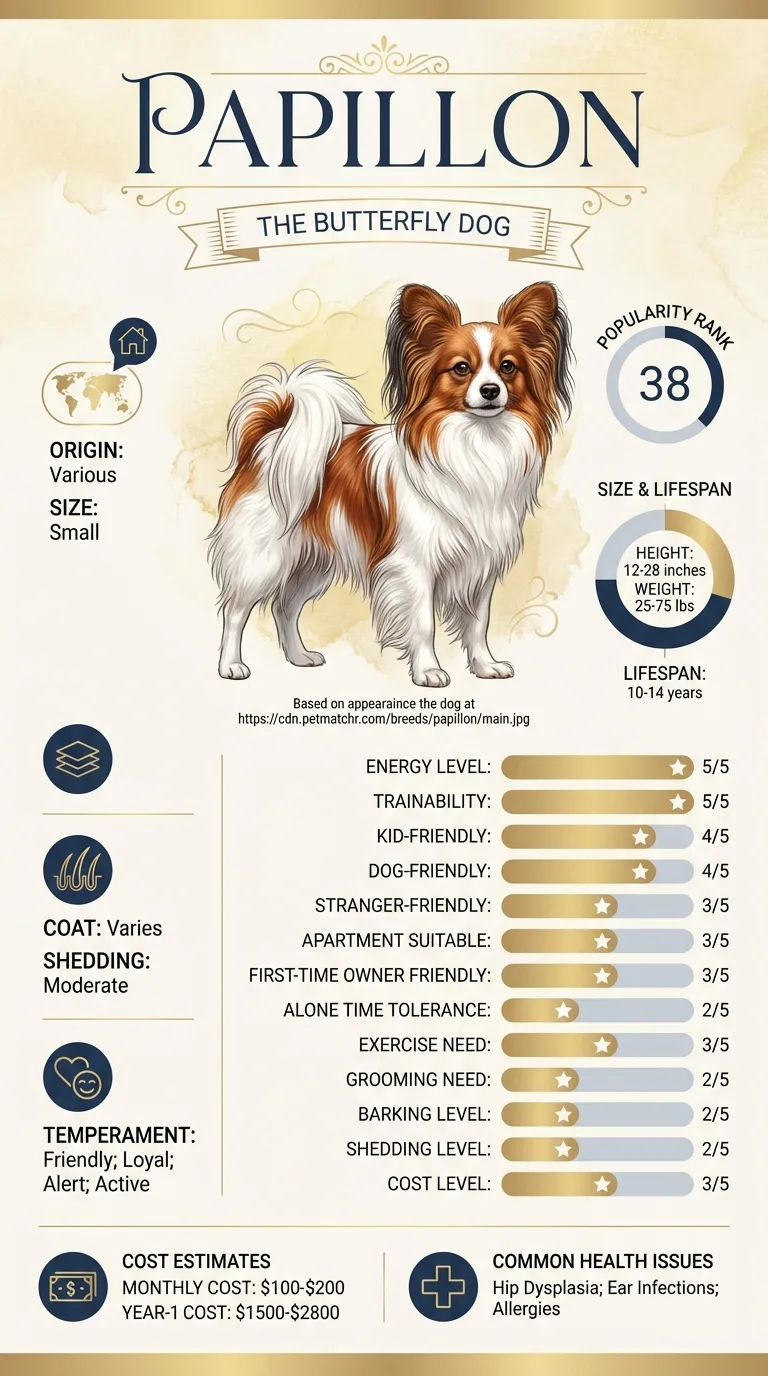
No. They are compact, squarely proportioned toy spaniels standing eight to eleven inches tall, without the exaggerated spine-to-leg ratio that defines chondrodystrophic breeds. Advice written for Dachshunds does not transfer directly.
It is not among the Papillon's documented problems, which are patellar luxation, progressive retinal atrophy, dental disease, an open fontanel and a collapsing trachea. Individual dogs still get spinal pain, most often from trauma or from age-related change in a dog that lives to fifteen.
A dog in neck pain holds its head low and level, resists looking up, and often will not take food from a raised hand. A dog with pain further down arches its back, tucks its abdomen and moves stiffly through the hips. Both cry when picked up, which is why the location is worth pinning down.
One yelp with immediate normal behaviour afterwards is often a wrenched moment. A dog that yelps and then stays quiet, will not jump, or repeats the cry on the next lift should be seen within a day. Do not test it repeatedly to find out.
Yes, particularly if the landing is on hard flooring or the dog twists. A seven pound body with light bones and a small margin of muscle takes an awkward landing less well than a stocky dog three times its weight.
A well-fitted harness protects the neck and windpipe far better than a collar, which matters in a breed with collapsing trachea on its health list. Avoid harnesses that require you to lift a leg awkwardly to fit, and never use a lead attached to a collar on a dog with any neck pain.
One hand flat under the chest between the front legs, the other supporting the rear, and lift both ends together so the spine stays level. Never scoop under the armpits and let the back end hang.
Weakness or dragging in the back legs, wobbliness in all four, inability to stand, or loss of bladder control. Those indicate spinal cord involvement and need an immediate veterinary assessment, not a wait-and-see night.
Radiographs under sedation typically run a few hundred dollars. Advanced imaging such as MRI, which is what a neurological case usually needs, commonly runs into the low thousands before any treatment.
Redirect rather than forbid. A ramp or a wide padded step to the one sofa the dog insists on gets used within a week, and removes the repeated hard landings without shrinking the dog's life.
Easily. This breed sits at the top of the trainability range. Lure the dog up and down with food a few times a day for a week, block the jump while it learns, and the new route becomes the default.
A one-page prep sheet for this condition: the signs, the questions to ask, what to get priced. Unlocks here.
You get: Vet visit prep sheet
No spam. One-click unsubscribe. See our privacy policy.
Preview page 1 before you decide.