Health
What's the difference between DCM and a heart murmur?
DCM is a weakening of the heart muscle itself; a murmur is the sound of blood leaking backward through a valve that isn't sealing. Both need an echocardiogram to properly tell apart.

Quick answer
What's the difference between DCM and a heart murmur?
DCM is a weakening of the heart muscle itself; a murmur is the sound of blood leaking backward through a valve that isn't sealing. Both need an echocardiogram to properly tell apart.
A stretched, weakening heart muscle and a leaking valve can sound almost identical through a stethoscope, but they call for very different treatment paths.
Owners of adult and senior Old English Sheepdogs, especially anyone noticing a drop in stamina, a new cough, or a vet mentioning an enlarged heart shadow on an X-ray taken for an unrelated reason.
This guide is not medical advice. If your dog shows pain, sudden behavior change, or worsening symptoms, consult a licensed veterinarian.
Some links may be affiliate links. We may earn a commission at no extra cost to you. We only suggest products we believe are helpful for dog owners.
Dilated cardiomyopathy is a disease of the heart muscle rather than the valves, causing the chambers to stretch and lose pumping strength. It skews toward large and giant breeds as a category, which includes the Old English Sheepdog by size even though the breed isn't specifically flagged for it, and it can occur alongside or independently of murmur-producing valve disease.
DCM isn't among the handful of conditions considered defining for this breed, but as a disease category it appears often enough across large dogs generally that unexplained exercise intolerance or a new cough in an adult Old English Sheepdog warrants a full cardiac workup rather than an assumption of simple age-related valve wear.
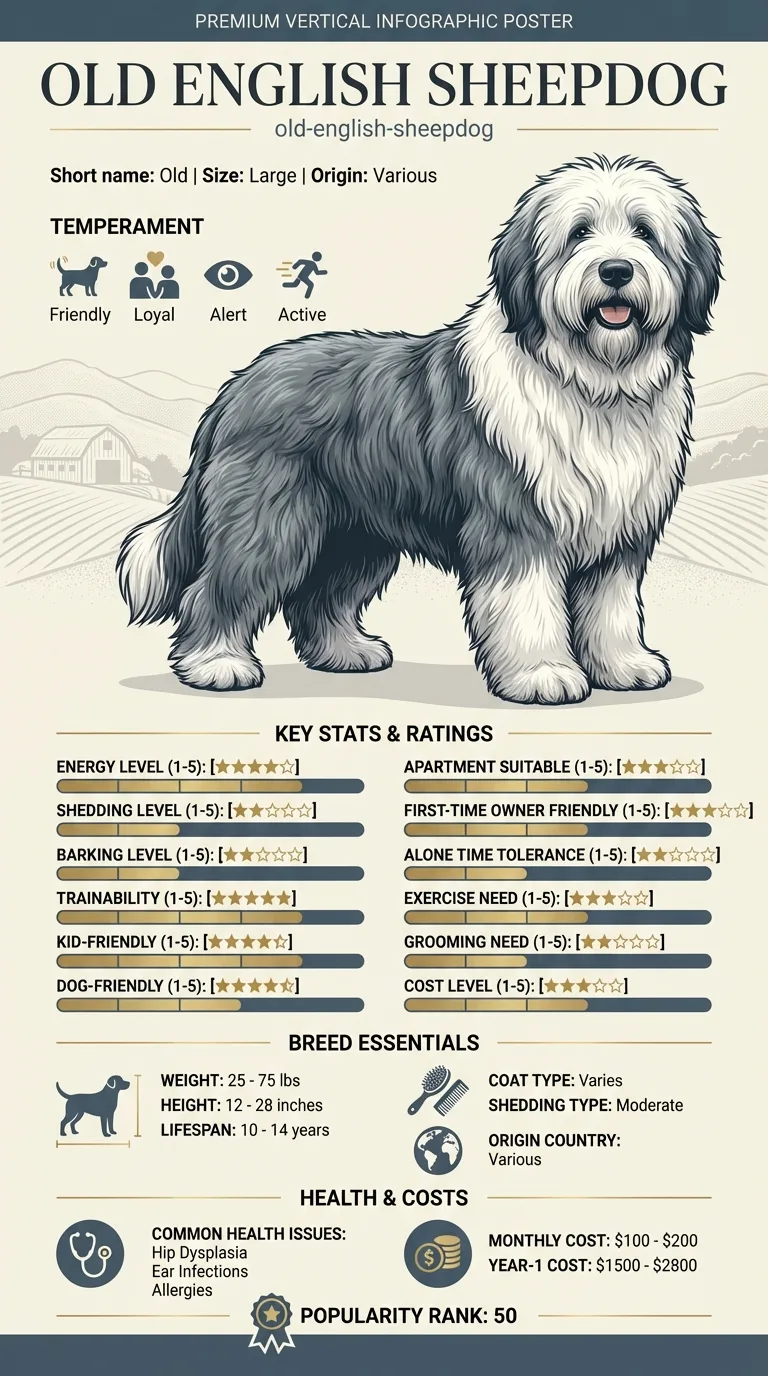
This breed's own documented health record doesn't single out DCM the way it does hip dysplasia or hypothyroidism, but DCM as a disease process is strongly associated with larger body size across dogs broadly, and an adult frame of sixty to a hundred pounds places this breed in the same general risk category as other large and giant breeds.
Diet is an active area of research, with certain grain-free and boutique formulations under study for a possible association with diet-associated DCM across breeds. Excess weight and under-exercise, both realistic risks in a heavily coated breed where extra pounds are easy to miss, add further strain to an already taxed heart muscle.
Seek same-day veterinary care for fainting, collapse, rapid or labored breathing at rest, a swollen belly, or gums that look pale or bluish. These can indicate the heart is failing to compensate and require urgent evaluation, not monitoring at home.
See all OLD English Sheepdog health problems, which breeds are prone to heart disease, or the full OLD English Sheepdog breed guide for temperament, exercise needs and ownership costs.
DCM is typically staged over a few weeks of testing once suspected, and treatment is lifelong from the point of diagnosis. Some dogs remain in an earlier, asymptomatic stage for a long time with monitoring alone before medication becomes necessary.
Success means stable or slowly progressing imaging results, a dog that maintains reasonable stamina for gentle daily activity, and no emergency episodes of fluid buildup, achieved through consistent medication and monitoring rather than a cure.
Dilated cardiomyopathy is fundamentally a muscle problem: the walls of the heart's chambers, especially the left ventricle, stretch out and lose the strength to contract efficiently. The chamber enlarges further to compensate, which only worsens the underlying weakness, a slow spiral that can go unnoticed for a long stretch before symptoms appear. A murmur, by contrast, is a plumbing problem, a valve that isn't closing tightly, letting blood leak backward and create the whooshing sound a vet hears. Both can eventually cause the same downstream symptoms, a cough, fluid backup, and exercise intolerance, which is exactly why an echocardiogram rather than a stethoscope alone is the tool that actually tells them apart in a large dog presenting with either sign.
Size matters here in a very literal, mechanical sense: a larger heart moving a larger blood volume simply has more structural mass that can stretch and thin, one of the reasons DCM skews toward large and giant breeds far more than toy ones.
In recent years, certain grain-free and boutique diets have been investigated for a possible association with diet-related DCM across dog breeds generally, a link researchers are still actively studying rather than one with settled conclusions. This is worth mentioning at a cardiology visit if your Old English Sheepdog is on a boutique or novel-protein food, not because any single diet is confirmed to cause the disease, but because it's a simple, no-cost detail to flag while a full workup is underway.

If you think your Old has heart disease, the plan is three steps: write down what you have seen and when it started, book a veterinary appointment rather than waiting for the next flare, and take video of the behaviour or symptom before you go — the thing you are worried about rarely happens in the consulting room. Screening in the parents covers hip dysplasia, cataracts, hypothyroidism.
What the vet visit should produce is a diagnosis and a written plan, not just reassurance: what is being ruled out, what the monitoring interval is, and which signs mean you come back sooner. Ask what the treatment costs across a year rather than per visit, because that is the number that decides whether you are managing this condition or reacting to it.
Between appointments, keep a short log — dates, what you saw, what changed. It is the single most useful thing an owner brings to a follow-up, and for heart disease it is often what separates a clear pattern from a guess.
Bramble, a seven-year-old Old English Sheepdog in Columbus, had always napped hard after her morning walk, so when her owner Priya noticed she was napping even harder and skipping her usual evening patrol of the backyard fence line, it took a few weeks to register as unusual rather than just a phase. A vet visit turned up a faint murmur and, on an X-ray taken for an unrelated limp, a heart silhouette that looked slightly larger than expected for her frame. An echocardiogram confirmed early dilated cardiomyopathy rather than simple valve disease. Bramble started on cardiac medication, and Priya switched her off a boutique venison formula onto a standard vet-recommended diet at the cardiologist's suggestion. Six months later, Bramble's energy on walks had noticeably returned, and her evening fence patrol was back on the schedule.
Key takeaway: A weakening heart muscle and a leaking valve can look identical from the couch, and only imaging, not guesses about diet or age, tells you which one you're actually managing.
It's a disease of the heart muscle itself, where the chamber walls stretch and thin, reducing how forcefully the heart can pump. It's a different mechanism from valve disease, even though the two can eventually cause similar symptoms like coughing and fatigue.
It isn't documented as one of this breed's defining conditions, but DCM as a disease category skews toward large and giant breeds generally, and this breed's adult size puts it in that broader risk group, so unexplained fatigue or coughing warrants a real cardiac workup.
An echocardiogram is the definitive test, showing the actual size and contraction strength of the heart chambers. Chest X-rays and sometimes a Holter monitor are added to check for fluid buildup and rhythm disturbances that often accompany DCM.
Researchers are still studying a possible link between certain grain-free and boutique diets and diet-associated DCM in dogs broadly. It's worth mentioning your dog's current food to your vet, but no single food should be assumed the cause without a proper workup.
Treatment typically centers on medication that helps the heart pump more efficiently and manage fluid buildup, prescribed and dosed entirely by your veterinary cardiologist based on your dog's specific staging. There's no home substitute for this.
A mild murmur from early valve leakage can sometimes be monitored for years before treatment becomes necessary. DCM tends to be a more directly muscle-weakening process, and once symptoms appear it's usually treated as needing active management right away.
Mild, early-stage findings often don't require major activity changes, but this is a case-by-case call from your vet or cardiologist after imaging, not something to decide from symptoms alone.
DCM is a weakening of the heart muscle itself; a murmur is the sound of blood leaking backward through a valve that isn't sealing. Both need an echocardiogram to properly tell apart.
Yes, dilated cardiomyopathy skews toward large and giant breeds as a category far more than toy breeds, and a sixty-to-hundred-pound adult frame falls squarely in that group.
An echocardiogram plus supporting tests commonly runs several hundred dollars, with ongoing cardiac medication adding a recurring monthly cost after diagnosis.
Many dogs manage well for a meaningful stretch with proper medication and monitoring, though DCM is generally a lifelong, progressive condition rather than one that resolves.
Only under your cardiologist's guidance, since any diet change for a suspected diet-associated component needs to be coordinated with the rest of the treatment plan.
A one-page prep sheet for this condition: the signs, the questions to ask, what to get priced. Unlocks here.
You get: Vet visit prep sheet
No spam. One-click unsubscribe. See our privacy policy.
Preview page 1 before you decide.