Health
Is hip dysplasia one of this breed's main health risks?
Yes, it's one of the most documented conditions in Old English Sheepdogs, tied directly to the breed's large adult body size and joint conformation.

Quick answer
Is hip dysplasia one of this breed's main health risks?
Yes, it's one of the most documented conditions in Old English Sheepdogs, tied directly to the breed's large adult body size and joint conformation.
A joint that doesn't fit quite right at six months old doesn't magically fit better at six years old; it just wears down faster.
Owners of growing puppies during the critical first eighteen months, and owners of adult and senior dogs managing the arthritis that hip dysplasia leaves behind even after growth has finished.
This guide is not medical advice. If your dog shows pain, sudden behavior change, or worsening symptoms, consult a licensed veterinarian.
Some links may be affiliate links. We may earn a commission at no extra cost to you. We only suggest products we believe are helpful for dog owners.
Hip dysplasia is a mismatch between the ball and socket of the hip joint that lets the joint move with more instability than it should, and in a breed that grows to sixty to a hundred pounds, that instability wears down cartilage steadily over the growth period and beyond. It's one of the most consistently documented health issues in the Old English Sheepdog.
Hip dysplasia is one of the handful of conditions specifically documented as common in this breed, alongside cataracts and hypothyroidism, making it one of the first things a prospective owner or new puppy owner should understand and plan around.
This breed's own documented health profile lists hip dysplasia directly, and the mechanism is straightforward: a joint that forms with imperfect depth and fit, combined with an adult body that can reach a hundred pounds, means more sustained load on a joint that was already at a mechanical disadvantage from the start.
Rapid weight gain during puppyhood, repeated jumping or high-impact play before the growth plates close, and slippery indoor flooring that forces awkward joint angles all add environmental stress on top of the underlying genetic looseness.
Talk to your vet promptly if you notice a bunny-hop gait, reluctance to jump or climb stairs, stiffness that doesn't ease with movement, or any sudden worsening of mobility. A dog that stops bearing weight on a hind leg or seems to be in acute pain needs same-day evaluation.
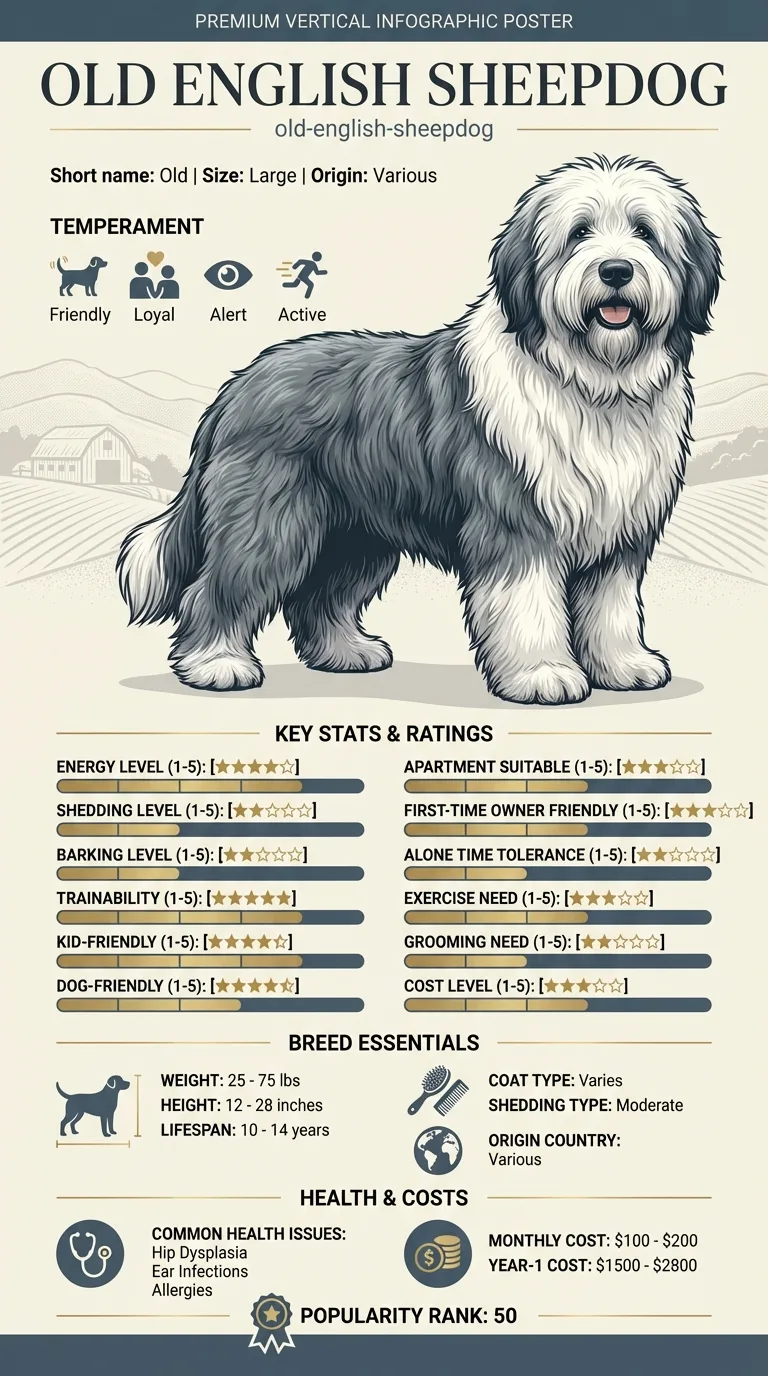
See all OLD English Sheepdog health problems, which breeds are prone to hip dysplasia, or the full OLD English Sheepdog breed guide for temperament, exercise needs and ownership costs.
Puppies can show early laxity as young as a few months old, though many dogs aren't formally diagnosed until closer to one to two years old when growth has finished. Once arthritis sets in, it's a lifelong, progressive condition managed rather than reversed.
Success looks like a dog that maintains a comfortable activity level and lean weight, with pain well controlled and mobility preserved for as long as possible, rather than a joint that returns to normal.
Hip dysplasia starts as a mismatch between the ball of the femur and the socket of the pelvis, a joint that's looser or shallower than it should be. In a growing large-breed puppy, that looseness lets the joint move in ways it wasn't designed for, and repeated micro-instability wears down cartilage faster than it can regenerate. By the time a dog is fully grown, often somewhere past a year old for a breed this size, the joint surfaces may already show early arthritic changes that no longer reflect the original looseness so much as the accumulated wear from it. This is why a dog diagnosed with dysplasia as a puppy and one diagnosed with arthritis as a senior are often describing the same underlying joint at two different points along the same timeline, not two separate problems.
Because this breed's heavy coat hides muscle loss and subtle gait changes, owners often notice indirect signs before an obvious limp.

If you think your Old has hip dysplasia, the plan is three steps: write down what you have seen and when it started, book a veterinary appointment rather than waiting for the next flare, and take video of the behaviour or symptom before you go — the thing you are worried about rarely happens in the consulting room. Screening in the parents covers hip dysplasia, cataracts, hypothyroidism.
What the vet visit should produce is a diagnosis and a written plan, not just reassurance: what is being ruled out, what the monitoring interval is, and which signs mean you come back sooner. Ask what the treatment costs across a year rather than per visit, because that is the number that decides whether you are managing this condition or reacting to it.
Between appointments, keep a short log — dates, what you saw, what changed. It is the single most useful thing an owner brings to a follow-up, and for hip dysplasia it is often what separates a clear pattern from a guess.
Boone, a ten-month-old Old English Sheepdog in Spokane, had always run with an odd double-leg hop his owner Grant assumed was just puppy clumsiness. When it hadn't smoothed out by his next checkup, his vet recommended hip X-rays, which showed moderate bilateral hip dysplasia with early arthritic changes already visible despite his young age. Rather than jumping straight to surgery, Boone's vet recommended a structured weight and exercise plan, controlled leash walks instead of off-leash sprinting, and a canine rehabilitation program to build supporting muscle. A year later, Boone was noticeably more comfortable on walks, and while the bunny-hop gait never fully disappeared, his mobility and mood had both improved substantially.
Key takeaway: A gait quirk that looked like puppy clumsiness turned out to be the joint telling on itself early, and catching it before serious arthritis set in gave Boone's family real management options instead of just a surgery decision.
Yes, it's one of the most consistently documented health issues in this breed, driven largely by the combination of a large adult body size and a joint that can form with imperfect depth and fit during growth.
X-rays are the standard tool, often scored through a formal program like OFA or PennHIP, which measure joint laxity and the degree of any arthritic change. Diagnosis can happen as early as a few months old with PennHIP or closer to two years old for a standard OFA score.
Not entirely, since there's a genetic component, but keeping a puppy lean during its growth phase, avoiding excessive high-impact exercise like repeated jumping before growth plates close, and choosing a breeder who screens breeding stock all reduce the risk and severity.
No. Many dogs, especially those with mild to moderate dysplasia, are managed successfully for years with weight control, joint-friendly exercise, and vet-directed pain management. Surgery is generally reserved for more severe cases or dogs who aren't responding to conservative management.
Keeping the dog at a lean weight to reduce joint load, providing controlled, low-impact exercise like swimming or leash walks rather than repeated jumping, and following your vet's guidance on any joint support are the main pillars, alongside monitoring for when pain management needs adjusting.
Some puppies show looseness or a bunny-hop gait as early as four to twelve months old. Others don't show visible symptoms until arthritis has built up in middle age, even though the underlying joint laxity was present from puppyhood.
Costs range widely depending on severity, from ongoing weight and activity management with occasional vet visits on the lower end, to surgical intervention that can run into the thousands of dollars on the higher end.
Yes, it's one of the most documented conditions in Old English Sheepdogs, tied directly to the breed's large adult body size and joint conformation.
A bunny-hop gait when running, where both back legs move together, or reluctance to jump into a car, are common early clues.
No, many dogs are managed for years with weight control and low-impact exercise, with surgery reserved for more severe or unresponsive cases.
It ranges widely, from modest ongoing costs for conservative management to several thousand dollars if surgery becomes necessary.
Yes, controlled, low-impact exercise is usually encouraged rather than restricted entirely, since moderate movement helps maintain muscle support around the joint.
A one-page prep sheet for this condition: the signs, the questions to ask, what to get priced. Unlocks here.
You get: Vet visit prep sheet
No spam. One-click unsubscribe. See our privacy policy.
Preview page 1 before you decide.