Health
Is this breed's hip dysplasia rate especially high compared to others?
It's a commonly documented issue for this breed, but rates vary across breeds based on screening history, so it isn't uniquely worse than every other large breed.

Quick answer
Is this breed's hip dysplasia rate especially high compared to others?
It's a commonly documented issue for this breed, but rates vary across breeds based on screening history, so it isn't uniquely worse than every other large breed.
Two large breeds can share a body size and still have very different hip dysplasia rates depending on decades of breeding choices behind them.
Prospective buyers comparing this breed against others, and current owners trying to understand whether their dog's individual risk is closer to the breed average or notably better or worse.
This guide is not medical advice. If your dog shows pain, sudden behavior change, or worsening symptoms, consult a licensed veterinarian.
Some links may be affiliate links. We may earn a commission at no extra cost to you. We only suggest products we believe are helpful for dog owners.
Hip dysplasia prevalence differs substantially across dog breeds, shaped by decades of screening history and selective breeding as much as by body size alone. It's one of this breed's more commonly documented conditions, but understanding where it actually sits relative to other breeds, and how much an individual puppy's parents' hip scores matter, gives buyers a far more useful picture than the general "large breed problem" label.
This breed sits among the more commonly affected in published screening data, though not at the extreme end of the spectrum, and its rate reflects both a large body size and how consistently local breeders have adopted hip screening over recent decades.
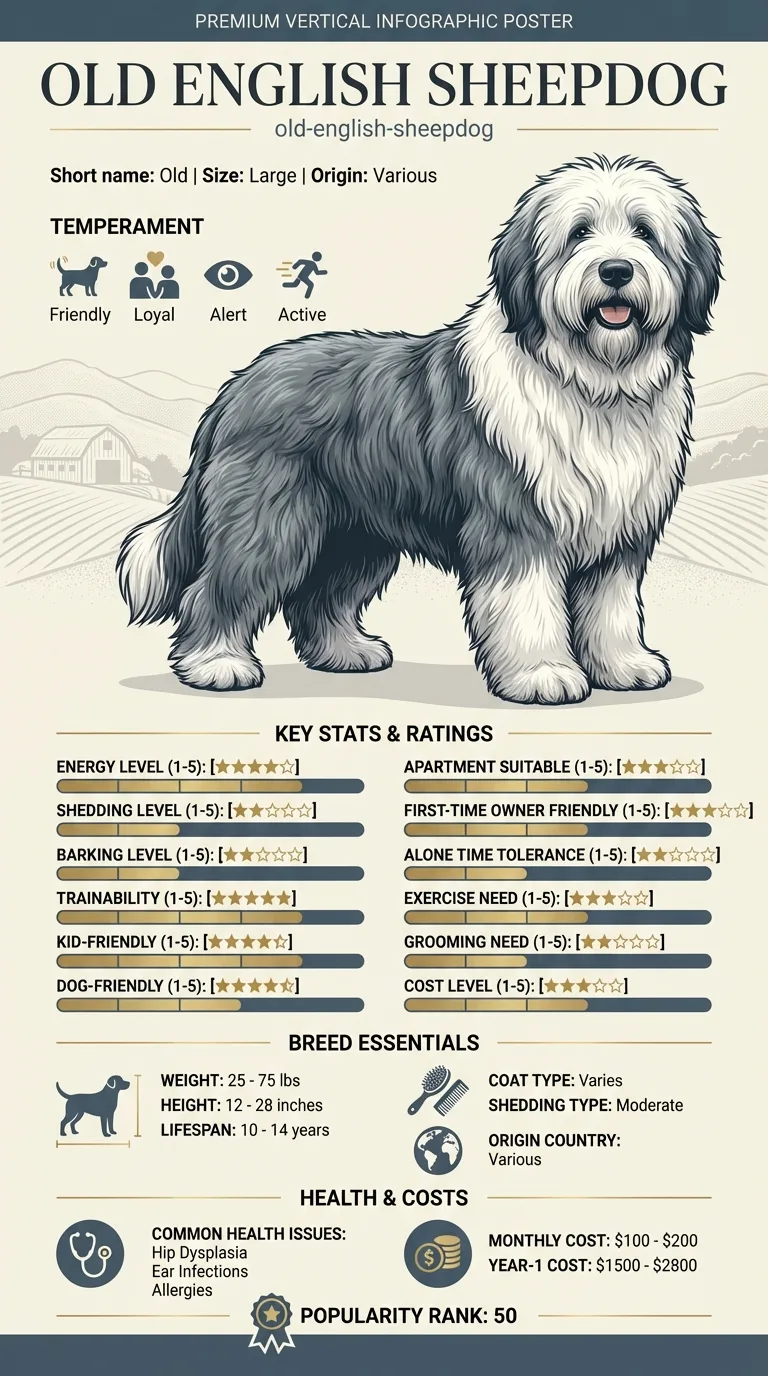
This breed's documented health profile lists hip dysplasia directly, and its large adult size, up to a hundred pounds, places real ongoing mechanical demand on a joint whose fit is governed by many interacting genes rather than one clear marker, making it harder to eliminate through breeding than a single-gene condition would be.
Prevalence at the population level is also shaped by how widely local and international breeders have adopted formal hip screening programs, since selecting only from screened, well-scored parents measurably reduces rates over successive generations.
Talk to your vet if your dog shows a bunny-hop gait, reluctance to jump, or stiffness after rest, regardless of what the breed-level prevalence data suggests, since an individual dog's symptoms always take priority over statistical averages.
See all OLD English Sheepdog health problems, which breeds are prone to hip dysplasia prevalence, or the full OLD English Sheepdog breed guide for temperament, exercise needs and ownership costs.
Prevalence data at the breed level shifts slowly, generally over many years and generations, as more breeders adopt consistent screening. For an individual puppy, risk is essentially fixed at birth by genetics, though environmental management during growth still influences how severely it expresses.
Success for a buyer looks like choosing a puppy from parents with documented, favorable hip scores rather than relying on breed reputation alone, meaningfully improving the odds relative to an unscreened pairing.
Hip dysplasia is polygenic, meaning it's shaped by many genes interacting rather than one single mutation, and its expression is also influenced by environment during growth. That combination means breeds with a long, active history of screening and selective breeding against dysplasia tend to show meaningfully lower rates over generations than breeds where screening has been less consistent. Body size correlates with risk in a general sense, since larger frames put more mechanical load on the joint, but it's not the whole story: some large breeds have pushed prevalence down significantly through sustained screening, while some smaller breeds, including a few not typically thought of as at-risk, still show up in the data with real rates of their own.
For a prospective owner, breed-level prevalence is a useful baseline, but it's the individual breeding pair's hip scores that actually predict a given puppy's risk far more precisely than the breed average alone. A breeder who can show OFA or PennHIP results for both parents, ideally with scores in the better half of the breed's distribution, is giving a buyer a much more specific and useful piece of information than the general breed reputation ever could. Buyers who skip this step and rely on breed-level statistics alone are effectively betting on an average, when a straightforward records request could tell them much more about the specific puppy in front of them.

Before bringing home her Old English Sheepdog puppy Pepper, Selena had read that the breed carried a real hip dysplasia risk and almost second-guessed the decision entirely based on general breed reputation alone. Instead, she asked the breeder directly for OFA documentation on both of Pepper's parents. Both scored in the better half of the breed's published range, with the sire rated Good and the dam rated Excellent. Selena still kept Pepper lean through puppyhood and avoided repeated jumping off furniture, treating the favorable parent scores as a better starting point, not a guarantee. At eighteen months, Pepper's own PennHIP results came back solidly within normal range.
Key takeaway: Breed-level prevalence told Selena what to ask about; it was the actual parent hip scores, not the general reputation, that told her something specific about Pepper.
It's among the more commonly documented conditions for this breed specifically, but prevalence varies widely across all large breeds depending on decades of screening history, so it isn't uniformly worse here than everywhere else.
Yes, several small breeds, including some not typically associated with joint problems, show measurable rates in screening data. Body size correlates with risk generally but doesn't fully explain it.
OFA (Orthopedic Foundation for Animals) and PennHIP are the two main programs in the U.S., both of which publish aggregated breed statistics based on submitted X-rays over many years.
Not on its own. Breed averages describe a population, not an individual dog. A specific puppy's actual risk depends far more on its own parents' hip scores than on the breed's overall published rate.
Yes, this is one of the most useful, concrete pieces of information a buyer can request, more predictive of an individual puppy's risk than any general breed statistic.
Broadly, breeds with active screening programs and breeders who select against dysplasia tend to see prevalence trend downward over generations, though progress depends heavily on how widely screening is actually adopted within the breeding population.
PennHIP can assess joint laxity as early as sixteen weeks, useful for early breeding decisions, while OFA scoring is typically done around two years old and has a very large historical dataset for breed comparison. Many serious breeders use both.
It's a commonly documented issue for this breed, but rates vary across breeds based on screening history, so it isn't uniquely worse than every other large breed.
Yes, a specific puppy's risk is far better predicted by its own parents' screened hip scores than by the breed's general published rate.
OFA hip evaluation typically costs a modest fee per dog for X-rays and grading, a cost responsible breeders factor into their overall breeding expenses.
Yes, and doing so is one of the most useful steps a buyer can take, more informative than relying on breed reputation alone.
Yes, prevalence varies significantly even among large breeds depending on decades of selective breeding and screening consistency, not just body size alone.
A one-page prep sheet for this condition: the signs, the questions to ask, what to get priced. Unlocks here.
You get: Vet visit prep sheet
No spam. One-click unsubscribe. See our privacy policy.
Preview page 1 before you decide.