Health
What raises complication risk during whelping?
Litter size extremes, puppy positioning, uterine inertia during prolonged labor, and breeding age all contribute to elevated risk.

Quick answer
What raises complication risk during whelping?
Litter size extremes, puppy positioning, uterine inertia during prolonged labor, and breeding age all contribute to elevated risk.
A whelping that's going well can turn into an emergency within an hour, and knowing the difference in advance is what actually protects both the dam and her puppies.
Breeders managing a pregnant female through gestation and delivery, and any owner of an intact female who needs to recognize when a whelping requires emergency veterinary intervention.
This guide is not medical advice. If your dog shows pain, sudden behavior change, or worsening symptoms, consult a licensed veterinarian.
Some links may be affiliate links. We may earn a commission at no extra cost to you. We only suggest products we believe are helpful for dog owners.
We research and check what we publish, but we do not warrant that any figure, date, price, or statement is accurate, complete, or current, and we accept no liability for any loss, cost, injury, or other harm arising from the use of this site. Use it as one reference among several. You remain responsible for your own decisions and for your dog's care - confirm anything that matters with a licensed veterinarian or another qualified professional before you act on it. Full disclaimer.
Check this first
These signs mean a delivery isn't progressing normally and needs immediate veterinary attention, potentially including an emergency C-section.
If any of these apply, call your vet or an emergency clinic now. The rest of this page is for the cases that are not an emergency.
Whelping complications in this breed follow the same general large-breed risk factors seen across dogs broadly: litter size extremes, puppy positioning problems, uterine inertia during prolonged labor, and breeding age all contribute. Recognizing when a delivery has stalled and needs emergency veterinary care, potentially including a C-section, matters more for outcomes than any single statistic.
Complication rates vary by individual factors more than by breed alone, but large-breed whelping carries genuine, well-documented risk broadly, making preparation, not just hope for an uneventful delivery, the responsible approach for anyone breeding this dog.
This breed's large adult size places it within the general large-breed whelping risk category, where litter size variability, puppy positioning, and uterine inertia during prolonged labor are recognized contributors, none of which are unique to this breed but all of which apply to it.
Breeding age, prenatal care quality, and access to timely emergency veterinary support when labor stalls all meaningfully affect outcomes, making preparation and monitoring during whelping as important as any inherent biological risk factor.
Contact your vet immediately for strong contractions lasting more than thirty minutes without a puppy, gaps of more than two to four hours between puppies with labor ongoing, green or dark discharge without a puppy following, or any sign of distress or weakness in the dam.
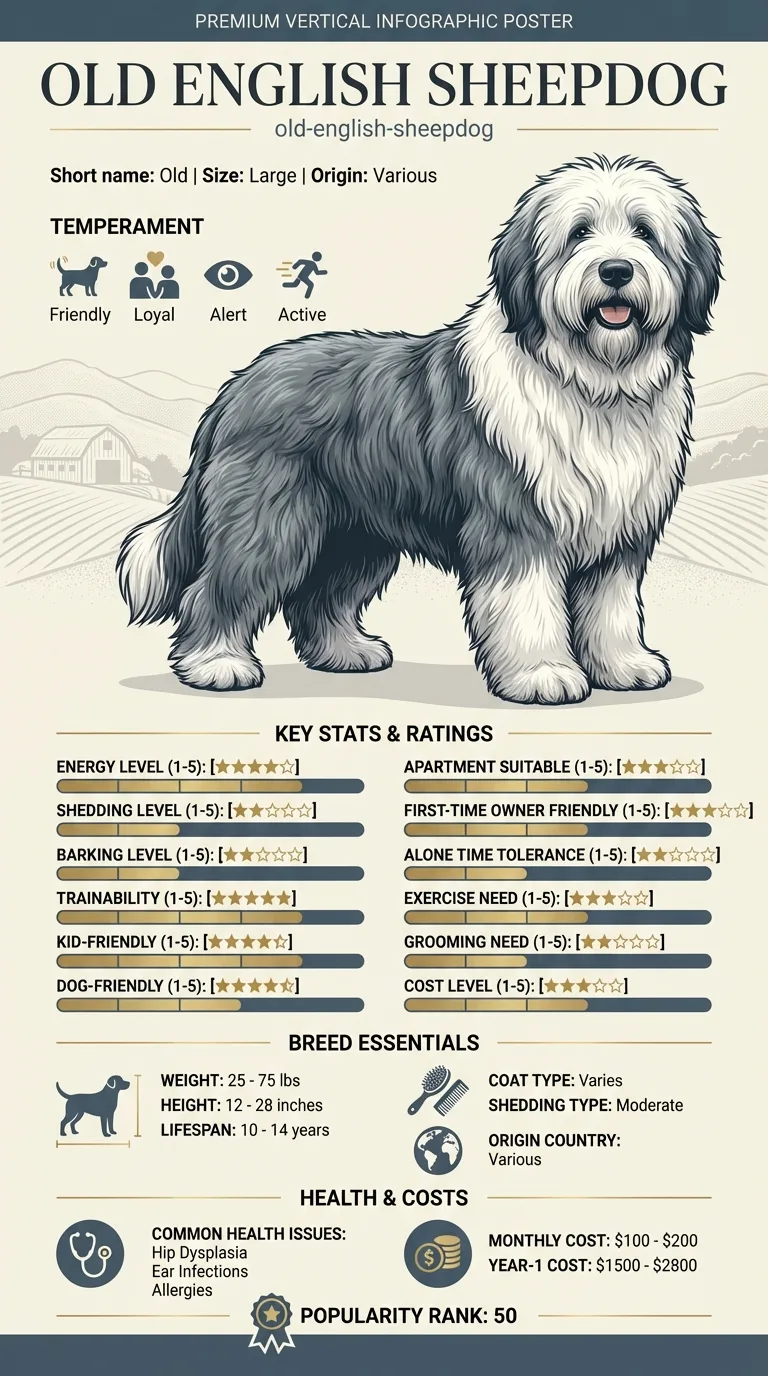
See all OLD English Sheepdog health problems, which breeds are prone to pregnancy complications, or the full OLD English Sheepdog breed guide for temperament, exercise needs and ownership costs.
Normal whelping typically spans several hours from the first puppy to the last, with intervals generally under two hours between deliveries. A prolonged or complicated labor can escalate to needing emergency intervention within just an hour or two of contractions stalling.
Success looks like a delivery that's actively monitored throughout, with a clear plan for recognizing when labor has stalled and prompt access to emergency veterinary care if a C-section becomes necessary, rather than hoping complications simply won't happen.
Litter size is one of the most direct factors, since very large or very small litters both carry distinct risks, oversized litters straining uterine capacity and single-puppy litters sometimes growing too large for a normal delivery given the lack of competition for space in utero. General whelping difficulty in large breeds can also stem from a puppy positioned incorrectly for delivery, or from uterine inertia, where contractions weaken or stop before all puppies are delivered, which becomes more likely as a dam tires during a prolonged labor. Age also matters: females bred either too young or notably older than ideal breeding age carry elevated complication risk compared to females bred in their prime reproductive years. None of these risk factors are unique to this breed specifically, but they apply directly to any breeding program working with it.
Marigold, a four-year-old Old English Sheepdog dam being bred by an experienced breeder named Joanne, delivered her first three puppies without incident over about three hours. When ninety minutes passed with no fourth puppy despite Marigold continuing to strain, Joanne, who'd confirmed an emergency vet contact well before the due date, called ahead and brought her in immediately. An exam found a fourth puppy positioned incorrectly for delivery, and an emergency C-section delivered the remaining two puppies in the litter safely. Because Joanne recognized the stalled pattern quickly rather than waiting longer to see if things would resolve, both Marigold and the remaining puppies came through the procedure without further complications.
Key takeaway: Having an emergency plan already in place before labor even started was what let Joanne act within minutes of recognizing a stall, rather than losing critical time figuring out where to go.
Breeding data broadly have flagged elevated complication risk in various populations, and general large-breed whelping factors, litter size, puppy positioning, and uterine inertia during prolonged labor, all apply to this breed like any other large dog.
It's when uterine contractions weaken or stop before all puppies are delivered, often because the dam has tired during a prolonged labor. It's one of the more common reasons a whelping in progress suddenly stalls and needs veterinary intervention.
Strong contractions for more than thirty minutes without a puppy, more than two to four hours between puppies with labor ongoing, or visible distress in the dam are all signs that warrant immediate veterinary attention.
It isn't a routine expectation for every litter, but it becomes necessary often enough across large breeds facing prolonged or stalled labor that any breeder should have an emergency vet plan in place before whelping begins.
Yes, both unusually large and unusually small litters carry distinct risks, oversized litters straining uterine capacity and single-puppy litters sometimes growing too large for normal delivery.
Females bred in their prime reproductive years generally carry lower complication risk than those bred notably young or older, which is a key reason responsible breeding programs plan around age carefully.
Yes, having a plan and knowing your nearest emergency vet with C-section capability before labor begins is one of the most practical steps any breeder can take, given how quickly a stalled delivery can become urgent.
Litter size extremes, puppy positioning, uterine inertia during prolonged labor, and breeding age all contribute to elevated risk.
Generally under two hours with active labor; longer gaps with ongoing contractions or distress warrant veterinary attention.
It's not routine for every litter but occurs often enough that having an emergency vet plan in place before whelping matters.
Emergency whelping surgery commonly runs over a thousand dollars, more with complications, making it a real cost to plan for in advance.
Yes, females bred in their prime reproductive years generally have lower complication rates than those bred too young or older.
A one-page prep sheet for this condition: the signs, the questions to ask, what to get priced. Unlocks here.
You get: Vet visit prep sheet
No spam. One-click unsubscribe. See our privacy policy.
Preview page 1 before you decide.