Health
Is this a documented issue in this breed?
No, chronic active hepatitis isn't among this breed's documented common health issues.

Quick answer
Is this a documented issue in this breed?
No, chronic active hepatitis isn't among this breed's documented common health issues.
An elevated liver enzyme on a routine blood panel doesn't automatically mean chronic hepatitis, and in this breed, it's worth checking the thyroid before assuming the worst.
This is relevant to owners who've seen an abnormal liver value flagged on routine senior bloodwork and are trying to understand what it actually means before jumping to a specific diagnosis.
This guide is not medical advice. If your dog shows pain, sudden behavior change, or worsening symptoms, consult a licensed veterinarian.
Some links may be affiliate links. We may earn a commission at no extra cost to you. We only suggest products we believe are helpful for dog owners.
We research and check what we publish, but we do not warrant that any figure, date, price, or statement is accurate, complete, or current, and we accept no liability for any loss, cost, injury, or other harm arising from the use of this site. Use it as one reference among several. You remain responsible for your own decisions and for your dog's care - confirm anything that matters with a licensed veterinarian or another qualified professional before you act on it. Full disclaimer.
Check this first
Yellowing of the gums or eyes (jaundice), sudden loss of appetite, vomiting, disorientation, or abdominal swelling are signs of significant liver dysfunction and warrant prompt veterinary attention rather than waiting for a routine recheck. A single elevated liver enzyme on an otherwise normal senior panel, in a dog that's eating, active, and feeling well, is more often a starting point for investigation than a reason for alarm.
Because chronic active hepatitis isn't a documented issue in this breed, and hypothyroidism is, a reasonable and efficient approach when liver values are abnormal is to rule out thyroid dysfunction, along with other more common causes, before assuming a primary liver disease is present.
If any of these apply, call your vet or an emergency clinic now. The rest of this page is for the cases that are not an emergency.
Chronic active hepatitis is not a documented predisposition in Old English Sheepdogs, unlike in a handful of other breeds with known copper storage disorders. This topic matters for the breed mainly because this breed's documented hypothyroidism can contribute to abnormal liver values on routine bloodwork, prompting the question without it necessarily being the right diagnosis.
True chronic active hepatitis is uncommon in dogs generally and not documented as a breed-specific risk in Old English Sheepdogs. Abnormal liver values prompting this question are a fairly routine finding on senior bloodwork across many dogs, most often traced to something other than primary chronic hepatitis.
There's no documented genetic predisposition to chronic hepatitis in this breed. What is genuinely relevant is the breed's documented hypothyroidism risk, since thyroid dysfunction can influence metabolic values reflected in routine bloodwork, sometimes prompting further liver-focused investigation that isn't ultimately about primary liver disease.
Diet, medication history, and overall metabolic health all influence liver enzyme values generally. In this breed specifically, ruling out thyroid dysfunction is a particularly relevant environmental and physiological factor to check early.
Talk to your vet about any abnormal liver value found on bloodwork, and ask specifically about thyroid testing given this breed's documented risk. Seek prompt care for jaundice, sudden appetite loss, vomiting, or disorientation.
A single abnormal value on a blood panel is a starting point for investigation, not a diagnosis on its own.
See all OLD English Sheepdog health problems, which breeds are prone to chronic active hepatitis, or the full OLD English Sheepdog breed guide for temperament, exercise needs and ownership costs.
A recheck panel and thyroid testing typically return results within days, giving a clearer picture relatively quickly compared to more invasive liver-specific workups, which may take longer if pursued.
Success looks like identifying the actual underlying cause, often something more common and treatable than primary chronic hepatitis, and addressing that directly rather than treating a liver enzyme number in isolation.
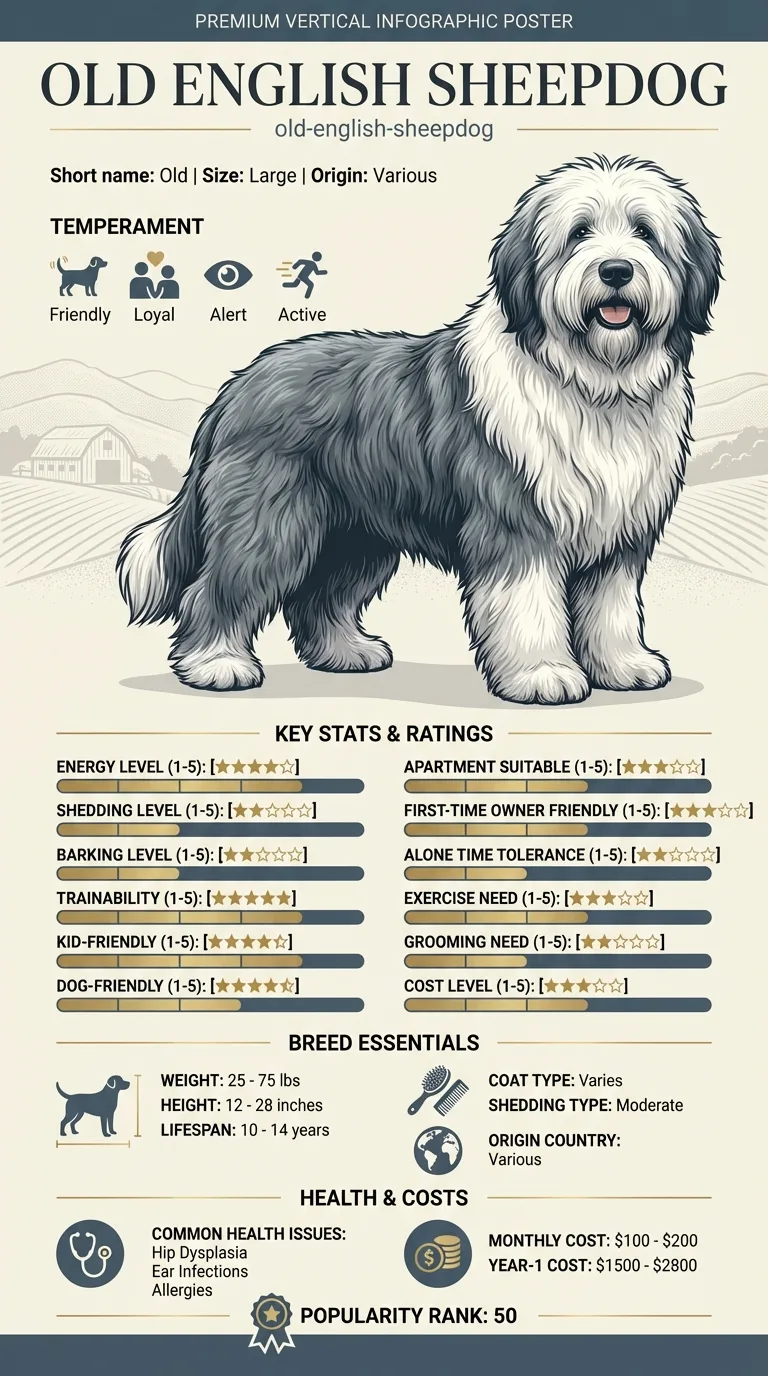
If you think your Old has chronic active hepatitis, the plan is three steps: write down what you have seen and when it started, book a veterinary appointment rather than waiting for the next flare, and take video of the behaviour or symptom before you go — the thing you are worried about rarely happens in the consulting room. Screening in the parents covers hip dysplasia, cataracts, hypothyroidism.
What the vet visit should produce is a diagnosis and a written plan, not just reassurance: what is being ruled out, what the monitoring interval is, and which signs mean you come back sooner. Ask what the treatment costs across a year rather than per visit, because that is the number that decides whether you are managing this condition or reacting to it.
Between appointments, keep a short log — dates, what you saw, what changed. It is the single most useful thing an owner brings to a follow-up, and for chronic active hepatitis it is often what separates a clear pattern from a guess.
Hazel, an eight-year-old Old English Sheepdog, had a mildly elevated liver enzyme flagged on her annual senior bloodwork. Her owner immediately worried about chronic hepatitis after searching the term online. Her vet recommended a recheck panel along with a thyroid test, given the breed's documented hypothyroidism risk. The recheck confirmed an underactive thyroid, and once treatment started, Hazel's liver values normalized on a follow-up panel a couple of months later, with no primary liver disease ever actually present.
Key takeaway: An abnormal liver value is a prompt to investigate, not a diagnosis. In this breed, checking the thyroid first is often the more efficient and more likely answer.
No, it's not among this breed's documented common health issues. It has documented links in a few other breeds, mostly tied to copper storage disorders, that don't apply here.
Usually because an elevated liver enzyme showed up on routine bloodwork, prompting a broader conversation about possible causes, chronic hepatitis being one on a longer list rather than the most likely one for this breed.
It can contribute to changes reflected in some blood values, and since hypothyroidism is a documented issue in this breed, it's a reasonable and often overlooked line of investigation when liver values are abnormal.
Usually a recheck panel to confirm the finding, alongside a broader bloodwork panel that includes thyroid function, before moving to more invasive testing like imaging or biopsy.
There's no specific breed-based recommendation for this breed the way there is for breeds with documented copper storage disorders. Standard senior wellness bloodwork, which includes liver values, is a reasonable general practice.
It depends entirely on the underlying cause identified. If hypothyroidism is found to be contributing, treating that directly is the relevant path, rather than treating the liver enzyme number in isolation.
Not as a first step. Less invasive tests are typically tried first, with biopsy reserved for cases where the cause remains unclear or a more serious primary liver disease is suspected.
No, chronic active hepatitis isn't among this breed's documented common health issues.
A recheck panel and thyroid function testing, given this breed's documented hypothyroidism risk.
Not typically on its own in a dog that's eating and feeling well; it's a starting point for further testing.
Yellowing of the gums or eyes, sudden appetite loss, vomiting, or disorientation.
A recheck panel and thyroid testing typically run under a couple hundred dollars; imaging or biopsy adds significantly more if needed.
A one-page prep sheet for this condition: the signs, the questions to ask, what to get priced. Unlocks here.
You get: Vet visit prep sheet
No spam. One-click unsubscribe. See our privacy policy.
Preview page 1 before you decide.