Health
Do Newfoundlands get BOAS?
Not in the true sense. BOAS is a disease of shortened-muzzle breeds, and the Newfoundland has a long broad muzzle. Breathing difficulty in this breed usually traces to laryngeal disease or heat stress instead.

Quick answer
Do Newfoundlands get BOAS?
Not in the true sense. BOAS is a disease of shortened-muzzle breeds, and the Newfoundland has a long broad muzzle. Breathing difficulty in this breed usually traces to laryngeal disease or heat stress instead.
The breathing trouble Newfoundland owners describe is real, common and sometimes an emergency. It just does not come from a squashed face, and treating it as BOAS sends people looking in the wrong place.

For owners whose Newfoundland has started making a harsh noise on the intake of breath, who struggles badly in warm weather, or who has been told by a well-meaning acquaintance that big-headed dogs are brachycephalic.
This guide is not medical advice. If your dog shows pain, sudden behavior change, or worsening symptoms, consult a licensed veterinarian.
Some links may be affiliate links. We may earn a commission at no extra cost to you. We only suggest products we believe are helpful for dog owners.
We research and check what we publish, but we do not warrant that any figure, date, price, or statement is accurate, complete, or current, and we accept no liability for any loss, cost, injury, or other harm arising from the use of this site. Use it as one reference among several. You remain responsible for your own decisions and for your dog's care - confirm anything that matters with a licensed veterinarian or another qualified professional before you act on it. Full disclaimer.
Owners searching for BOAS in connection with a Newfoundland are usually describing a genuine airway problem attached to the wrong label. The breed is not brachycephalic. What large and giant dogs do develop is laryngeal dysfunction, which narrows the airway at the top of the windpipe and interferes directly with panting. Because panting is how a dog cools, and because this breed already carries a heavy insulating coat, airway disease and heat intolerance amplify each other dangerously.
True brachycephalic airway syndrome is not a Newfoundland condition, and the breed's documented health issues are hip dysplasia, subaortic stenosis, dilated cardiomyopathy, cystinuria and bloat rather than anything airway-related. Laryngeal paralysis, by contrast, is a well-recognised acquired condition of older large and giant breed dogs, and heat intolerance is a practical reality for any dog wearing this much coat. Both are worth knowing about; the flat-faced syndrome is not.
Three documented features drive the real risk. The heavy water-resistant double coat is superb insulation, which means heat is retained and panting has to work harder than it would in a shorthaired dog of the same size. A body mass of 100 to 150 pounds generates a large amount of metabolic heat and requires a large volume of air to cool. And the great length of the nerve supplying the larynx in a tall, deep-chested dog is precisely why giant breeds are over-represented in acquired laryngeal disease. Notably absent from the list is anything about skull shape, because the Newfoundland's muzzle is long and its nostrils are not pinched.
Ambient temperature and humidity do most of the damage. A Newfoundland who copes well in fifteen degrees can be in trouble at twenty-eight, especially with humidity that reduces the cooling value of panting. Cars, conservatories and sun-facing rooms accumulate heat faster than owners expect. Exercise timing matters: mid-morning and late afternoon walks in summer are a common route to a crisis. And collar pressure from a dog that pulls compresses exactly the region already under strain, which is why harnesses come up so often in this conversation.
Book an appointment for any new noise on the intake of breath, any change in the sound of the bark, coughing or gagging around food and water, or reduced stamina in warm weather. Ask specifically about the larynx rather than about brachycephalic anatomy. Treat as an immediate emergency and travel now, with the air conditioning on and the dog wetted down, if breathing is laboured at rest, if your dog will not lie down or stands with the neck extended and elbows out, if the tongue or gums look blue, purple or grey, if there is collapse, or if any of this happens on a warm day. Heat-related airway crisis in a giant coated breed escalates in minutes, and it kills dogs who could have been saved by an earlier decision to drive.
See all Newfoundland health problems, which breeds are prone to brachycephalic airway syndrome boas, or the full Newfoundland breed guide for temperament, exercise needs and ownership costs.
Environmental changes such as harness use, cooler walk times and weight loss show their effect within weeks. Laryngeal disease itself is progressive: dogs typically deteriorate gradually over months to years, and the trajectory usually looks like a series of increasingly bad summers rather than a steady decline. Where corrective surgery is chosen, breathing usually improves markedly and quickly, but lifelong care around feeding and swimming is needed afterwards because the risk of material entering the lungs rises.
Success is a dog whose breathing sounds the same at the end of the summer as at the start, who completes a cool-weather walk without a rasp, and whose household has arranged its routine around temperature rather than around convenience. For a dog with confirmed laryngeal disease, success means avoiding crises, not restoring a young dog's airway, and owners are better served by an honest conversation about progression than by reassurance.
The condition that deserves a Newfoundland owner's attention is laryngeal paralysis. The larynx sits at the top of the windpipe, and two cartilage flaps swing open with each breath to let air through. They are driven by a nerve that runs an absurdly long course down the neck into the chest and back up again. In large and giant breeds, that nerve can degenerate with age, the flaps stop opening properly, and the airway narrows exactly when the dog needs it most.
The signature is a change in the sound of the breath, specifically on the way in. Owners describe it as a harsh rasp, a wheeze or a roar that appears during exercise or excitement and was not there a year ago. The bark often changes character too, becoming hoarse or weaker. Some dogs cough or gag when drinking.
Then comes the part that makes this urgent in this particular breed. Dogs cool themselves by panting, panting requires moving large volumes of air through the larynx, and a dog with a narrowed larynx cannot pant efficiently. Overheating causes swelling in the throat, swelling narrows the airway further, and the dog panics. That cycle is a genuine emergency, and a Newfoundland carrying a heavy water-resistant double coat and up to 150 pounds of body mass is already the worst-equipped dog in the park for shedding heat.
So the honest reframing for this breed is this: worry about the larynx and worry about the heat. Do not spend time looking for the flat-faced anatomy your dog does not have.

The single most useful clinical information about an airway comes from the sound, and owners are much better placed to gather it than a vet who sees the dog for ten minutes in a cool consulting room.
Wren was eight, a 129-pound Newfoundland who had always been vocal at the door. Her owner Josh noticed that her bark had gone gravelly, but put it down to age. The following July she went out into the garden after a delivery van, came back in and stood in the hall making a harsh sound on every breath in. She would not lie down. Josh had read enough about giant breeds to recognise that a dog refusing to lie down was a dog struggling, and he took her straight to the emergency clinic with the car's air conditioning on full and a wet towel over her. She was treated for heat stress and airway swelling and kept overnight. Ten days later, under light sedation with a specialist watching her larynx as she breathed, she was diagnosed with laryngeal paralysis. Josh chose management rather than surgery after a long conversation about the risks. Wren now walks at six in the morning and again after dark in summer, wears a harness, has lost nine pounds, and has an air-conditioned room she is shut into on hot afternoons whether she wants it or not. She has had no further crises in two summers. What Josh tells other owners is that the warning came a full year early and arrived as a hoarse bark, which he had filed under getting older.
Key takeaway: In a Newfoundland, do not go looking for a flat face. Listen for a change in the bark and a rasp on the way in, and treat any hot-day breathing difficulty as the emergency it is.
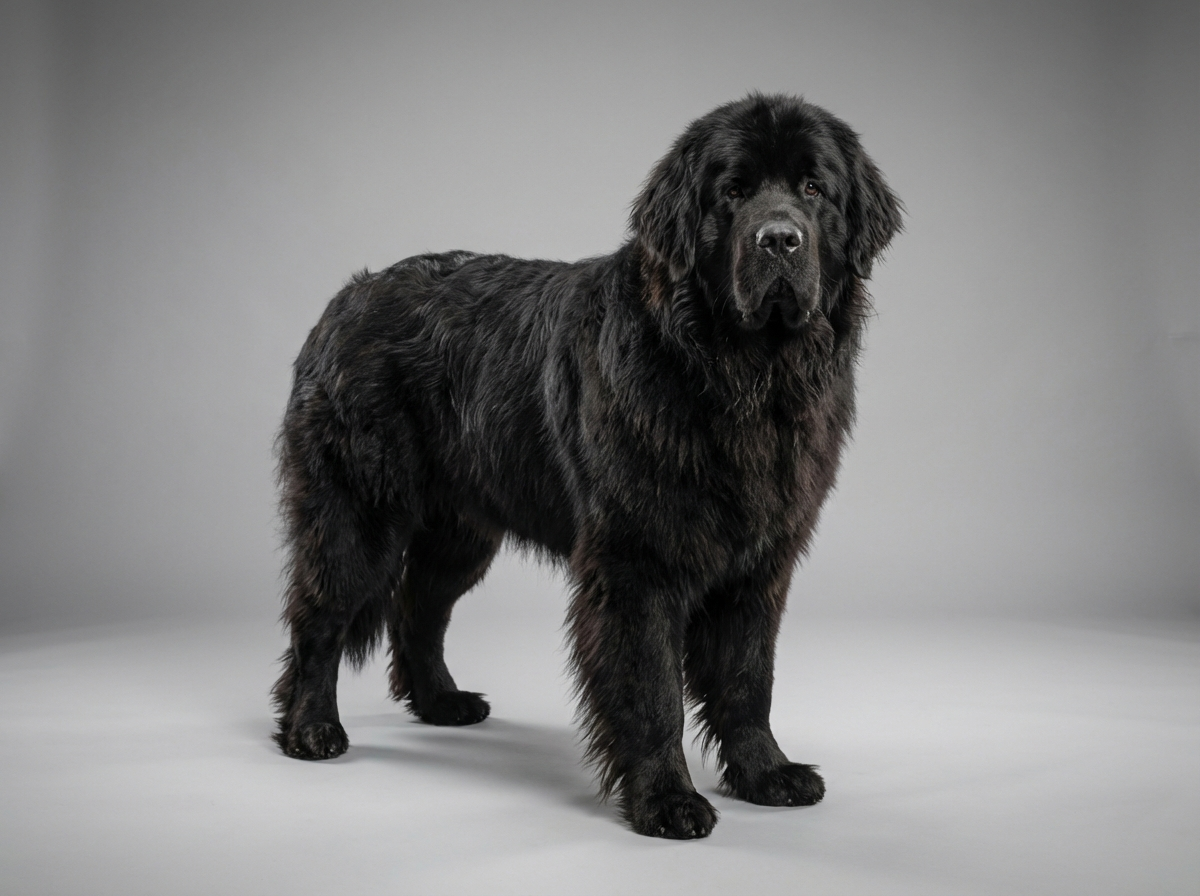
No. Brachycephalic means shortened-skulled, with a compressed muzzle, and the Newfoundland has a long, broad, normally proportioned head. The confusion usually comes from the breed's heavy jowls, wide skull and prodigious drool, none of which are indicators of a shortened airway. Judging by muzzle length rather than head size clears it up quickly.
Many perfectly healthy large dogs with loose throat tissue snore when asleep, and a Newfoundland's heavy flews and relaxed pharyngeal tissue make that common. What matters is not whether the dog snores but whether awake breathing has become noisy, whether the noise appears on exertion, and whether the sound has changed over recent months.
It is a failure of the cartilage flaps at the top of the windpipe to open properly during breathing, usually due to degeneration of the nerve supplying them. Diagnosis requires a vet to look directly at the larynx under light sedation while the dog is still breathing, which is a specific procedure rather than something visible on an examination or a radiograph.
Surgical options exist to hold one side of the larynx open, and they can transform a dog's ability to breathe. They also carry a meaningful risk of material entering the lungs afterwards, and the decision belongs with your vet or a surgical specialist who has assessed your dog. Milder cases are sometimes managed with weight control, heat avoidance and harness use.
Because panting is the cooling system and the airway is the bottleneck. A dog who cannot move enough air cannot cool, rising body temperature causes throat tissue to swell, and the swelling narrows the airway further. In a breed with a heavy insulating double coat that cycle can escalate from laboured breathing to a crisis in minutes.
A well-fitted harness is generally preferable for any dog with an airway concern, because it takes pressure off the throat. A Newfoundland is strong enough that lead pressure on a collar is significant, and switching is a simple, cheap change with no downside.
Not in the true sense. BOAS is a disease of shortened-muzzle breeds, and the Newfoundland has a long broad muzzle. Breathing difficulty in this breed usually traces to laryngeal disease or heat stress instead.
A harsh rasping or roaring sound on the intake of breath during exercise or excitement, especially if it is new within the last year or accompanied by a change in the bark.
Immediately, if the gums or tongue look blue, grey or purple, if the dog cannot settle or lie down, if there is open-mouth distress at rest, or if it happens on a hot day. Cool the dog on the way and go.
Considerably. Excess weight adds tissue around the throat and chest and increases the heat a dog generates, so weight control is one of the most effective non-surgical measures available.
Walk in the cool parts of the day, use a harness rather than a collar, keep sessions short, and choose water over exertion. Teaching a calm, non-pulling walk removes a lot of unnecessary effort.
A one-page prep sheet for this condition: the signs, the questions to ask, what to get priced. Unlocks here.
You get: Vet visit prep sheet
No spam. One-click unsubscribe. See our privacy policy.
Preview page 1 before you decide.