Living
Which fits a small living space?
The French Bulldog decisively, 5/5 for apartment suitability against the Newfoundland's 1/5, the widest gap in this category for either breed.

Quick answer
Which fits a small living space?
The French Bulldog decisively, 5/5 for apartment suitability against the Newfoundland's 1/5, the widest gap in this category for either breed.
French Bulldog or Newfoundland? On paper they differ most on apartment suitability, and on the scales Newfoundland is the heavier at 100–150 lbs. Here is how the two compare on everything that shapes an ordinary week.
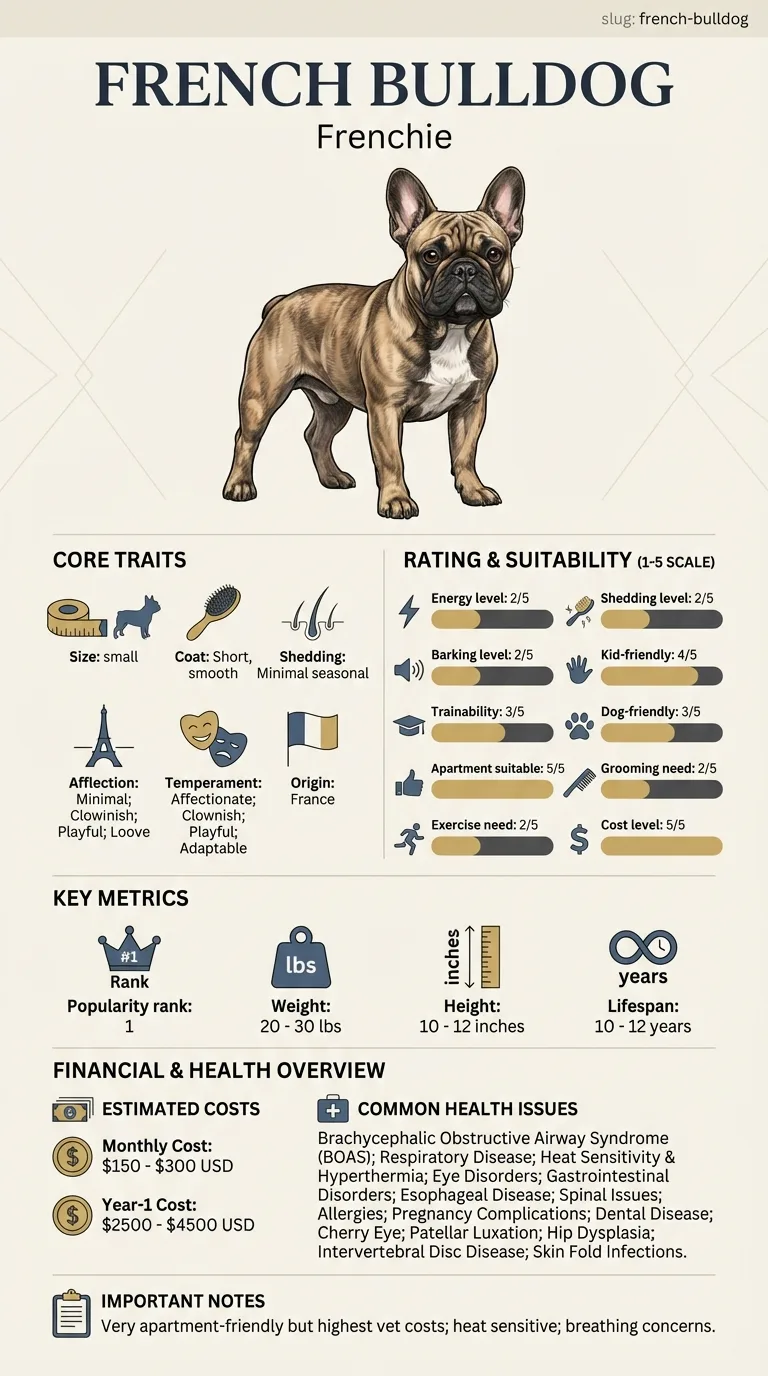
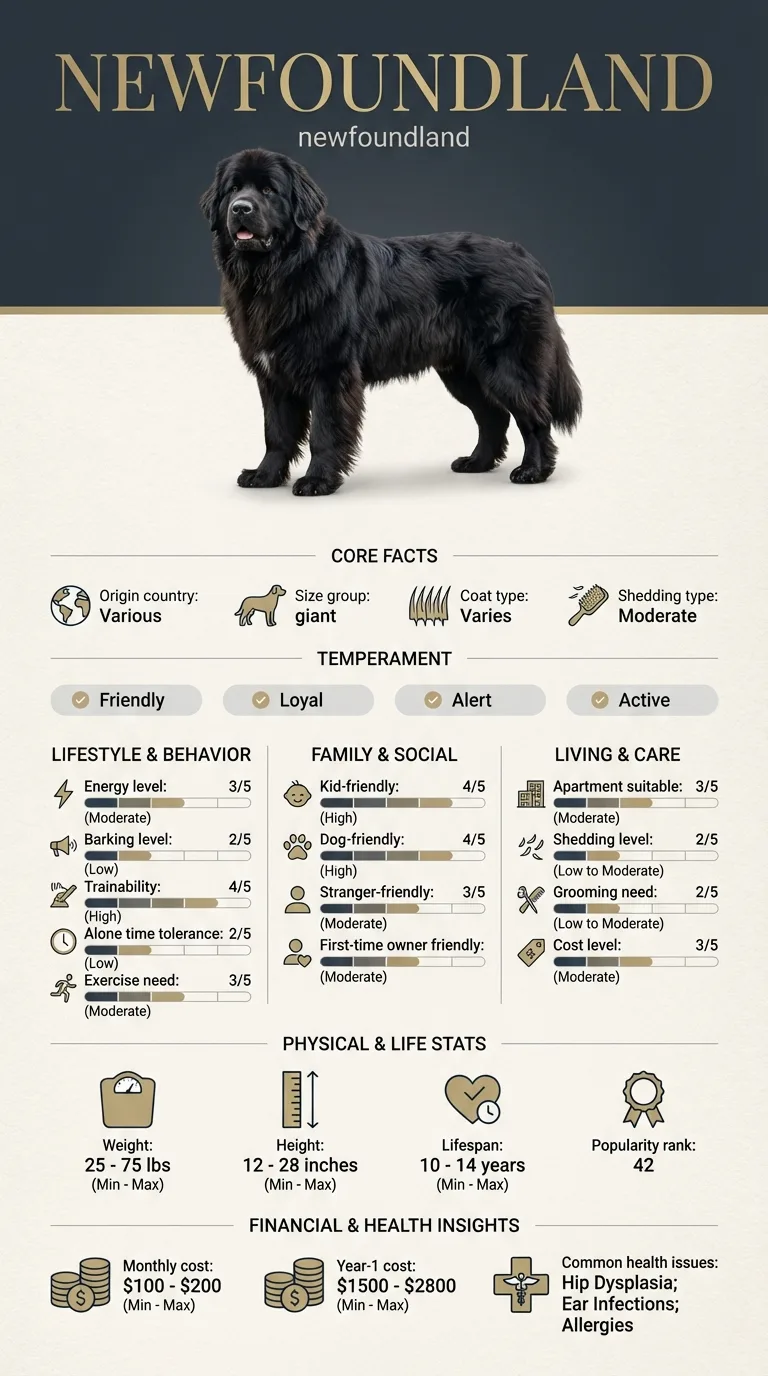
This is for someone already down to French Bulldog and Newfoundland and deciding between them. For this pair the decision usually turns on apartment suitability and shedding, so those are covered first and in most detail. Anyone choosing from a flat has a clear answer here: French Bulldog rates 5/5 against 1/5. Breed history is left out; what follows is what you will actually live with.
Between French Bulldog and Newfoundland, apartment suitability is what separates them, and French Bulldog is the lower-effort dog of the two to keep.
Choose French Bulldog if you are in a flat or a smaller home, this is your first dog and you do not want a standing grooming appointment.
Choose Newfoundland if there are young children at home, you already have another dog and you want a dog that picks up training quickly.
| Feature | french bulldog | newfoundland | Winner |
|---|---|---|---|
| Size class | small | giant | Equal |
| Weight | 20–30 lbs | 100–150 lbs | Equal |
| Height | 10–12 in | 26–28 in | Equal |
| Lifespan | 10–12 years | 9–10 years | french bulldog |
| Exercise need | Low (2/5) | Moderate (3/5) | french bulldog |
| Grooming need | Low (2/5) | High (4/5) | french bulldog |
| Shedding | Low (2/5) | Very high (5/5) | french bulldog |
| Energy level | Low (2/5) | Low (2/5) | Equal |
| Barking | Low (2/5) | Low (2/5) | Equal |
| Apartment suitability | Very high (5/5) | Very low (1/5) | french bulldog |
| Good for first-time owners | Very high (5/5) | Moderate (3/5) | french bulldog |
| Tolerates being alone | Very high (5/5) | Moderate (3/5) | french bulldog |
| Trainability | Moderate (3/5) | High (4/5) | newfoundland |
| Good with kids | High (4/5) | Very high (5/5) | newfoundland |
| Good with other dogs | Moderate (3/5) | High (4/5) | newfoundland |
| Friendly to strangers | Moderate (3/5) | High (4/5) | newfoundland |
| Cost level | Very high (5/5) | Very high (5/5) | Equal |
| Coat | Short, smooth | Heavy water-resistant double coat | Equal |
| Origin | France | Various | Equal |
| Typical monthly cost | $150–$300 | $150–$310 | Equal |
| Typical first-year cost | $2,500–$4,500 | $2,200–$4,200 | Equal |
The size difference here is the largest in this batch: a 20-30 lb Frenchie against a 100-150 lb Newfoundland, with height running 10-12 inches versus 26-28. A grown Newfoundland can outweigh a Frenchie by more than four times its own body weight. This isn't a comparison of two small dogs, it's small versus giant, full stop.
Despite the size gap, exercise need is closer than you'd expect: 2/5 for the Frenchie, 3/5 for the Newfoundland, both rated moderate at most, with energy level tying at low (2/5) for both. Giant breeds like the Newfoundland tend to be calmer than their size suggests, and this table backs that up.
This is where the giant breed catches up on maintenance: grooming rates 4/5 for the Newfoundland against the Frenchie's 2/5, and shedding hits 5/5, the maximum on this scale, against the Frenchie's 2/5. A heavy water-resistant double coat on a 150 lb dog means a serious volume of hair and regular brushing to manage it.
Barking ties at a low 2/5 for both breeds, so a Newfoundland isn't a noisy dog. Apartment suitability is a different matter entirely, 5/5 for the Frenchie against just 1/5 for the Newfoundland. A dog this size needs floor space to move and turn around in, something most apartments simply don't offer regardless of how quiet the dog is.
Trainability favors the Newfoundland, 4/5 against the Frenchie's 3/5, but the first-time-owner score flips that, 5/5 for the Frenchie, a more moderate 3/5 for the Newfoundland. Training a 150 lb dog carries higher stakes than training a 25 lb one; a Newfoundland that hasn't learned to walk politely on a leash is a much bigger handling problem.
The Newfoundland leads on every household-fit measure: 5/5 with kids against the Frenchie's 4/5, 4/5 with other dogs against 3/5, and 4/5 with strangers against 3/5. Newfoundlands have a long-standing reputation as gentle giants around children, and these numbers are consistent with that reputation rather than an exception to it.
Lifespan actually favors the smaller dog here, 10-12 years for the Frenchie against just 9-10 for the Newfoundland, a common pattern in giant breeds. The Newfoundland's health list is shorter but serious: hip dysplasia, subaortic stenosis, dilated cardiomyopathy, and bloat, all conditions tied to its size. The Frenchie's risks are airway-related instead. Hip dysplasia is the only overlap.
Cost level ties at 5/5 for both breeds, the only pair in this batch where both dogs land at the top of the scale. Monthly costs are close too, $150-$300 for the Frenchie versus $150-$310 for the Newfoundland, and first-year costs run $2,500-$4,500 against $2,200-$4,200. A giant breed's food and vet bills scale up to match the Frenchie's brachycephalic care costs almost exactly.
French Bulldog weighs 20–30 lbs and lives 10–12 years; Newfoundland weighs 100–150 lbs and lives 9–10 years. The two diverge most on apartment suitability, shedding and grooming need and 2 other rated axes. They are level on barking, cost level and energy level, so those cannot decide it. The comparison marks an easier option only where one exists. Facts like weight and country of origin are not scored. Both dogs are rated from the same dataset, which is what makes the numbers comparable with each other even though any individual dog sits somewhere inside its breed's range.

Enormously, 100-150 lbs against 20-30 lbs, the widest weight gap in this entire batch of comparisons.
Yes, the maximum 5/5 on this scale, against the Frenchie's 2/5. Its heavy double coat sheds heavily and needs regular brushing to keep up with it.
No, it scores just 1/5 for apartment suitability. A dog this size needs room to move regardless of its genuinely calm temperament.
The French Bulldog, 10-12 years against the Newfoundland's 9-10, a case where the smaller breed has the lifespan edge, typical of giant breeds generally.
Yes, cost level ties at 5/5 with the Frenchie, and the dollar ranges are nearly identical, $150-$310 monthly against the Frenchie's $150-$300.
Very, a 5/5 rating, the highest on this table, consistent with the breed's reputation for gentleness around children.
Hip dysplasia, subaortic stenosis, dilated cardiomyopathy, cystinuria, and bloat, hip dysplasia is the only condition it shares with the Frenchie.
The French Bulldog decisively, 5/5 for apartment suitability against the Newfoundland's 1/5, the widest gap in this category for either breed.
Nearly identical, $150-$300 for the Frenchie and $150-$310 for the Newfoundland, both rated 5/5 on overall cost level.
No, just moderate, 3/5, close to the Frenchie's 2/5, since Newfoundlands tend to be calm despite their size.
The French Bulldog, 10-12 years against the Newfoundland's 9-10, giant breeds like the Newfoundland typically have shorter lifespans.
Secure checkout on Stripe. We never see your card.
7-day money-back guarantee. Instant access.

Health information here is general and is not veterinary advice. If your dog shows pain, sudden behaviour change, or worsening symptoms, consult a licensed veterinarian.
Some links on this site are affiliate links. We may earn a commission at no extra cost to you, and we only suggest products we believe are helpful for dog owners.
We research and check what we publish, but we do not warrant that any figure, date, price, or statement is accurate, complete, or current, and we accept no liability for any loss, cost, injury, or other harm arising from the use of this site. Use it as one reference among several. You remain responsible for your own decisions and for your dog's care - confirm anything that matters with a licensed veterinarian or another qualified professional before you act on it. Full disclaimer.
Match your lifestyle to the right dog.
Take quizNot sure which breed is right for you? Take our 2-minute quiz to find out.
Take the quiz