Health
What is the first thing to do?
Get the dog out of the heat and into shade or air conditioning. Everything else comes second.

Quick answer
What is the first thing to do?
Get the dog out of the heat and into shade or air conditioning. Everything else comes second.
This is the one Newfoundland emergency where what you do before you reach the clinic changes the outcome. It is worth rehearsing before you need it.

For every Newfoundland household, but especially for owners in warm climates, owners of senior dogs, and anyone whose dog has a known cardiac condition that limits its ability to cool itself.
This guide is not medical advice. If your dog shows pain, sudden behavior change, or worsening symptoms, consult a licensed veterinarian.
Some links may be affiliate links. We may earn a commission at no extra cost to you. We only suggest products we believe are helpful for dog owners.
We research and check what we publish, but we do not warrant that any figure, date, price, or statement is accurate, complete, or current, and we accept no liability for any loss, cost, injury, or other harm arising from the use of this site. Use it as one reference among several. You remain responsible for your own decisions and for your dog's care - confirm anything that matters with a licensed veterinarian or another qualified professional before you act on it. Full disclaimer.
Hyperthermia in a Newfoundland is a true emergency in which core body temperature rises beyond what the dog can correct. Cells and blood vessel linings are damaged, and the gut, kidneys and clotting system can fail over the hours that follow. The breed's heavy water-resistant double coat and 100 to 150 pound body make it one of the most vulnerable breeds to this event, and the outcome depends heavily on how quickly cooling begins.
Serious heat emergencies are not an everyday occurrence, but Newfoundlands are over-represented among the dogs that experience them, and warm-climate clinics see them predictably each summer. Most cases are preventable, which is why the prevention routine and the emergency plan are two halves of the same subject.
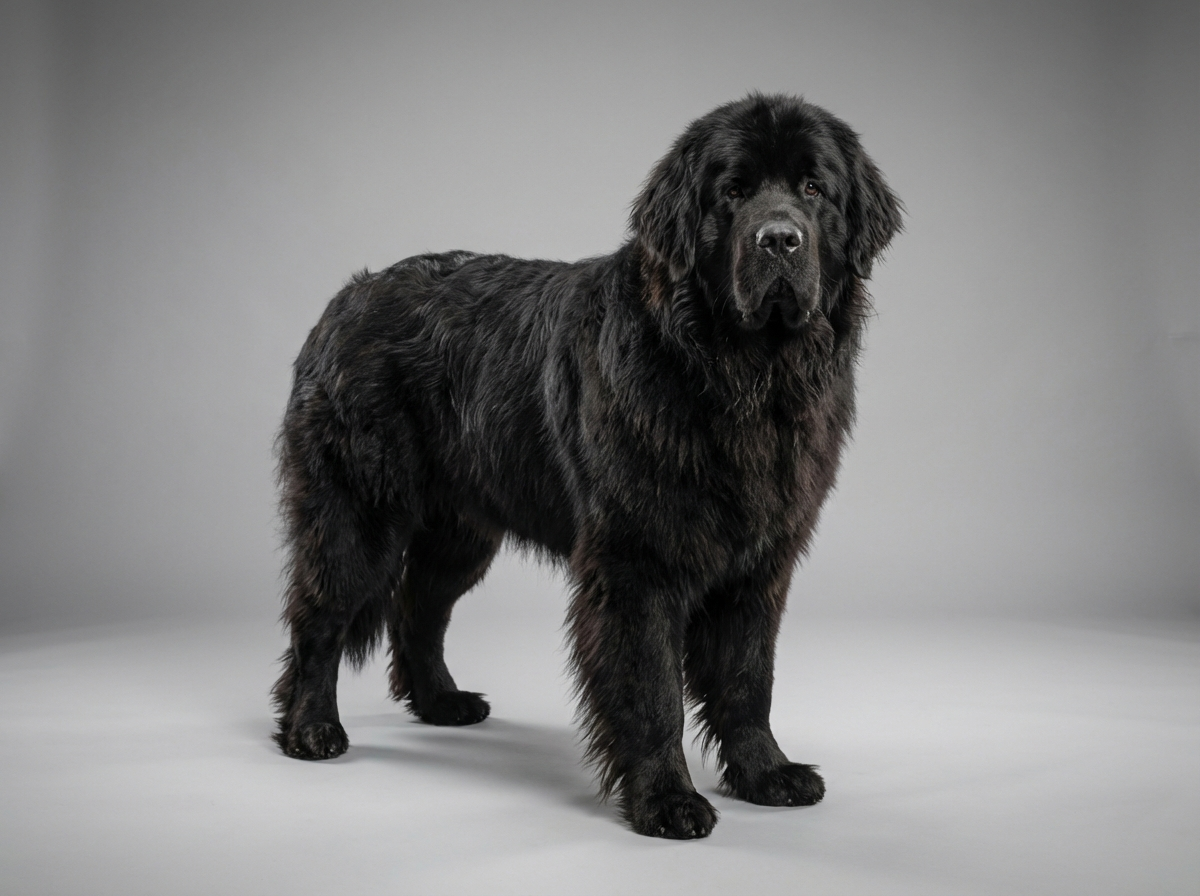
A dog developed for cold water carries insulation it cannot take off. The heavy water-resistant double coat holds warm air against the skin and repels the water an owner tries to cool it with. At 100 to 150 pounds and 26 to 28 inches tall, the dog generates heat in proportion to a large mass while losing it through a proportionally smaller surface. The breed's documented cardiac predispositions matter too, because cooling is a circulatory task and a compromised heart has less output to redirect to the skin. Finally, a calm, patient dog that has always been happy to lie down quietly gives its owner a weaker behavioural signal than a normally exuberant dog would.
Enclosed spaces are the sharpest danger, because temperature inside a car or a sunroom climbs far faster than most people expect. Humidity is the quiet one, since it disables evaporative cooling while the thermometer reading still seems tolerable. Lack of shade, absence of moving air, hot ground surfaces, and unavailable drinking water each remove one of the dog's few coping mechanisms. Warm-water swimming is a specific trap for this breed, because the dog is exerting itself in a medium that is no longer taking heat away.
Treat suspected heatstroke as an emergency and go immediately, cooling as you travel. The signs that mean go now are frantic ineffective panting, thick ropey drool, bright red or pale or grey gums, staggering, disorientation, vomiting or diarrhoea in a hot dog, seizure, or collapse. Go on the same day even if the dog appears fully recovered, because organ injury declares itself later. In the days after an episode, return promptly for bloody stool, unusual bruising or bleeding, reduced or absent urination, ongoing vomiting, or lethargy that does not lift.
See all Newfoundland health problems, which breeds are prone to heat sensitivity hyperthermia, or the full Newfoundland breed guide for temperament, exercise needs and ownership costs.
The critical window is the first thirty minutes, and cooling begun in that period is the single largest factor in outcome. Veterinary stabilisation typically takes hours, and dogs with significant episodes are commonly hospitalised for one to three days while organ function is monitored. Full recovery, where it occurs, takes days to weeks. Some dogs recover completely; some carry lasting organ damage; a proportion do not survive. That range is the honest picture.
The best version of success is that this page stays theoretical, because the prevention routine held. Where an episode does happen, success is that it was recognised early, cooling started immediately, the dog was seen the same day regardless of how well it looked, organ function was monitored, and the household changed its summer plan afterwards so there is no second event.
The earliest stage looks like ordinary heavy panting, with the dog seeking shade or lying down and refusing to move. Drool becomes thick and ropey rather than watery. Gums may look brighter red than usual as blood is shunted to the surface in an effort to lose heat.
The middle stage is where it stops looking like heat and starts looking like illness. The dog seems dazed or unusually unresponsive to its name. It may stagger, its hind end may seem unreliable, and it may vomit or produce diarrhoea, sometimes with blood in it. Panting becomes frantic and ineffective rather than rhythmic.
The late stage is collapse, gums turning pale or grey rather than red, seizures, or unconsciousness. By this point damage is already occurring.
Two features of this breed distort the picture. Newfoundlands are described as calm and patient, so a dog lying quietly is not obviously alarming to an owner who has seen that dog lie quietly a thousand times. And the coat hides the flushed skin that might otherwise be a visual clue. Judge by behaviour, drool consistency, gum colour and responsiveness rather than by whether the dog looks distressed.

The goal is to start dropping core temperature before you arrive, without overshooting. Cooling on the way to the clinic is what buys the veterinary team a treatable patient.
The cruellest feature of heatstroke is the apparent recovery. A dog cooled reasonably quickly often looks dramatically better within twenty minutes: standing, alert, drinking, wagging. Owners understandably conclude the crisis has passed and cancel the trip to the clinic.
What is happening underneath is different. High core temperature damages the lining of blood vessels, the gut wall and the kidneys, and the consequences of that damage develop over the following hours and days rather than immediately. The classic pattern is a dog that seems fine in the evening and is seriously unwell the next morning, with bloody diarrhoea, abnormal bleeding, or signs of kidney injury.
This is why every heatstroke episode, including the mild-looking ones, needs veterinary assessment on the day. Bloodwork can identify organ stress that is entirely invisible from the outside, and supportive care started early is far more effective than treatment started once the failure is obvious.
It is also worth saying plainly: a dog that has had one heat emergency is more vulnerable to the next. The household plan needs revising afterwards, not just the day's schedule.
If you think your Newfoundland has heat sensitivity & hyperthermia, the plan is three steps: write down what you have seen and when it started, book a veterinary appointment rather than waiting for the next flare, and take video of the behaviour or symptom before you go — the thing you are worried about rarely happens in the consulting room. Screening in the parents covers hip dysplasia, subaortic stenosis, dilated cardiomyopathy.
What the vet visit should produce is a diagnosis and a written plan, not just reassurance: what is being ruled out, what the monitoring interval is, and which signs mean you come back sooner. Ask what the treatment costs across a year rather than per visit, because that is the number that decides whether you are managing this condition or reacting to it.
Between appointments, keep a short log — dates, what you saw, what changed. It is the single most useful thing an owner brings to a follow-up, and for heat sensitivity & hyperthermia it is often what separates a clear pattern from a guess.
Marta's Newfoundland, Kip, was nine and had swum in the same lake every summer of his life. On an August afternoon the water was unusually warm and Kip had been in and out of it for around ten minutes while the family sat on the dock. He came out, lay down on the boards, and Marta initially registered nothing more than a tired old dog. What made her look twice was the drool, which had gone thick and stringy in a way she had never seen. His gums were a deep, alarming red and he did not respond when she said his name. Her husband brought the car around while she poured cool lake water over Kip's belly and inner thighs, and they drove with the air conditioning aimed at the back seat. He was standing and bright by the time they reached the clinic twenty minutes later, and Marta admitted afterwards she had nearly turned around. The bloodwork found kidney values already climbing. Kip spent two nights on fluids and came home. The veterinarian was clear that arriving an hour later would have been a different conversation.
Key takeaway: Warm water is not cooling, and a dog that looks better is not necessarily a dog that is better. Go anyway, and go while you are still unsure whether you need to.
The risk is meaningfully higher than for a short-coated dog of average size. The combination of a heavy water-resistant double coat, a 100 to 150 pound body and panting-based cooling gives this breed a narrow safety margin in warm, humid conditions.
Yes. Many episodes involve a dog simply being in a hot environment with no shade, no moving air or no water, including a parked car, a conservatory, a crate in the sun, or a yard that lost its shade as the sun moved.
Cool water is the safer choice. Very cold applications can constrict surface blood vessels and trigger shivering, both of which work against heat loss. Aim for steady cooling with airflow rather than the fastest possible shock.
Without a thermometer you cannot know precisely, which is a reason not to try to complete the cooling yourself. Cool on the way, hand over to the clinic, and let them measure and stop at the right point rather than overcooling.
Yes. Organ damage from high core temperature declares itself over the next twelve to forty-eight hours, and by then treatment is harder. A same-day assessment with bloodwork is the appropriate response to every episode.
It does. Cooling depends on the circulation delivering warm blood to the skin and to the airway, and a heart with reduced capacity has less to give. Newfoundlands with documented cardiac disease need a more conservative heat plan than others.
Generally yes. Older dogs regulate temperature less efficiently, are more likely to have an underlying cardiac or respiratory limitation, and may not move themselves to cooler ground as readily. Assume less margin for a senior.
Know your nearest emergency clinic and its hours, keep the route in your phone, work out in advance how two people will lift a 130 pound dog into a vehicle, and keep a towel and a water container in the car through the warm months.
Get the dog out of the heat and into shade or air conditioning. Everything else comes second.
Belly, groin, armpits and paw pads, then get air moving over those wet areas. The back coat repels water.
Yes. Organ damage shows up hours later. Every episode needs a same-day veterinary assessment regardless of how well the dog looks.
Yes, and for this breed it is one of the highest-risk situations that exists. Never leave a Newfoundland in a parked vehicle, even briefly.
Emergency care, fluids and hospitalisation for a 130 pound dog is expensive, and it is one of the strongest arguments for insuring this breed early.
A one-page prep sheet for this condition: the signs, the questions to ask, what to get priced. Unlocks here.
You get: Vet visit prep sheet
No spam. One-click unsubscribe. See our privacy policy.
Preview page 1 before you decide.