Living
Which is the easier dog for most homes?
The Beagle, mainly on space and cost. The Newfoundland's gentle temperament is a real asset, but it needs a house and budget built around a 150-pound dog.

Quick answer
Which is the easier dog for most homes?
The Beagle, mainly on space and cost. The Newfoundland's gentle temperament is a real asset, but it needs a house and budget built around a 150-pound dog.
Beagle or Newfoundland? On paper they differ most on grooming need, and on the scales Newfoundland is the heavier at 100–150 lbs. Here is how the two compare on everything that shapes an ordinary week.
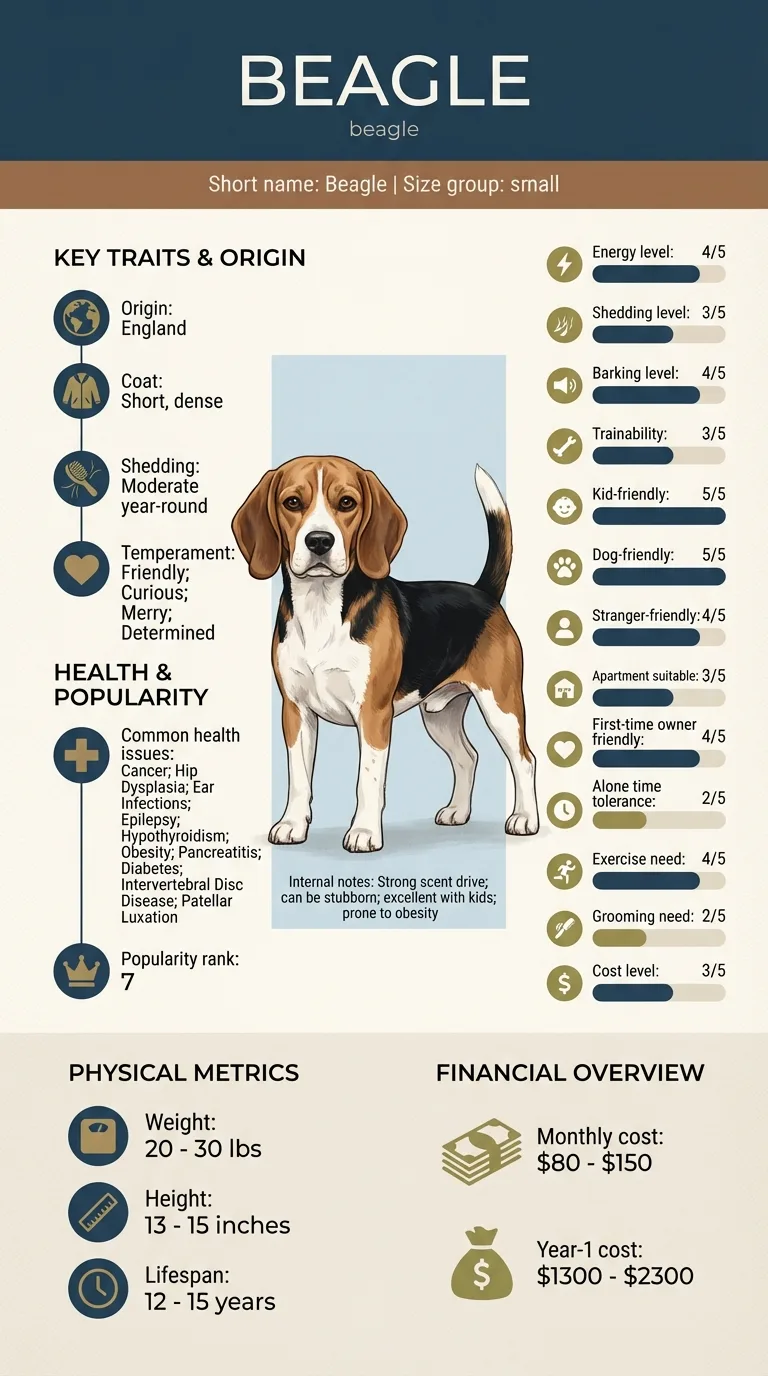
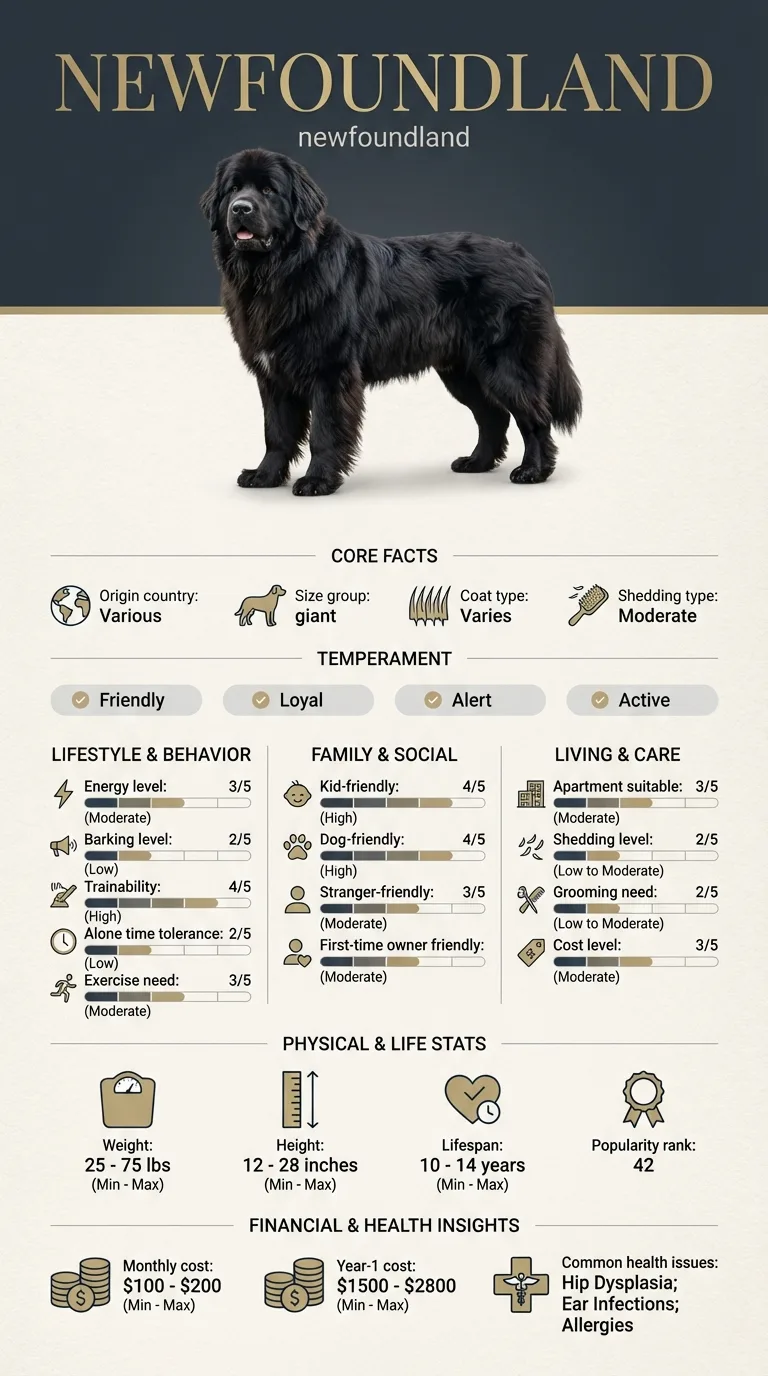
This is for someone already down to Beagle and Newfoundland and deciding between them. For this pair the decision usually turns on grooming need and energy level, so those are covered first and in most detail. Anyone choosing from a flat has a clear answer here: Beagle rates 3/5 against 1/5. It is written for the decision rather than the breed history.
Between Beagle and Newfoundland, grooming need is what separates them, and Beagle is the lower-effort dog of the two to keep.
Choose Beagle if you are in a flat or a smaller home, this is your first dog and you do not want a standing grooming appointment.
Choose Newfoundland if your walking routine is modest, the dog will be alone during the working day and you want a dog that picks up training quickly.
| Feature | beagle | newfoundland | Winner |
|---|---|---|---|
| Size class | small | giant | Equal |
| Weight | 20–30 lbs | 100–150 lbs | Equal |
| Height | 13–15 in | 26–28 in | Equal |
| Lifespan | 12–15 years | 9–10 years | beagle |
| Exercise need | High (4/5) | Moderate (3/5) | newfoundland |
| Grooming need | Low (2/5) | High (4/5) | beagle |
| Shedding | Moderate (3/5) | Very high (5/5) | beagle |
| Energy level | High (4/5) | Low (2/5) | Equal |
| Barking | High (4/5) | Low (2/5) | newfoundland |
| Apartment suitability | Moderate (3/5) | Very low (1/5) | beagle |
| Good for first-time owners | High (4/5) | Moderate (3/5) | beagle |
| Tolerates being alone | Low (2/5) | Moderate (3/5) | newfoundland |
| Trainability | Moderate (3/5) | High (4/5) | newfoundland |
| Good with kids | Very high (5/5) | Very high (5/5) | Equal |
| Good with other dogs | Very high (5/5) | High (4/5) | beagle |
| Friendly to strangers | High (4/5) | High (4/5) | Equal |
| Cost level | Moderate (3/5) | Very high (5/5) | beagle |
| Coat | Short, dense | Heavy water-resistant double coat | Equal |
| Origin | England | Various | Equal |
| Typical monthly cost | $80–$150 | $150–$310 | Equal |
| Typical first-year cost | $1,300–$2,300 | $2,200–$4,200 | Equal |
A Newfoundland can weigh five times what a Beagle does -- 100 to 150 pounds against the Beagle's 20 to 30, with a shoulder height of 26 to 28 inches against 13 to 15. This is a giant working breed built for water rescue, not a lapdog scaled up; expect a dog that takes up real physical space in your home and your car.
The Beagle rates high (4/5) for exercise need, the Newfoundland a more moderate 3 out of 5. Newfoundlands were bred for endurance work in cold water rather than constant activity, so a couple of solid walks and some swimming time, if you have access to water, generally covers it -- less demanding day-to-day than the Beagle's near-constant need to sniff and roam.
This is a real commitment on the Newfoundland side: grooming need rates high (4/5) and shedding rates very high (5/5), the top of the scale, thanks to a heavy, water-resistant double coat that blows out seasonally. The Beagle, by contrast, needs low grooming (2/5) and sheds only moderately (3/5). If shedding volume is a dealbreaker for you, the Newfoundland is likely the wrong choice regardless of how much you love the temperament.
The Beagle is the far better apartment dog on paper: moderate (3/5) suitability against the Newfoundland's very low (1/5), which reflects sheer size more than temperament. Barking favors the Newfoundland, low (2/5) against the Beagle's high (4/5). Interestingly, the Newfoundland tolerates being alone slightly better too -- moderate (3/5) versus the Beagle's low (2/5) -- a rare edge for a giant breed.
The Newfoundland actually trains more easily than the Beagle -- high (4/5) versus moderate (3/5) -- thanks to a temperament built around cooperation and devotion rather than independent scent work. But first-time-owner suitability still favors the Beagle, high (4/5) against the Newfoundland's moderate (3/5), simply because managing a 150-pound dog physically takes more experience regardless of how well-behaved it is.
Both breeds rate very high (5/5) with kids and high (4/5) with strangers -- reassuring numbers for a breed as large as the Newfoundland, and consistent with its reputation as a gentle giant. The Beagle edges ahead only with other dogs, very high (5/5) against the Newfoundland's still-strong high (4/5). Supervision around small kids still matters with the Newfoundland simply due to its size, temperament aside.
The lifespan gap is stark: 12 to 15 years for the Beagle against just 9 to 10 for the Newfoundland. The two breeds share only one listed risk, hip dysplasia -- the Newfoundland's remaining conditions (subaortic stenosis, dilated cardiomyopathy, cystinuria, bloat) are largely unique to it and mostly cardiac or size-related. Cardiac screening is worth asking a Newfoundland breeder about specifically, since two of its five listed conditions are heart-related.
Keeping a Newfoundland costs roughly double a Beagle: $150 to $310 a month against $80 to $150, and $2,200 to $4,200 in the first year against $1,300 to $2,300. Food for a 150-pound dog, plus the grooming tools and time needed for that heavy double coat, account for most of the gap -- budget for both, not just one, and don't assume the food bill alone explains the difference.
Beagle weighs 20–30 lbs and lives 12–15 years; Newfoundland weighs 100–150 lbs and lives 9–10 years. The two diverge most on grooming need, energy level and apartment suitability and 3 other rated axes. They are level on good with kids and friendly to strangers, so those cannot decide it. In the table, a "winner" means easier for an ordinary household — not better. Size, coat and origin are recorded without a verdict. Because both breeds are scored the same way, the gaps are reliable even where the absolute numbers are rough.

Substantially -- a Newfoundland can weigh 100 to 150 pounds against the Beagle's 20 to 30, roughly five times as much at the low end alone.
The Newfoundland, by far -- very high (5/5), the top of the scale, against the Beagle's moderate (3/5). Its heavy double coat blows out seasonally and demands serious brushing.
It's workable but not ideal -- moderate (3/5) for first-time owners against the Beagle's high (4/5). Its cooperative, easy-to-train temperament helps offset the physical challenge of managing its size.
The Beagle, decisively -- moderate (3/5) apartment suitability against the Newfoundland's very low (1/5). Size alone rules the Newfoundland out of most apartments.
$80-$150 for the Beagle versus $150-$310 for the Newfoundland -- largely food and grooming costs scaled to a much bigger dog.
Only one directly -- hip dysplasia. The Newfoundland's other listed risks (subaortic stenosis, dilated cardiomyopathy, cystinuria, bloat) don't overlap with the Beagle's list at all, which is unusual for this comparison set.
The Newfoundland, actually -- high (4/5) versus the Beagle's moderate (3/5). Its devoted, cooperative temperament makes it more responsive to training despite its size.
The Beagle, mainly on space and cost. The Newfoundland's gentle temperament is a real asset, but it needs a house and budget built around a 150-pound dog.
Beagle: $80-$150. Newfoundland: $150-$310 -- food and grooming for a giant breed.
The Beagle, rated High (4/5) against the Newfoundland's Moderate (3/5) -- a calmer giant breed than its size suggests.
The Beagle, 12-15 years, well ahead of the Newfoundland's 9-10.
Secure checkout on Stripe. We never see your card.
7-day money-back guarantee. Instant access.
Health information here is general and is not veterinary advice. If your dog shows pain, sudden behaviour change, or worsening symptoms, consult a licensed veterinarian.
Some links on this site are affiliate links. We may earn a commission at no extra cost to you, and we only suggest products we believe are helpful for dog owners.
We research and check what we publish, but we do not warrant that any figure, date, price, or statement is accurate, complete, or current, and we accept no liability for any loss, cost, injury, or other harm arising from the use of this site. Use it as one reference among several. You remain responsible for your own decisions and for your dog's care - confirm anything that matters with a licensed veterinarian or another qualified professional before you act on it. Full disclaimer.
Match your lifestyle to the right dog.
Take quizNot sure which breed is right for you? Take our 2-minute quiz to find out.
Take the quiz