Newfoundland vs Schnauzer (Standard): Which Suits Your Home?
Quick answer
Newfoundland or Standard Schnauzer, which should you get?
If you want a longer-lived, lower-shedding, more apartment-friendly dog and can tolerate more barking, go Schnauzer. If you want a calmer, quieter giant and have the space, go Newfoundland.
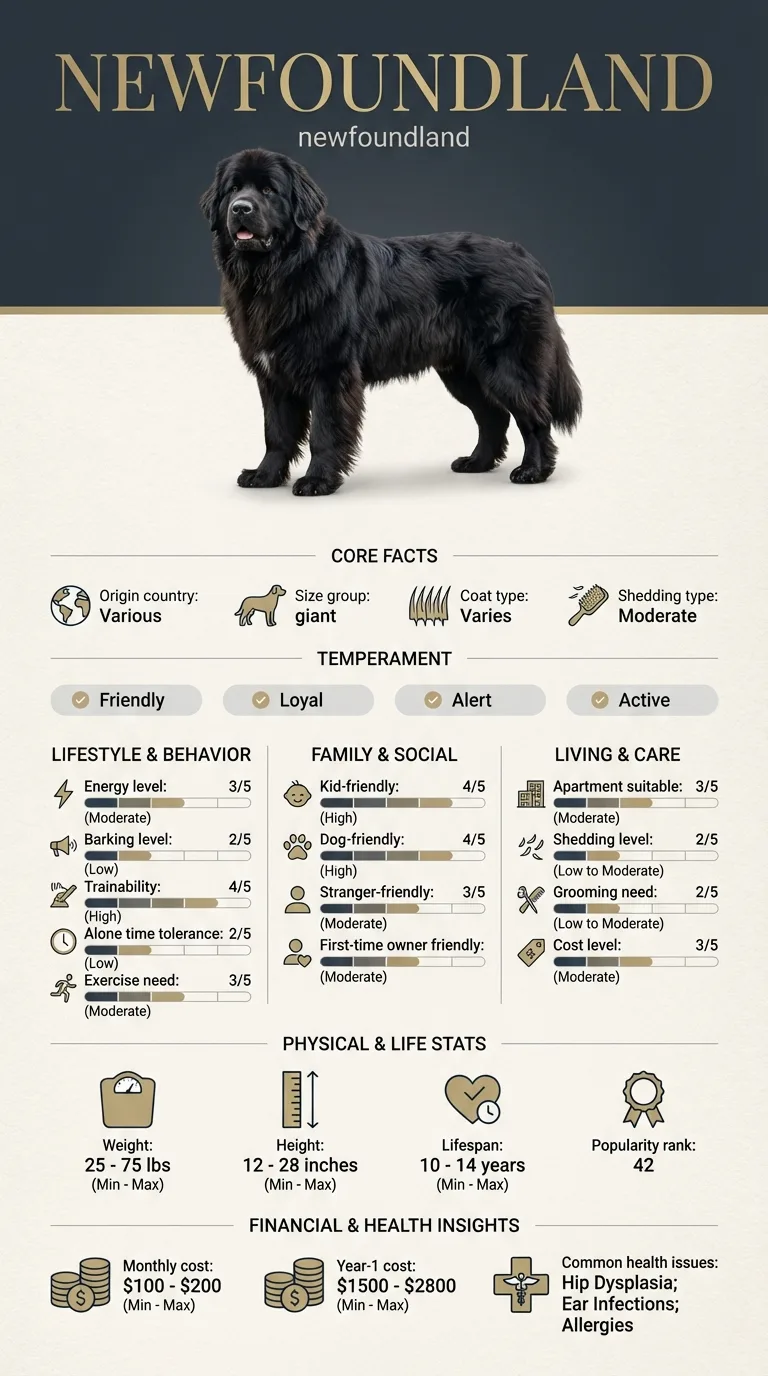
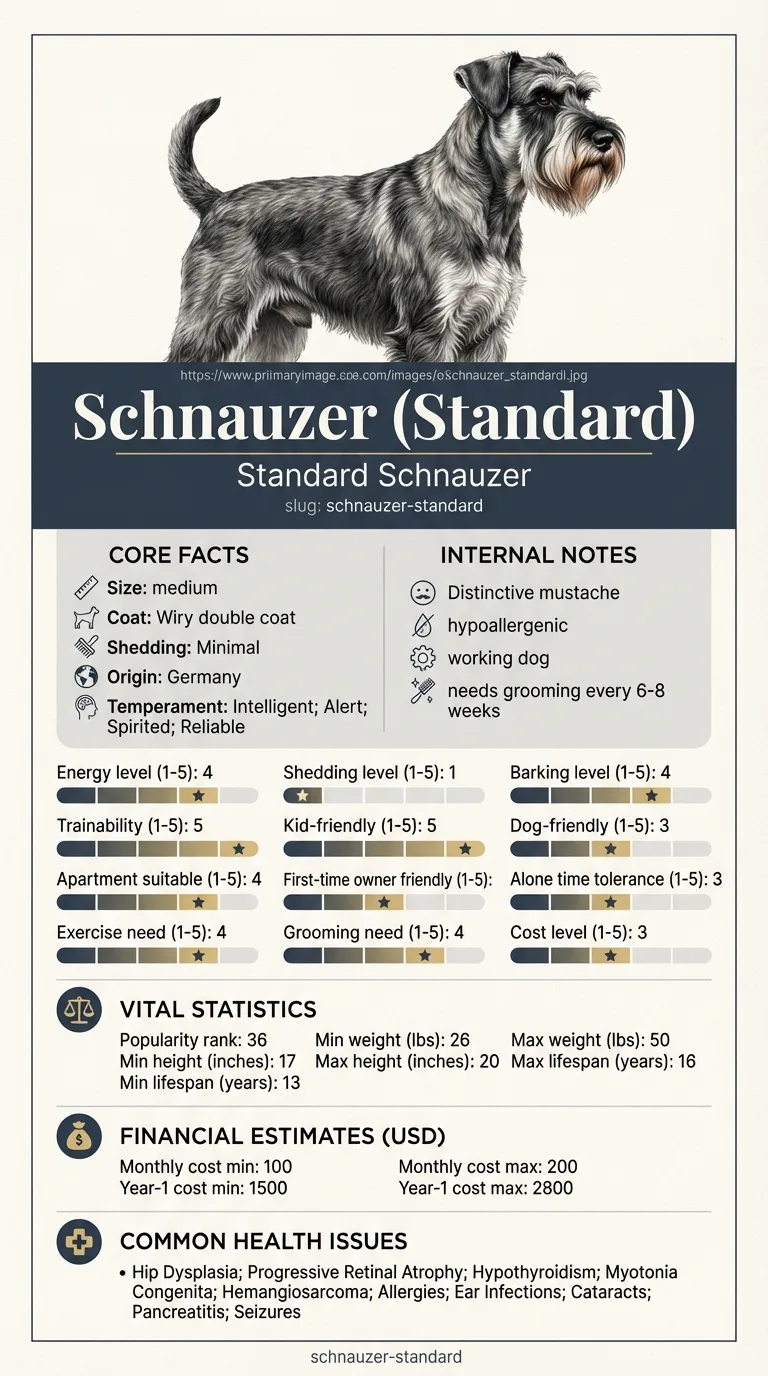
Newfoundland or Schnauzer (Standard)? On paper they differ most on shedding, and on the scales Newfoundland is the heavier at 100–150 lbs. Here is how the two compare on everything that shapes an ordinary week.
This is for someone already down to Newfoundland and Schnauzer (Standard) and deciding between them. For this pair the decision usually turns on shedding and apartment suitability, so those are covered first and in most detail. Anyone choosing from a flat has a clear answer here: Schnauzer (Standard) rates 4/5 against 1/5. The focus throughout is on daily consequences rather than breed background.
Quick verdict
Between Newfoundland and Schnauzer (Standard), shedding is what separates them, and Schnauzer (Standard) is the lower-effort dog of the two to keep.
Choose newfoundland if...
Choose Newfoundland if your walking routine is modest and you already have another dog.
Choose schnauzer standard if...
Choose Schnauzer (Standard) if you are in a flat or a smaller home, shedding is a problem in your house and you want a dog that picks up training quickly.
Head-to-head comparison
Feature
newfoundland
schnauzer standard
Winner
Size class
giant
medium
Equal
Weight
100–150 lbs
26–50 lbs
Equal
Height
26–28 in
17–20 in
Equal
Lifespan
9–10 years
13–16 years
schnauzer standard
Exercise need
Moderate (3/5)
High (4/5)
newfoundland
Grooming need
High (4/5)
High (4/5)
Equal
Shedding
Very high (5/5)
Very low (1/5)
schnauzer standard
Energy level
Low (2/5)
High (4/5)
Equal
Barking
Low (2/5)
High (4/5)
newfoundland
Apartment suitability
Very low (1/5)
High (4/5)
schnauzer standard
Good for first-time owners
Moderate (3/5)
Moderate (3/5)
Equal
Tolerates being alone
Moderate (3/5)
Moderate (3/5)
Equal
Trainability
High (4/5)
Very high (5/5)
schnauzer standard
Good with kids
Very high (5/5)
Very high (5/5)
Equal
Good with other dogs
High (4/5)
Moderate (3/5)
newfoundland
Friendly to strangers
High (4/5)
Moderate (3/5)
newfoundland
Cost level
Very high (5/5)
Moderate (3/5)
schnauzer standard
Coat
Heavy water-resistant double coat
Wiry double coat
Equal
Origin
Various
Germany
Equal
Typical monthly cost
$150–$310
$100–$200
Equal
Typical first-year cost
$2,200–$4,200
$1,500–$2,800
Equal
Deep dive
Size and build
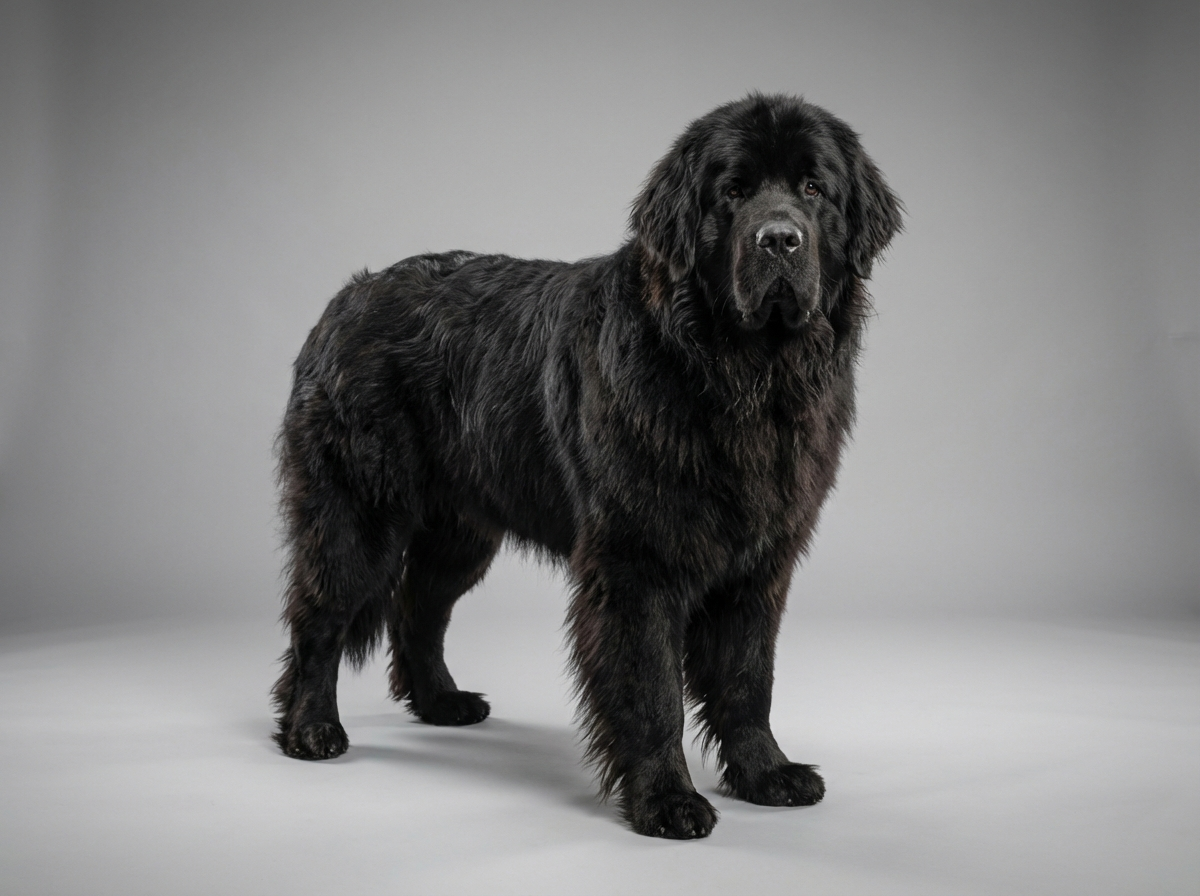
The gap here is stark: 100-150 lbs for the Newfoundland against 26-50 lbs for the Standard Schnauzer, with height nearly ten inches apart at the low end (26-28 in vs 17-20 in). The Schnauzer is a solidly built medium dog, not a small one, but next to a Newfoundland it looks compact. This is a giant-versus-medium matchup, so expect the differences to show up everywhere else in this comparison too.
Energy and exercise
The Schnauzer wants more from you day to day, High (4/5) exercise need against the Newfoundland's Moderate (3/5), despite being a fraction of the size. In practice a Standard Schnauzer is a working-line dog that needs a job or a serious walk schedule, while the Newfoundland is happy ambling along beside you. Do not let the smaller frame fool you into underestimating what the Schnauzer needs.
Grooming and shedding
Grooming ties at High (4/5) for both, the Schnauzer's wiry coat needs regular hand-stripping or clipping, just like the Newfoundland's double coat needs regular brushing. Shedding is where they split hard: Very High (5/5) for the Newfoundland against Very Low (1/5) for the Schnauzer, whose wiry coat sheds minimally. Similar grooming effort, very different amounts of hair left behind.
Apartment living, noise and time alone
Apartment suitability favors the Schnauzer heavily, High (4/5) versus the Newfoundland's Very Low (1/5), but barking flips that advantage on its head, the Schnauzer rates High (4/5) for barking against the Newfoundland's Low (2/5). A Schnauzer fits the space better but is the louder neighbor; weigh that tradeoff against your walls and your neighbors' patience.
Training and owner experience
Both tie at Moderate (3/5) for first-time owners, but the Schnauzer edges ahead on trainability, Very High (5/5) versus High (4/5) for the Newfoundland. Standard Schnauzers were bred as working and guard dogs and pick up commands fast, though their alertness and intelligence mean they need consistent mental engagement or they will find their own projects.
Kids, other dogs and visitors
The Newfoundland leads with other dogs (High 4/5 vs Moderate 3/5) and strangers (High 4/5 vs Moderate 3/5), while both tie at Very High (5/5) with kids. The Schnauzer is not unfriendly, just more reserved and watchful by nature, consistent with its guard-dog background. Either works with children; the Newfoundland is the more universally welcoming of the two.
Health and lifespan
The lifespan gap is significant, 13-16 years for the Schnauzer versus 9-10 for the Newfoundland, a difference of 3-6 years that is hard to ignore. The Schnauzer's health list is also longer, ten conditions against the Newfoundland's five, including hemangiosarcoma, seizures, and pancreatitis alongside more common issues like hip dysplasia and allergies. The only overlap between the two lists is hip dysplasia, so most of what you would watch for differs by breed entirely.
Cost to keep
The Newfoundland costs meaningfully more: Very High (5/5) versus Moderate (3/5) for the Schnauzer, $150-310 monthly versus $100-200, and $2,200-4,200 versus $1,500-2,800 in the first year. Food volume is the biggest driver given the weight gap, though the Schnauzer's grooming needs, High (4/5), same as the Newfoundland, keep its costs from dropping as low as its size alone might suggest.
Newfoundland vs Schnauzer (Standard) at a glance
Newfoundland weighs 100–150 lbs and lives 9–10 years; Schnauzer (Standard) weighs 26–50 lbs and lives 13–16 years. The two diverge most on shedding, apartment suitability and energy level and 2 other rated axes. They are level on tolerates being alone, good for first-time owners and grooming need, so those cannot decide it. The table below marks a winner only where one breed is genuinely easier for a typical owner; size and origin are facts rather than merits and stay level. Ratings come from one source applied to both breeds, so they are meaningful against each other rather than as absolute scores.
Newfoundland vs Schnauzer (Standard): Which Suits Your Home? - Newfoundland vs Schnauzer (Standard) at a glance
Frequently asked questions
How much smaller is a Standard Schnauzer than a Newfoundland?
Considerably, 26-50 lbs versus 100-150 lbs, and about 9-11 inches shorter at the withers. This is a medium breed against a giant one.
Which barks more?
The Schnauzer, by a wide margin, High (4/5) versus Low (2/5) for the Newfoundland. If noise is a concern for your living situation, that gap matters more than the apartment-suitability numbers alone suggest.
Which is easier to train?
The Schnauzer, rated Very High (5/5) versus High (4/5) for the Newfoundland, though the Newfoundland is no slouch either.
Which fits an apartment better?
The Schnauzer, rated High (4/5) versus the Newfoundland's Very Low (1/5). Just be prepared for more barking in exchange for the smaller footprint.
What's the cost difference?
The Schnauzer is notably cheaper to keep, $100-200 monthly versus $150-310 for the Newfoundland, and $1,500-2,800 versus $2,200-4,200 in year one.
Which one is likely to live longer?
The Schnauzer, and not by a small amount, 13-16 years versus 9-10 for the Newfoundland, a gap of up to six years.
Newfoundland or Standard Schnauzer, which should you get?
If you want a longer-lived, lower-shedding, more apartment-friendly dog and can tolerate more barking, go Schnauzer. If you want a calmer, quieter giant and have the space, go Newfoundland.
Costs
Monthly cost?
$150-310 for the Newfoundland, $100-200 for the Schnauzer.
Training
Which needs more exercise?
The Schnauzer, rated High (4/5) versus the Newfoundland's Moderate (3/5), despite being far smaller.
Health
Which lives longer?
The Schnauzer, by a wide margin, 13-16 years versus 9-10 for the Newfoundland.
Related DogBreedCompass guides
Newfoundland breed guide – Readers comparing the two usually want the full profile of Newfoundland before deciding.
Health information here is general and is not veterinary advice. If your dog shows pain, sudden behaviour change, or worsening symptoms, consult a licensed veterinarian.
Some links on this site are affiliate links. We may earn a commission at no extra cost to you, and we only suggest products we believe are helpful for dog owners.
We research and check what we publish, but we do not warrant that any figure, date, price, or statement is accurate, complete, or current, and we accept no liability for any loss, cost, injury, or other harm arising from the use of this site. Use it as one reference among several. You remain responsible for your own decisions and for your dog's care - confirm anything that matters with a licensed veterinarian or another qualified professional before you act on it. Full disclaimer.