Health
Is ARVC a Mastiff disease?
No. It is established in Boxers and described in a few other breeds, not in English Mastiffs. Mastiff cardiac risk centres on heart disease and dilated cardiomyopathy instead.

Quick answer
Is ARVC a Mastiff disease?
No. It is established in Boxers and described in a few other breeds, not in English Mastiffs. Mastiff cardiac risk centres on heart disease and dilated cardiomyopathy instead.
If you searched for ARVC in Mastiffs, you probably read a health list that copied a Boxer entry. The underlying worry is still worth taking seriously.
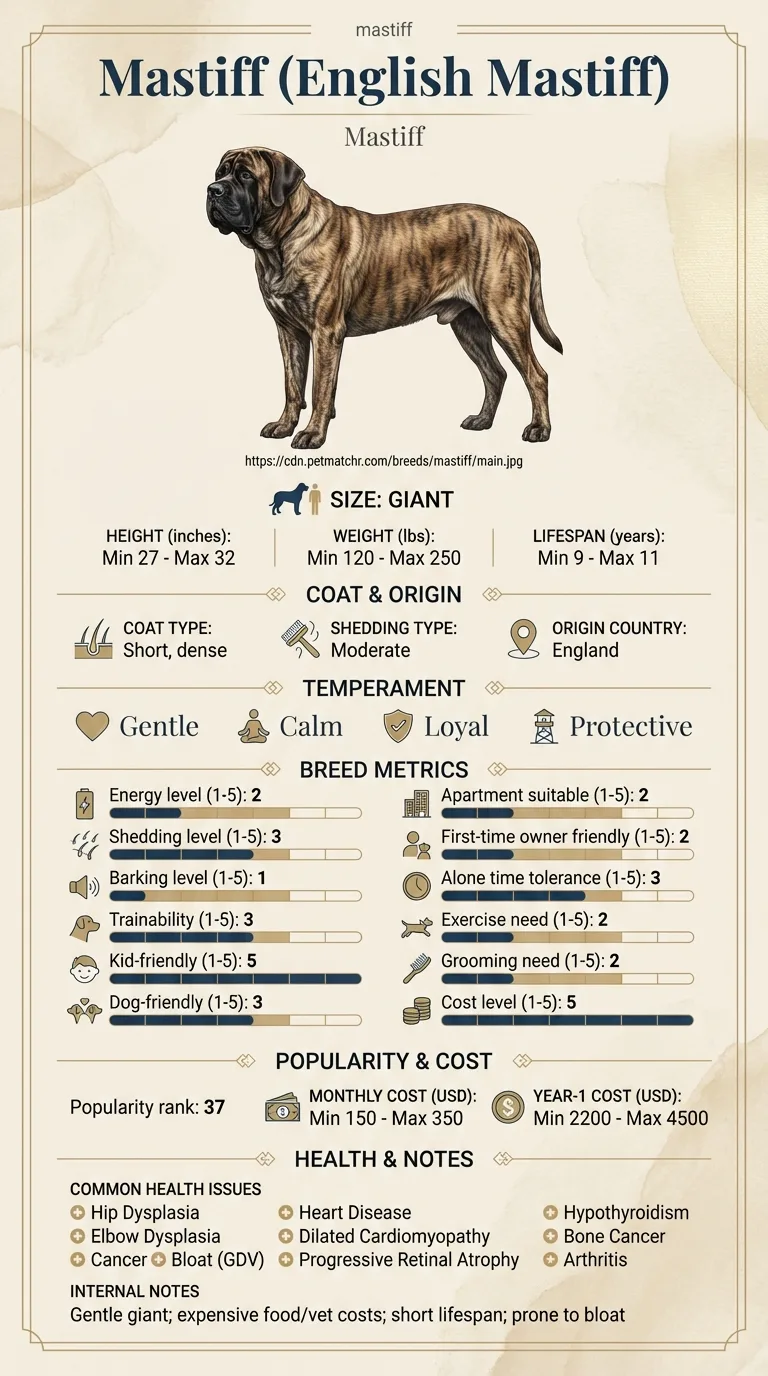
Owners who have seen their Mastiff faint, stagger or drop briefly and are trying to work out what to search for. Also buyers reading breeder health-test lists who want to know which cardiac screening genuinely applies to this breed and which was pasted in from elsewhere.
This guide is not medical advice. If your dog shows pain, sudden behavior change, or worsening symptoms, consult a licensed veterinarian.
Some links may be affiliate links. We may earn a commission at no extra cost to you. We only suggest products we believe are helpful for dog owners.
We research and check what we publish, but we do not warrant that any figure, date, price, or statement is accurate, complete, or current, and we accept no liability for any loss, cost, injury, or other harm arising from the use of this site. Use it as one reference among several. You remain responsible for your own decisions and for your dog's care - confirm anything that matters with a licensed veterinarian or another qualified professional before you act on it. Full disclaimer.
Arrhythmogenic right ventricular cardiomyopathy is a progressive disease in which right ventricular muscle is replaced by fatty and fibrous tissue, producing dangerous ventricular arrhythmias. It is a recognised Boxer disease. Owners of English Mastiffs typically arrive at this topic after seeing a fainting episode or reading a copied health list, and the useful answer redirects them towards the cardiac problems that this breed actually faces.
In English Mastiffs, ARVC is not a documented breed problem, and there is no reason to screen for it as a matter of routine. What is genuinely common enough to plan around is cardiac disease more broadly, and specifically dilated cardiomyopathy, which appears among the health issues recognised in the breed and can produce some of the same alarming symptoms, including weakness and collapse.
In the breeds where ARVC occurs it is inherited, and the Boxer form is linked to a specific genetic variant. Nothing equivalent is described in the English Mastiff. The heart problem that does track with this breed is disease of the ventricular muscle affecting pumping strength, which is influenced by the general biology of giant dogs: large hearts, comparatively short lifespans of roughly nine to eleven years, and a tendency for cardiac disease to appear in middle age rather than old age.
Environment does not cause inherited rhythm disease, but it decides how visible the symptoms are and how dangerous an episode becomes. Heat, excitement, a heavy meal, hard play with another dog and being pushed on a walk all increase cardiac demand, and a Mastiff already struggling will show it under those conditions first. Excess body weight adds work to a heart that may already be compromised.
Any fainting or collapse deserves a veterinary assessment, and it should be soon rather than eventually. Go immediately, as an emergency, if your Mastiff collapses and does not fully recover within a minute or two, if the gums are pale, grey or blue, if breathing is fast and laboured while resting, if there is a cough with froth or fluid, or if the abdomen has swollen. Repeated episodes in a single day are also an emergency. For a dog under investigation, ask your vet directly what should prompt an out-of-hours call, and write the answer down.
See all Mastiff health problems, which breeds are prone to arrhythmogenic right ventricular cardiomyopathy arvc, or the full Mastiff breed guide for temperament, exercise needs and ownership costs.
Getting to an answer usually takes two to six weeks: an initial examination, an echocardiogram appointment with a cardiologist, and sometimes a 24-hour recording after that. If a cardiac condition is confirmed, it is managed for life rather than cured, with medication reviews and repeat imaging typically every six to twelve months.
For most owners, success here is a clear answer and a plan. Either the heart is imaged and found sound, in which case the fainting is investigated elsewhere, or a specific condition is named and managed early enough to give the dog a comfortable, ordinary life for as long as this breed generally has.
Before deciding whether this applies to your dog, it helps to know what the condition is and how it is found.
Dismissing ARVC does not mean dismissing the heart. Heart disease generally, and dilated cardiomyopathy specifically, are documented concerns in the English Mastiff, and dilated cardiomyopathy carries its own arrhythmia risk. So the worry that sent you searching is legitimate even if the label was wrong.
The practical translation is this. If your Mastiff has fainted, collapsed briefly, gone weak and then recovered, or has become noticeably less willing to exercise, that needs investigating as a cardiac question. The examination that answers it is an echocardiogram, which images the heart muscle and its function, usually combined with an ECG, and a Holter monitor if an intermittent rhythm problem is suspected.
There is a second reason to take this seriously in a giant breed: the signs are easy to explain away. A Mastiff is a low-energy dog by design, with modest exercise needs and a reputation for lying down whenever the option exists. An owner who watches their dog decline a walk may read it as laziness or as heat, and both are plausible. That ambiguity is exactly why a fainting episode should be treated as a finding rather than as a quirk.
Be similarly careful with breeder claims. A breeder advertising an ARVC test on a Mastiff is either testing for something irrelevant or repeating a list they do not understand. The screening that carries weight in this breed is a cardiologist's echocardiogram on the parents, along with hip and elbow scoring and an eye examination.

Nell was a five-year-old Mastiff whose owner, Tomas, found her lying flat in the hallway one evening after she had rushed to the door. She was up within seconds and behaved normally afterwards. Searching that night, he found a breed health page listing ARVC and spent a fortnight convinced she had a Boxer disease. His vet unpicked it in ten minutes. ARVC was not the question. The question was why a five-year-old giant breed had lost consciousness, and the answer required imaging rather than a genetic test. Nell's echocardiogram showed early changes in the heart muscle consistent with dilated cardiomyopathy. She was started on medication, her walks were moved to the cool of the morning, and Tomas began counting her sleeping breathing rate every Sunday. Two years on she is still walking her usual route.
Key takeaway: The wrong diagnosis on the internet delayed Nell by two weeks. The symptom, not the search term, is what should have gone to the vet.
There is no established association between ARVC and the English Mastiff. The condition is recognised principally in Boxers. Mastiffs do have documented heart disease risk, including dilated cardiomyopathy, which is a disease of the heart muscle with its own arrhythmia risk, but it is a different condition with different screening.
Because breed health lists are frequently assembled by copying entries between large breeds without checking. The same phenomenon puts short-legged disc disease on giant breeds and Labrador collapse genes on mastiffs. Treat any list that has not named its evidence with suspicion.
Get a veterinary assessment promptly rather than waiting to see whether it recurs. Fainting is not normal in a dog of any breed, and in a giant breed it points towards the heart, the airway or overheating, all of which are worth distinguishing quickly. Note the time, the activity and how long the episode lasted.
It can be, when an intermittent rhythm disturbance is suspected and a single ECG has been unrevealing. It is not a routine screening test for the breed the way it is in Boxer breeding programmes. Your vet or a cardiologist will decide based on the clinical picture.
An echocardiogram performed by a cardiologist on both parents, with a date and a report, is the meaningful item. Ask to see the actual certificates rather than accepting a claim, and ask about longevity and cause of death in the immediate family, which tells you more than most tests.
No. Arrhythmias are intermittent by nature, and a quiet dog on a consulting room table may have a perfectly normal rhythm for the two minutes anyone is listening. That is precisely why a reported fainting episode carries more weight than a normal examination.
Until the heart has been assessed, keep activity gentle and avoid excitement, heat and hard exertion, and speak to your vet about limits. Do not design a restriction plan yourself, and do not assume that a dog which seems fine at rest is safe to push.
The early signs are set out in the sections above, and they are the reason to book a veterinary appointment rather than wait. Arrhythmogenic Right Ventricular Cardiomyopathy (ARVC) in Mastiffs is diagnosed by a vet, not from a symptom list, and the sooner it is on record the more options remain open.
No. It is established in Boxers and described in a few other breeds, not in English Mastiffs. Mastiff cardiac risk centres on heart disease and dilated cardiomyopathy instead.
Fainting or brief collapse, especially during excitement or exertion. It should always trigger a veterinary assessment rather than observation.
A 24-hour Holter recording, which captures the whole day rather than the two minutes of a clinic ECG.
No. Ask instead for cardiologist echocardiograms on both parents, plus hip and elbow scores and a current eye examination.
Usually gentle lead walking is fine, but ask your vet for specific limits and avoid heat, excitement and any hard exertion until the heart has been imaged.
A one-page prep sheet for this condition: the signs, the questions to ask, what to get priced. Unlocks here.
You get: Vet visit prep sheet
No spam. One-click unsubscribe. See our privacy policy.
Preview page 1 before you decide.