Living
Which is the better overall choice?
For apartment living and low exercise needs, the French Bulldog wins clearly; for a lower lifetime health burden, the Bernedoodle does.

Quick answer
Which is the better overall choice?
For apartment living and low exercise needs, the French Bulldog wins clearly; for a lower lifetime health burden, the Bernedoodle does.
Bernedoodle or French Bulldog? On paper they differ most on apartment suitability, and on the scales Bernedoodle is the heavier at 20–90 lbs. Here is how the two compare on everything that shapes an ordinary week.
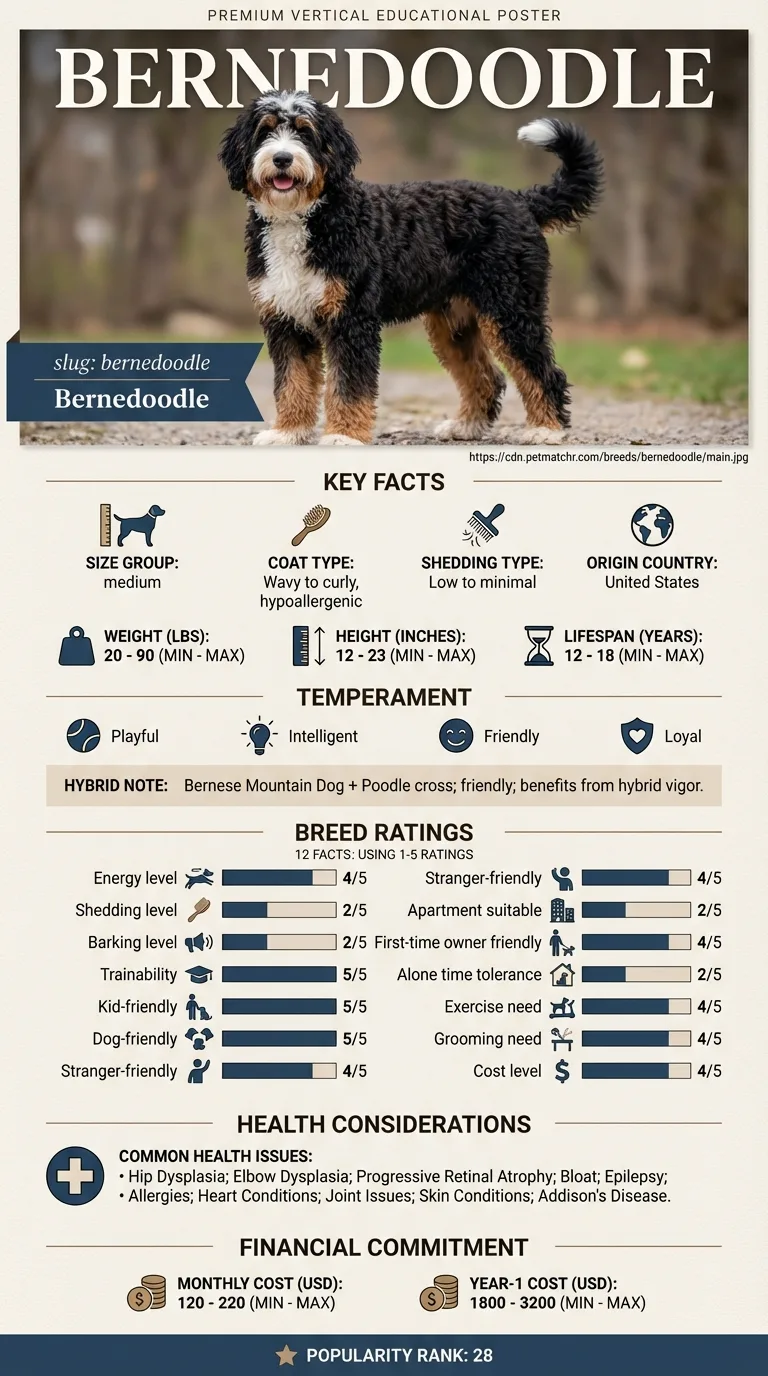
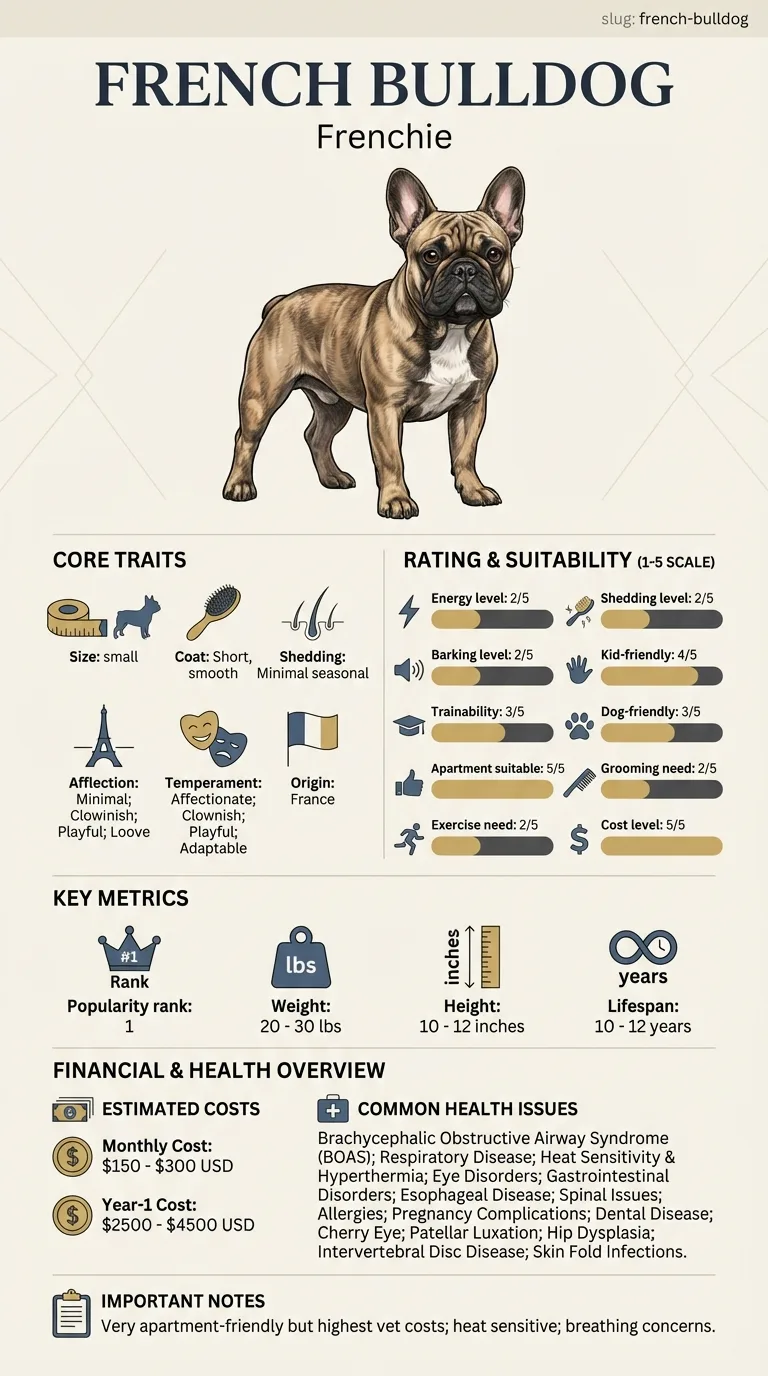
This is for someone already down to Bernedoodle and French Bulldog and deciding between them. For this pair the decision usually turns on apartment suitability and tolerates being alone, so those are covered first and in most detail. Anyone choosing from a flat has a clear answer here: French Bulldog rates 5/5 against 2/5. Breed history is left out; what follows is what you will actually live with.
Between Bernedoodle and French Bulldog, apartment suitability is what separates them, and French Bulldog is the lower-effort dog of the two to keep.
Choose Bernedoodle if there are young children at home, you already have another dog and you want a dog that picks up training quickly.
Choose French Bulldog if you are in a flat or a smaller home, this is your first dog and you do not want a standing grooming appointment.
| Feature | bernedoodle | french bulldog | Winner |
|---|---|---|---|
| Size class | medium | small | Equal |
| Weight | 20–90 lbs | 20–30 lbs | Equal |
| Height | 12–23 in | 10–12 in | Equal |
| Lifespan | 12–18 years | 10–12 years | bernedoodle |
| Exercise need | High (4/5) | Low (2/5) | french bulldog |
| Grooming need | High (4/5) | Low (2/5) | french bulldog |
| Shedding | Low (2/5) | Low (2/5) | Equal |
| Energy level | High (4/5) | Low (2/5) | Equal |
| Barking | Low (2/5) | Low (2/5) | Equal |
| Apartment suitability | Low (2/5) | Very high (5/5) | french bulldog |
| Good for first-time owners | High (4/5) | Very high (5/5) | french bulldog |
| Tolerates being alone | Low (2/5) | Very high (5/5) | french bulldog |
| Trainability | Very high (5/5) | Moderate (3/5) | bernedoodle |
| Good with kids | Very high (5/5) | High (4/5) | bernedoodle |
| Good with other dogs | Very high (5/5) | Moderate (3/5) | bernedoodle |
| Friendly to strangers | High (4/5) | Moderate (3/5) | bernedoodle |
| Cost level | High (4/5) | Very high (5/5) | bernedoodle |
| Coat | Wavy to curly, hypoallergenic | Short, smooth | Equal |
| Origin | United States | France | Equal |
| Typical monthly cost | $120–$220 | $150–$300 | Equal |
| Typical first-year cost | $1,800–$3,200 | $2,500–$4,500 | Equal |
The French Bulldog is a small dog - 20-30 lbs, 10-12 inches - while the Bernedoodle's 20-90 lb range starts right where the Frenchie's ends. Even a mini Bernedoodle overlaps only at the very bottom of its size range; a standard is on a completely different scale. If a compact dog that's easy to carry and doesn't need much space is the goal, the Frenchie wins on numbers alone.
This is one of the widest gaps in the comparison. The Bernedoodle rates high (4/5) for exercise need; the French Bulldog rates low (2/5). Frenchies are brachycephalic - their short muzzles restrict airflow - so low exercise tolerance isn't laziness, it's largely a breathing limitation, and it means the Bernedoodle is going to ask a lot more of your schedule.
The Frenchie's short coat needs little upkeep, rating low (2/5) on grooming against the Bernedoodle's high (4/5). Shedding ties at low (2/5) for both. What the numbers don't show is the Frenchie's skin folds, which need regular cleaning to prevent infection - a maintenance task that doesn't show up as grooming in the traditional sense but adds real time. Wipe those folds a few times a week and you'll avoid most of the irritation issues that crop up otherwise.
The French Bulldog is built for apartment life - very high suitability (5/5) versus the Bernedoodle's low (2/5) - and it also tolerates being left alone far better, rating very high (5/5) against the Bernedoodle's low (2/5). Barking ties at low (2/5) for both, so noise complaints aren't the differentiator here; space and independence are. For anyone renting a small unit without outdoor access, that combination makes the Frenchie the far easier dog to manage day to day.
The French Bulldog actually rates higher for first-time owners (very high, 5/5, versus the Bernedoodle's high, 4/5), even though the Bernedoodle is the more trainable of the two on paper (very high, 5/5, versus the Frenchie's moderate, 3/5). Frenchies are stubborn but low-maintenance in ways that offset the training gap for a new owner who isn't chasing obedience titles. Patience and consistency go further with a Frenchie than intensity, given its independent streak.
The Bernedoodle rates ahead across the board - very high with kids and other dogs versus the Frenchie's high (4/5) and moderate (3/5), and high with strangers versus the Frenchie's moderate (3/5). None of these Frenchie scores are bad, but if you're weighing a dog-park-heavy lifestyle or a house that sees a lot of other dogs, the Bernedoodle's numbers are stronger.
This is the category where the Frenchie's numbers should give you pause. Its lifespan (10-12 years) trails the Bernedoodle's (12-18), and its health list runs to fifteen conditions, dominated by brachycephalic obstructive airway syndrome, heat sensitivity, and a string of respiratory, spinal, and eye issues. The Bernedoodle's ten-condition list overlaps only on allergies and hip dysplasia - otherwise the Frenchie is carrying a materially heavier health burden.
Counterintuitively, the smaller dog costs more here. The French Bulldog rates very high (5/5) on cost against the Bernedoodle's high (4/5), and the dollar figures confirm it: $150-300 a month versus $120-220, and $2,500-4,500 in year one against $1,800-3,200. The health list above is almost certainly why - vet costs, not food, drive that gap. Set aside a larger vet fund for the Frenchie than the sticker price alone would suggest.
Bernedoodle weighs 20–90 lbs and lives 12–18 years; French Bulldog weighs 20–30 lbs and lives 10–12 years. The two diverge most on apartment suitability, tolerates being alone and exercise need and 4 other rated axes. They are level on barking and shedding, so those cannot decide it. The comparison marks an easier option only where one exists. Facts like weight and country of origin are not scored. Both dogs are rated from the same dataset, which is what makes the numbers comparable with each other even though any individual dog sits somewhere inside its breed's range.

Health, mostly. The French Bulldog's fifteen-item health list - heavy on breathing and spinal issues tied to its brachycephalic build - pushes up expected vet spending, reflected in its higher monthly ($150-300) and first-year ($2,500-4,500) cost figures compared to the Bernedoodle.
The French Bulldog by a wide margin, rated low (2/5) against the Bernedoodle's high (4/5) - largely because its short muzzle limits how much exertion it can safely handle.
The French Bulldog, decisively - 5/5 for apartment suitability and 5/5 for tolerating alone time, against the Bernedoodle's 2/5 on both.
Yes, rated very high (5/5), edging out the Bernedoodle's high (4/5) rating - even though the Bernedoodle is the more trainable dog on paper.
A long list, headlined by brachycephalic obstructive airway syndrome and heat sensitivity, plus respiratory, spinal, and eye conditions. Only allergies and hip dysplasia overlap with the Bernedoodle's health list.
The Bernedoodle averages 12-18 years; the French Bulldog 10-12, likely tied to its breathing-related health burden.
No - both rate low (2/5) on shedding. This is one of the few categories where the two breeds tie despite their very different coats.
For apartment living and low exercise needs, the French Bulldog wins clearly; for a lower lifetime health burden, the Bernedoodle does.
The Frenchie runs higher - $150-300 versus $120-220 for the Bernedoodle - mostly due to health-related expenses.
The Bernedoodle needs high (4/5) activity; the Frenchie only low (2/5), a limitation tied to its short muzzle.
12-18 years for the Bernedoodle versus 10-12 for the French Bulldog.
Secure checkout on Stripe. We never see your card.
7-day money-back guarantee. Instant access.
Health information here is general and is not veterinary advice. If your dog shows pain, sudden behaviour change, or worsening symptoms, consult a licensed veterinarian.
Some links on this site are affiliate links. We may earn a commission at no extra cost to you, and we only suggest products we believe are helpful for dog owners.
We research and check what we publish, but we do not warrant that any figure, date, price, or statement is accurate, complete, or current, and we accept no liability for any loss, cost, injury, or other harm arising from the use of this site. Use it as one reference among several. You remain responsible for your own decisions and for your dog's care - confirm anything that matters with a licensed veterinarian or another qualified professional before you act on it. Full disclaimer.
Match your lifestyle to the right dog.
Take quizNot sure which breed is right for you? Take our 2-minute quiz to find out.
Take the quiz